
Subgenres of Literature Satire Parody Allegory and Pastoral
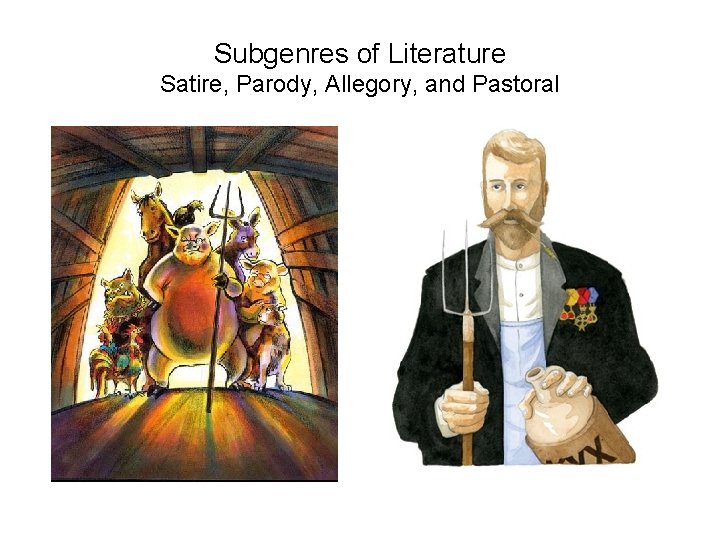
Subgenres of Literature Satire, Parody, Allegory, and Pastoral
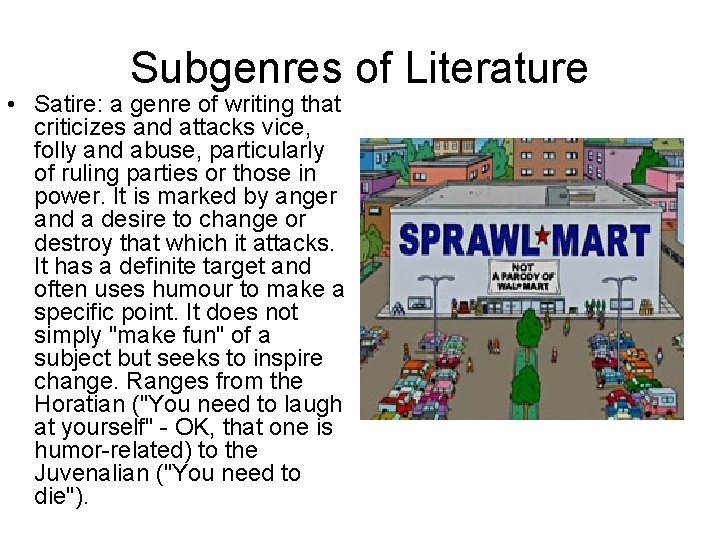
Subgenres of Literature • Satire: a genre of writing that criticizes and attacks vice, folly and abuse, particularly of ruling parties or those in power. It is marked by anger and a desire to change or destroy that which it attacks. It has a definite target and often uses humour to make a specific point. It does not simply "make fun" of a subject but seeks to inspire change. Ranges from the Horatian ("You need to laugh at yourself" - OK, that one is humor-related) to the Juvenalian ("You need to die").
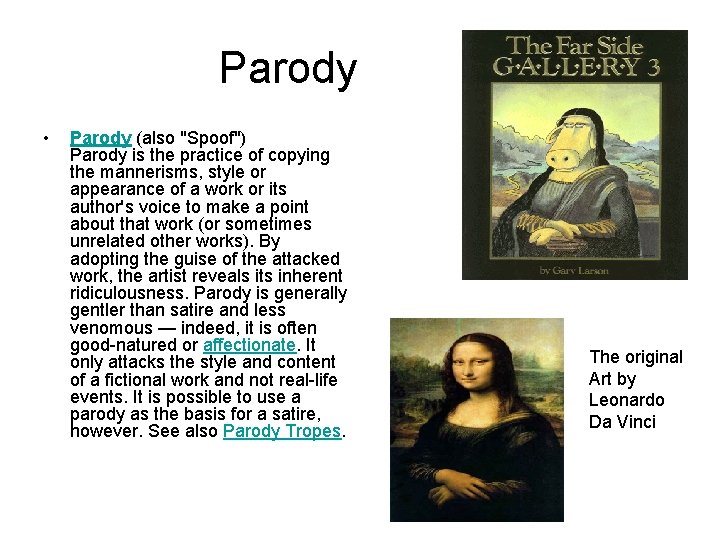
Parody • Parody (also "Spoof") Parody is the practice of copying the mannerisms, style or appearance of a work or its author's voice to make a point about that work (or sometimes unrelated other works). By adopting the guise of the attacked work, the artist reveals its inherent ridiculousness. Parody is generally gentler than satire and less venomous — indeed, it is often good-natured or affectionate. It only attacks the style and content of a fictional work and not real-life events. It is possible to use a parody as the basis for a satire, however. See also Parody Tropes. The original Art by Leonardo Da Vinci
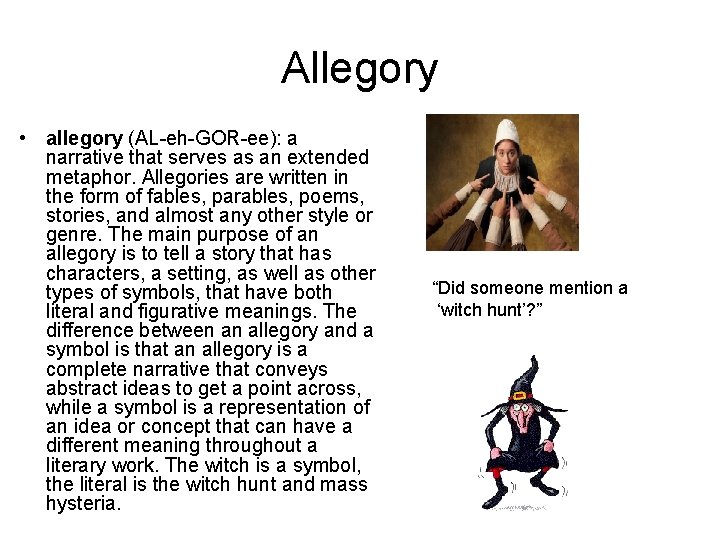
Allegory • allegory (AL-eh-GOR-ee): a narrative that serves as an extended metaphor. Allegories are written in the form of fables, parables, poems, stories, and almost any other style or genre. The main purpose of an allegory is to tell a story that has characters, a setting, as well as other types of symbols, that have both literal and figurative meanings. The difference between an allegory and a symbol is that an allegory is a complete narrative that conveys abstract ideas to get a point across, while a symbol is a representation of an idea or concept that can have a different meaning throughout a literary work. The witch is a symbol, the literal is the witch hunt and mass hysteria. “Did someone mention a ‘witch hunt’? ”
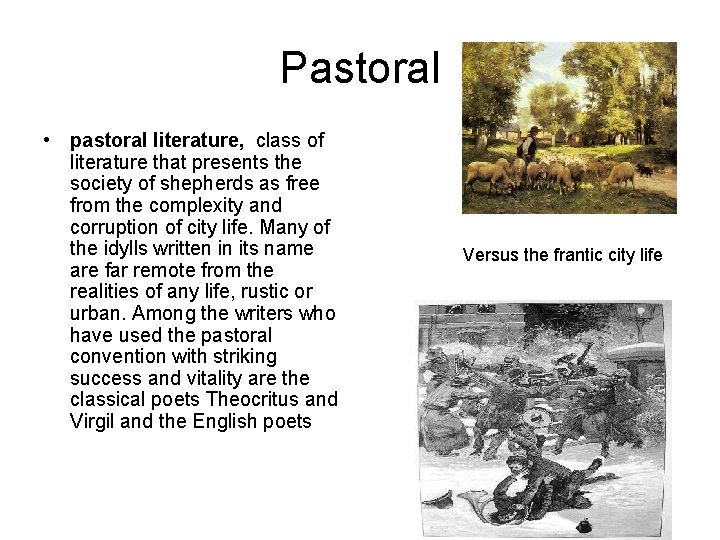
Pastoral • pastoral literature, class of literature that presents the society of shepherds as free from the complexity and corruption of city life. Many of the idylls written in its name are far remote from the realities of any life, rustic or urban. Among the writers who have used the pastoral convention with striking success and vitality are the classical poets Theocritus and Virgil and the English poets Versus the frantic city life
- Slides: 5