
SubDoppler Spectroscopy of the A 1 B 1
Sub-Doppler Spectroscopy of the A 1 B 1 -X 1 A 1 Electronic Transition of CBr 2 Eyad H. Al-Samra* and Colin M. Western School of Chemistry, University of Bristol, Bristol BS 8 1 TS, UK Email : C. M. Western@bristol. ac. uk * Now at the University of Oxford
Recent work on CBr 2 In the A 1 B 1 -X 1 A 1 electronic transition: C Tao, C Mukarate, D Brusse, Y Mishchenko, S Reid, J. Mol. Spectrosc. 240 139 (2006); 241 180 (2007) • Two vibronic progressions 20 n and 10120 n observed using LIF • Band Origin, T 00=15278. 78 cm-1. • Limited rotational analysis (A rotational constant only) In this work • Re-examine LIF spectrum using our high resolution OPO system. • Full rotational resolution obtained. • Check vibrational assignment. • Prepared in molecular beam: CHBr 3/CBr 4/Ar + electric discharge
Injection Seeded Optical Parametric Oscillator • Transform limited output ~ 0. 003 cm-1 • Net resolution 0. 01 cm-1 in UV
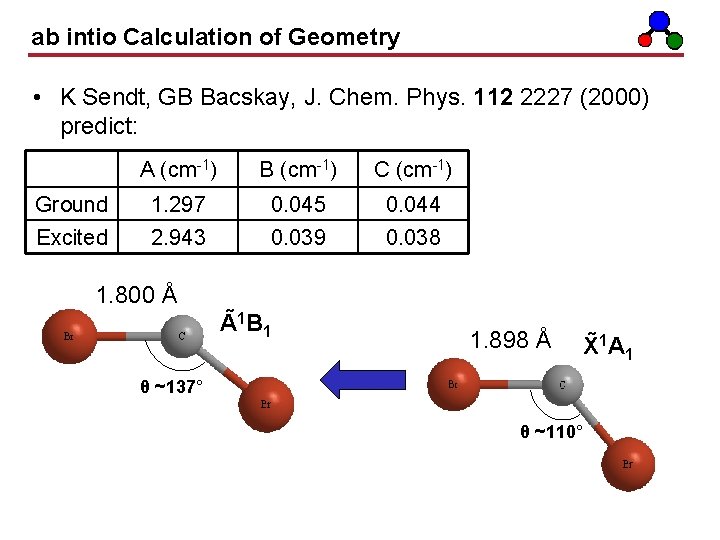
ab intio Calculation of Geometry • K Sendt, GB Bacskay, J. Chem. Phys. 112 2227 (2000) predict: A (cm-1) B (cm-1) C (cm-1) Ground 1. 297 0. 045 0. 044 Excited 2. 943 0. 039 0. 038 1. 800 Å A 1 B 1 1. 898 Å X 1 A 1 θ ~137° θ ~110°
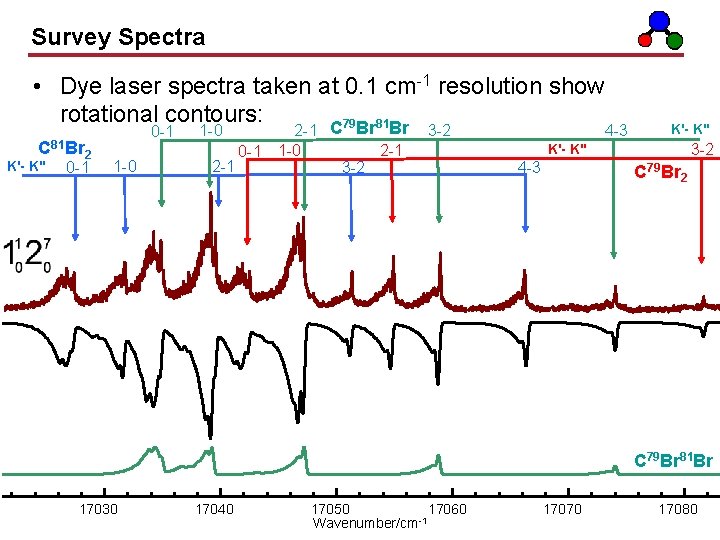
Survey Spectra • Dye laser spectra taken at 0. 1 cm-1 resolution show rotational contours: C 79 Br 81 Br C 81 Br 2 K'- K" 0 -1 1 -0 2 -1 0 -1 2 -1 1 -0 3 -2 2 -1 4 -3 K'- K" 3 -2 K'- K" 4 -3 C 79 Br 2 C 79 Br 81 Br 17030 17040 17050 17060 Wavenumber/cm-1 17070 17080
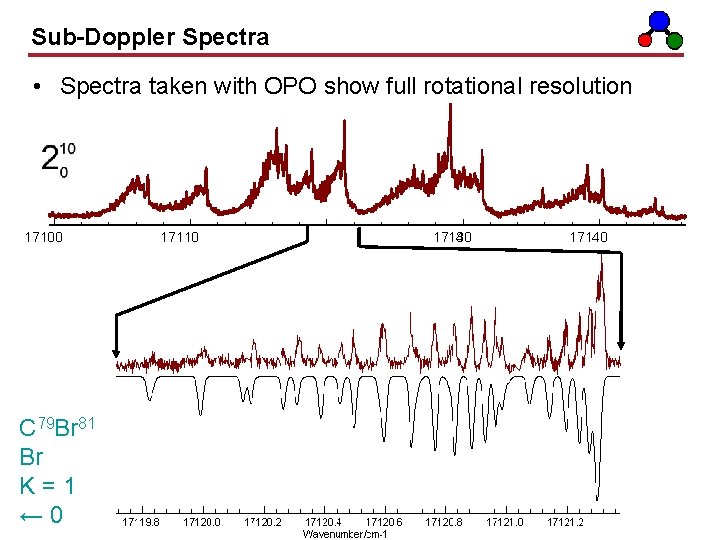
Sub-Doppler Spectra • Spectra taken with OPO show full rotational resolution 17100 C 79 Br 81 Br K=1 ← 0 17110 17130 17140
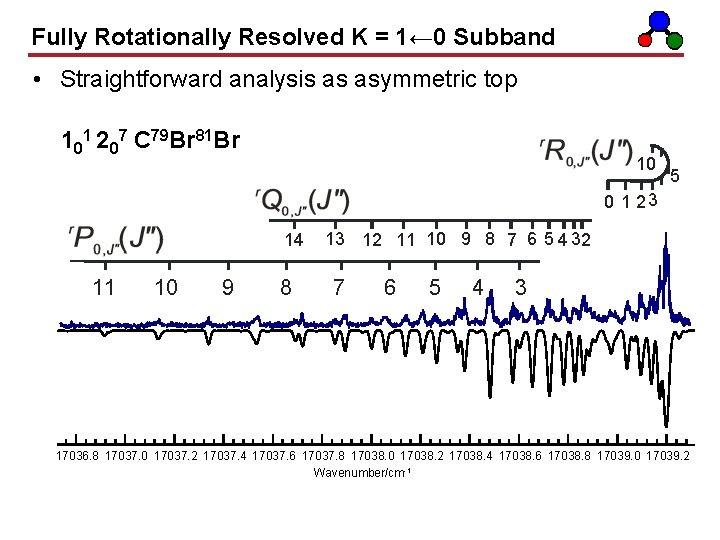
Fully Rotationally Resolved K = 1← 0 Subband • Straightforward analysis as asymmetric top 101 207 C 79 Br 81 Br 10 5 0 1 23 14 11 10 9 8 13 12 11 10 9 8 7 6 5 4 32 7 6 5 4 3 17036. 8 17037. 0 17037. 2 17037. 4 17037. 6 17037. 8 17038. 0 17038. 2 17038. 4 17038. 6 17038. 8 17039. 0 17039. 2 Wavenumber/cm-1
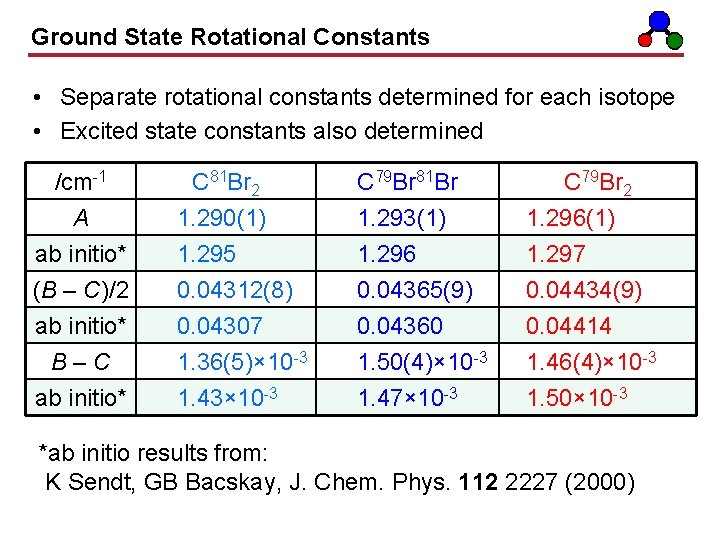
Ground State Rotational Constants • Separate rotational constants determined for each isotope • Excited state constants also determined /cm-1 C 81 Br 2 C 79 Br 81 Br C 79 Br 2 A ab initio* (B – C)/2 1. 290(1) 1. 295 0. 04312(8) 1. 293(1) 1. 296 0. 04365(9) 1. 296(1) 1. 297 0. 04434(9) ab initio* B–C ab initio* 0. 04307 1. 36(5)× 10 -3 1. 43× 10 -3 0. 04360 1. 50(4)× 10 -3 1. 47× 10 -3 0. 04414 1. 46(4)× 10 -3 1. 50× 10 -3 *ab initio results from: K Sendt, GB Bacskay, J. Chem. Phys. 112 2227 (2000)
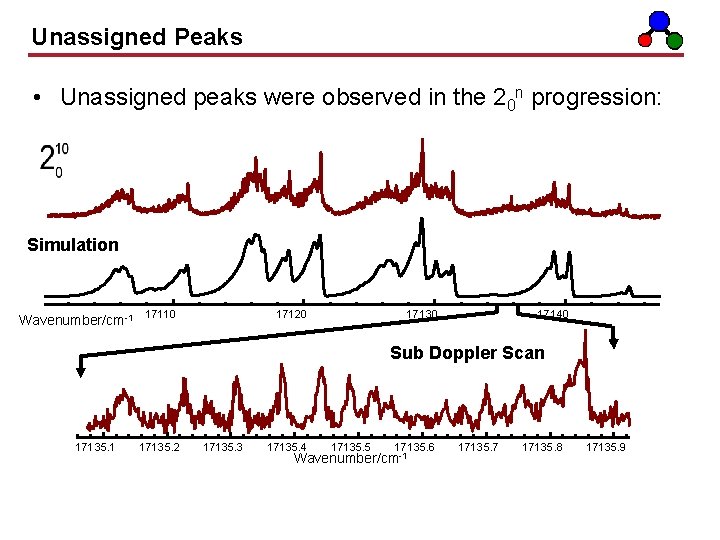
Unassigned Peaks • Unassigned peaks were observed in the 20 n progression: Simulation Wavenumber/cm-1 17110 17120 17130 17140 Sub Doppler Scan 17135. 1 17135. 2 17135. 3 17135. 4 17135. 5 17135. 6 Wavenumber/cm-1 17135. 7 17135. 8 17135. 9
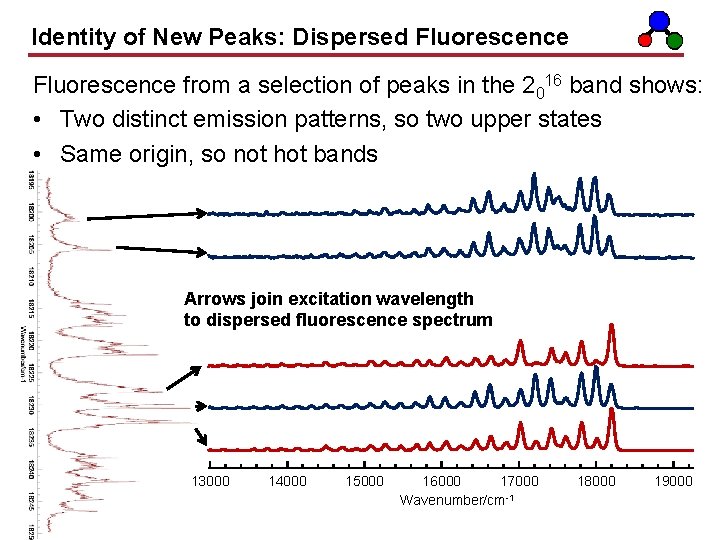
Identity of New Peaks: Dispersed Fluorescence from a selection of peaks in the 2016 band shows: • Two distinct emission patterns, so two upper states • Same origin, so not hot bands Arrows join excitation wavelength to dispersed fluorescence spectrum 13000 14000 15000 16000 17000 Wavenumber/cm-1 18000 19000
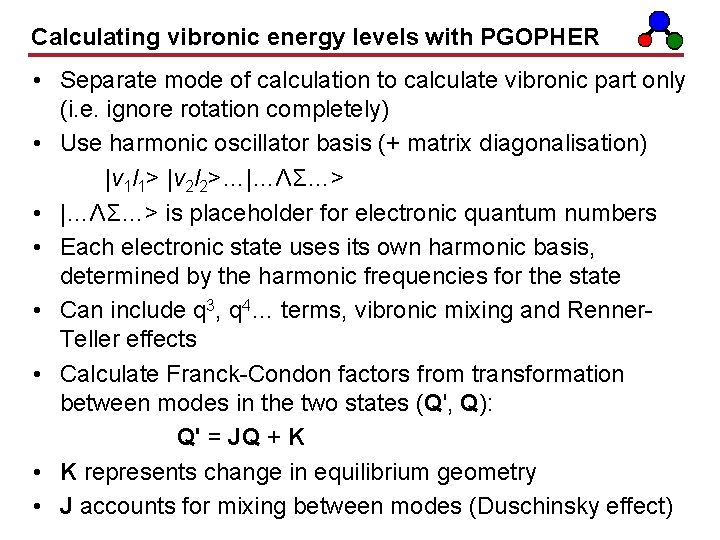
Calculating vibronic energy levels with PGOPHER • Separate mode of calculation to calculate vibronic part only (i. e. ignore rotation completely) • Use harmonic oscillator basis (+ matrix diagonalisation) |v 1 l 1> |v 2 l 2>…|…ΛΣ…> • |…ΛΣ…> is placeholder for electronic quantum numbers • Each electronic state uses its own harmonic basis, determined by the harmonic frequencies for the state • Can include q 3, q 4… terms, vibronic mixing and Renner. Teller effects • Calculate Franck-Condon factors from transformation between modes in the two states (Q', Q): Q' = JQ + K • K represents change in equilibrium geometry • J accounts for mixing between modes (Duschinsky effect)
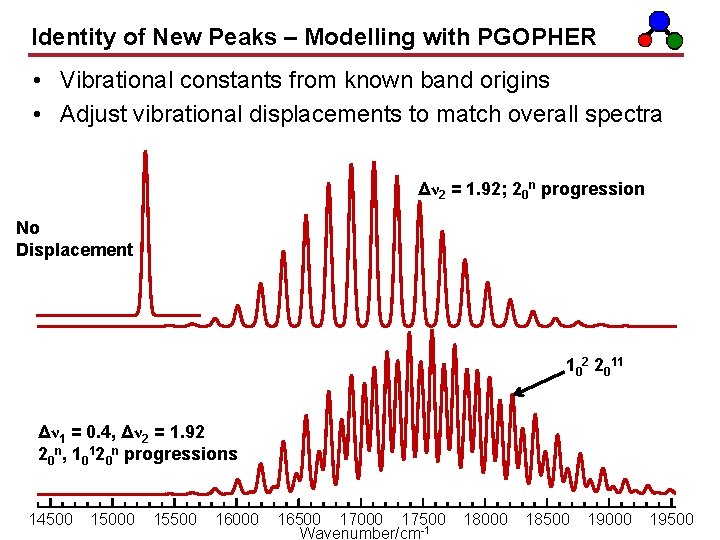
Identity of New Peaks – Modelling with PGOPHER • Vibrational constants from known band origins • Adjust vibrational displacements to match overall spectra Δν 2 = 1. 92; 20 n progression No Displacement 102 2011 Δν 1 = 0. 4, Δν 2 = 1. 92 20 n, 10120 n progressions 14500 15000 15500 16000 16500 17000 17500 Wavenumber/cm-1 18000 18500 19000 19500
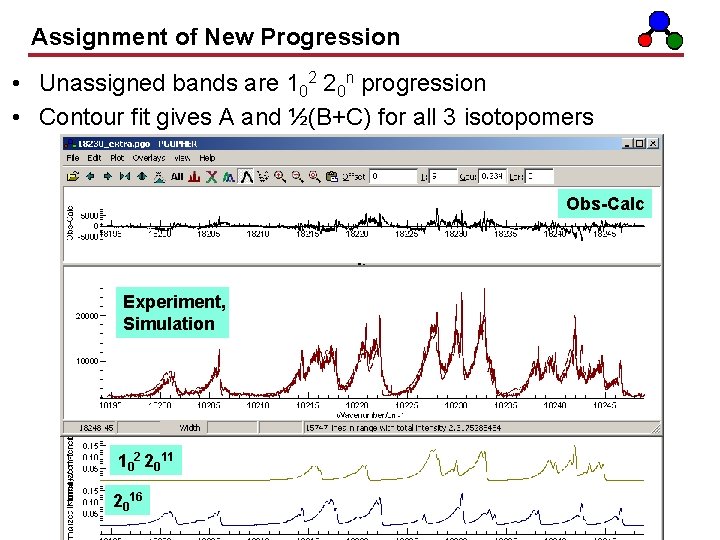
Assignment of New Progression • Unassigned bands are 102 20 n progression • Contour fit gives A and ½(B+C) for all 3 isotopomers Obs-Calc Experiment, Simulation 102 2011 2016
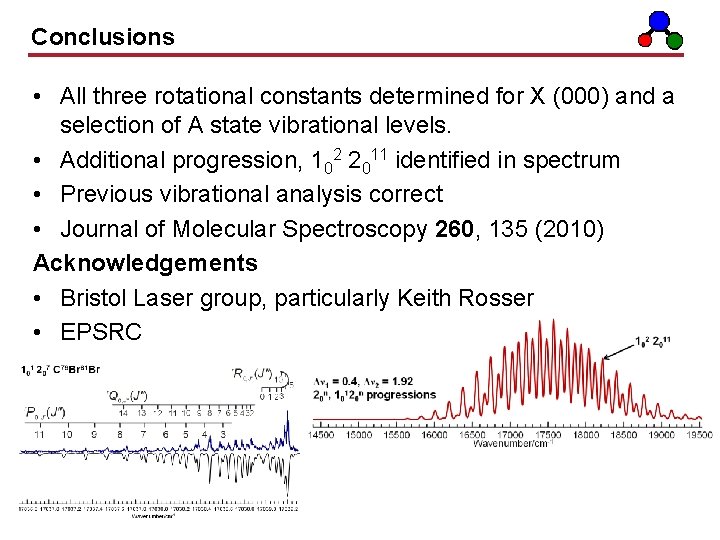
Conclusions • All three rotational constants determined for X (000) and a selection of A state vibrational levels. • Additional progression, 102 2011 identified in spectrum • Previous vibrational analysis correct • Journal of Molecular Spectroscopy 260, 135 (2010) Acknowledgements • Bristol Laser group, particularly Keith Rosser • EPSRC
- Slides: 14