
SUBDOPPLER INFRARED SPECTROSCOPY OF JET COOLED NDH 3
SUB-DOPPLER INFRARED SPECTROSCOPY OF JET COOLED NDH 3+: N–H STRETCH VIBRATIONS IN A KEY ASTROCHEMICAL ION P. G. Scrape, A. Kortyna, D. Lesko, D. J. Nesbitt International Symposium on Molecular Spectroscopy University of Illinois at Urbana-Champaign-Urbana, Illinois June 20, 2018 JILA, Department of Chemistry and Biochemistry, National Institute of Standards and Technology University of Colorado Boulder, CO
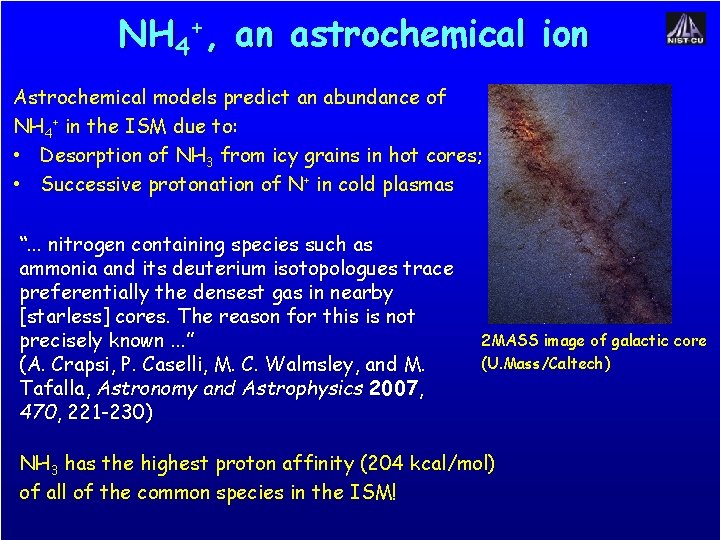
NH 4+, an astrochemical ion Astrochemical models predict an abundance of NH 4+ in the ISM due to: • Desorption of NH 3 from icy grains in hot cores; • Successive protonation of N+ in cold plasmas “. . . nitrogen containing species such as ammonia and its deuterium isotopologues trace preferentially the densest gas in nearby [starless] cores. The reason for this is not precisely known. . . ” (A. Crapsi, P. Caselli, M. C. Walmsley, and M. Tafalla, Astronomy and Astrophysics 2007, 470, 221 -230) 2 MASS image of galactic core (U. Mass/Caltech) NH 3 has the highest proton affinity (204 kcal/mol) of all of the common species in the ISM!
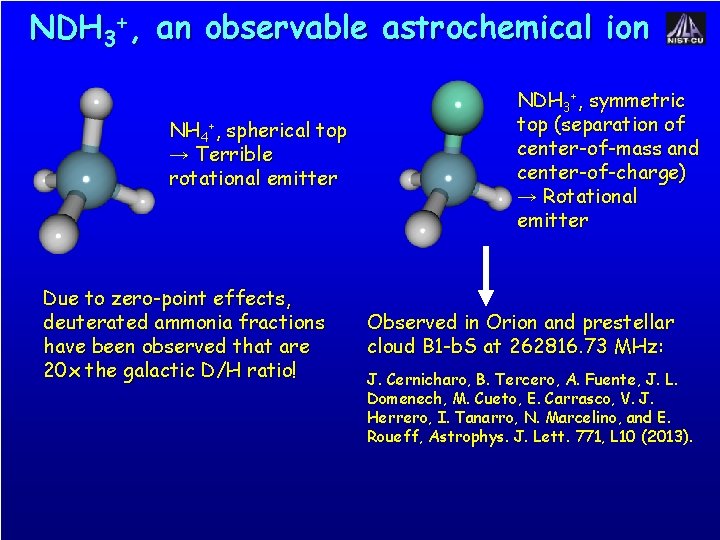
NDH 3+, an observable astrochemical ion NH 4+, spherical top → Terrible rotational emitter Due to zero-point effects, deuterated ammonia fractions have been observed that are 20 x the galactic D/H ratio! NDH 3+, symmetric top (separation of center-of-mass and center-of-charge) → Rotational emitter Observed in Orion and prestellar cloud B 1 -b. S at 262816. 73 MHz: J. Cernicharo, B. Tercero, A. Fuente, J. L. Domenech, M. Cueto, E. Carrasco, V. J. Herrero, I. Tanarro, N. Marcelino, and E. Roueff, Astrophys. J. Lett. 771, L 10 (2013).
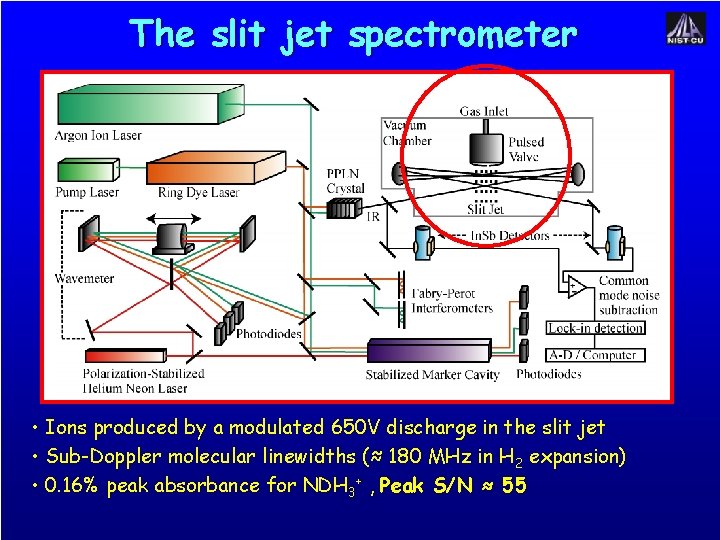
The slit jet spectrometer • Ions produced by a modulated 650 V discharge in the slit jet • Sub-Doppler molecular linewidths (≈ 180 MHz in H 2 expansion) • 0. 16% peak absorbance for NDH 3+ , Peak S/N ≈ 55
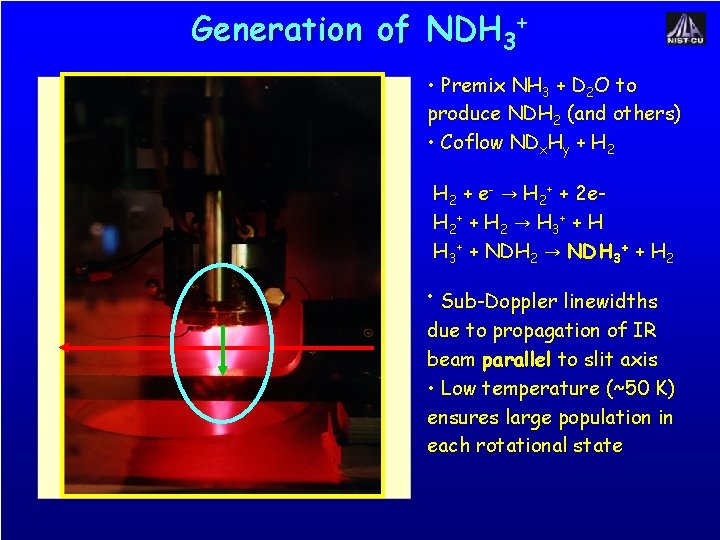
Generation of NDH 3+ • Premix NH 3 + D 2 O to produce NDH 2 (and others) • Coflow NDx. Hy + H 2 + e- → H 2+ + 2 e. H 2+ + H 2 → H 3+ + H H 3+ + NDH 2 → NDH 3+ + H 2 Sub-Doppler linewidths due to propagation of IR beam parallel to slit axis • Low temperature (~50 K) ensures large population in each rotational state •
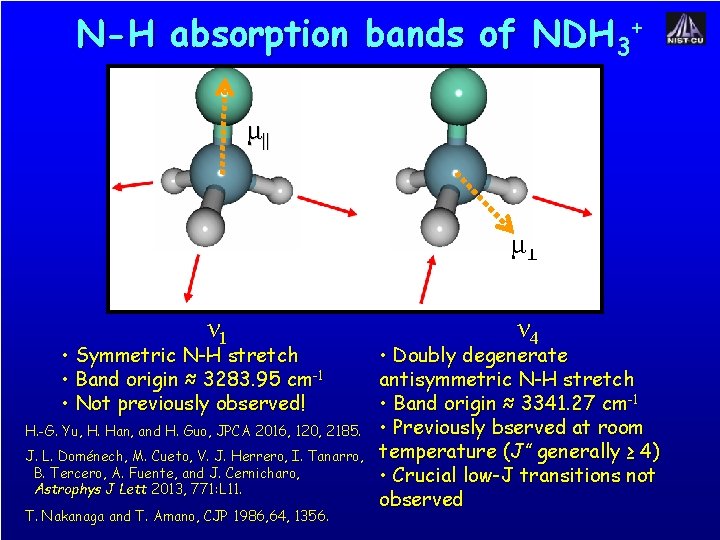
N-H absorption bands of NDH 3+ μ|| μ⊥ ν 1 • Symmetric N-H stretch • Band origin ≈ 3283. 95 cm-1 • Not previously observed! H. -G. Yu, H. Han, and H. Guo, JPCA 2016, 120, 2185. J. L. Doménech, M. Cueto, V. J. Herrero, I. Tanarro, B. Tercero, A. Fuente, and J. Cernicharo, Astrophys J Lett 2013, 771: L 11. T. Nakanaga and T. Amano, CJP 1986, 64, 1356. ν 4 • Doubly degenerate antisymmetric N-H stretch • Band origin ≈ 3341. 27 cm-1 • Previously bserved at room temperature (J’’ generally ≥ 4) • Crucial low-J transitions not observed
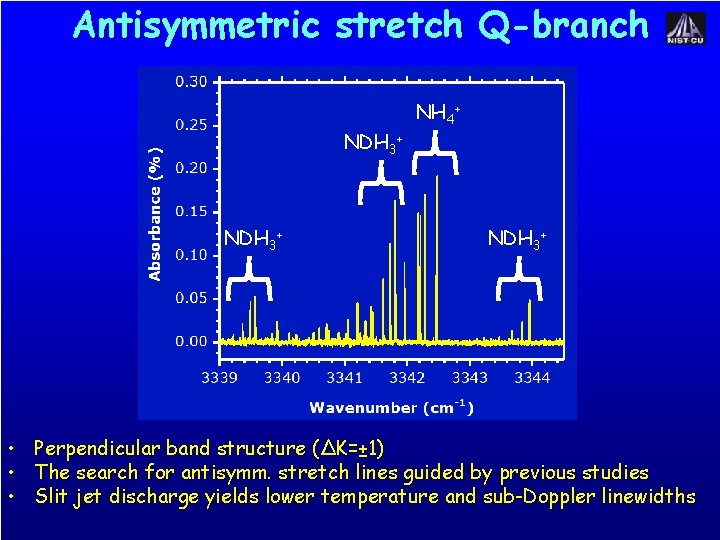
Antisymmetric stretch Q-branch NDH 3+ NH 4+ NDH 3+ • Perpendicular band structure (ΔK=± 1) • The search for antisymm. stretch lines guided by previous studies • Slit jet discharge yields lower temperature and sub-Doppler linewidths
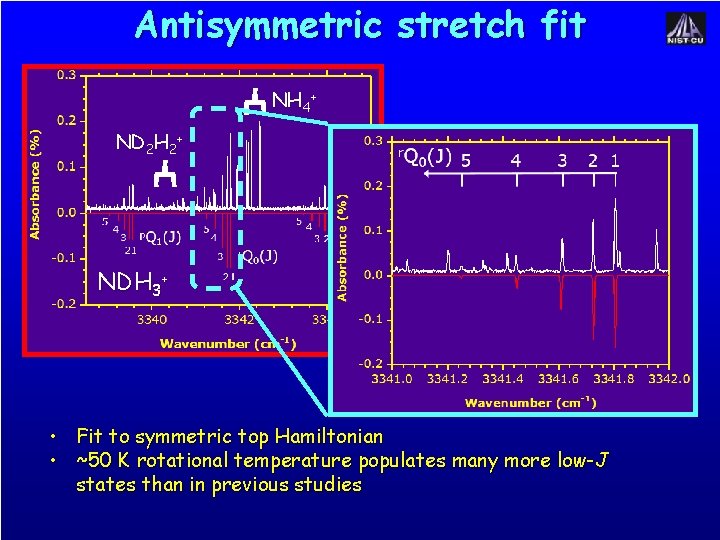
Antisymmetric stretch fit NH 4+ ND 2 H 2+ NDH 3+ • Fit to symmetric top Hamiltonian • ~50 K rotational temperature populates many more low- J states than in previous studies
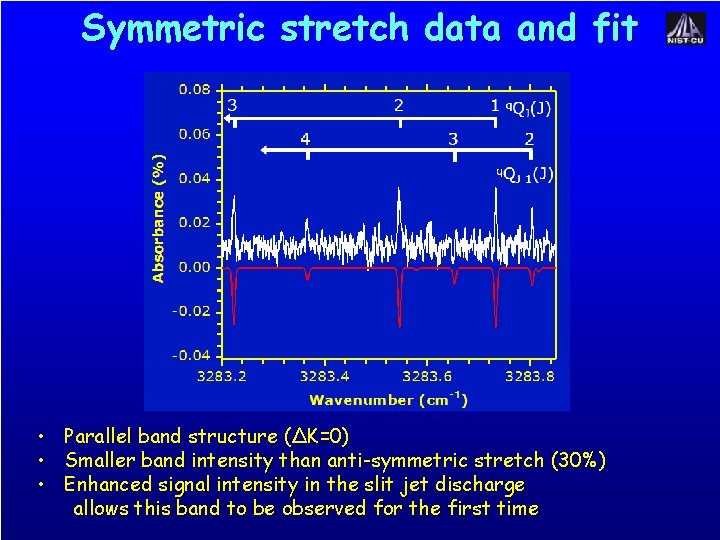
Symmetric stretch data and fit • Parallel band structure (ΔK=0) • Smaller band intensity than anti-symmetric stretch (30%) • Enhanced signal intensity in the slit jet discharge allows this band to be observed for the first time
Fitted rotational constants * final rotational constants and pure rotational transitions to appear in a forthcoming manuscript by P. G. Scrape, C. -H. Chang, and D. J. Nesbitt
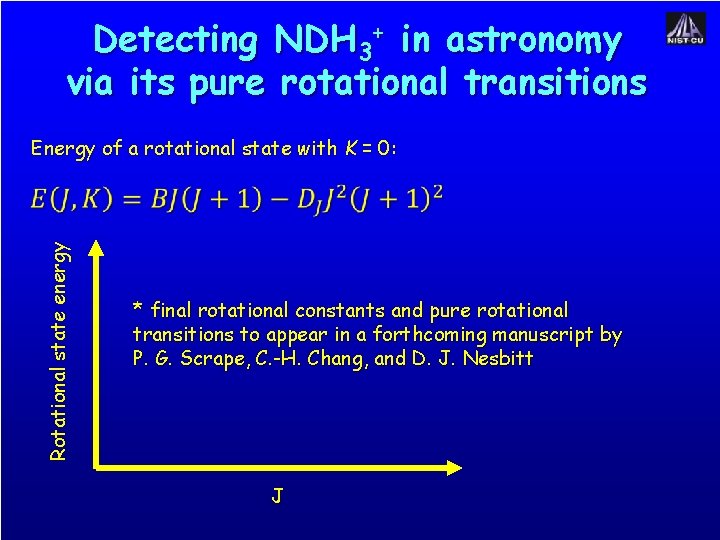
Detecting NDH 3+ in astronomy via its pure rotational transitions Rotational state energy Energy of a rotational state with K = 0: * final rotational constants and pure rotational transitions to appear in a forthcoming manuscript by P. G. Scrape, C. -H. Chang, and D. J. Nesbitt J
Summary • In the sub-Doppler slit jet spectrometer, the symmetric N-H stretch band is observed for the first time, as well as several new transitions in the anti-symmetric stretch band. • Error bars in spectroscopic constants are reduced due to these new observations. • Pure rotational transitions of NDH 3+ are predicted with greater precision.
Acknowledgments Andrew Kortyna Daniel Lesko Funding: NSF DOE National Research Council Fellowship Above: (Most) Members of the Nesbitt group (missing Dan Lesko… and me)
- Slides: 13