
Subchapter M Towing Vessel National Center of Expertise
Subchapter M Towing Vessel National Center of Expertise U. S. Coast Guard
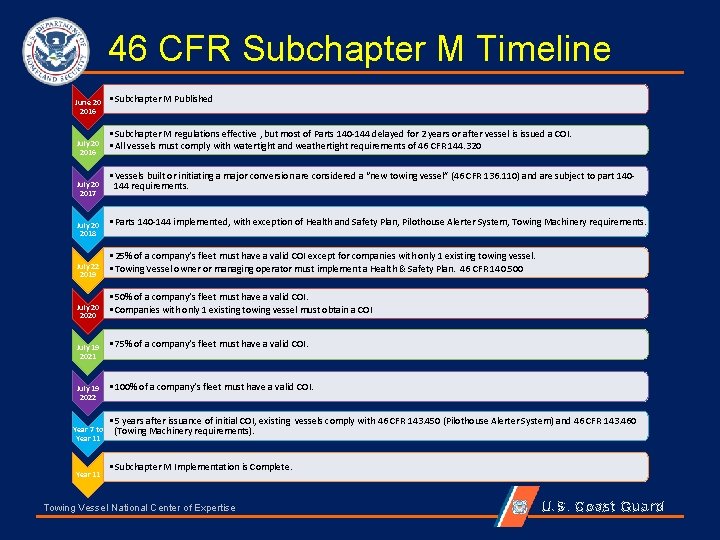
46 CFR Subchapter M Timeline June 20 2016 July 20 2017 July 20 2018 July 22 2019 July 20 2020 July 19 2021 July 19 2022 Year 7 to Year 11 • Subchapter M Published • Subchapter M regulations effective , but most of Parts 140 -144 delayed for 2 years or after vessel is issued a COI. • All vessels must comply with watertight and weathertight requirements of 46 CFR 144. 320 • Vessels built or initiating a major conversion are considered a “new towing vessel” (46 CFR 136. 110) and are subject to part 140144 requirements. • Parts 140 -144 implemented, with exception of Health and Safety Plan, Pilothouse Alerter System, Towing Machinery requirements. • 25% of a company’s fleet must have a valid COI except for companies with only 1 existing towing vessel. • Towing Vessel owner or managing operator must implement a Health & Safety Plan. 46 CFR 140. 500 • 50% of a company’s fleet must have a valid COI. • Companies with only 1 existing towing vessel must obtain a COI • 75% of a company’s fleet must have a valid COI. • 100% of a company’s fleet must have a valid COI. • 5 years after issuance of initial COI, existing vessels comply with 46 CFR 143. 450 (Pilothouse Alerter System) and 46 CFR 143. 460 (Towing Machinery requirements). • Subchapter M Implementation is Complete. Towing Vessel National Center of Expertise U. S. Coast Guard
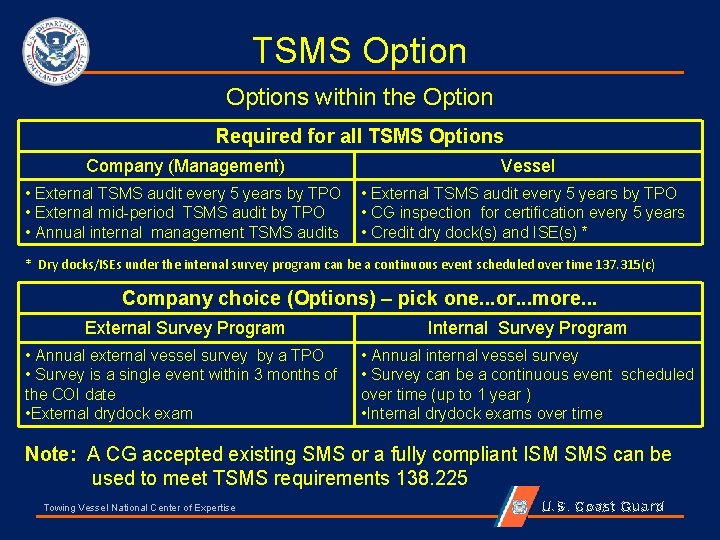
TSMS Options within the Option Required for all TSMS Options Company (Management) Vessel • External TSMS audit every 5 years by TPO • External mid-period TSMS audit by TPO • Annual internal management TSMS audits • External TSMS audit every 5 years by TPO • CG inspection for certification every 5 years • Credit dry dock(s) and ISE(s) * * Dry docks/ISEs under the internal survey program can be a continuous event scheduled over time 137. 315(c) Company choice (Options) – pick one. . . or. . . more. . . External Survey Program Internal Survey Program • Annual external vessel survey by a TPO • Survey is a single event within 3 months of the COI date • External drydock exam • Annual internal vessel survey • Survey can be a continuous event scheduled over time (up to 1 year ) • Internal drydock exams over time Note: A CG accepted existing SMS or a fully compliant ISM SMS can be used to meet TSMS requirements 138. 225 Towing Vessel National Center of Expertise U. S. Coast Guard
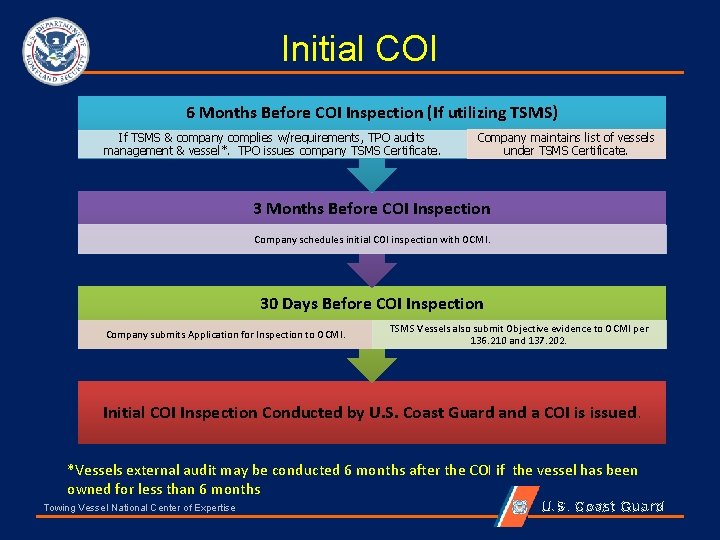
Initial COI 6 Months Before COI Inspection (If utilizing TSMS) If TSMS & company complies w/requirements, TPO audits management & vessel*. TPO issues company TSMS Certificate. Company maintains list of vessels under TSMS Certificate. 3 Months Before COI Inspection Company schedules initial COI inspection with OCMI. 30 Days Before COI Inspection Company submits Application for Inspection to OCMI. TSMS Vessels also submit Objective evidence to OCMI per 136. 210 and 137. 202. Initial COI Inspection Conducted by U. S. Coast Guard and a COI is issued. *Vessels external audit may be conducted 6 months after the COI if the vessel has been owned for less than 6 months Towing Vessel National Center of Expertise U. S. Coast Guard
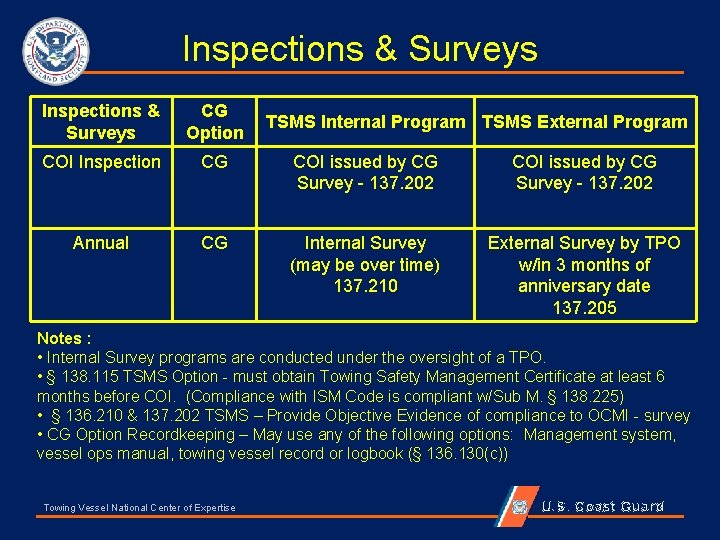
Inspections & Surveys CG Option COI Inspection CG TSMS Internal Program TSMS External Program COI issued by CG Survey - 137. 202 Annual CG Internal Survey (may be over time) 137. 210 External Survey by TPO w/in 3 months of anniversary date 137. 205 Notes : • Internal Survey programs are conducted under the oversight of a TPO. • § 138. 115 TSMS Option - must obtain Towing Safety Management Certificate at least 6 months before COI. (Compliance with ISM Code is compliant w/Sub M. § 138. 225) • § 136. 210 & 137. 202 TSMS – Provide Objective Evidence of compliance to OCMI - survey • CG Option Recordkeeping – May use any of the following options: Management system, vessel ops manual, towing vessel record or logbook (§ 136. 130(c)) Towing Vessel National Center of Expertise U. S. Coast Guard
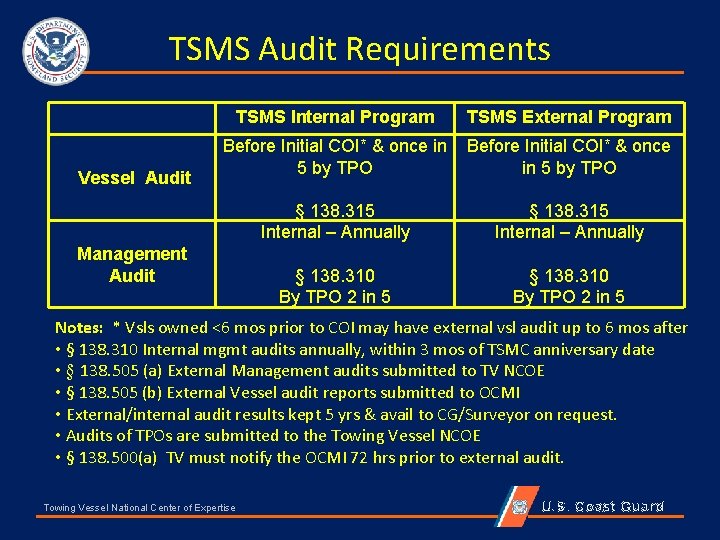
TSMS Audit Requirements TSMS Internal Program Vessel Audit Management Audit TSMS External Program Before Initial COI* & once in Before Initial COI* & once 5 by TPO in 5 by TPO § 138. 315 Internal – Annually § 138. 310 By TPO 2 in 5 Notes: * Vsls owned <6 mos prior to COI may have external vsl audit up to 6 mos after • § 138. 310 Internal mgmt audits annually, within 3 mos of TSMC anniversary date • § 138. 505 (a) External Management audits submitted to TV NCOE • § 138. 505 (b) External Vessel audit reports submitted to OCMI • External/internal audit results kept 5 yrs & avail to CG/Surveyor on request. • Audits of TPOs are submitted to the Towing Vessel NCOE • § 138. 500(a) TV must notify the OCMI 72 hrs prior to external audit. Towing Vessel National Center of Expertise U. S. Coast Guard
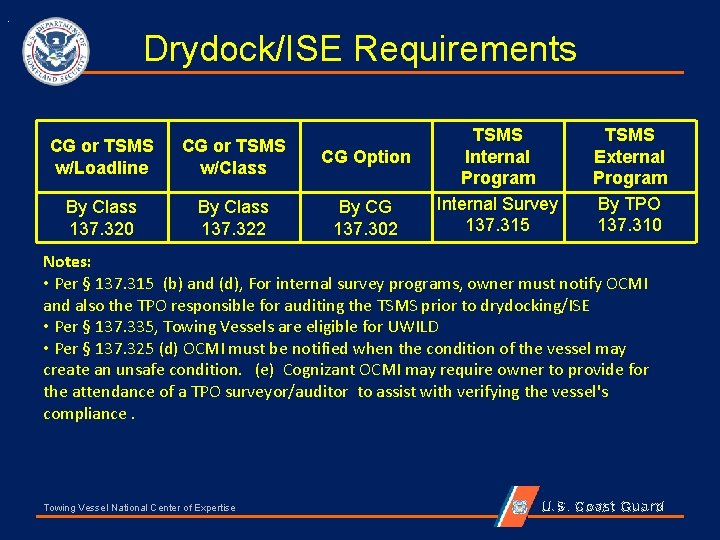
. Drydock/ISE Requirements CG or TSMS w/Loadline CG or TSMS w/Class CG Option By Class 137. 320 By Class 137. 322 By CG 137. 302 TSMS Internal Program Internal Survey 137. 315 TSMS External Program By TPO 137. 310 Notes: • Per § 137. 315 (b) and (d), For internal survey programs, owner must notify OCMI and also the TPO responsible for auditing the TSMS prior to drydocking/ISE • Per § 137. 335, Towing Vessels are eligible for UWILD • Per § 137. 325 (d) OCMI must be notified when the condition of the vessel may create an unsafe condition. (e) Cognizant OCMI may require owner to provide for the attendance of a TPO surveyor/auditor to assist with verifying the vessel's compliance. Towing Vessel National Center of Expertise U. S. Coast Guard
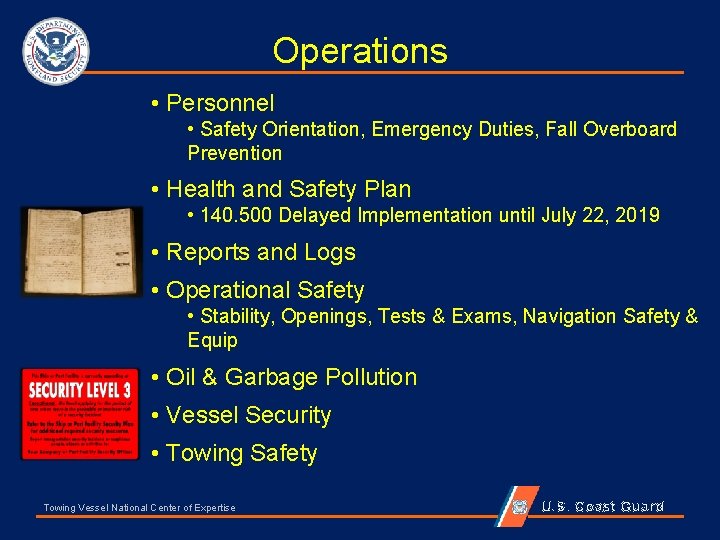
Operations • Personnel • Safety Orientation, Emergency Duties, Fall Overboard Prevention • Health and Safety Plan • 140. 500 Delayed Implementation until July 22, 2019 • Reports and Logs • Operational Safety • Stability, Openings, Tests & Exams, Navigation Safety & Equip • Oil & Garbage Pollution • Vessel Security • Towing Safety Towing Vessel National Center of Expertise U. S. Coast Guard
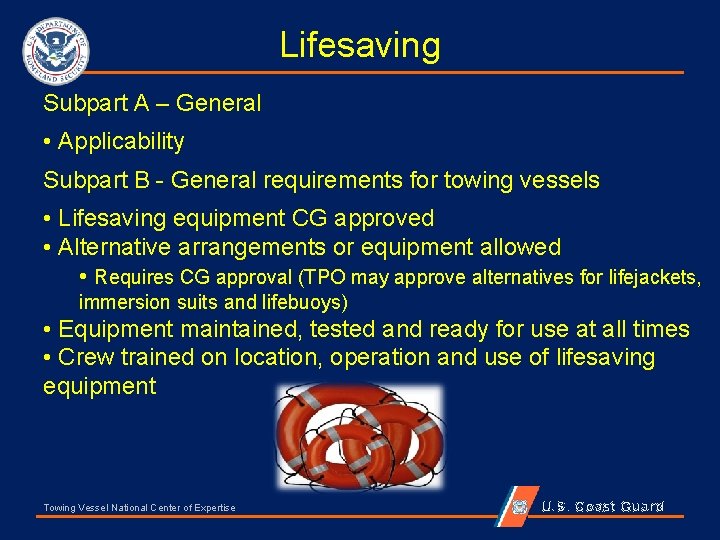
Lifesaving Subpart A – General • Applicability Subpart B - General requirements for towing vessels • Lifesaving equipment CG approved • Alternative arrangements or equipment allowed • Requires CG approval (TPO may approve alternatives for lifejackets, immersion suits and lifebuoys) • Equipment maintained, tested and ready for use at all times • Crew trained on location, operation and use of lifesaving equipment Towing Vessel National Center of Expertise U. S. Coast Guard
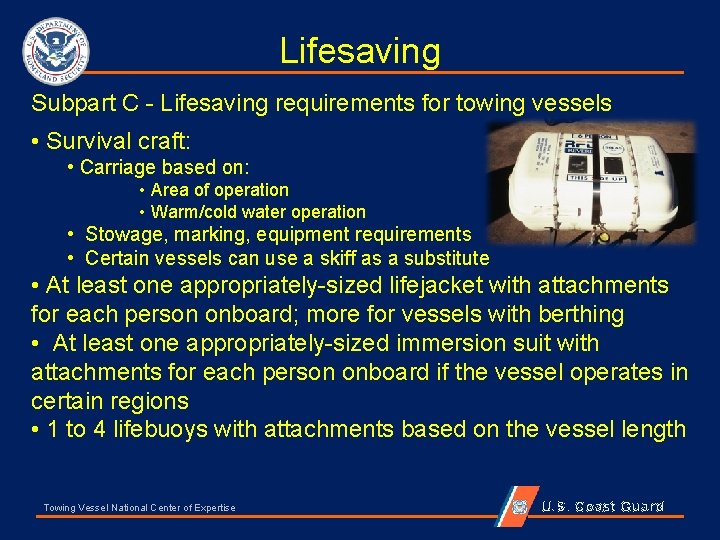
Lifesaving Subpart C - Lifesaving requirements for towing vessels • Survival craft: • Carriage based on: • Area of operation • Warm/cold water operation • Stowage, marking, equipment requirements • Certain vessels can use a skiff as a substitute • At least one appropriately-sized lifejacket with attachments for each person onboard; more for vessels with berthing • At least one appropriately-sized immersion suit with attachments for each person onboard if the vessel operates in certain regions • 1 to 4 lifebuoys with attachments based on the vessel length Towing Vessel National Center of Expertise U. S. Coast Guard
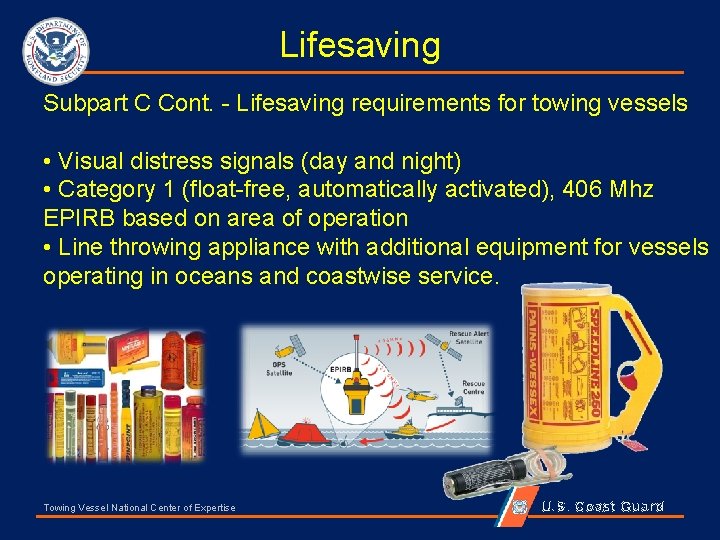
Lifesaving Subpart C Cont. - Lifesaving requirements for towing vessels • Visual distress signals (day and night) • Category 1 (float-free, automatically activated), 406 Mhz EPIRB based on area of operation • Line throwing appliance with additional equipment for vessels operating in oceans and coastwise service. Towing Vessel National Center of Expertise U. S. Coast Guard
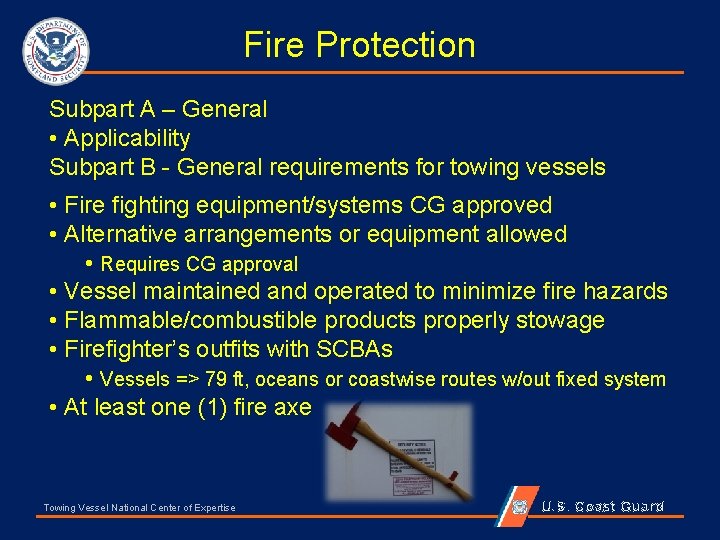
Fire Protection Subpart A – General • Applicability Subpart B - General requirements for towing vessels • Fire fighting equipment/systems CG approved • Alternative arrangements or equipment allowed • Requires CG approval • Vessel maintained and operated to minimize fire hazards • Flammable/combustible products properly stowage • Firefighter’s outfits with SCBAs • Vessels => 79 ft, oceans or coastwise routes w/out fixed system • At least one (1) fire axe Towing Vessel National Center of Expertise U. S. Coast Guard
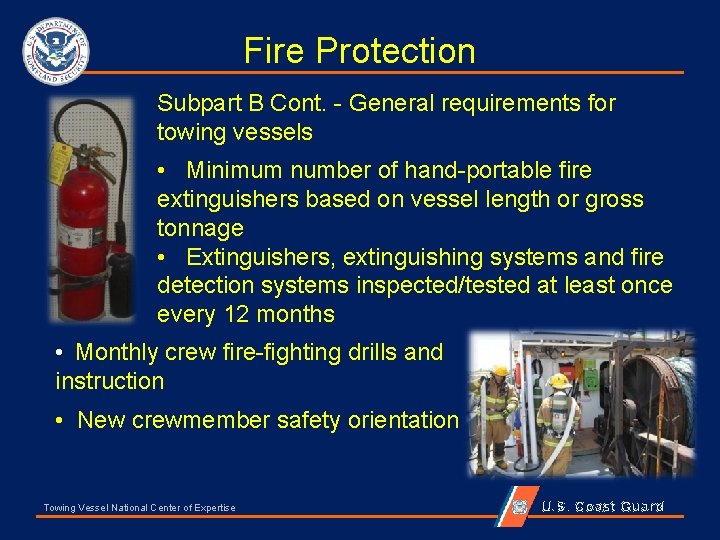
Fire Protection Subpart B Cont. - General requirements for towing vessels • Minimum number of hand-portable fire extinguishers based on vessel length or gross tonnage • Extinguishers, extinguishing systems and fire detection systems inspected/tested at least once every 12 months • Monthly crew fire-fighting drills and instruction • New crewmember safety orientation Towing Vessel National Center of Expertise U. S. Coast Guard
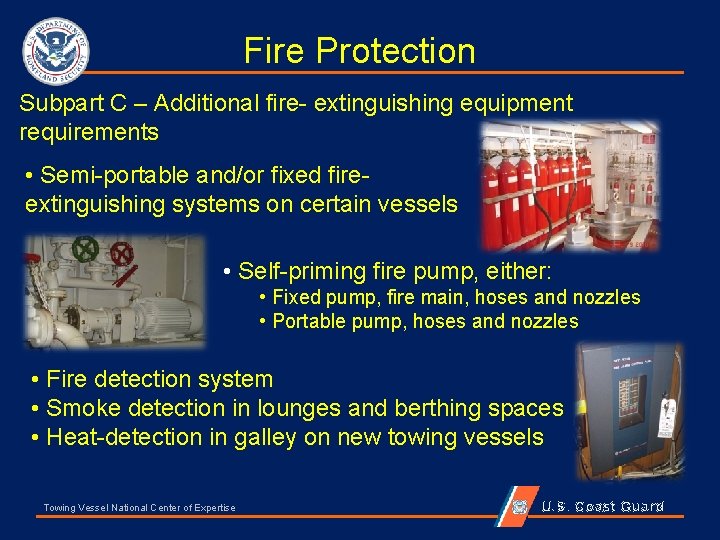
Fire Protection Subpart C – Additional fire- extinguishing equipment requirements • Semi-portable and/or fixed fire- extinguishing systems on certain vessels • Self-priming fire pump, either: • Fixed pump, fire main, hoses and nozzles • Portable pump, hoses and nozzles • Fire detection system • Smoke detection in lounges and berthing spaces • Heat-detection in galley on new towing vessels Towing Vessel National Center of Expertise U. S. Coast Guard
Machinery & Electrical – Existing Vsls • Acceptance of classed vessels • Control, Alarms, General Alarms and Monitoring – periodic readiness testing of alarms • Fuel System & Shutoffs-similar to existing Subchapter C requirements • Bilge Pumps & Dewatering-installed or portable • Pressure Vessels-working gauge and relief valve • Electrical Systems & Lighting – proper insulation and enclosures, marking of circuit breakers • Deferred (Pilothouse Alerter & Towing Machinery) Towing Vessel National Center of Expertise U. S. Coast Guard
Appeals, Equivalents& Special Consideration • Appeals (1. 03 -55) • • Survey – OCMI Audit – District Commander TVNCOE – COMDT (CG-CVC) OCMI or District Decision – OCMI, District, Commandant • Equivalents (136. 115) • Arrangement, fitting, applicance, apparatus, equipment, calculation, information or test – Request from OCMI • Compliance with SOLAS provisions • Alternative Compliance arrangements documented in TSMS • Special Consideration (136. 120) - OCMI Towing Vessel National Center of Expertise U. S. Coast Guard
- Slides: 16