
SUBAXIAL CERVICAL SPINE TRAUMA DIAGNOSIS AND MANAGEMENT 1
SUBAXIAL CERVICAL SPINE TRAUMA- DIAGNOSIS AND MANAGEMENT 1
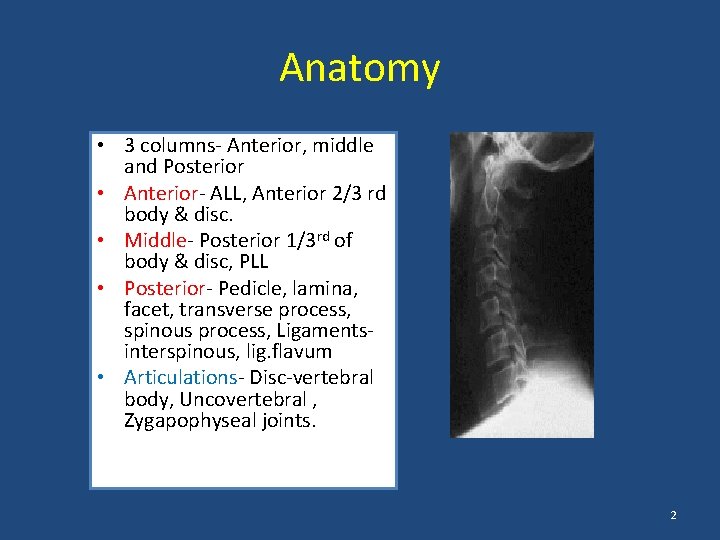
Anatomy • 3 columns- Anterior, middle and Posterior • Anterior- ALL, Anterior 2/3 rd body & disc. • Middle- Posterior 1/3 rd of body & disc, PLL • Posterior- Pedicle, lamina, facet, transverse process, spinous process, Ligamentsinterspinous, lig. flavum • Articulations- Disc-vertebral body, Uncovertebral , Zygapophyseal joints. 2
Cervical spine injuries • Common cause of disability • Incidence – Spine without cord injury- 3% – Cord without #- 0. 7% • • Most commonly involves C 5 and C 6 levels. Primarily involves adolescents and young adults Males predominate. Most common causes– RTA, Fall, Penetrating trauma, Sports 3
Clinical features • • Neck pain Restriction of neck movements Neck tenderness Varying degrees of neurological deficits – Complete cord syndrome – Incomplete cord syndrome • • Central cord syndrome Brown-Sequard syndrome Anterior cord syndrome Combination 4
Mechanisms of injury A-Axial compression force B- Hyperextension injury C- Hyperflexion injury 5
By mechanisms of injury • Flexion – – – Anterior subluxation Unilateral facet dislocation Bilateral facet dislocation Wedge compression fracture Flexion teardrop fracture Clay Shoveler's fracture • Extension – Hangman's fracture • Compression – Jefferson fracture Burst fracture • Complex – Odontoid 6
• IMAGING • Lateral view – Disc spaces, vertebral body, facet joints • AP view- Spinous process, Uncovertebral joints • Oblique view- Foramina, pedicles, facet joints, lateral mass, lamina 7
• Up to 20 % of fractures are missed on conventional radiographs. • The sensitivity and specificity of CSR to detect fractures around 31. 6 and 99. 2%, respectively. • For radiographic clearance of the cervical spine- CT is a must. • CT- Excellent details about the # morphology. 8
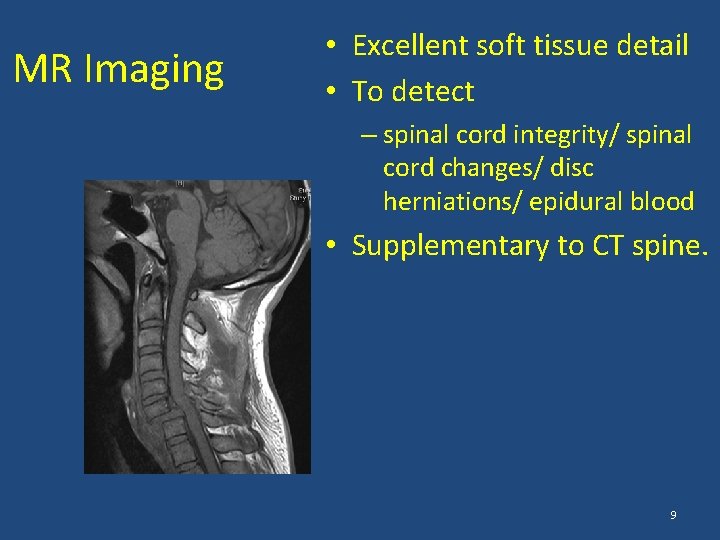
MR Imaging • Excellent soft tissue detail • To detect – spinal cord integrity/ spinal cord changes/ disc herniations/ epidural blood • Supplementary to CT spine. 9
Classification • AO SPINE • SLIC • Allen 10
AO spine classification • Based on 2 column concept of Nicolle and Holdsworth. • Similar to the ones of thoraco-lumbar injuries • 3 types- based on fundamental injury patterns – A- vertebral body compression – B- anterior and posterior element with distraction – C- anterior and posterior element with rotation • • Each type has 3 groups with 3 sub groups Isolated spinous/ transverse process # not considered. Type B and type C injuries are the dominating cervical spinal injuries. The severity in terms of instability of the injuries as well as the rate of neurological deficits does not continuously increase from A to C in the cervical spine as it does in the thoracolumbar spine. 11
Type A (Compression) Fractures Axial compression with or without flexion. Height of vertebral body (anterior column) reduced. Shortening of the anterior column Posterior ligamentous complex intact (flexion/extension x-rays, MRI). • Translation in sagittal plane does not occur. • Rare in comparison to the thoracic and lumbar spine. • Posterior elements’ disruption to be always ruled out so as to classify as type A injury. • • 12
Group A 1 - Impaction # • Deformation of the vertebral body is due to compression of the cancellous bone rather than to fragmentation. • Posterior column is intact. • Narrowing of the spinal canal does not occur. • Injuries are stable. • Posterior vertebral body wall is intact. • Neurological deficit is very rare 13
A 1. 1 end-plate impaction A 1. 2 - wedge impaction • Superior wedge impaction • Lateral wedge impaction • Inferior wedge impaction A 1. 3 -Vertebral collapse fracture. • Rare in cervical spine. • No subluxation. • Posterior elements remain intact. 14
Group A 2 - split # • Vertebral body is split in the coronal or sagittal plane with a variable degree of dislocation of the main fragments. • When the main fragments are significantly dislocated, the gap is filled with disc material which may result in a nonunion. • Neurological deficit is uncommon • The posterior column is not affected. 15
A 2. 1 - Sagital split # A 2. 2 - Coronal split# A 2. 3 - Pincer # • Pincer #- Coronal fracture with dislocation of main fragments 16
Group A 3 - Burst # • Vertebral body is partially or completely comminuted with a centrifugal extrusion of fragments. • Fragments of the posterior wall are retropulsed into the spinal canal and may be the cause of neural injury. • The posterior ligamentous complex is intact. • Injury to the arch, if present, is always a vertical split through the lamina or spinous process. 17
• • A 3. 1 incomplete burst fracture – 1. superior incomplete burst fracture – 2. lateral incomplete burst fracture – 3. inferior incomplete burst fracture A 3. 2 burst-split fracture – 1. superior burst-split fracture – 2. lateral burst-split fracture – 3. inferior burst-split fracture A 3. 3 complete burst fracture – 1. pincer burst fracture – 2. complete flexion burst fracture – 3. complete axial burst fracture Pathognomonic feature– Broken, shortened posterior wall and – Subsequent narrowing of the spinal canal often combined with a neurological deficit. – Disc also usually involved. 18
TYPE B INJURIES—ANTERIOR AND POSTERIOR ELEMENT INJURY WITH DISTRACTION • Account for almost half of all injuries • B component of an injury has to be looked carefully because it changes the prognosis dramatically • Typical features: – Transverse disruption of one or both spinal columns initiated by flexiondistraction (posterior) or hyperextension (anterior). – Translation dislocation in the sagittal direction. • The main criterion is a transverse disruption of one or both spinal columns. • Flexion/distraction initiates posterior disruption and elongation (B 1 and B 2) • Hyperextension with or without anteroposterior shear causes anterior disruption and elongation (B 3). • In B 1 and B 2 injuries, the anterior lesion may be through the disc or a type A fracture of the vertebral body. 19
Group B 1 - Posterior disruption primarily ligamentous (Flexion distraction injuries) • Leading feature is disruption of the posterior ligamentous complex with bilateral subluxation, dislocation, or facet fracture. • Pure flexion-subluxations are only unstable in flexion, whereas pure dislocations are unstable in flexion and shear. • Neurological deficit is frequent and caused by translational displacement and/or vertebral body fragments retropulsed into the spinal canal. 20
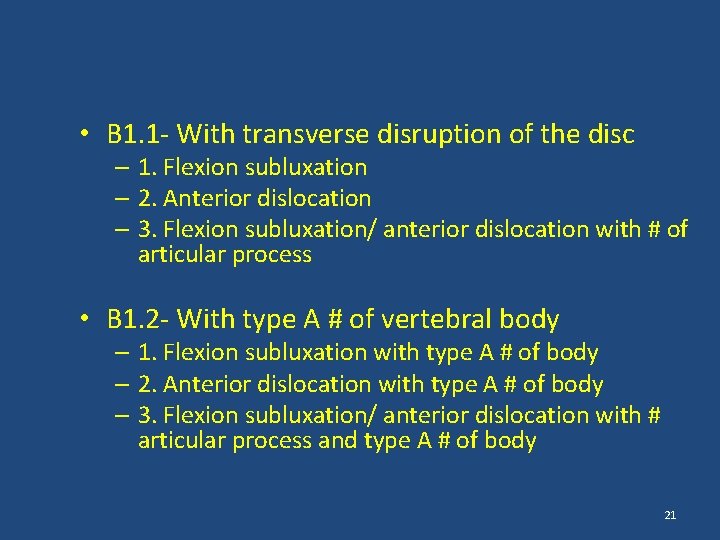
• B 1. 1 - With transverse disruption of the disc – 1. Flexion subluxation – 2. Anterior dislocation – 3. Flexion subluxation/ anterior dislocation with # of articular process • B 1. 2 - With type A # of vertebral body – 1. Flexion subluxation with type A # of body – 2. Anterior dislocation with type A # of body – 3. Flexion subluxation/ anterior dislocation with # articular process and type A # of body 21
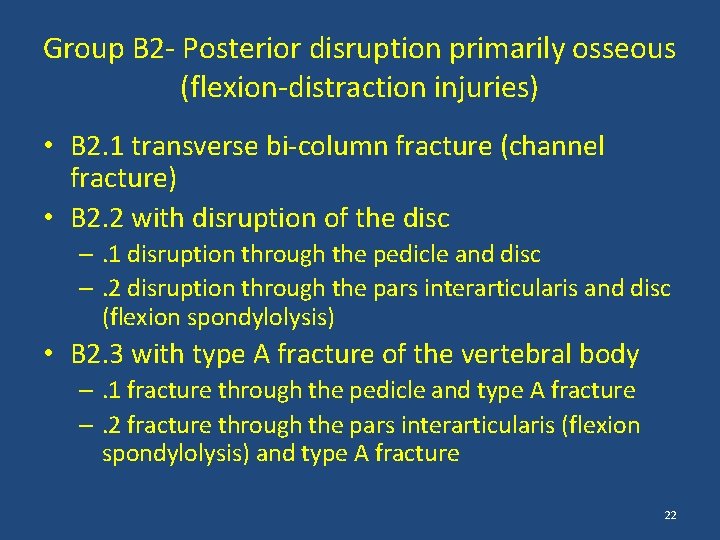
Group B 2 - Posterior disruption primarily osseous (flexion-distraction injuries) • B 2. 1 transverse bi-column fracture (channel fracture) • B 2. 2 with disruption of the disc –. 1 disruption through the pedicle and disc –. 2 disruption through the pars interarticularis and disc (flexion spondylolysis) • B 2. 3 with type A fracture of the vertebral body –. 1 fracture through the pedicle and type A fracture –. 2 fracture through the pars interarticularis (flexion spondylolysis) and type A fracture 22
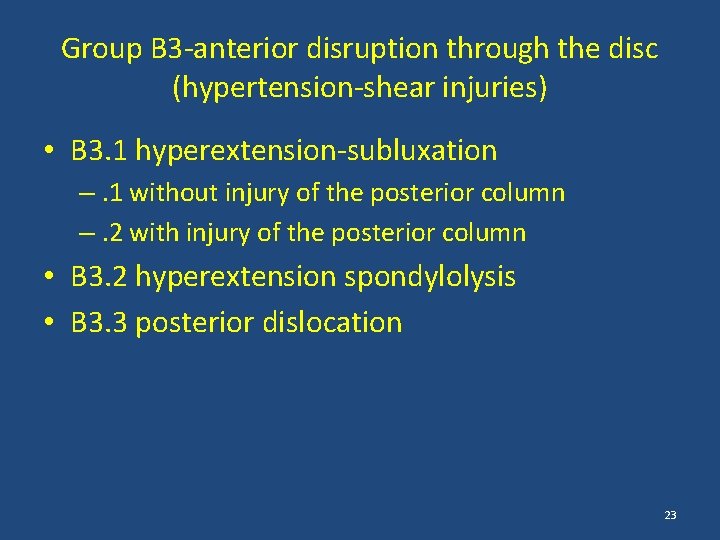
Group B 3 -anterior disruption through the disc (hypertension-shear injuries) • B 3. 1 hyperextension-subluxation –. 1 without injury of the posterior column –. 2 with injury of the posterior column • B 3. 2 hyperextension spondylolysis • B 3. 3 posterior dislocation 23
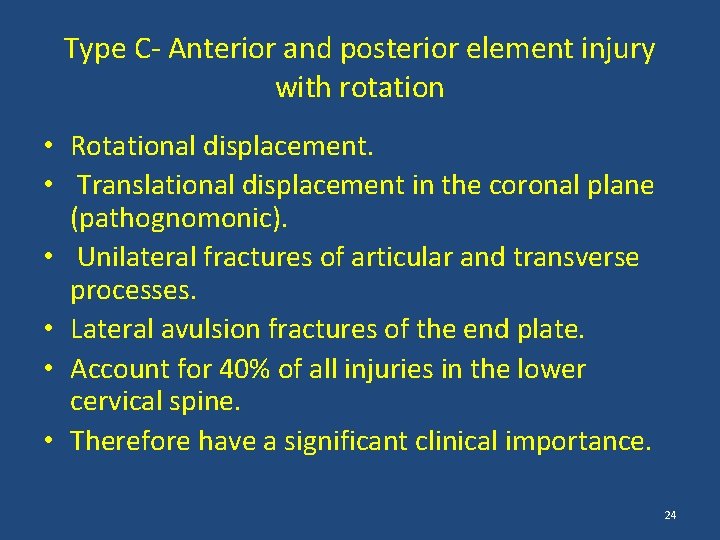
Type C- Anterior and posterior element injury with rotation • Rotational displacement. • Translational displacement in the coronal plane (pathognomonic). • Unilateral fractures of articular and transverse processes. • Lateral avulsion fractures of the end plate. • Account for 40% of all injuries in the lower cervical spine. • Therefore have a significant clinical importance. 24
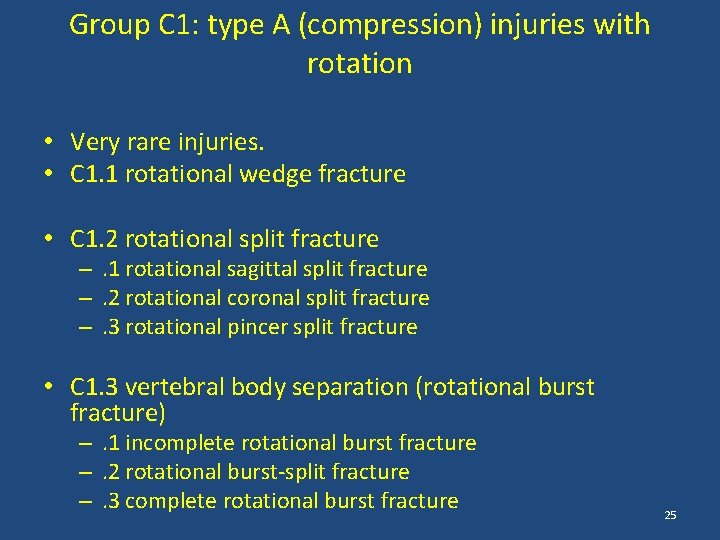
Group C 1: type A (compression) injuries with rotation • Very rare injuries. • C 1. 1 rotational wedge fracture • C 1. 2 rotational split fracture –. 1 rotational sagittal split fracture –. 2 rotational coronal split fracture –. 3 rotational pincer split fracture • C 1. 3 vertebral body separation (rotational burst fracture) –. 1 incomplete rotational burst fracture –. 2 rotational burst-split fracture –. 3 complete rotational burst fracture 25
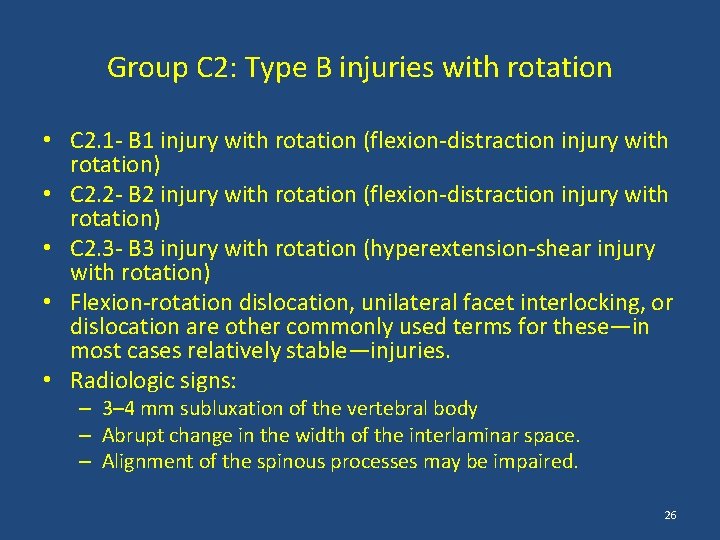
Group C 2: Type B injuries with rotation • C 2. 1 - B 1 injury with rotation (flexion-distraction injury with rotation) • C 2. 2 - B 2 injury with rotation (flexion-distraction injury with rotation) • C 2. 3 - B 3 injury with rotation (hyperextension-shear injury with rotation) • Flexion-rotation dislocation, unilateral facet interlocking, or dislocation are other commonly used terms for these—in most cases relatively stable—injuries. • Radiologic signs: – 3– 4 mm subluxation of the vertebral body – Abrupt change in the width of the interlaminar space. – Alignment of the spinous processes may be impaired. 26
Group C 3 - Rotation shear injuries • • Most unstable injuries. C 3. 1 slice fracture C 3. 2 oblique fracture C 3. 3 Complete separation 27
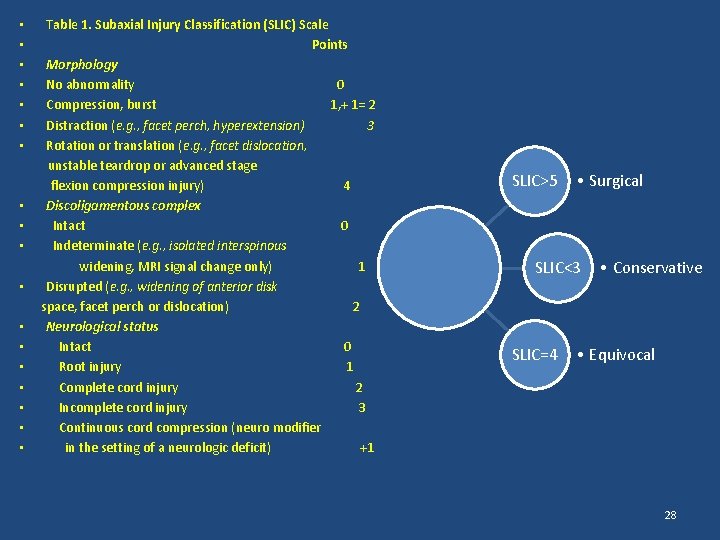
• • • • • Table 1. Subaxial Injury Classification (SLIC) Scale Points Morphology No abnormality 0 Compression, burst 1, + 1= 2 Distraction (e. g. , facet perch, hyperextension) 3 Rotation or translation (e. g. , facet dislocation, unstable teardrop or advanced stage flexion compression injury) 4 Discoligamentous complex Intact 0 Indeterminate (e. g. , isolated interspinous widening, MRI signal change only) 1 Disrupted (e. g. , widening of anterior disk space, facet perch or dislocation) 2 Neurological status Intact 0 Root injury 1 Complete cord injury 2 Incomplete cord injury 3 Continuous cord compression (neuro modifier in the setting of a neurologic deficit) +1 SLIC>5 • Surgical SLIC<3 SLIC=4 • Conservative • Equivocal 28
Which ones to be operated? Type A 2 injuries Type A 3 injuries Type B injuries Type C injuries 29
Management Assess ABC Initial neck immobilization in a hard collar. Assess neurological status. Check for associated injuries. Role of steroids- Not a guideline (Only Class III evidence) • Imaging- Digital X ray C-spine, NCCT spine+/- MRI • Conservative v/s surgical management • • • 30
Goals of treatment • A pain free patient with normal spinal function and a clinically stable spine • The maintenance or recovery of neurological function by reduction and decompression of neural elements. • Restoration of a physiological spinal alignment. • A definite bony healing of a surgically fused spinal segment. • An as short as possible stabilization and fusion • Number of segments involved in surgical management to be kept to a minimum. 31
Conservative treatment • Can be done in less severe deficits (ASIA D, E) • Cervical traction • Early mobilization (to prevent chest infections and bedsores) • Physiotherapy (Limb and chest) 32
SURGICAL TREATMENT • Timing of surgery • Type of surgery ( Anterior/ Posterior/ Combined) 33
Timing of surgical intervention • No clear consensus yet. • Currently no standards regarding the role and timing of decompression in acute SCI. • For injuries of the cervical spine there is some evidence that neurological recovery improved when the dislocation was reduced as early as possible – Indication, surgical technique and surgical results of 100 surgically treated # and #-dislocations of cervical spine. Clin Orthop Relat Res; (203): 244– 257. • Currently no standards regarding the role and timing of decompression in acute SCI. • Role of surgical decompression in patients with SCI is only supported by Class III and limited Class II evidence. – J Neurosurg. 1999 Jul; 91(1 Suppl): 1 -11. 34
• Early treatment in acute central cord injuries – Reasonable and safe to consider early surgical decompression (<24 hrs) in patients with profound neurologic deficit (ASIA = C) and persistent spinal cord compression due to developmental cervical spinal canal stenosis without fracture or instability. • Spine (Phila Pa 1976). 2010 Oct 1; 35(21 Suppl): S 180 -6. – Surgical intervention consisting of Open door expansile cervical laminoplasty can be safely applied in the subset of patients with ATCCS without instability who have significant cervical spondylosis/stenosis. 29 cases. Average delay from injury to surgery was 3 days. • Surg Neurol. 2005 Jun; 63(6): 505 -10 – Surgical decompression, however, was associated with immediate neurologic improvement, faster recovery of neurologic function, early mobilization, better long-term neurologic outcome, briefer hospital stays, and fewer complications related to long confinements in bed than was nonoperative treatment. 13/16 showed improvement. • Spine (Phila Pa 1976). 1998 Nov 15; 23(22): 2398 -403. 35
• Recommended- Urgent decompression of bilateral locked facets in a patient with incomplete tetraplegia or in a patient with SCI with neurologic deterioration. Urgent decompression in acute cervical SCI remains a reasonable practice option and can be performed safely. There is emerging evidence that surgery within 24 hours may reduce length of intensive care unit stay and reduce post-injury medical complications. • 66 articles were reviewed including 1 RCT – Spine (Phila Pa 1976). 2006 May 15; 31(11 Suppl): S 28 -35. 36
Anterior approaches • Discectomy and fusion. • Corpectomy • Anterior cervical plating 37
Posterior approaches • Posterior wiring technique and bone grafting approach – Injuries of the posterior complex involving predominantly soft tissue with insignificant damage to the vertebral body. – Enhancement of other posterior fusion techniques. • Lateral mass fixation – Posterior stabilization of the cervical spine from C 3 to C 7. – Biomechanically stronger than posterior wiring techniques and anterior plating – Risks of injury to the vertebral artery and segmental nerve. • Others- not generally performed nowadays – Interlaminar clamps – Sublaminar wiring 38
- Slides: 38