
SUBATOMIC PARTICLES A typical atom consists of three
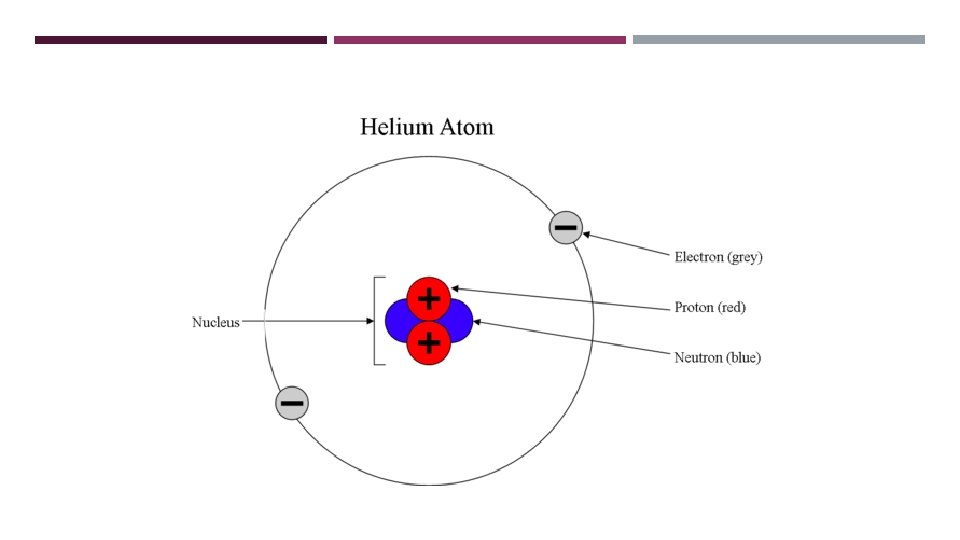
SUB-ATOMIC PARTICLES A typical atom consists of three subatomic particles: protons, neutrons, and electrons. Other particles exist as well, such as alpha and beta particles. Most of an atom's mass is in the nucleus—a small, dense area at the center of every atom, composed of nucleons. Nucleons include protons and neutrons. All the positive charge of an atom is contained in the nucleus, and originates from the protons. Neutrons are neutrally-charged. Electrons, which are negatively-charged, are located outside of the nucleus.
Protons • Protons were discovered by Ernest Rutherford in the year 1919, when he performed his gold foil experiment. He projected alpha particles (helium nuclei) at gold foil, and the positive alpha particles were deflected. • He concluded that protons exist in a nucleus and have a positive nuclear charge. • The atomic number or proton number is the number of protons present in an atom. • The atomic number determines an element (e. g. , the element of atomic number 6 is carbon).
Electrons • Electrons were discovered by Sir John Joseph Thomson in 1897. • After many experiments involving cathode rays, these became known as electrons. • Electrons are located in an electron cloud, which is the area surrounding the nucleus of the atom. • There is usually a higher probability of finding an electron closer to the nucleus of an atom. • Electrons can abbreviated as e-. • Electrons have a negative charge that is equal in magnitude to the positive charge of the protons. • However, their mass is considerably less than that of a proton or neutron (and as such is usually considered insignificant). • Unequal amounts of protons and electrons create ions: positive cations or negative anions.
Neutrons • Neutrons were discovered by James Chadwick in 1932, when he demonstrated that penetrating radiation incorporated beams of neutral particles. • Neutrons are located in the nucleus with the protons. • Along with protons, they make up almost all of the mass of the atom. • The number of neutrons is called the neutron number and can be found by subtracting the proton number from the atomic mass number. • The neutrons in an element determine the isotope of an atom, and often its stability. • The number of neutrons is not necessarily equal to the number of protons.
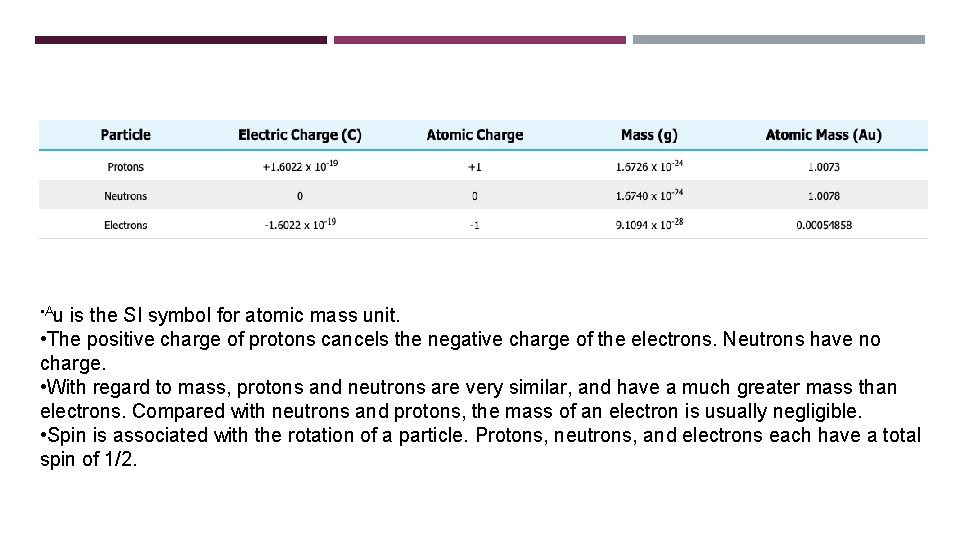
• Au is the SI symbol for atomic mass unit. • The positive charge of protons cancels the negative charge of the electrons. Neutrons have no charge. • With regard to mass, protons and neutrons are very similar, and have a much greater mass than electrons. Compared with neutrons and protons, the mass of an electron is usually negligible. • Spin is associated with the rotation of a particle. Protons, neutrons, and electrons each have a total spin of 1/2.
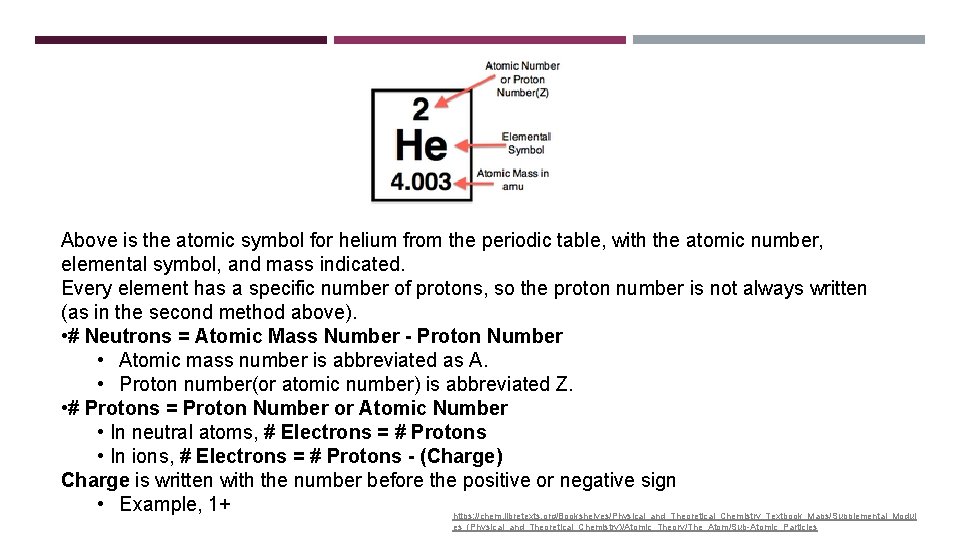
Above is the atomic symbol for helium from the periodic table, with the atomic number, elemental symbol, and mass indicated. Every element has a specific number of protons, so the proton number is not always written (as in the second method above). • # Neutrons = Atomic Mass Number - Proton Number • Atomic mass number is abbreviated as A. • Proton number(or atomic number) is abbreviated Z. • # Protons = Proton Number or Atomic Number • In neutral atoms, # Electrons = # Protons • In ions, # Electrons = # Protons - (Charge) Charge is written with the number before the positive or negative sign • Example, 1+ https: //chem. libretexts. org/Bookshelves/Physical_and_Theoretical_Chemistry_Textbook_Maps/Supplemental_Modul es_(Physical_and_Theoretical_Chemistry)/Atomic_Theory/The_Atom/Sub-Atomic_Particles
- Slides: 7