
Subaru UM 1302008 Do YSOs host a wideangled
Subaru UM, 1/30/2008 Do YSOs host a wide-angled wind? - NIR imaging spectroscopy of H 2 emission Hiro Takami (ASIAA) 1. Introduction 2. Long-Slit Spectroscopy using Subaru. IRCS 3. Spectro-Imaging using Gemini-NIFS
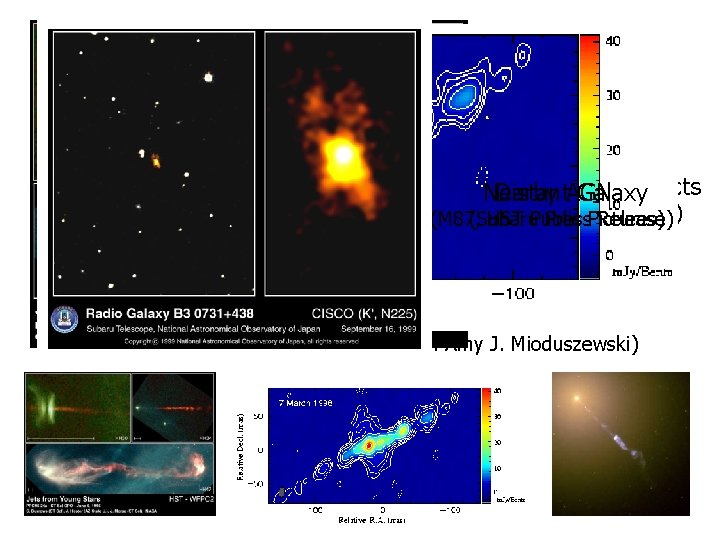
Young stellar objects Nearby Distant AGN Galaxy (HST Public Pictures) (M 87, (Subaru HST Public Press Pictures) Release) X-ray binary (SS 433, Courtesy of Amy J. Mioduszewski)
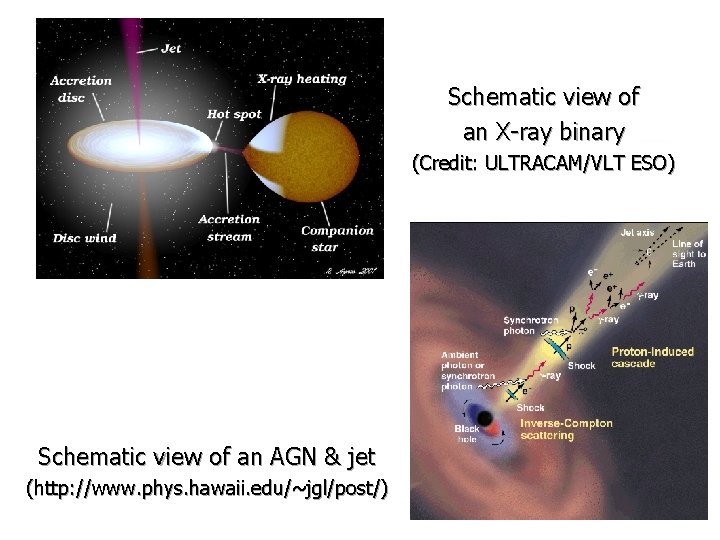
Schematic view of an X-ray binary (Credit: ULTRACAM/VLT ESO) Schematic view of an AGN & jet (http: //www. phys. hawaii. edu/~jgl/post/)
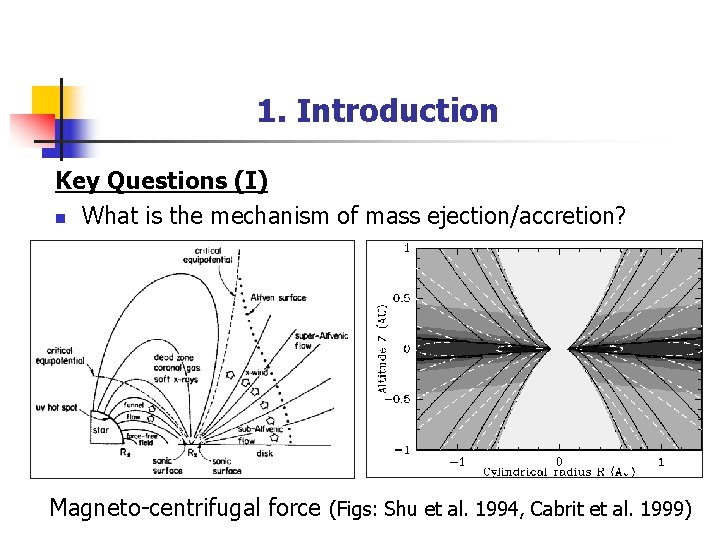
1. Introduction Key Questions (I) n What is the mechanism of mass ejection/accretion? Magneto-centrifugal force (Figs: Shu et al. 1994, Cabrit et al. 1999)
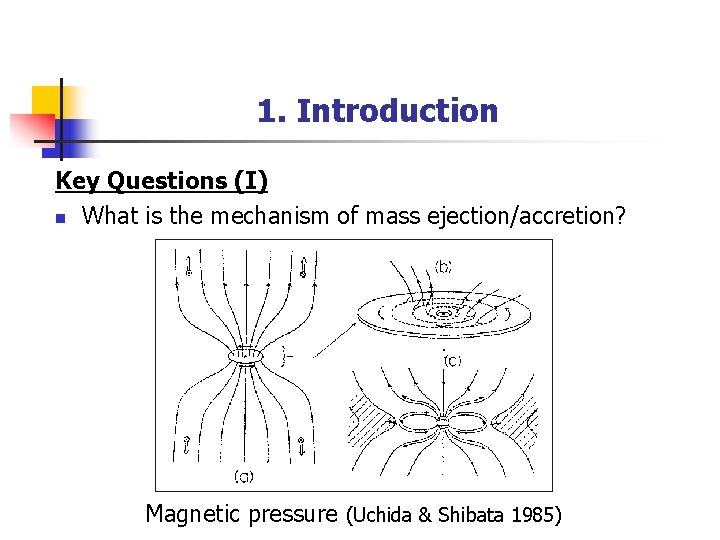
1. Introduction Key Questions (I) n What is the mechanism of mass ejection/accretion? Magnetic pressure (Uchida & Shibata 1985)
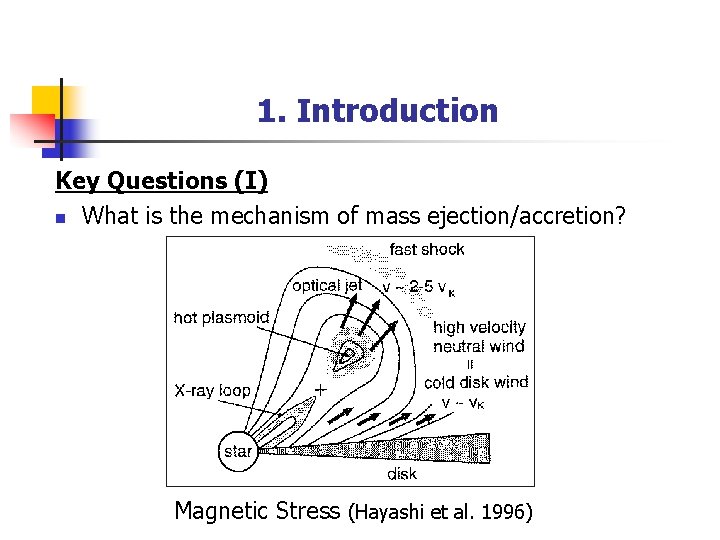
1. Introduction Key Questions (I) n What is the mechanism of mass ejection/accretion? Magnetic Stress (Hayashi et al. 1996)
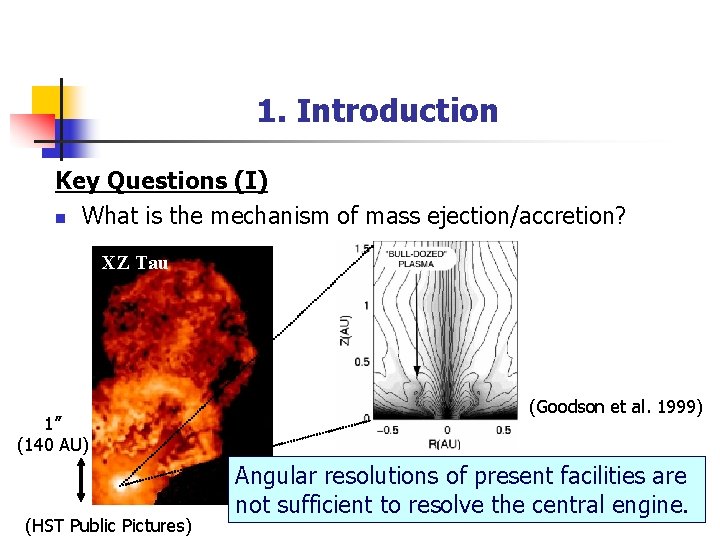
1. Introduction Key Questions (I) n What is the mechanism of mass ejection/accretion? XZ Tau 1” (140 AU) (HST Public Pictures) (Goodson et al. 1999) Angular resolutions of present facilities are not sufficient to resolve the central engine.
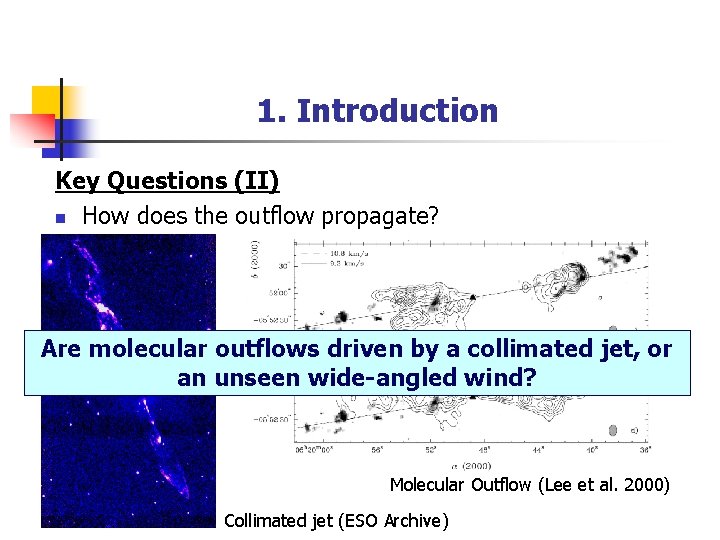
1. Introduction Key Questions (II) n How does the outflow propagate? Are molecular outflows driven by a collimated jet, or an unseen wide-angled wind? Molecular Outflow (Lee et al. 2000) Collimated jet (ESO Archive)
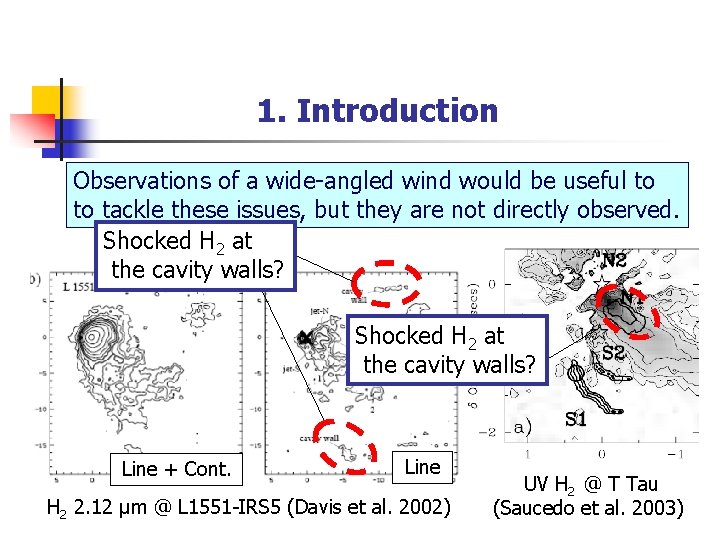
1. Introduction Observations of a wide-angled wind would be useful to to tackle these issues, but they are not directly observed. Shocked H 2 at the cavity walls? Line + Cont. Line H 2 2. 12 μm @ L 1551 -IRS 5 (Davis et al. 2002) UV H 2 @ T Tau (Saucedo et al. 2003)
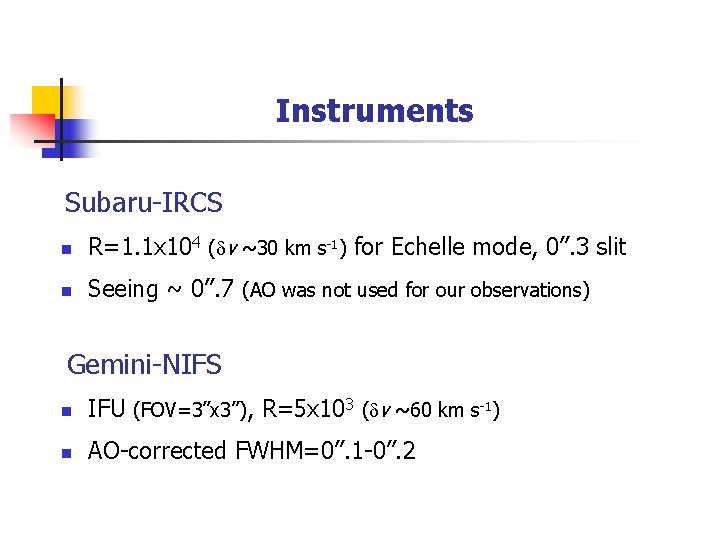
Instruments Subaru-IRCS n R=1. 1 x 10⁴ (dv ~30 km s-1) for Echelle mode, 0”. 3 slit n Seeing ~ 0”. 7 (AO was not used for our observations) Gemini-NIFS n IFU (FOV=3”x 3”), R=5 x 10³ (dv ~60 km s-1) n AO-corrected FWHM=0”. 1 -0”. 2
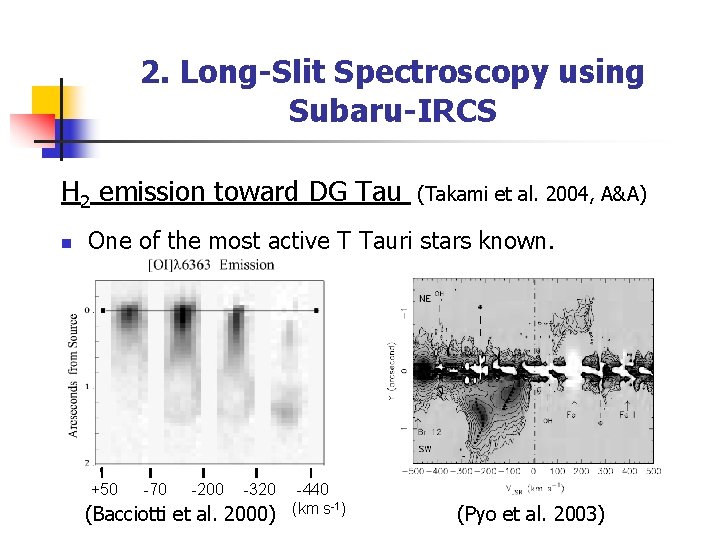
2. Long-Slit Spectroscopy using Subaru-IRCS H 2 emission toward DG Tau n (Takami et al. 2004, A&A) One of the most active T Tauri stars known. +50 -70 -200 -320 (Bacciotti et al. 2000) -440 (km s-1) (Pyo et al. 2003)
2. Long-Slit Spectroscopy using Subaru-IRCS H 2 emission toward DG Tau n n (Takami et al. 2004, A&A) One of the most active T Tauri stars known. Before this study, only 1 star was known as a T Tauri star with NIR H 2 emission associated with outflow. n Emission from the other objects are associated with the disk (or quiescent gas)
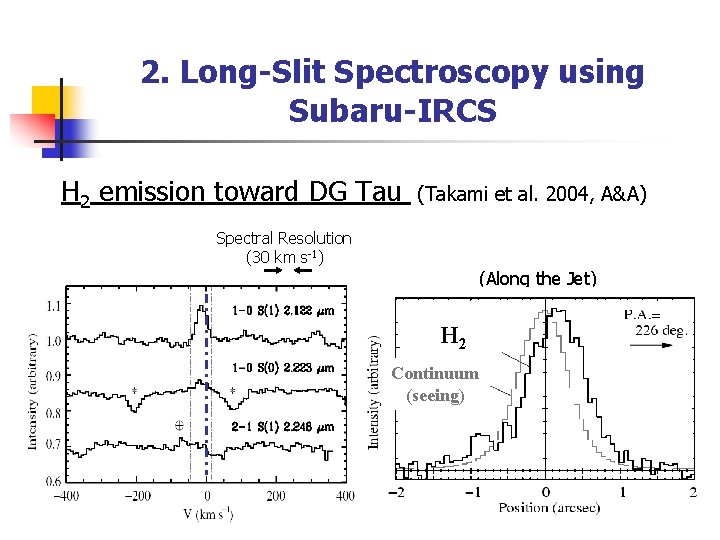
2. Long-Slit Spectroscopy using Subaru-IRCS H 2 emission toward DG Tau (Takami et al. 2004, A&A) Spectral Resolution (30 km s-1) (Along the Jet) H 2 Continuum (seeing)
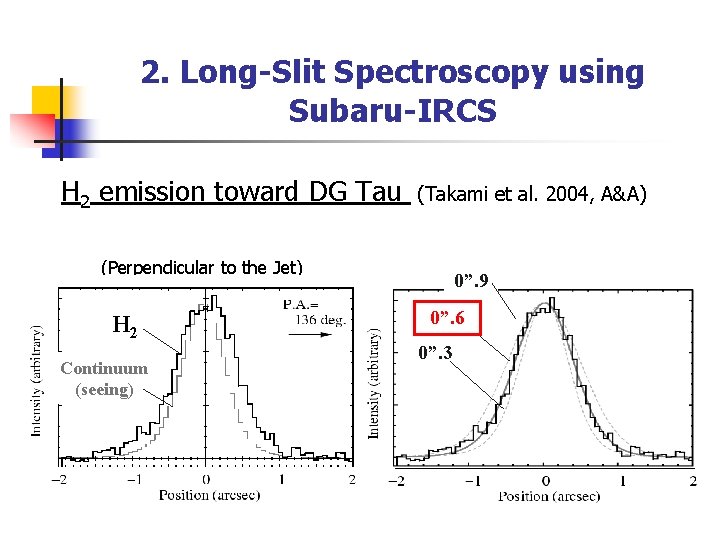
2. Long-Slit Spectroscopy using Subaru-IRCS H 2 emission toward DG Tau (Takami et al. 2004, A&A) (Perpendicular to the Jet) H 2 Continuum (seeing) 0”. 9 0”. 6 0”. 3
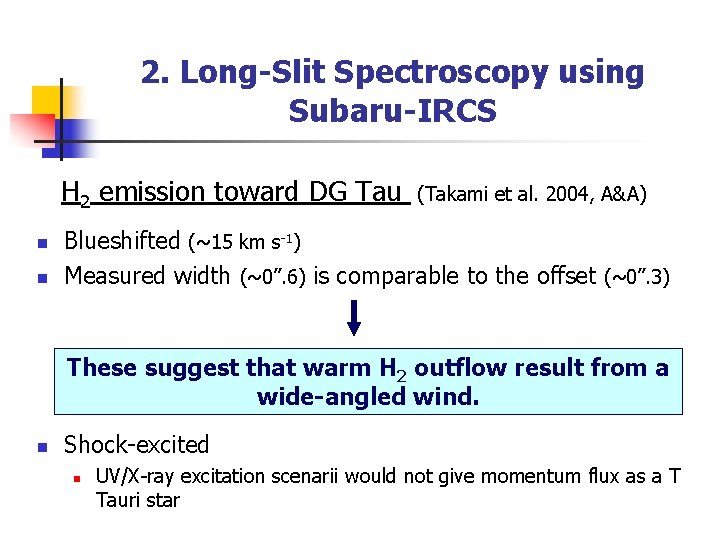
2. Long-Slit Spectroscopy using Subaru-IRCS H 2 emission toward DG Tau n n (Takami et al. 2004, A&A) Blueshifted (~15 km s-1) Measured width (~0”. 6) is comparable to the offset (~0”. 3) These suggest that warm H 2 outflow result from a wide-angled wind. n Shock-excited n UV/X-ray excitation scenarii would not give momentum flux as a T Tauri star
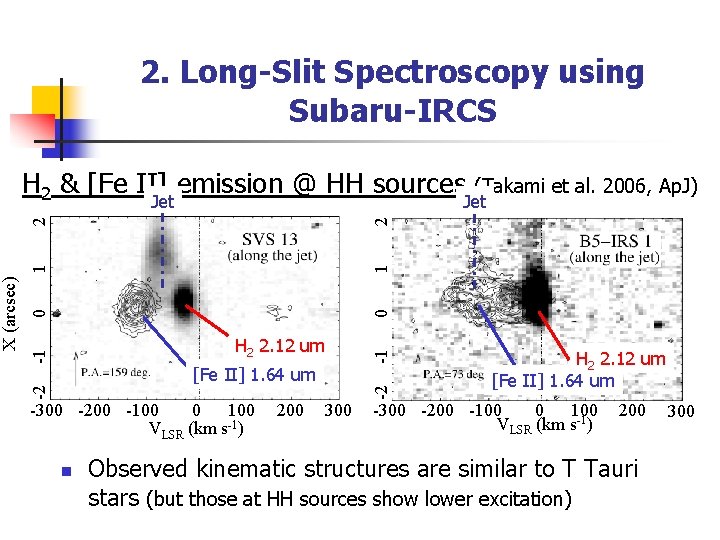
H 2 & [Fe II] emission @ HH sources (Takami et al. 2006, Ap. J) Jet 2 -1 H 2 2. 12 um -2 [Fe II] 1. 64 um -1 0 0 1 1 2 Jet -2 X (arcsec) 2. Long-Slit Spectroscopy using Subaru-IRCS -300 -200 -100 0 100 VLSR (km s-1) n 200 300 H 2 2. 12 um [Fe II] 1. 64 um -300 -200 -100 0 100 VLSR (km s-1) 200 Observed kinematic structures are similar to T Tauri stars (but those at HH sources show lower excitation) 300
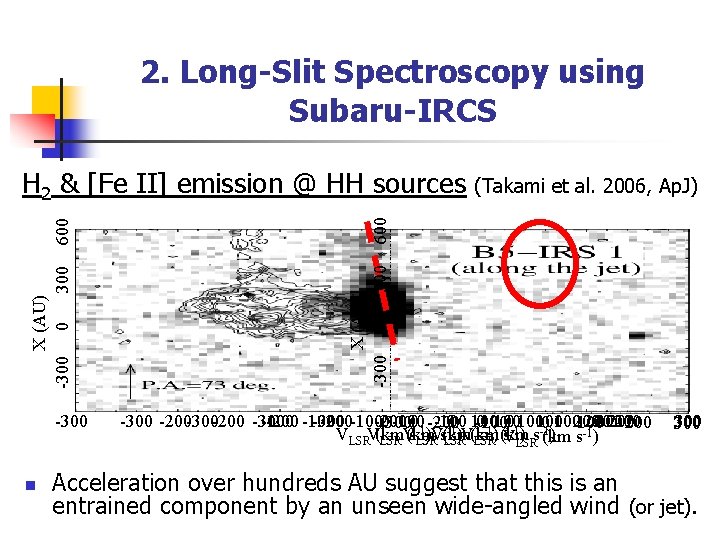
2. Long-Slit Spectroscopy using Subaru-IRCS -300 n 600 X (AU) -300 0 300 600 H 2 & [Fe II] emission @ HH sources (Takami et al. 2006, Ap. J) -300 -200 -300 -200 -300 -100 -200 -100 -300 -200 -100 -200 0 -100 0 -1 -200 -100 0 -1100100 200 200 -300 -100 0 100200 100 200 -1 -1 VLSRV(km V (km s ) V s (km ) V (km s ) s ) V (km s ) LSR LSR LSR 300 Acceleration over hundreds AU suggest that this is an entrained component by an unseen wide-angled wind (or jet).
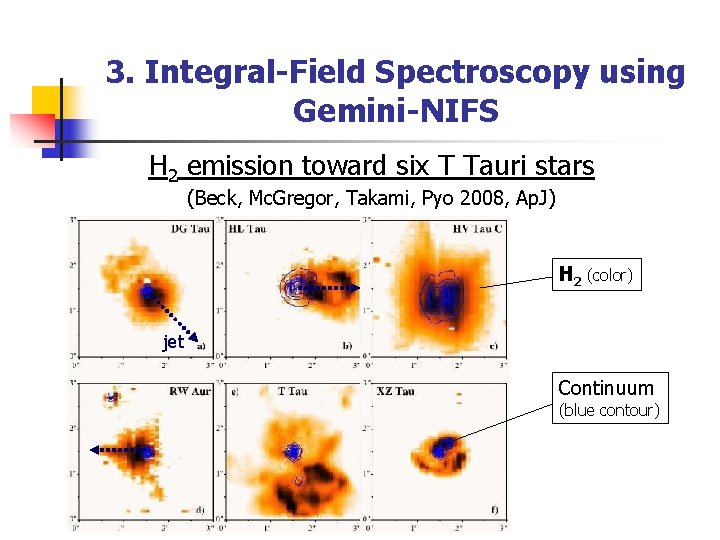
3. Integral-Field Spectroscopy using Gemini-NIFS H 2 emission toward six T Tauri stars (Beck, Mc. Gregor, Takami, Pyo 2008, Ap. J) H 2 (color) jet Continuum (blue contour)
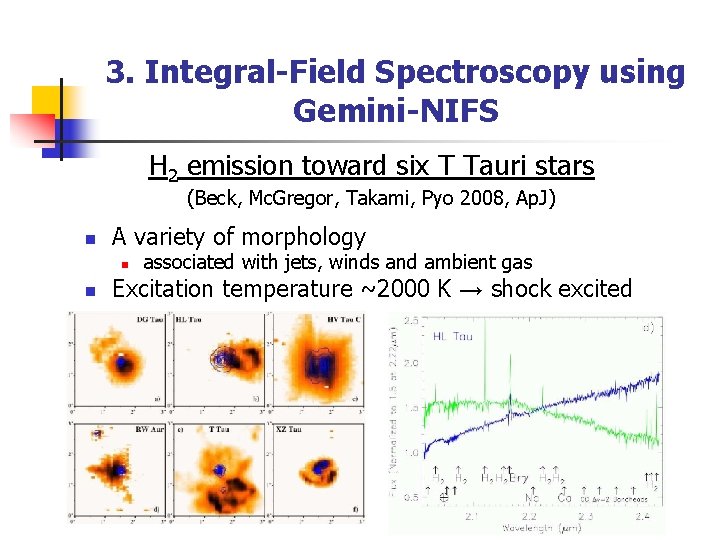
3. Integral-Field Spectroscopy using Gemini-NIFS H 2 emission toward six T Tauri stars (Beck, Mc. Gregor, Takami, Pyo 2008, Ap. J) n A variety of morphology n n associated with jets, winds and ambient gas Excitation temperature ~2000 K → shock excited
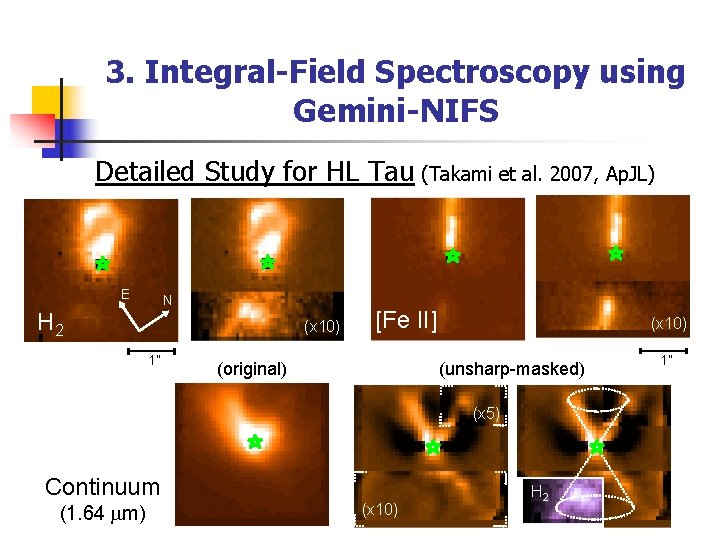
3. Integral-Field Spectroscopy using Gemini-NIFS Detailed Study for HL Tau (Takami et al. 2007, Ap. JL) E N H 2 (x 10) 1” [Fe II] (original) (x 10) (unsharp-masked) (x 5) Continuum (1. 64 m) (x 10) H 2 1”
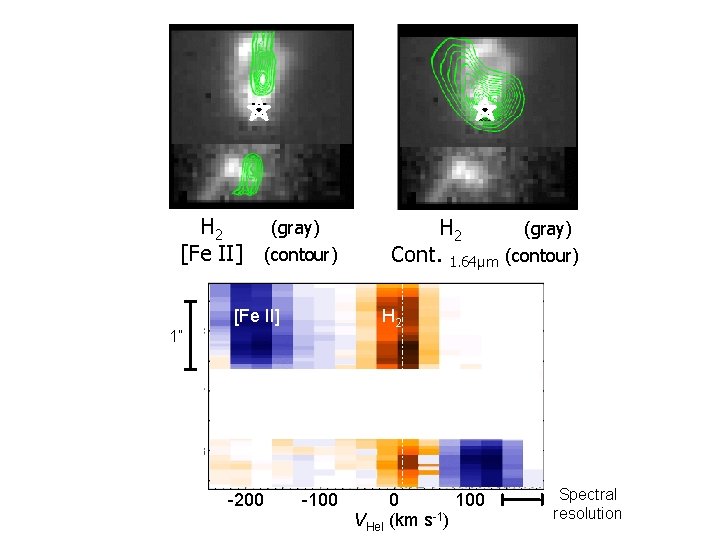
H 2 (gray) [Fe II] (contour) [Fe II] H 2 1” -200 H 2 (gray) Cont. 1. 64μm (contour) -100 0 100 VHel (km s-1) Spectral resolution
3. Integral-Field Spectroscopy using Gemini-NIFS Detailed Study for HL Tau (Takami et al. 2007, Ap. JL) n n n Presence of “micro molecular bipolar H 2 flow” is revealed H 2 emission in some regions are associated with the cavity walls. There is no evidence for kinematic interaction with the collimated jet. A wide-angled wind interacts with ambient material, opening up cavities.
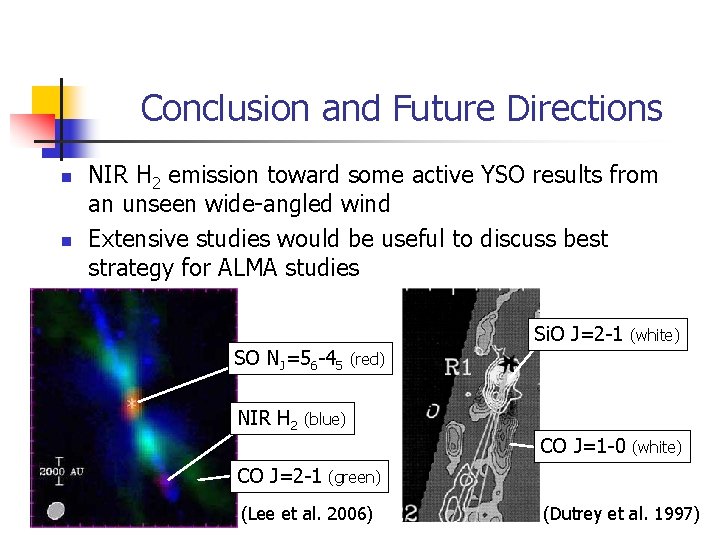
Conclusion and Future Directions n n NIR H 2 emission toward some active YSO results from an unseen wide-angled wind Extensive studies would be useful to discuss best strategy for ALMA studies SO NJ=56 -45 NIR H 2 Si. O J=2 -1 (white) CO J=1 -0 (white) (red) (blue) CO J=2 -1 (green) (Lee et al. 2006) (Dutrey et al. 1997)
- Slides: 23