
Sub teacherMrs Mumbaikar K V STD IX Science
Sub. teacher-Mrs. Mumbaikar K. V. STD. -IX
Science and Technology Part one Chapter 3 Structure of Atom
n You have read the title of the chapter, ‘ structure of atom’. What do you understand from this title ? Have you ever heard of atom? Do you know what is structure?
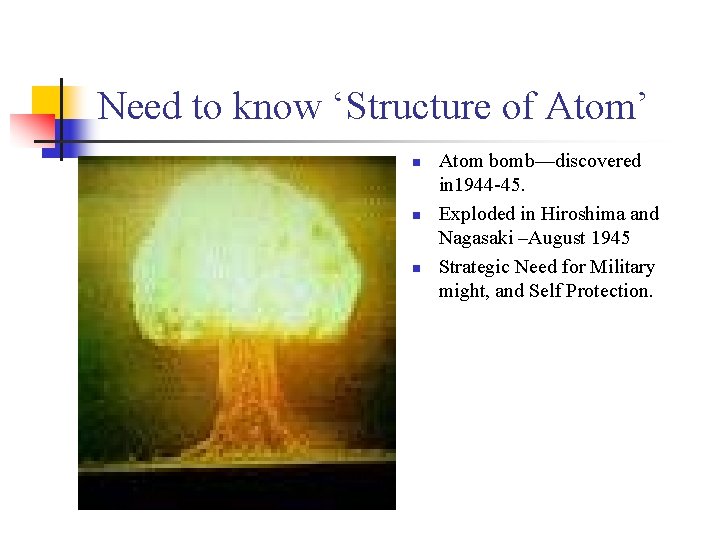
Need to know ‘Structure of Atom’ n n n Atom bomb—discovered in 1944 -45. Exploded in Hiroshima and Nagasaki –August 1945 Strategic Need for Military might, and Self Protection.
Questions: n n Can you imagine how this huge amount of energy is squeezed in such a small volume? What shall be the possible steps in converting atomic energy in to useful form of the energy?
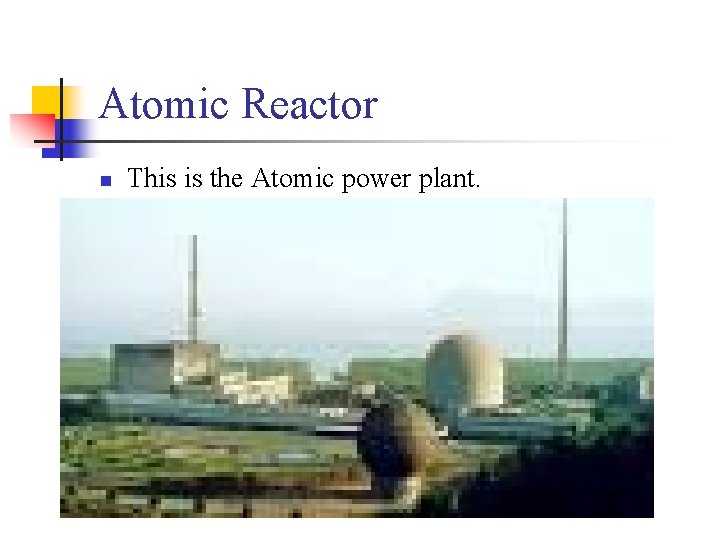
Atomic Reactor n This is the Atomic power plant.
Atomic Reactor It generates Electricity from Atomic Energy. Atomic energy → Fission energy →Heat energy → Steam turbine →Electricity. These are the main stages involved in getting electrical energy from the ‘atomic energy. ’ n Atomic power plant is the necessity of future for fulfillment of basic need of electrical power of the country. n Though there are so many forms of energy, why do we convert atomic energy in to electrical energy?
n n n One must know the ‘Science’ behind it and ‘Technology’ required for it. To understand it the ‘Structure of Atom ‘ is 1 st step. Many scientists contributed in evolving concept and structure of atom. Let us see few important of them.
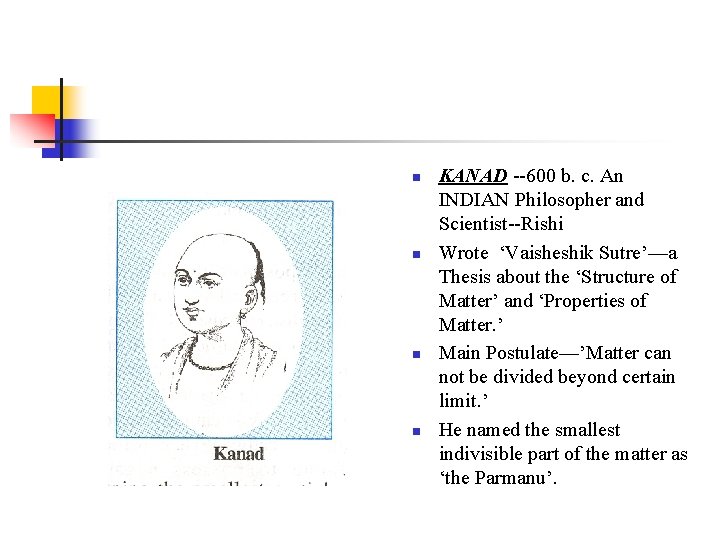
n n KANAD --600 b. c. An INDIAN Philosopher and Scientist--Rishi Wrote ‘Vaisheshik Sutre’—a Thesis about the ‘Structure of Matter’ and ‘Properties of Matter. ’ Main Postulate—’Matter can not be divided beyond certain limit. ’ He named the smallest indivisible part of the matter as ‘the Parmanu’.
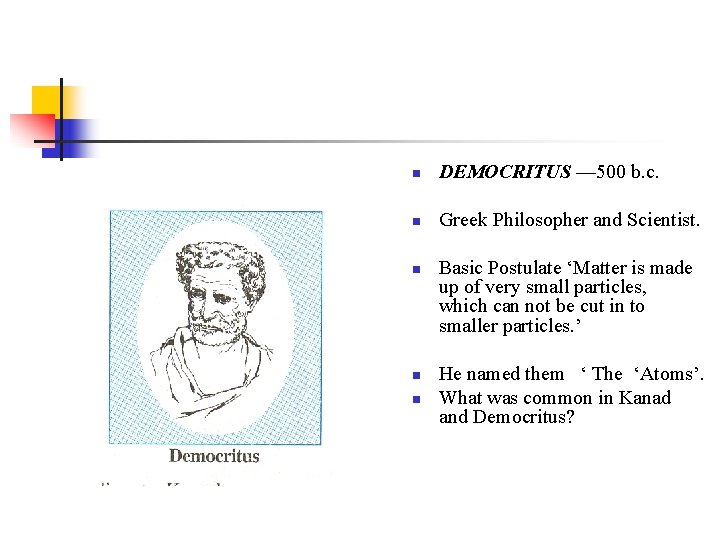
n DEMOCRITUS — 500 b. c. n Greek Philosopher and Scientist. n n n Basic Postulate ‘Matter is made up of very small particles, which can not be cut in to smaller particles. ’ He named them ‘ The ‘Atoms’. What was common in Kanad and Democritus?
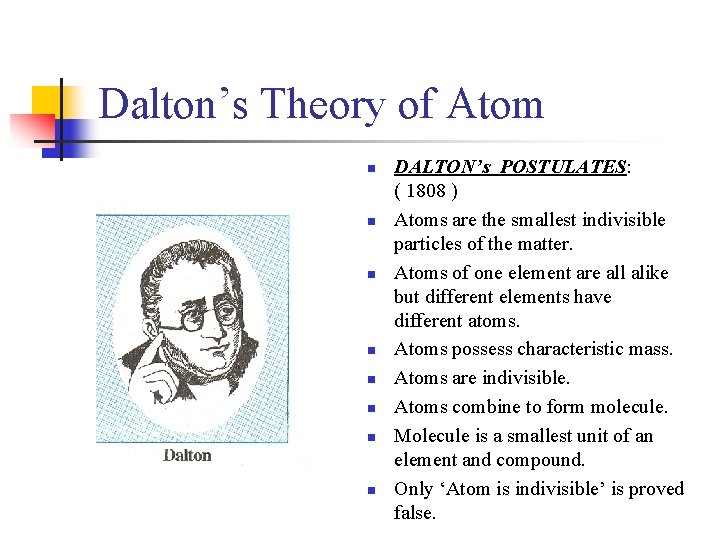
Dalton’s Theory of Atom n n n n DALTON’s POSTULATES: ( 1808 ) Atoms are the smallest indivisible particles of the matter. Atoms of one element are all alike but different elements have different atoms. Atoms possess characteristic mass. Atoms are indivisible. Atoms combine to form molecule. Molecule is a smallest unit of an element and compound. Only ‘Atom is indivisible’ is proved false.
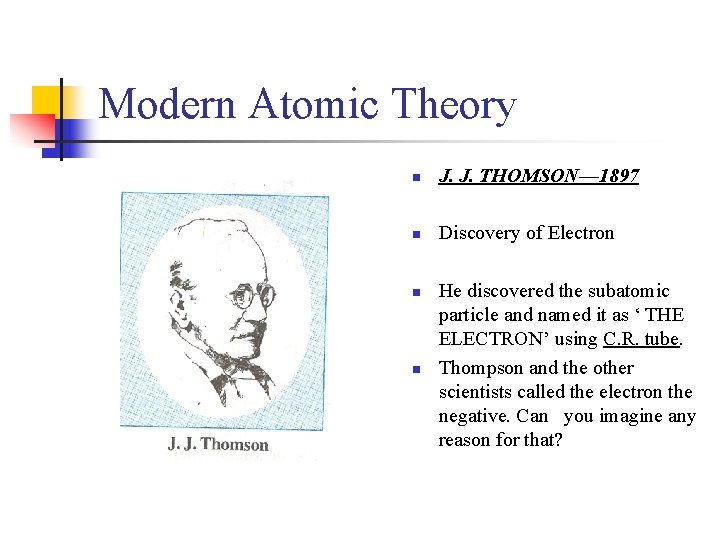
Modern Atomic Theory n J. J. THOMSON— 1897 n Discovery of Electron n n He discovered the subatomic particle and named it as ‘ THE ELECTRON’ using C. R. tube. Thompson and the other scientists called the electron the negative. Can you imagine any reason for that?
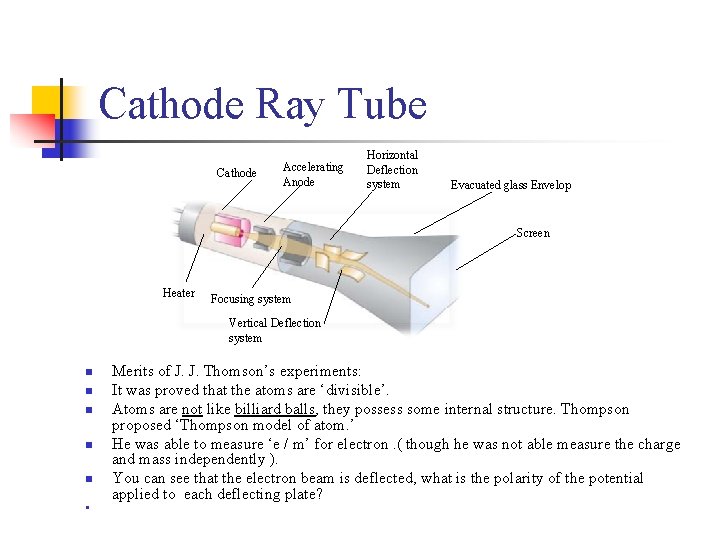
Cathode Ray Tube Cathode Accelerating Anode Horizontal Deflection system Evacuated glass Envelop Screen Heater Focusing system Vertical Deflection system n n n Merits of J. J. Thomson’s experiments: It was proved that the atoms are ‘divisible’. Atoms are not like billiard balls, they possess some internal structure. Thompson proposed ‘Thompson model of atom. ’ He was able to measure ‘e / m’ for electron. ( though he was not able measure the charge and mass independently ). You can see that the electron beam is deflected, what is the polarity of the potential applied to each deflecting plate?
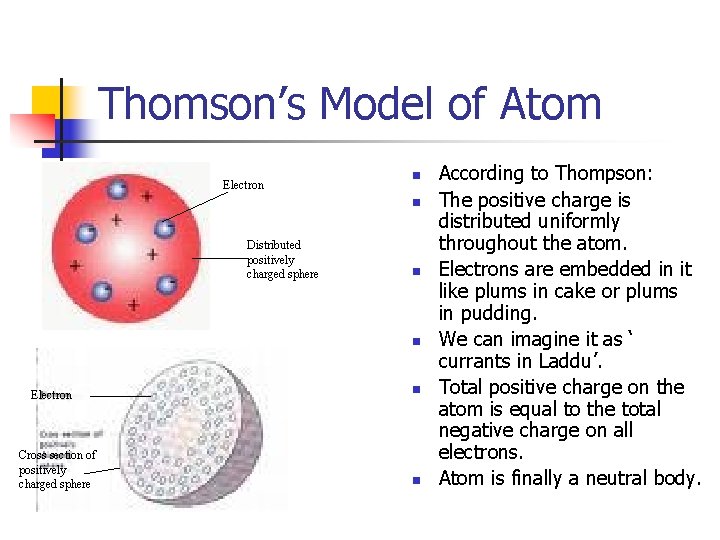
Thomson’s Model of Atom Electron n n Distributed positively charged sphere n n Electron Cross section of positively charged sphere n n According to Thompson: The positive charge is distributed uniformly throughout the atom. Electrons are embedded in it like plums in cake or plums in pudding. We can imagine it as ‘ currants in Laddu’. Total positive charge on the atom is equal to the total negative charge on all electrons. Atom is finally a neutral body.
n n n During the same time, other scientists were discovering. Bequeral, Merrie and Perie Curie had discovered radioactivity, α, β, r particles. Rutherford carried the experiments using α particles, to know the nature of gold atoms.
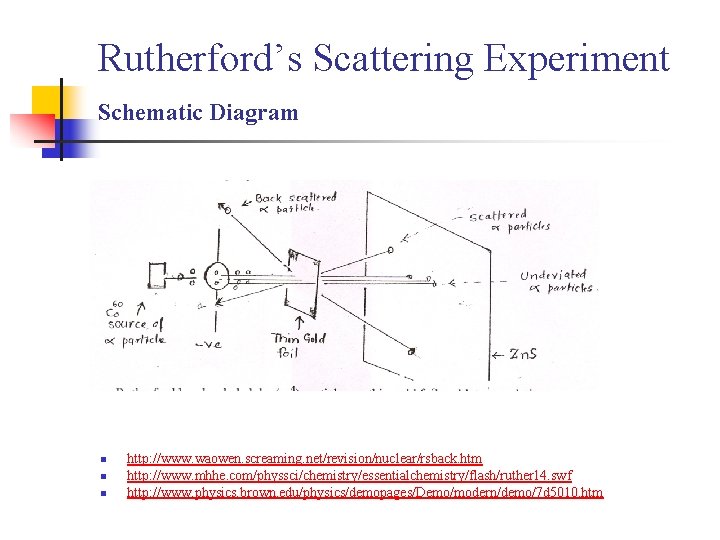
Rutherford’s Scattering Experiment Schematic Diagram n n n http: //www. waowen. screaming. net/revision/nuclear/rsback. htm http: //www. mhhe. com/physsci/chemistry/essentialchemistry/flash/ruther 14. swf http: //www. physics. brown. edu/physics/demopages/Demo/modern/demo/7 d 5010. htm
n n n We note here that, Internal structure of α particle was not known at that time. The charge was known as twice that of electron and positive and mass as four times the mass of Hydrogen atom. Gold atom has diameter about 3 A 0. A gold or platinum foil of thickness 100 A 0 (0. 01μm) has about 33 to 35 layers of atoms. See the websites recommended. Observe and answer: What happens if we change the energy of α particle? Can you measure how many α particles are backscattered w. r. to scattered in forward direction in the simulation which you can see it repetitively?
Observations and Conclusions n n n n About 80% of the α particles traveled undeviated. Most of the atom is EMPTY. Some particles scattered with small acute angle. Very few scattered with obtuse angle. In the simulation you have seen, Can you mark out which atoms are scattered with acute angles and which atoms are scattered with obtuse angles? About 1 in 20000 (approximately) suffered back scattering as if it has experienced head on collision. All positive charge and entire mass seems to be concentrated in a very small place.
n n n Rutherford postulated that “the whole positive charge on the atom and entire mass of the atom seems to be concentrated in a very small space. ” Which experiment in web demonstration might be responsible for this conclusion? He named it as the “ NUCLEUS”. On the basis of his observations and his postulate of the Nucleus , Rutherford proposed a model of atom. He proposed that Atom has the Nucleus at the center and electron revolves around it. But there was serious problem with this model.
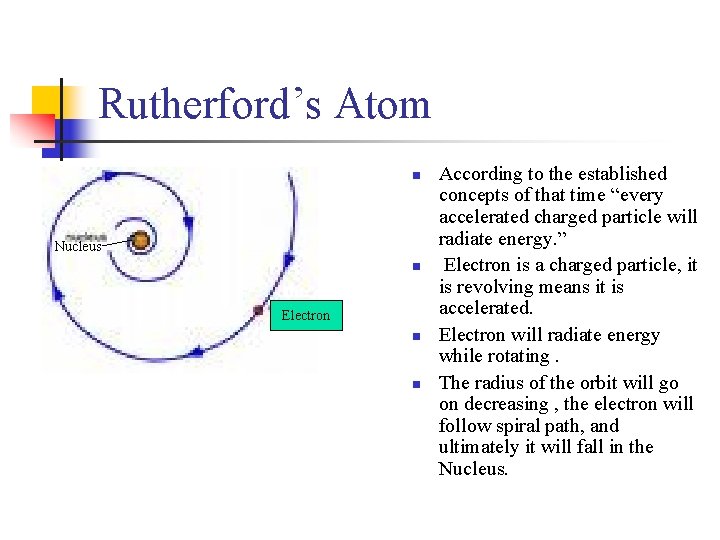
Rutherford’s Atom n Nucleus n Electron n n According to the established concepts of that time “every accelerated charged particle will radiate energy. ” Electron is a charged particle, it is revolving means it is accelerated. Electron will radiate energy while rotating. The radius of the orbit will go on decreasing , the electron will follow spiral path, and ultimately it will fall in the Nucleus.
Drawbacks of Rutherford’s model of Atom n n n n If a ball is rotating in a circle with a constant speed, is it accelerated? The Rutherford’s atom was Not a Stable Atom. The spectrum emitted by all atoms was predicted to be the same spectrum. Can you imagine why so? The characteristic spectrum of each element could not be explained or understood by Rutherford’s Atomic Model. Though Rutherford’s model was not accepted, his gift to Science is the concept of the ‘ NUCLEUS’. Neil Bohr proposed a new model of atom.
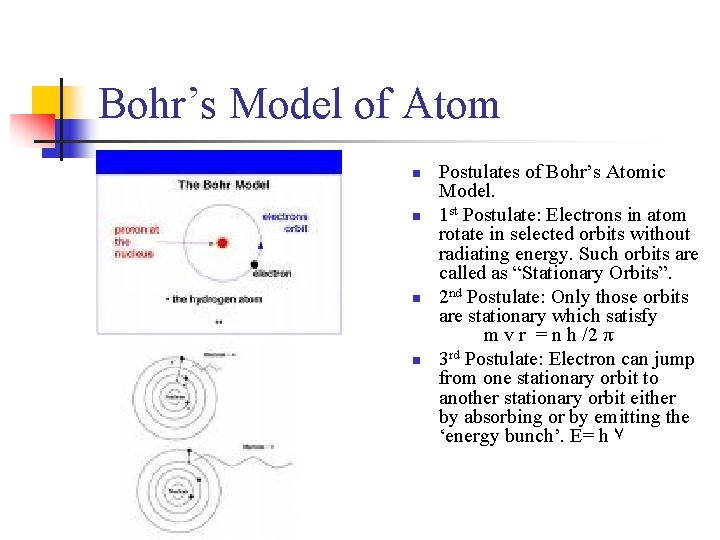
Bohr’s Model of Atom n n Postulates of Bohr’s Atomic Model. 1 st Postulate: Electrons in atom rotate in selected orbits without radiating energy. Such orbits are called as “Stationary Orbits”. 2 nd Postulate: Only those orbits are stationary which satisfy m v r = n h /2 π 3 rd Postulate: Electron can jump from one stationary orbit to another stationary orbit either by absorbing or by emitting the ‘energy bunch’. E= h ٧
Bohr’s Atom was stable atom. It was able to explain the spectrum emitted by Hydrogen atom. n n n Rutherford suggested the existence of the neutron in 1920. Chadwick discovered the Neutron experimentally in 1932. Chadwick received the Nobel for the discovery of neutron and not Rutherford, how will you justify it?
The Nucleus n n n n The Nucleus mainly contains the Nucleons. It contains mainly- Protons and Neutrons. There are large number of sub nuclear particles in it but they are not important at this stage. Electrons can not exist in the nucleus. The size of the nucleus is measured in femto-meters. ( 1 femtometer = 10 -15 m ). Charge on the nucleus is positive and it is equal to the total negative charge on all electrons in that atom. The mass of nucleus is measured in a. m. u. (1 a. m. u. = mass of 1 H atom = 1. 66 × 10 -27 Kg ) Extra nuclear part is negatively charged, as electrons revolve around the nucleus.
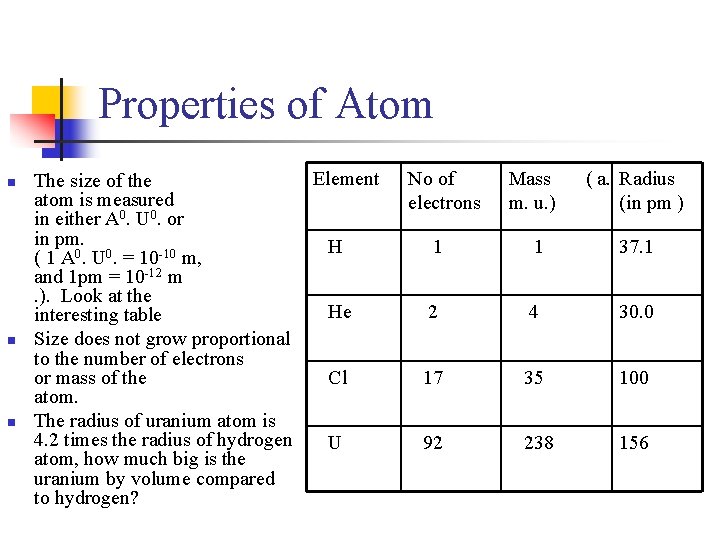
Properties of Atom n n n The size of the atom is measured in either A 0. U 0. or in pm. ( 1 A 0. U 0. = 10 -10 m, and 1 pm = 10 -12 m. ). Look at the interesting table Size does not grow proportional to the number of electrons or mass of the atom. The radius of uranium atom is 4. 2 times the radius of hydrogen atom, how much big is the uranium by volume compared to hydrogen? Element No of electrons Mass m. u. ) ( a. Radius (in pm ) H 1 1 37. 1 He 2 4 30. 0 Cl 17 35 100 U 92 238 156
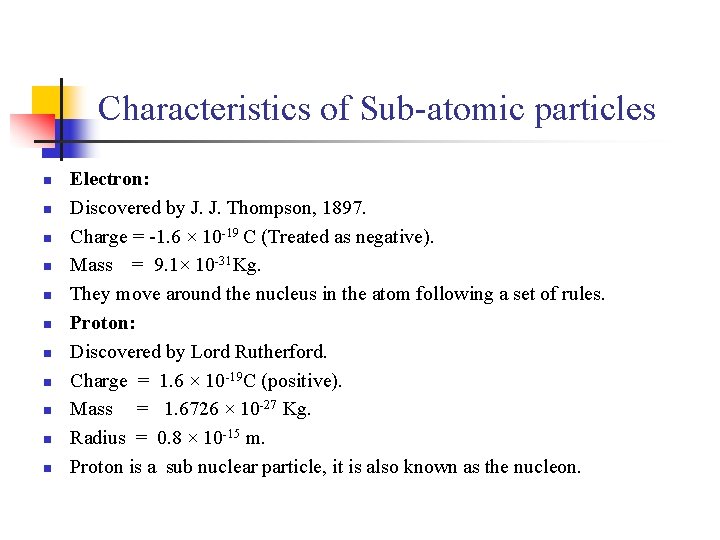
Characteristics of Sub-atomic particles n n n Electron: Discovered by J. J. Thompson, 1897. Charge = -1. 6 × 10 -19 C (Treated as negative). Mass = 9. 1× 10 -31 Kg. They move around the nucleus in the atom following a set of rules. Proton: Discovered by Lord Rutherford. Charge = 1. 6 × 10 -19 C (positive). Mass = 1. 6726 × 10 -27 Kg. Radius = 0. 8 × 10 -15 m. Proton is a sub nuclear particle, it is also known as the nucleon.
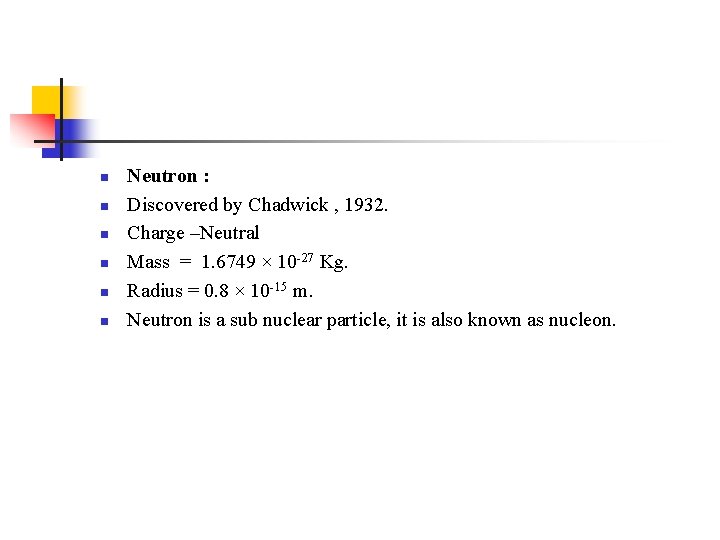
n n n Neutron : Discovered by Chadwick , 1932. Charge –Neutral Mass = 1. 6749 × 10 -27 Kg. Radius = 0. 8 × 10 -15 m. Neutron is a sub nuclear particle, it is also known as nucleon.
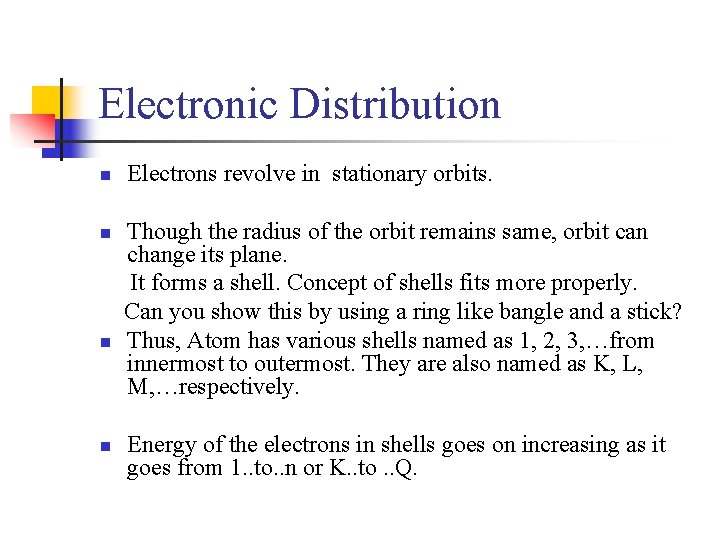
Electronic Distribution n n Electrons revolve in stationary orbits. Though the radius of the orbit remains same, orbit can change its plane. It forms a shell. Concept of shells fits more properly. Can you show this by using a ring like bangle and a stick? Thus, Atom has various shells named as 1, 2, 3, …from innermost to outermost. They are also named as K, L, M, …respectively. Energy of the electrons in shells goes on increasing as it goes from 1. . to. . n or K. . to. . Q.
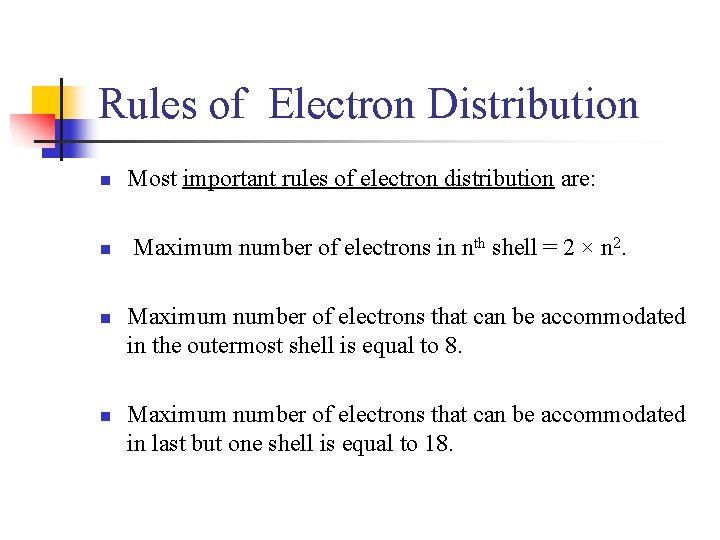
Rules of Electron Distribution n n Most important rules of electron distribution are: Maximum number of electrons in nth shell = 2 × n 2. Maximum number of electrons that can be accommodated in the outermost shell is equal to 8. Maximum number of electrons that can be accommodated in last but one shell is equal to 18.
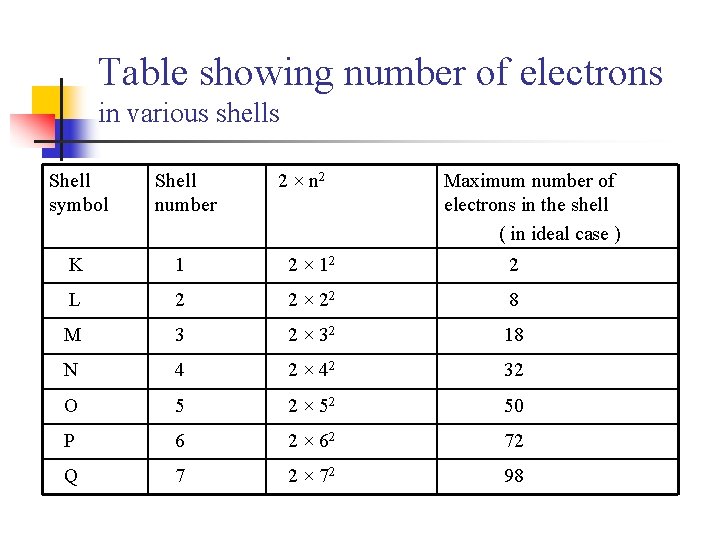
Table showing number of electrons in various shells Shell symbol Shell number 2 × n 2 Maximum number of electrons in the shell ( in ideal case ) K 1 2 × 12 2 L 2 2 × 22 8 M 3 2 × 32 18 N 4 2 × 42 32 O 5 2 × 52 50 P 6 2 × 62 72 Q 7 2 × 72 98
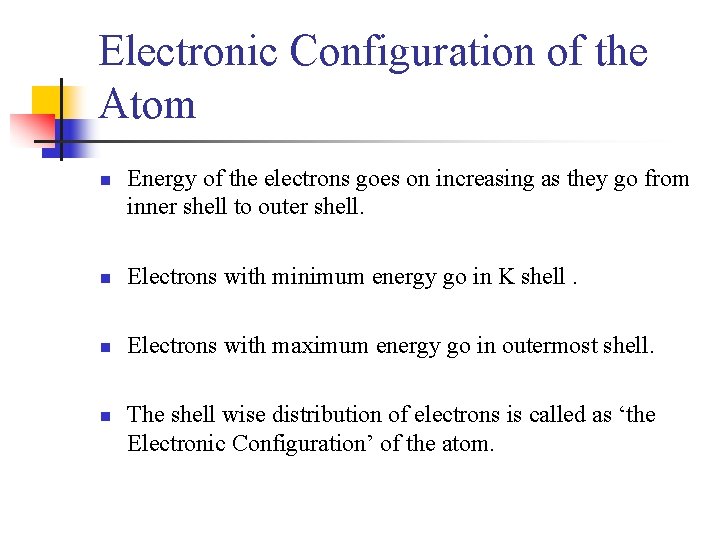
Electronic Configuration of the Atom n Energy of the electrons goes on increasing as they go from inner shell to outer shell. n Electrons with minimum energy go in K shell. n Electrons with maximum energy go in outermost shell. n The shell wise distribution of electrons is called as ‘the Electronic Configuration’ of the atom.
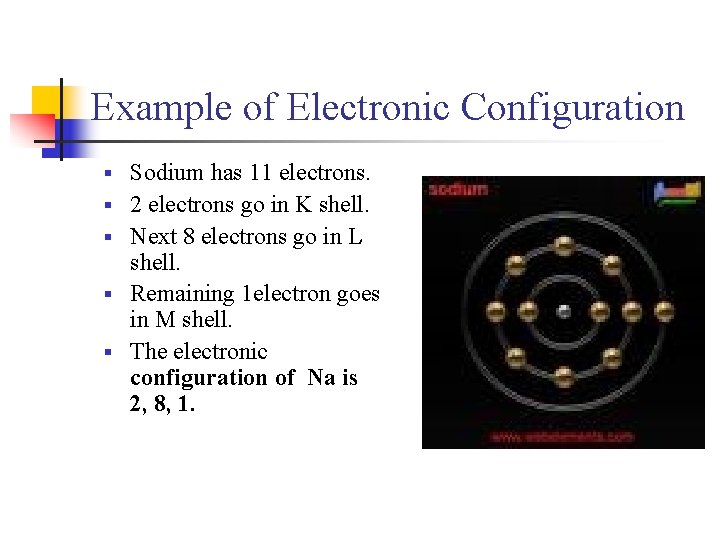
Example of Electronic Configuration § § § Sodium has 11 electrons. 2 electrons go in K shell. Next 8 electrons go in L shell. Remaining 1 electron goes in M shell. The electronic configuration of Na is 2, 8, 1.
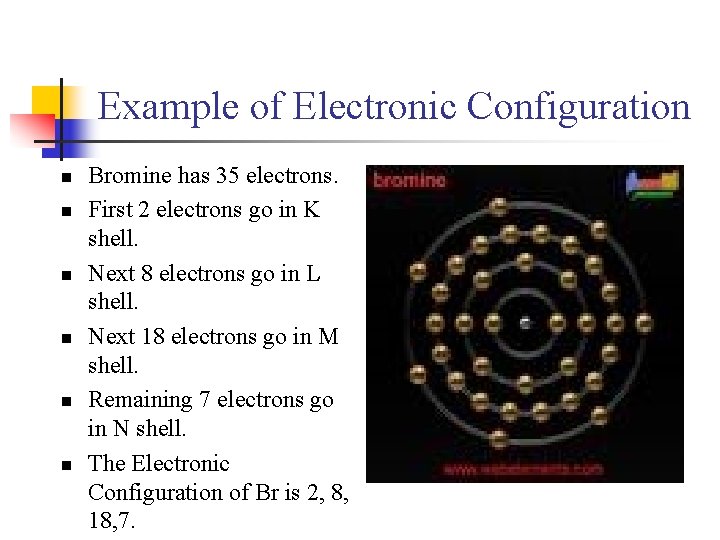
Example of Electronic Configuration n n n Bromine has 35 electrons. First 2 electrons go in K shell. Next 8 electrons go in L shell. Next 18 electrons go in M shell. Remaining 7 electrons go in N shell. The Electronic Configuration of Br is 2, 8, 18, 7.
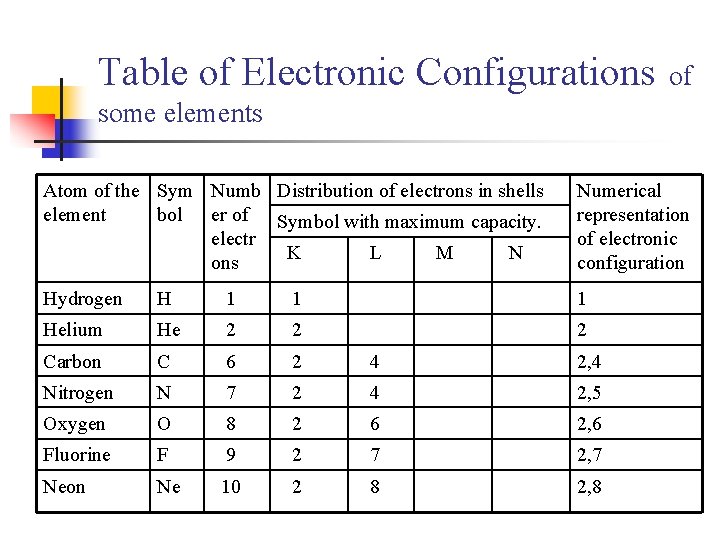
Table of Electronic Configurations of some elements Atom of the Sym Numb Distribution of electrons in shells element bol er of Symbol with maximum capacity. electr K L M N ons Numerical representation of electronic configuration Hydrogen H 1 1 1 Helium He 2 2 2 Carbon C 6 2 4 2, 4 Nitrogen N 7 2 4 2, 5 Oxygen O 8 2 6 2, 6 Fluorine F 9 2 7 2, 7 Neon Ne 10 2 8 2, 8
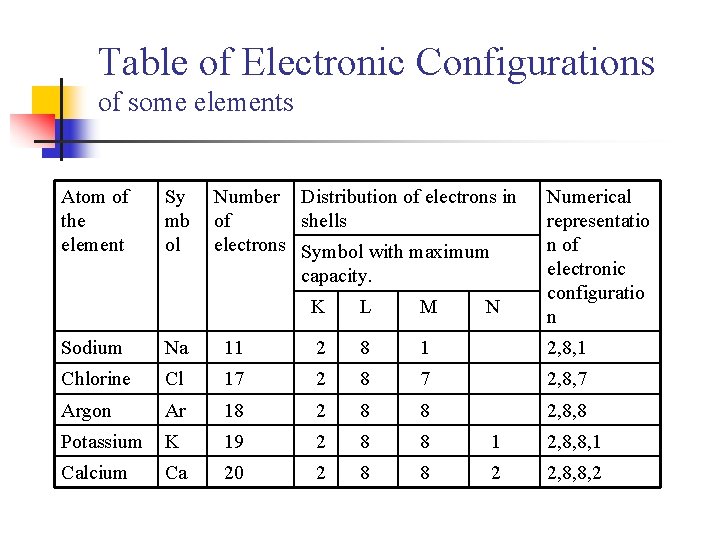
Table of Electronic Configurations of some elements Atom of the element Sy mb ol Number Distribution of electrons in of shells electrons Symbol with maximum capacity. K L M N Numerical representatio n of electronic configuratio n Sodium Na 11 2 8 1 2, 8, 1 Chlorine Cl 17 2 8 7 2, 8, 7 Argon Ar 18 2 8 8 2, 8, 8 Potassium K 19 2 8 8 1 2, 8, 8, 1 Calcium Ca 20 2 8 8 2 2, 8, 8, 2
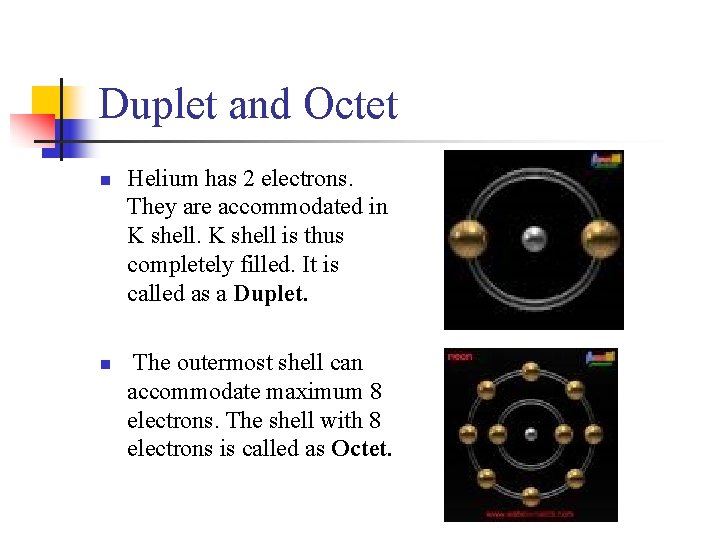
Duplet and Octet n n Helium has 2 electrons. They are accommodated in K shell is thus completely filled. It is called as a Duplet. The outermost shell can accommodate maximum 8 electrons. The shell with 8 electrons is called as Octet.
Valency n n n Atom is the smallest neutral part of the element. They have a natural tendency to combine with atoms of same element or the atoms of the different elements. Two or more atoms of the same element or of different elements combine to form a stable system, it is called as a molecule. H 2, N 2, O 2, Cl 2 are the stable molecules formed by combing the atoms of the same element. H 2 O, HCl are the stable molecules formed by combining the atoms of different elements. Let us see some simplified diagrams of some molecules.
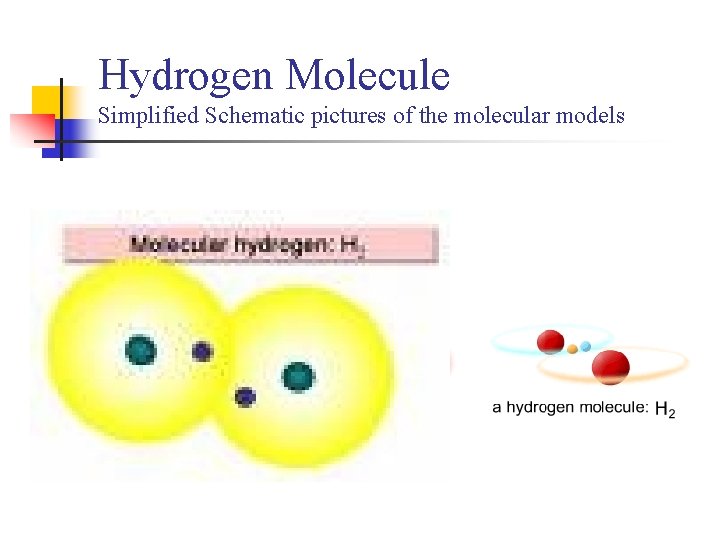
Hydrogen Molecule Simplified Schematic pictures of the molecular models
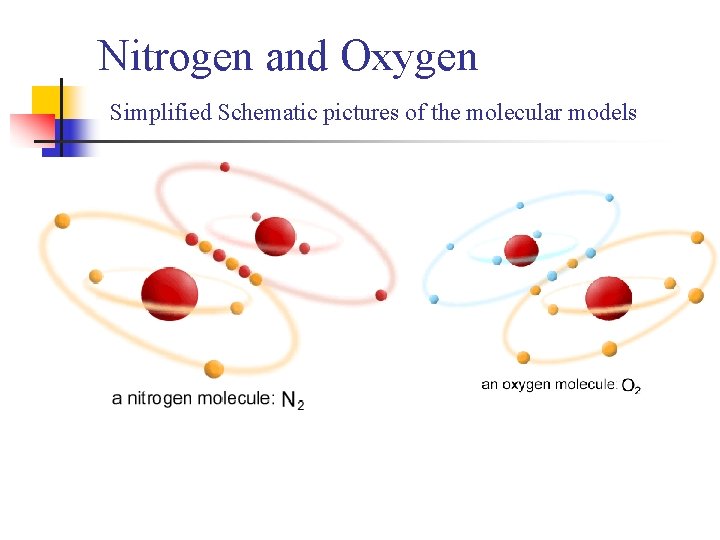
Nitrogen and Oxygen Simplified Schematic pictures of the molecular models
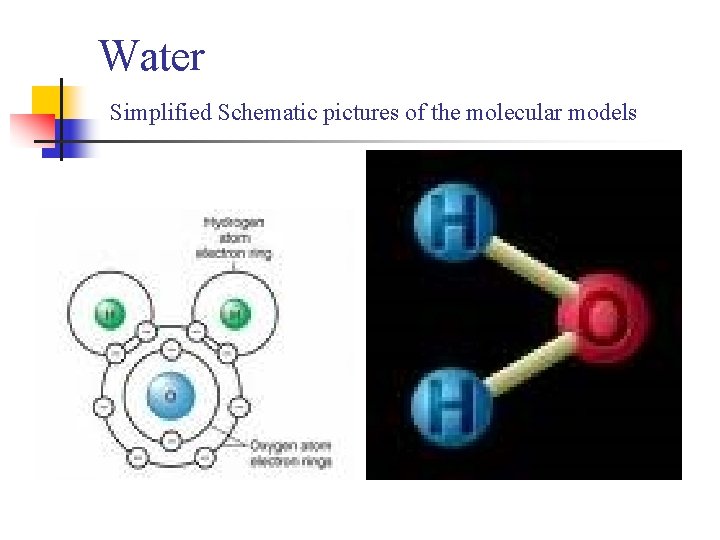
Water Simplified Schematic pictures of the molecular models
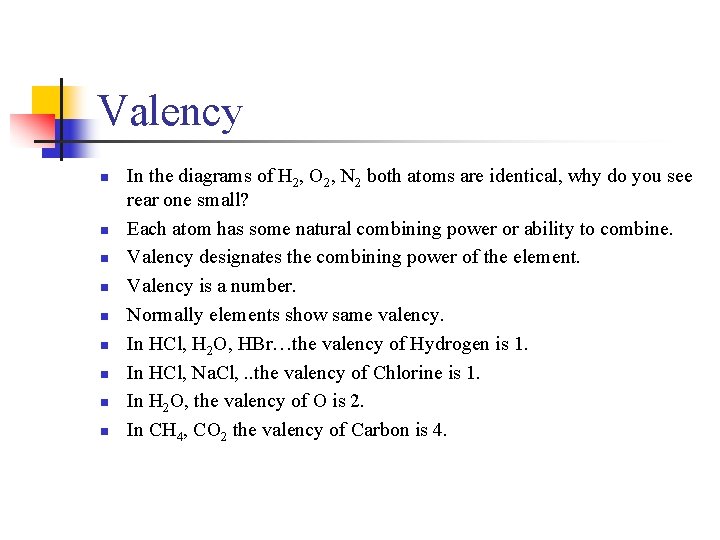
Valency n n n n n In the diagrams of H 2, O 2, N 2 both atoms are identical, why do you see rear one small? Each atom has some natural combining power or ability to combine. Valency designates the combining power of the element. Valency is a number. Normally elements show same valency. In HCl, H 2 O, HBr…the valency of Hydrogen is 1. In HCl, Na. Cl, . . the valency of Chlorine is 1. In H 2 O, the valency of O is 2. In CH 4, CO 2 the valency of Carbon is 4.
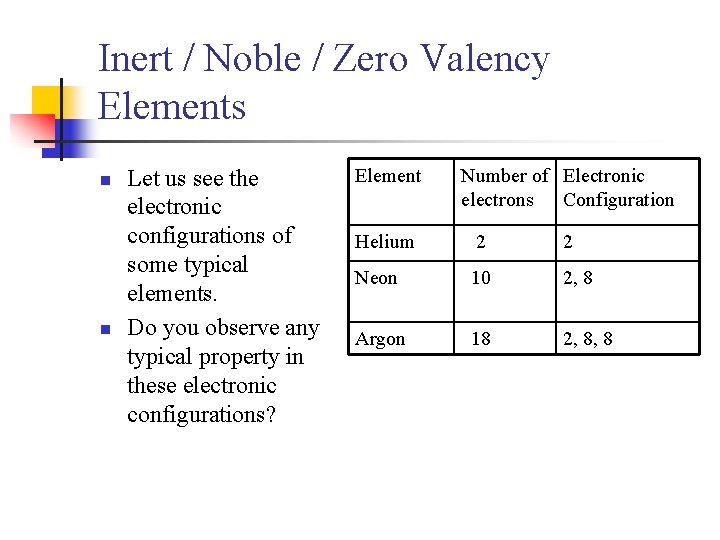
Inert / Noble / Zero Valency Elements n n Let us see the electronic configurations of some typical elements. Do you observe any typical property in these electronic configurations? Element Number of Electronic electrons Configuration Helium 2 2 Neon 10 2, 8 Argon 18 2, 8, 8
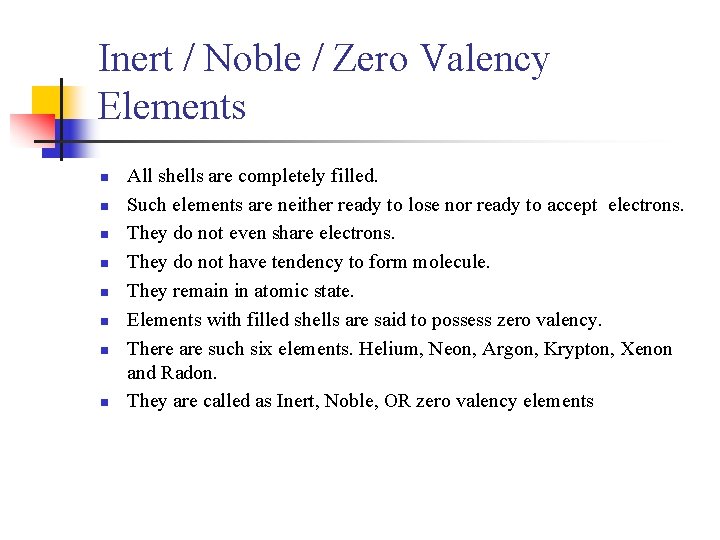
Inert / Noble / Zero Valency Elements n n n n All shells are completely filled. Such elements are neither ready to lose nor ready to accept electrons. They do not even share electrons. They do not have tendency to form molecule. They remain in atomic state. Elements with filled shells are said to possess zero valency. There are such six elements. Helium, Neon, Argon, Krypton, Xenon and Radon. They are called as Inert, Noble, OR zero valency elements
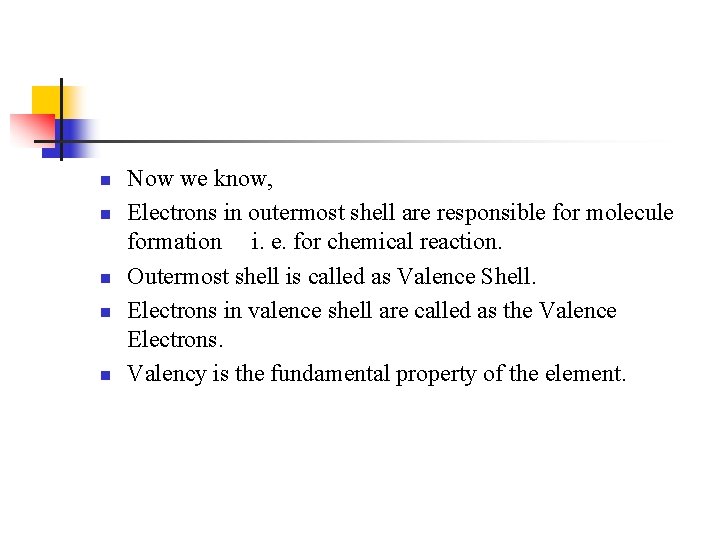
n n n Now we know, Electrons in outermost shell are responsible for molecule formation i. e. for chemical reaction. Outermost shell is called as Valence Shell. Electrons in valence shell are called as the Valence Electrons. Valency is the fundamental property of the element.
n n n n Thus Hydrogen has only one electron. Valency of Hydrogen is One. Sodium has only one electron in the outermost orbit i. e. in valence shell. Valency of Sodium is One. Chlorine requires only one electron to complete the Octet. Valency of Chlorine is One.
Conclusion n n The number of electrons in valence shell which can be lost or shared or accepted can be called as valency of that element. Also, the number of electrons required by the valence shell to complete duplet or octet is called as the valency.
n n n Summary: Indian and Greek philosophers imagined and argued that ‘the matter is made up of small indivisible particles. They named it as the Parmanu and Atom. Dalton made an excellent set of hypothesis based on the knowledge of chemistry of compounds at that time. Rutherford’s experiments of scattering lead to discovery of ‘the nucleus’. Bohr systematized the known concepts at that time and put forth a revolutionary model of atom.
n n n Atom consists of nucleus at its center and electrons moving around it. Nucleus consists nucleons, they are the protons and neutrons. The atomic size is measured in pm while the size of the nucleus is measured in femto-meters. The size is measured in terms of its radius. The mass of the atom is generally measured in a. m. u. The charge on the electrons is the basic charge. It is denoted by e. It is considered as negative. The charge on the proton is positive. It is equal in magnitude of the charge on one electron. In any atom, the number of electrons is equal to the number of protons. Therefore atom is always electrically neutral. . ’
n n Electrons occupy their positions in shells depending on their energies. They occupy K, L, M, …. . shells one after another. There can be maximum 2 n 2 electrons in each shell. Last shell can have maximum of 8 electrons in it. The last but one shell can have maximum of 18 electrons in it. Electrons with higher energy go to the higher shells. The distribution of electrons in shells is called as ‘the electronic configuration Atoms of the elements have natural tendency to combine with other atoms and form molecules. The combining power of the atom is known as the valency.
n n n The elements with completely filled shells do not have tendency to form molecules. Such elements are called as ‘the inert elements’. The inert elements are said to have the zero valency. The outermost shell is called as the valence shell. The valency of the atom is the number of electrons in the valence shell. Valency of the atom is also given by the number of electrons required to complete the octet when the number is more than four.
- Slides: 50