
Sub Phylum Vertebrata By Dr Preetha Karnaver Assistant
Sub Phylum Vertebrata By Dr. Preetha Karnaver Assistant Professor in Zoology Christian College, Chengannur
�They possess vertebral column- hence the name vertebrata �Also possess a brain case (Cranium)- hence also known as craniates �Possess all basic chordate characters
General characters � Veretebral column: � Notochord in embryo gets replaced by vertebral column. � Vertebrae are serially arranged to form a column � Inside that column, spinal cord is protected � Head: � distinct head is present. � Brain enclosed within brain case(Cranium)- hence craniates �Integument: �Outer epidermis and inner dermis �Epidermis derived from ectoderm and dermis derived from mesoderm � Endoskeleton �Internal cartilage or bony skeleton �Specialised tissue composed of compactly arranged collagen fibres �Bone contain crystals of calcium phosphate
�Muscular Pharynx �Possessed by all vertebrates �In fishes, pharyngeal pouches opens out as gill slits bearing gills �In tetrapods, they are sources of several glands �Digestive system �Completely muscular �Distinct liver and pancreas present �Circulatory system �Closed type �Heart multichambered and ventrally placed �Erythrocytes contain Haemoglobin
�Coelom: divided into two � 1) Pericardial cavity ( sorrounding heart ) � 2) Pleuroperitoneal cavity (sorrounding lungs and viscera) �Excretory system �Paired Kidneys and associated ducts to drain waste �Endocrine system �Consists of ductless glands scattered throughout the body �Appendages �Two pairs �Limb girdles �Appendicular skeleton
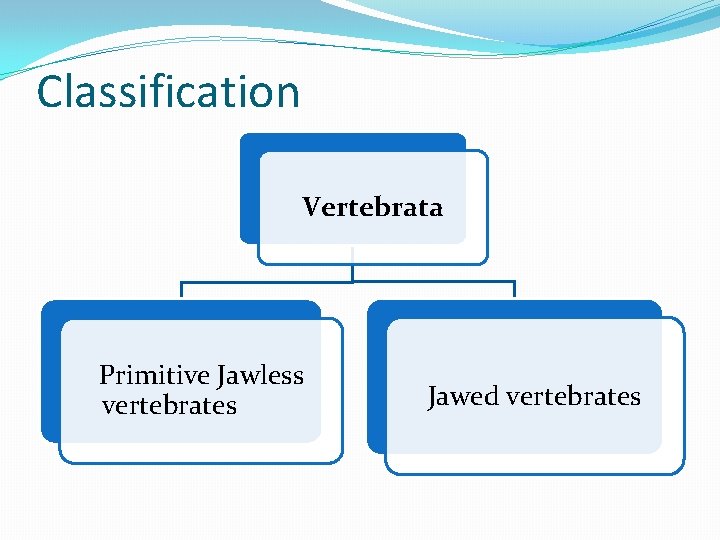
Classification Vertebrata Primitive Jawless vertebrates Jawed vertebrates
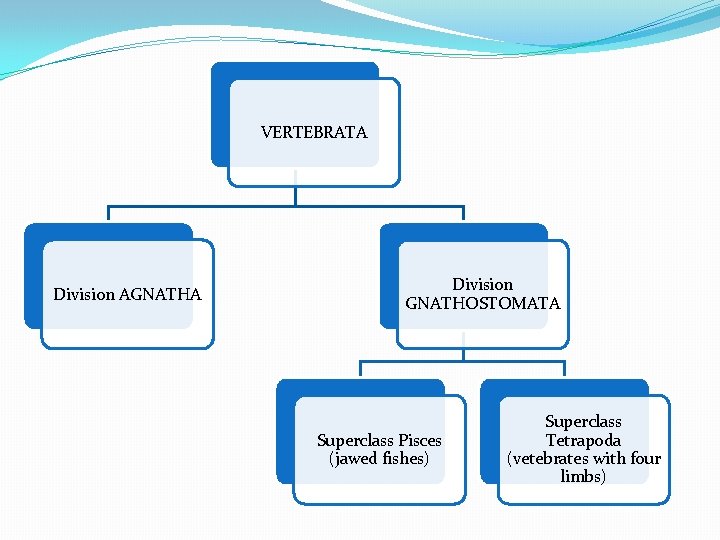
VERTEBRATA Division AGNATHA Division GNATHOSTOMATA Superclass Pisces (jawed fishes) Superclass Tetrapoda (vetebrates with four limbs)
DIVISION (SUPER CLASS) AGNATHA �Agnatha(Greek A= without; gnathos-jaw) �Comprises Jawless fishes �Evolved in ordovician period �Fossil remains of only one group Ostracodermi is available �Very few number of species survive as evolutionary relicts
Salient features of Agnatha �Jaws, teeth, paired appendages, ducts etc absent �Roof of cranium is membranous �Vertebral column consists of persistent notochord �Single median nostril � 7 -14 pairs of gill slits � 1 -2 semicircular canals in internal ears �Elongate kidneys with long archinephric ducts �Well developed pineal apparatus �Larval stage is microphagous �Possess endostyle
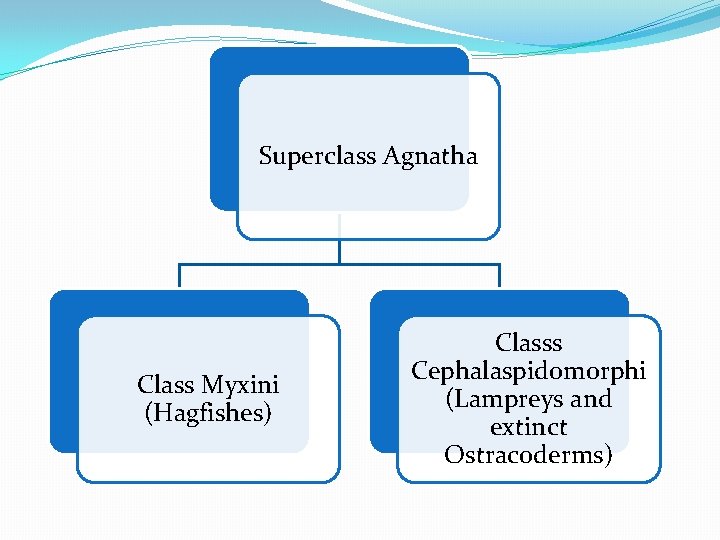
Superclass Agnatha Class Myxini (Hagfishes) Classs Cephalaspidomorphi (Lampreys and extinct Ostracoderms)
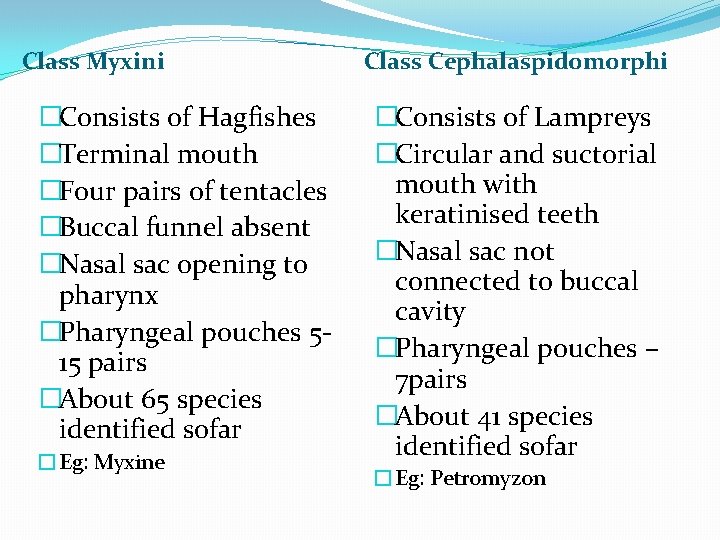
Class Myxini �Consists of Hagfishes �Terminal mouth �Four pairs of tentacles �Buccal funnel absent �Nasal sac opening to pharynx �Pharyngeal pouches 515 pairs �About 65 species identified sofar �Eg: Myxine Class Cephalaspidomorphi �Consists of Lampreys �Circular and suctorial mouth with keratinised teeth �Nasal sac not connected to buccal cavity �Pharyngeal pouches – 7 pairs �About 41 species identified sofar �Eg: Petromyzon
�But, according to another classification, hagfishes and lampreys are included under class Cyclostomata �Cyclos= circle; Stoma= Mouth) �Primitive jawless vertebrates commonly called Lampreys
�Elongate , round, eel like body �Soft, smooth skin �Exoskeleton absent; cartilaginous endoskeleton present �Jaws absent Mouth circular and suctorial �Single, median nasal opening �Persistent notochord � 2 chambered (auricle & Ventricle) heart �Gonad single; without Gonoducts �Development- direct/ indirect �Eg: Petromyzon
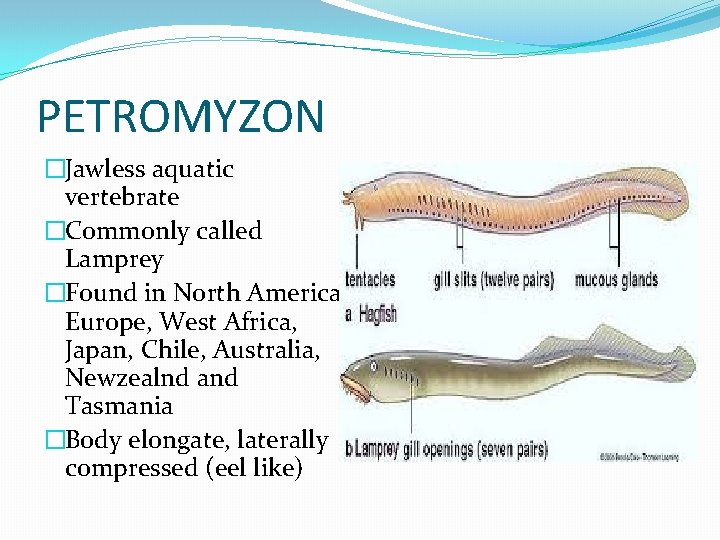
PETROMYZON �Jawless aquatic vertebrate �Commonly called Lamprey �Found in North America, Europe, West Africa, Japan, Chile, Australia, Newzealnd and Tasmania �Body elongate, laterally compressed (eel like)
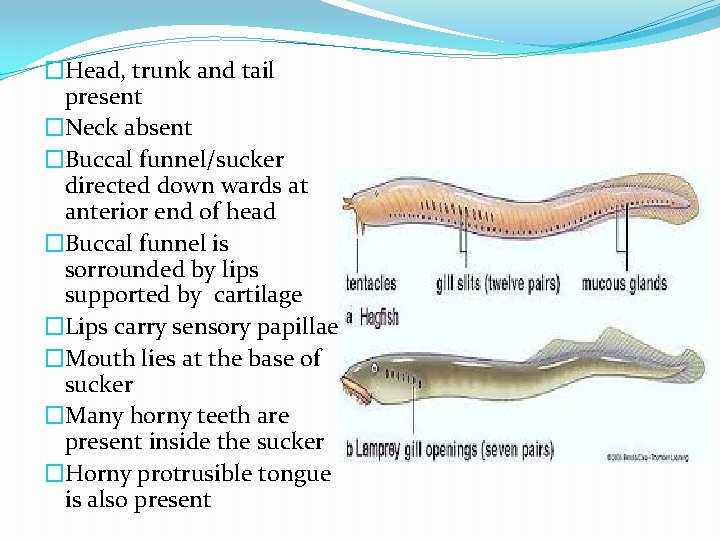
�Head, trunk and tail present �Neck absent �Buccal funnel/sucker directed down wards at anterior end of head �Buccal funnel is sorrounded by lips supported by cartilage �Lips carry sensory papillae �Mouth lies at the base of sucker �Many horny teeth are present inside the sucker �Horny protrusible tongue is also present
�Attaches to the body of fish by sucker and feeds on blood �Eyes lateral; without eyelids �There is a median transparent area behind eyes- Pineal organ �Single median nasal aperture � 7 gill clefts on either side of head behind each eye �Gill clefts do not open into pharynx �Anus lies at base of tail �Urinogenital opening lies on a papilla behind anus �Skin slimy, scale less �Lateral lines present �Presence of 2 dorsal fins and an anal fin �Pectoral and pelvic fins absent
�Presence of cartilaginous endoskeleton �RBC contains nucleus and haemoglobin �Sexes separate �Females lay eggs (oviparous) �Fertilisation external Characteristic larval stage called Ammocoete larva 3 species of Lamprey found in Northern hemisphere �Petromyzon marinus �Petromyzon fuviatilis ( river lamprey) �Petromyzon planeri (Brook lamprey)
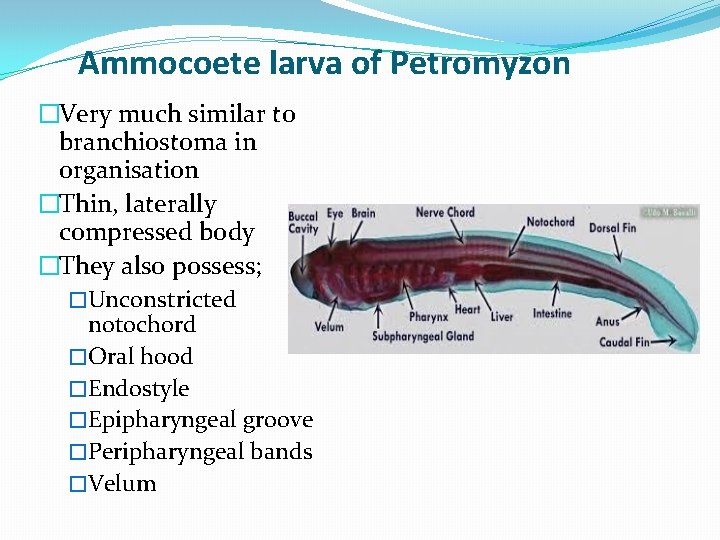
Ammocoete larva of Petromyzon �Very much similar to branchiostoma in organisation �Thin, laterally compressed body �They also possess; �Unconstricted notochord �Oral hood �Endostyle �Epipharyngeal groove �Peripharyngeal bands �Velum
Class Ostracodermi �Extinct jawless vertebrates �Fossil jawless agnatha of fresh water �Fish like body �Heavy head armour �Skin bears heavy , bony, dermal plates �Single nostril on top of head �Mouth- slit like opening at extreme tip of head �Scoops decaying matter with mouth from bottom of frewsh watre bodies �Axial endoskeleton/ vertebrae absent �Sometimes, a pair of fins are seen behind head
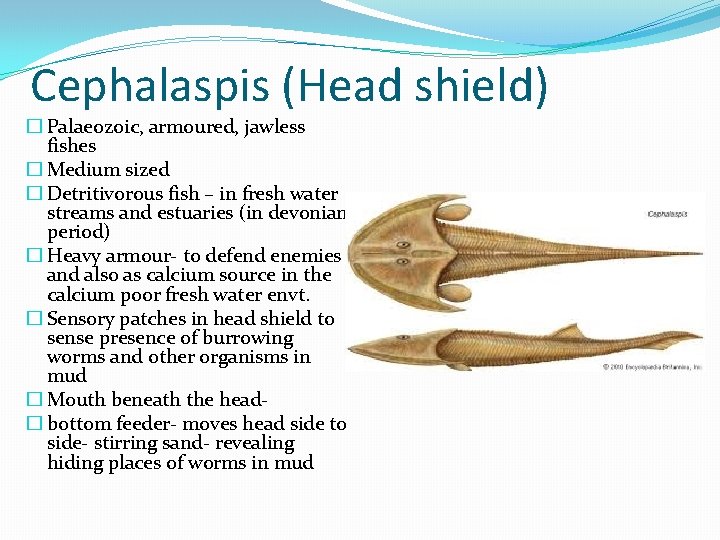
Cephalaspis (Head shield) � Palaeozoic, armoured, jawless fishes � Medium sized � Detritivorous fish – in fresh water streams and estuaries (in devonian period) � Heavy armour- to defend enemies and also as calcium source in the calcium poor fresh water envt. � Sensory patches in head shield to sense presence of burrowing worms and other organisms in mud � Mouth beneath the head� bottom feeder- moves head side to side- stirring sand- revealing hiding places of worms in mud
- Slides: 20