
Stylistics Chapter Three Surfacestructure Deviation 1 Objectives After
Stylistics Chapter Three Surface-structure Deviation 1
Objectives After studying this lesson, you would know: 1. the kinds of phonological irregularities 2. the kinds of graphological deviation 3. the kinds of syntactic deviation

Surface-structure Deviation Phonological Deviation Surface-structure Graphological Deviation 语相变异 Deviation Syntactic Deviation Lexical Deviation
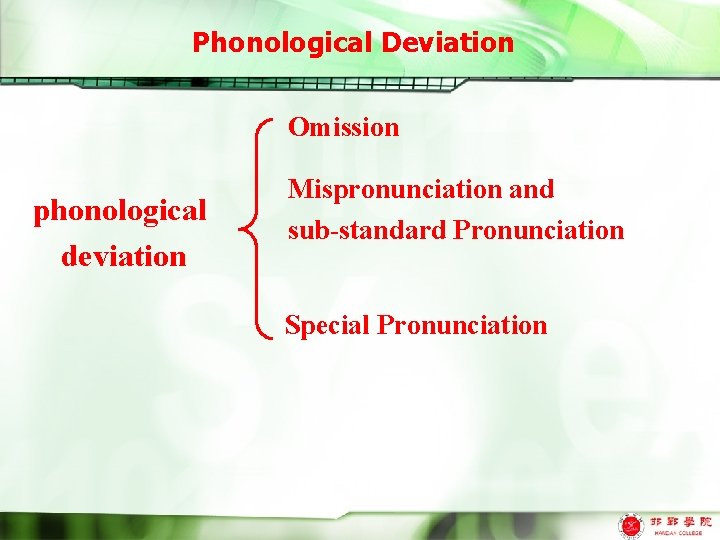
Phonological Deviation Omission phonological deviation Mispronunciation and sub-standard Pronunciation Special Pronunciation
Phonological Deviation q 2. 1. 1 Omission q 1) Aphesis — the omission of an initial part of a word, e. g. q (1) Thou on whose stream, ‘mid the steep sky’s commotion, q Loose clouds like earth’s decaying leaves are shed, (P. B. Shelley, Ode to the West Wind)
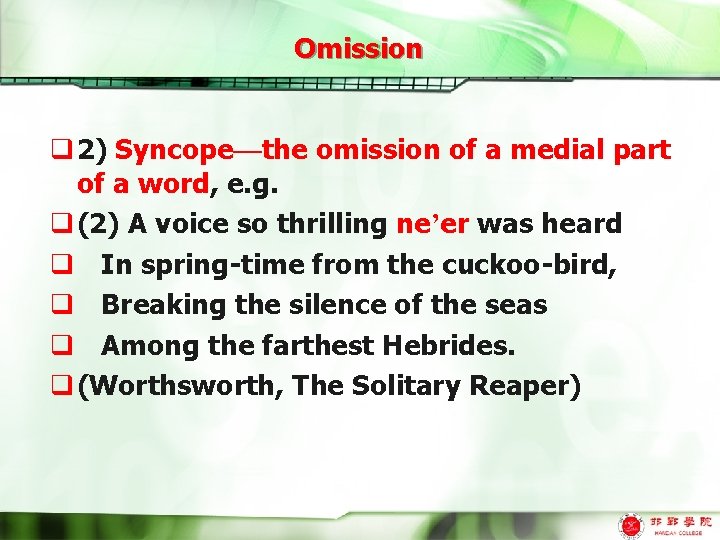
Omission q 2) Syncope—the omission of a medial part of a word, e. g. q (2) A voice so thrilling ne’er was heard q In spring-time from the cuckoo-bird, q Breaking the silence of the seas q Among the farthest Hebrides. q (Worthsworth, The Solitary Reaper)
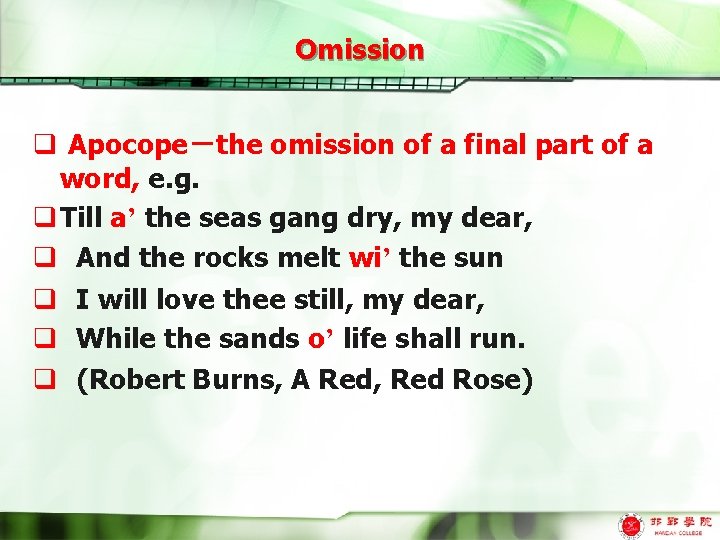
Omission q Apocope-the omission of a final part of a word, e. g. q Till a’ the seas gang dry, my dear, q And the rocks melt wi’ the sun q I will love thee still, my dear, q While the sands o’ life shall run. q (Robert Burns, A Red, Red Rose)
Omission q The omissions discussed above are conventional licenses of verse composition. They change the pronunciations of the original words so that the poet may better and more easily arrange sound patterns to achieve their intended communicative effects.
Mispronunciation & Sub-standard Pronunciation q In order to vividly describe a character, the literary writer may choose to let his character mispronounce certain words or simply pronounce them in sub-standard ways.
Mispronunciation q John Raulston, a florid-faced man, announced: ” I’m jist a reg’lar mountaineer jedge. ” q (Para. 11, The Trial That Rocked the World)
Mispronunciation q Tom Sawyer: ” … The Widder eats by a bell… she gits up by a bell…. ” q (Para. 16, Mark Twain—Mirror of America)
Sub-standard Pronunciation q Ogilvie says: “…your high-an’-mightiness. This city ‘s burnin’mad…who killed that kid an’its mother, there’ll be a squad of cops in here so fast you’ll hardly see ‘em. But I come to you first, in fairness, so’s you could tell your side of it to me. ‘f you want it the other way, just say so. ” q (Para. 18, The Blackmail)
Special Pronunciation q For convenience of rhyming, the poet may give special pronunciation to certain words, e. g. q The trumpet of a prophecy! O, Wind, q If winter comes, can spring be far behind? q (P. R. Shelley, Ode to the west Wind)
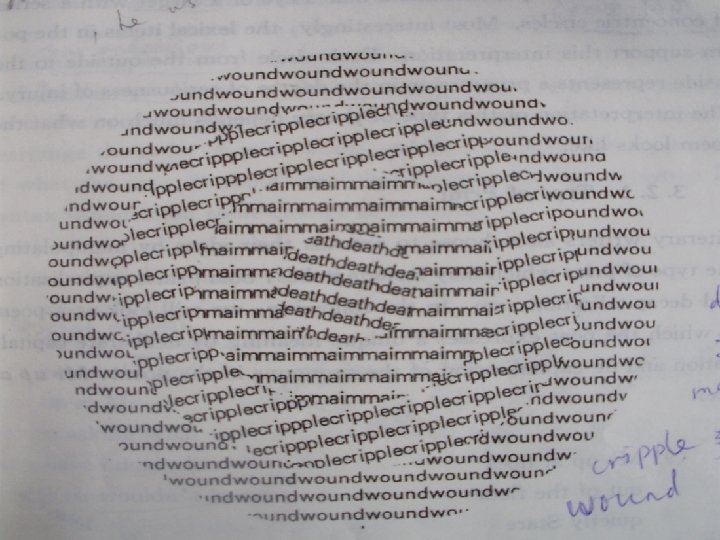
Graphological Deviation q By graphology is meant the encoding of meaning in visual symbols. q Deviation at this level seems to be much more interesting, but has been sadly neglected in literary discussions in the past.
Graphological Deviation q Graphological deviation can occur in any sub-area of graphology, such as the shape of the text, the type of print, grammetrics, punctuation, etc. In this section, we will chiefly consider deviation in the first three sub-areas.
Graphological Deviation Shape of Text Graphological Deviation Type of Print grammetrics
Type of Print q. Is asking “what q. Have i done that q. You wouldn’t have”
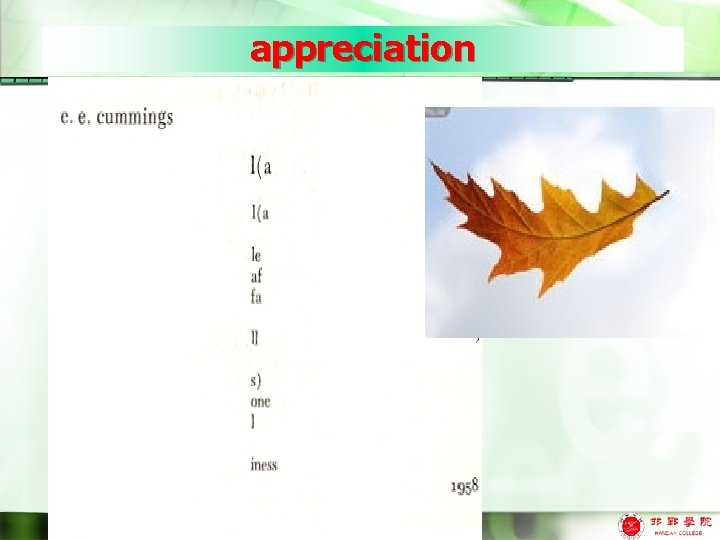
appreciation A leaf falls loneliness
q l(a q le q af q fa q II la A leaf falls loneliness q s) q one ql q iness E. E. Cummings
Type of Print q. Me up at does qout of the floor qquietly Stare qa poisoned mouse qstill who alive qis asking what qhave i done that q. You wouldn’t have q — E. E. Cummings
Type of Print qa poisoned mouse qwho still alive qdoes Stare quietly qout of the floor qup at Me q. Is asking what q. Have i done that q. You wouldn’t have
Grammetrics(语法单位嵌入诗歌单位之方法) q. By grammetrics is meant the ways in which grammatical units are fitted into metrical units such as lines and stanzas.
Grammetrics q Grammetrics 语法单位嵌入诗歌单位之方法 q I stepped into the cinema alone. q I stepped q into the cinema alone. q I stepped into q the cinema alone.
Grammetrics q I stepped into the cinema q Alone. q. I q stepped into the cinema alone.
Grammetrics q I stepped q Into q The cinema alone. q i stepped into the q CINEMA q alone.
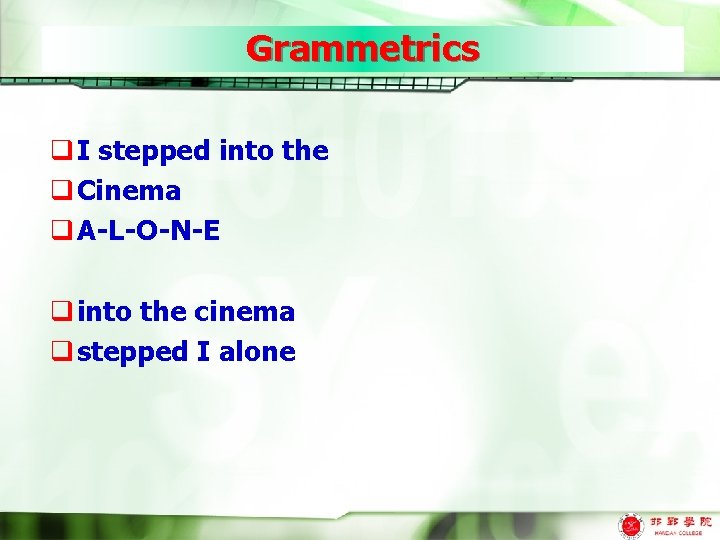
Grammetrics q I stepped into the q Cinema q A-L-O-N-E q into the cinema q stepped I alone
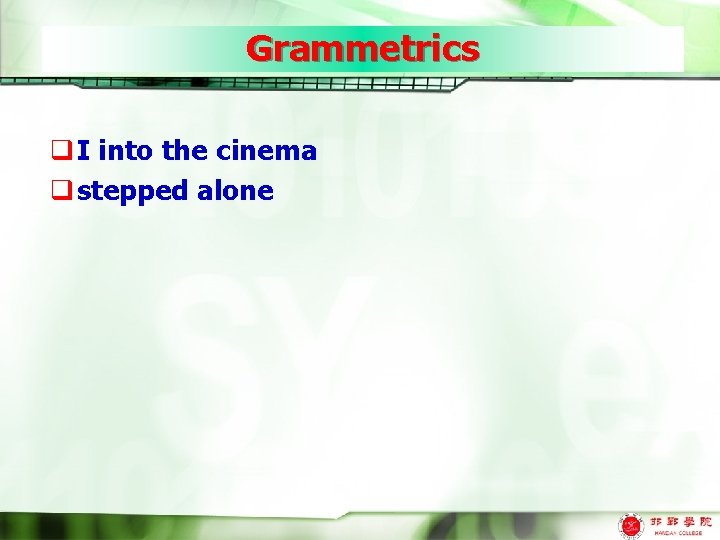
Grammetrics q I into the cinema q stepped alone
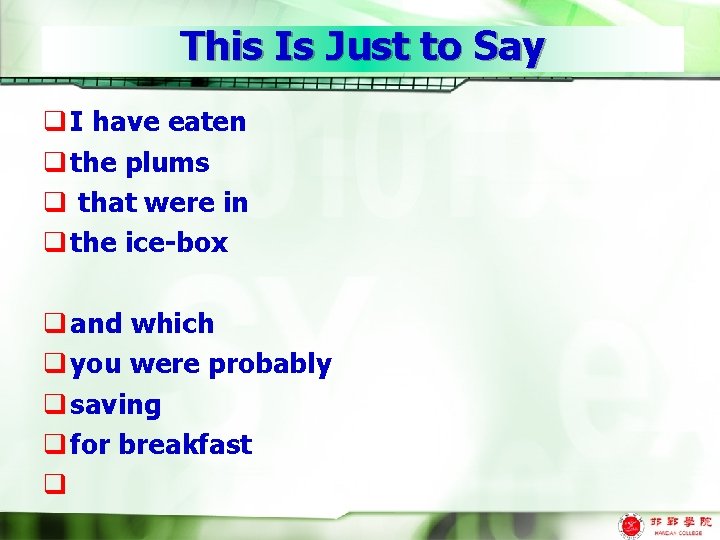
This Is Just to Say q I have eaten q the plums q that were in q the ice-box q and which q you were probably q saving q for breakfast q
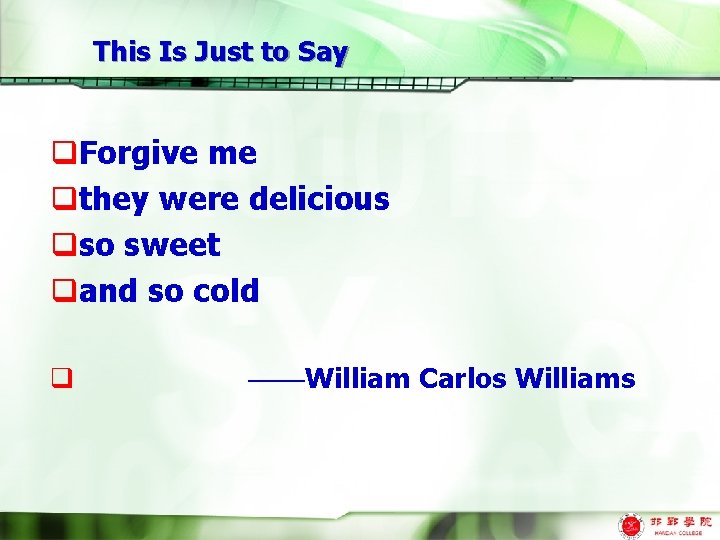
This Is Just to Say q. Forgive me qthey were delicious qso sweet qand so cold q ——William Carlos Williams
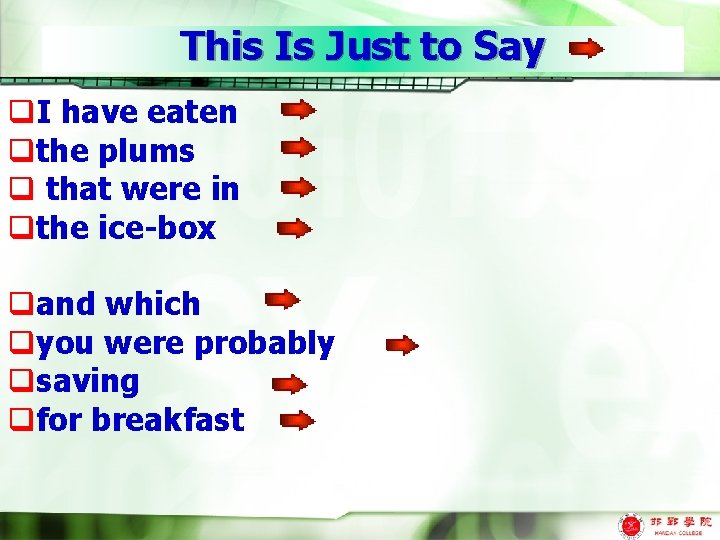
This Is Just to Say q. I have eaten qthe plums q that were in qthe ice-box qand which qyou were probably qsaving qfor breakfast
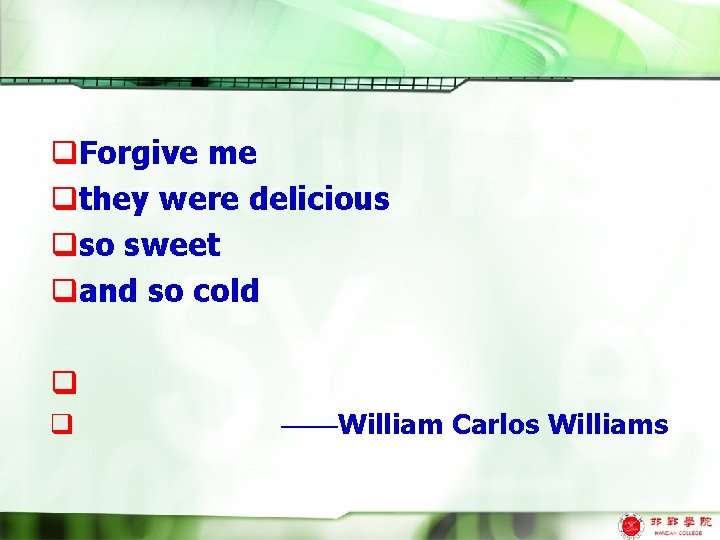
q. Forgive me qthey were delicious qso sweet qand so cold q q ——William Carlos Williams
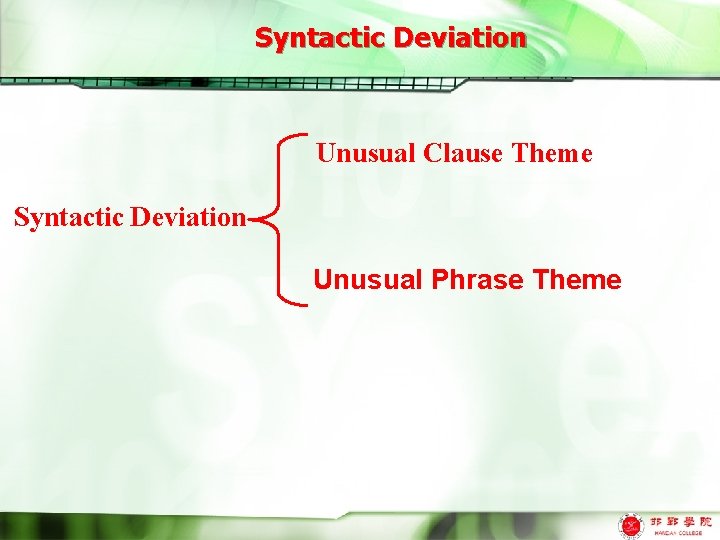
Syntactic Deviation Unusual Clause Theme Syntactic Deviation Unusual Phrase Theme
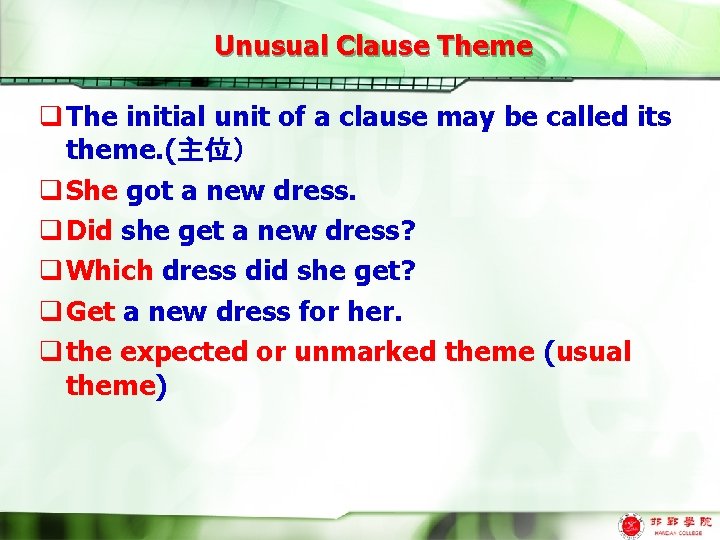
Unusual Clause Theme q The initial unit of a clause may be called its theme. (主位) q She got a new dress. q Did she get a new dress? q Which dress did she get? q Get a new dress for her. q the expected or unmarked theme (usual theme)
Unusual Clause Theme q However, the literary writer can go beyond this and may place any of the rest of clause elements in thematic position in order to achieve certain literary effect. q The theme thus produced is unusual and is therefore called a ‘marked theme’. (unusual theme)
Unusual Clause Theme q. My opinion of the coal trade on that river is, that it may require talent, but it certainly requires capital. Talent Mr. Micawber has, capital Mr. Micawber has not. q (Dickens, David Copperfield )
The Solitary Reaper (William Wordsworth) q. Behold her, single in the field, q. Yon solitary Highland Lass! q. Reaping and singing by herself; q. Stop here, or gently pass! q. Alone she cuts and binds the grain, q. And sings a melancholy strain; q. O listen! for the Vale profound, q. Is overflowing with the sound.
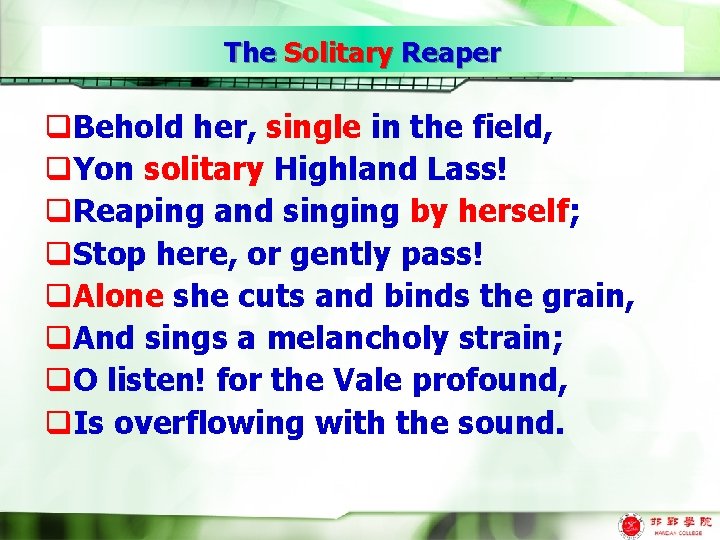
The Solitary Reaper q. Behold her, single in the field, q. Yon solitary Highland Lass! q. Reaping and singing by herself; q. Stop here, or gently pass! q. Alone she cuts and binds the grain, q. And sings a melancholy strain; q. O listen! for the Vale profound, q. Is overflowing with the sound.
The Solitary Reaper q. Making the element alone prominent greatly reinforces theme of the poem.
Unusual Clause Theme q. Here comes the bus. q. Away went the car like a whirlwind. q. There are our friends.
Snowflakes q. Out of the bosom of the Air, q. Out of the cloud-folds of her garments shaken, q. Over the woodlands brown and bare, q. Over the harvest-fields forsaken, q. Silent, and soft, and slow q. Descends the snow. q ——Longfellow
Parting at Morning q. Round the cape of a sudden came the sea, q. And the sun looked over the mountain’s rim q. And straight was a path of gold for him, q. And the need of a world of men for me.
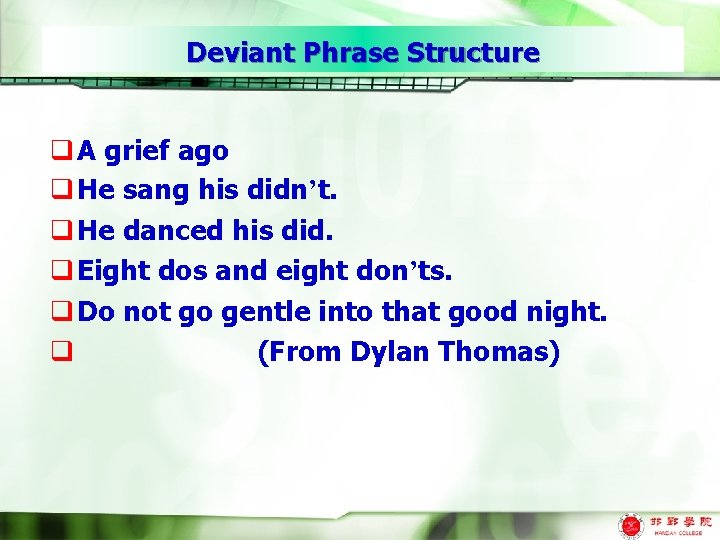
Deviant Phrase Structure q A grief ago q He sang his didn’t. q He danced his did. q Eight dos and eight don’ts. q Do not go gentle into that good night. q (From Dylan Thomas)
Lexical Deviation q Lexical Deviation in literature refers to almost exclusively to neologisms (新创词) or the coinage of new words.
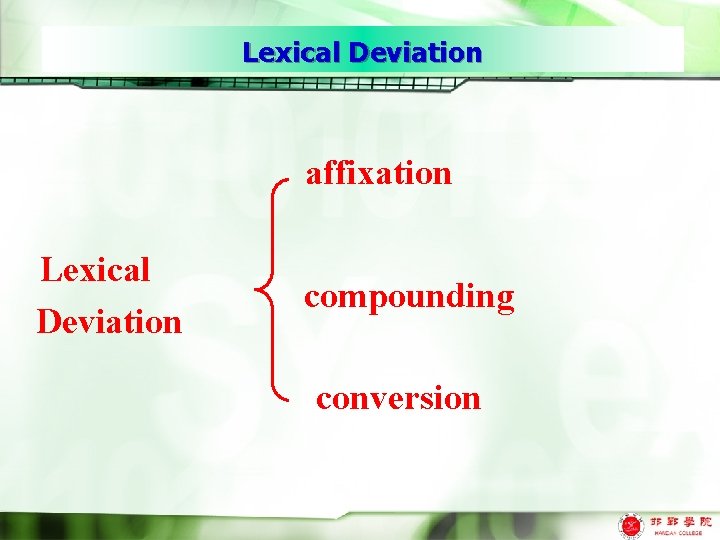
Lexical Deviation affixation Lexical Deviation compounding conversion
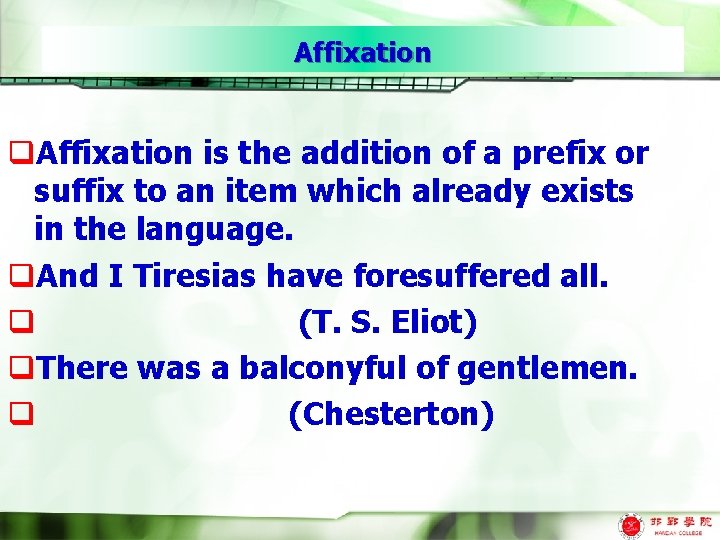
Affixation q. Affixation is the addition of a prefix or suffix to an item which already exists in the language. q. And I Tiresias have foresuffered all. q (T. S. Eliot) q. There was a balconyful of gentlemen. q (Chesterton)
Affixation q. We left the town refreshed and rehatted. q ( Fotherhill)
Compounding q. Compounding is the combination of two or more items to make a single compound one. q. While I, joy-jumping, empty-eyed sang on the day my father died. q (Edwin Brook) q. Babes wake q. Open-eyed; (W. H. Davies)
Compounding q. They were else-minded then, altogether, the men q (G. M. Hopkins)
Conversion q. Conversion (词性变化构词法) q“Don’t be such a harsh parent, father!” q“Don’t father me!”
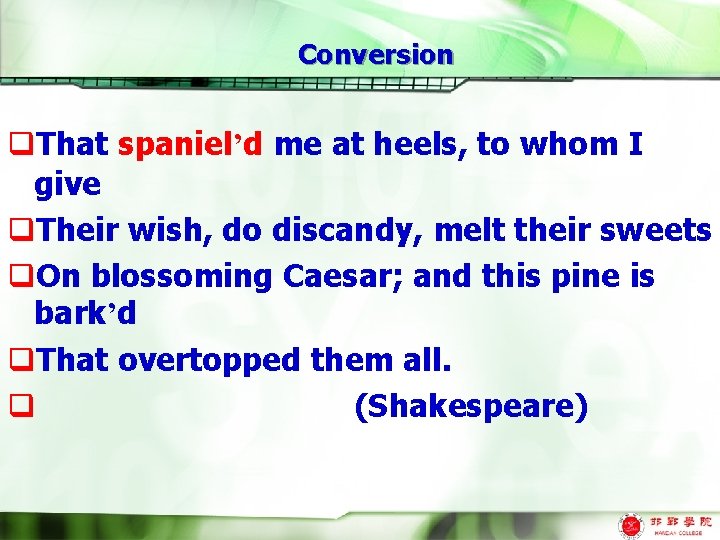
Conversion q. That spaniel’d me at heels, to whom I give q. Their wish, do discandy, melt their sweets q. On blossoming Caesar; and this pine is bark’d q. That overtopped them all. q (Shakespeare)

- Slides: 51