
Stylistic and Rhetorical Devices Litotes Definition An understatement
- Slides: 17
Stylistic and Rhetorical Devices
Litotes �Definition: An understatement; a statement that says less than what it means. The opposite of hyperbole. �Ex. “This is a novel type of warfare that produces no destruction, except to life. ” – E. B. White �Uses: Although litotes is understatement, the effect is actually emphasis. It is ironic understatement. In the example, White assumes the voice of an apologist for this new type of warfare, but the afterthought, “except to life, ” reveals and emphasizes his true feelings of horror for it.
Hyperbole �Definition: An overstatement; a figure of speech in which the author over-exaggerates to accomplish some purpose, usually emphasis. �“You’re right, Mom. We should deadbolt all the doors. If we don’t we’ll probably be dead by morning. ” �Uses: The use of hyperbole emphasizes a point, but the reason for emphasis depends on context. In the example, the son’s exaggeration ridicules what he sees as his mother’s over cautiousness.
Anecdote �Definition: A brief story used in an essay to illustrate point. �Uses: They are generally rhetorical devices that offer (anecdotal evidence for a particular argument. Their persuasiveness lies in their specificity. Specific examples tend to be more persuasive than abstract ones. The danger lies in offering as evidence something not closely related to the argument or in relying exclusively on anecdotal evidence.
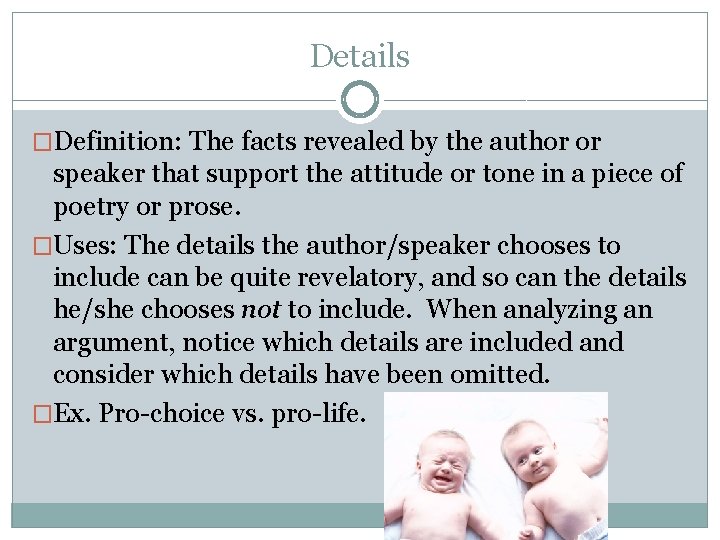
Details �Definition: The facts revealed by the author or speaker that support the attitude or tone in a piece of poetry or prose. �Uses: The details the author/speaker chooses to include can be quite revelatory, and so can the details he/she chooses not to include. When analyzing an argument, notice which details are included and consider which details have been omitted. �Ex. Pro-choice vs. pro-life.
Imagery �Definition: Words or phrases that create pictures or images in the reader’s mind; description based on any of the five senses. �Uses: Generally, imagery is used to fit the mood the author is going for. Fro example, when creating a melancholy mood, Poe will present imagery that is exclusively melancholy.
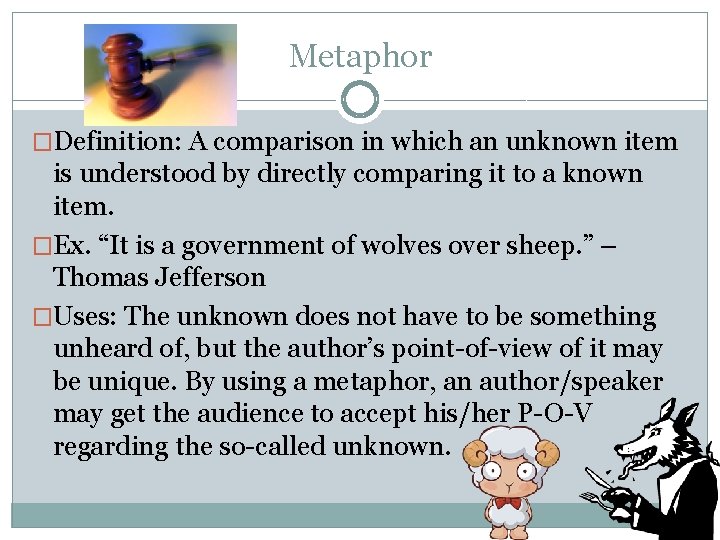
Metaphor �Definition: A comparison in which an unknown item is understood by directly comparing it to a known item. �Ex. “It is a government of wolves over sheep. ” – Thomas Jefferson �Uses: The unknown does not have to be something unheard of, but the author’s point-of-view of it may be unique. By using a metaphor, an author/speaker may get the audience to accept his/her P-O-V regarding the so-called unknown.
Simile �Definition: An indirect comparison using “like” or “as. ” �Ex. “Let us go then, you and I While the evening is spread out against the sky, Like a patient etherized upon a table…” --T. S. Elliot �Uses: The uses are the same as for the metaphor.
Analogy �Definition: Compares two things, which are alike in several respects, for the purpose of explaining or clarifying some unfamiliar or difficult idea or object by showing how the idea or object is similar to some familiar one. �Ex. “Knowledge always desires increase; it is like fire, which must first be kindled by some external agent, but which will afterwards propagate itself. ” –Samuel Johnson �Uses: While simile and analogy often overlap, the simile is general a more artistic likening, done briefly for effect and emphasis, while analogy serves the more practical end of explaining a thought process that may be more extended. An analogy is generally an appeal to logic (logos).
Logos �Definition: An appeal to the logic of the reader. �Ex. All men are mortal; George Bush is a man; therefore, George Bush is mortal. �Uses: Of the three rhetorical appeals (logos, pathos, and ethos), logos is given the most esteem. Logic is persuasive because it’s hard to argue against it when it is sound. However, logos alone may not be sufficient to persuade the audience.
Pathos �Definition: An appeal to the emotions of the reader/audience. �Ex. “He has plundered our seas, ravaged our Coasts, burnt our towns, and destroyed the lives of our people. ” Declaration of Independence. �Uses: Pathos is potentially the most persuasive of the appeals while, at the same time, the most suspect. The use of pathos can descend into outright manipulation of the audience as writers/speakers attempt to instill or increase fear, guilt, or other strong emotions. Generally, pathos is most readily apparent in imagery and diction, as these are the means by which authors typically try to appeal to emotions. �http: //www. idkwtf. com/videos/latest-videos/family-guy -lois-speech-on-9 -11
Dramatic Irony �Definition: Occurs when the audience or the reader has a better understanding of events or individuals than one or more of the characters. �Ex. Much of the humor in Twain’s Adventures of Huckleberry Finn is due to the ignorance of the narrator Huck. �Uses: May be used to create suspense, evoke laughter, or other reasons.
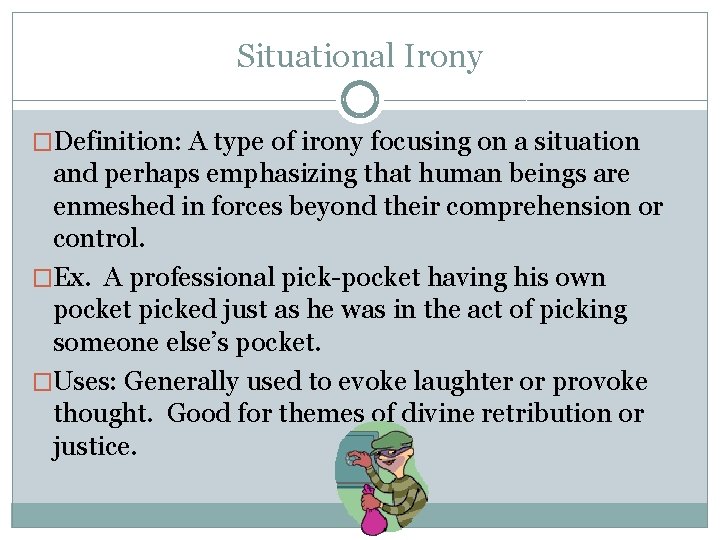
Situational Irony �Definition: A type of irony focusing on a situation and perhaps emphasizing that human beings are enmeshed in forces beyond their comprehension or control. �Ex. A professional pick-pocket having his own pocket picked just as he was in the act of picking someone else’s pocket. �Uses: Generally used to evoke laughter or provoke thought. Good for themes of divine retribution or justice.
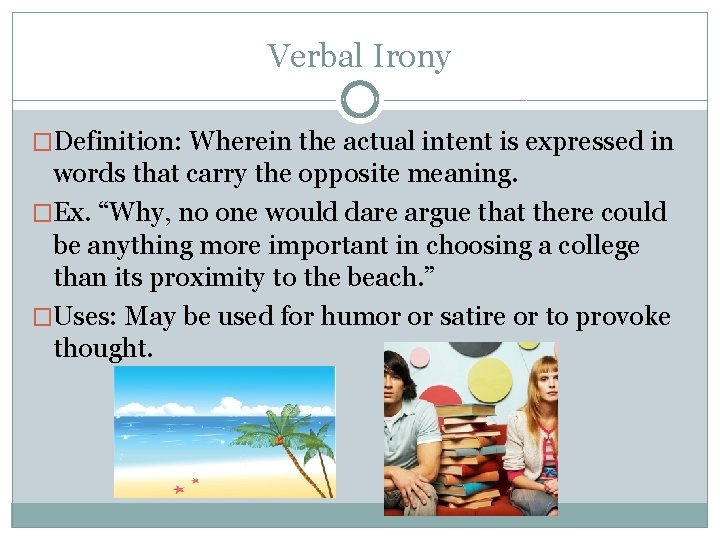
Verbal Irony �Definition: Wherein the actual intent is expressed in words that carry the opposite meaning. �Ex. “Why, no one would dare argue that there could be anything more important in choosing a college than its proximity to the beach. ” �Uses: May be used for humor or satire or to provoke thought.
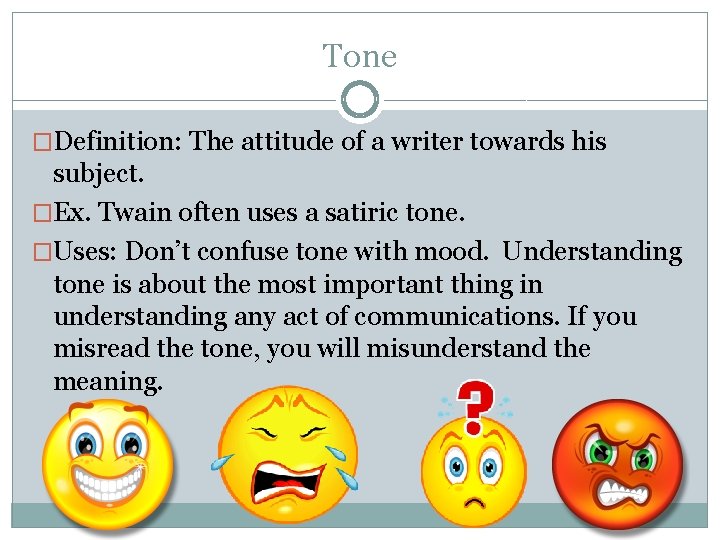
Tone �Definition: The attitude of a writer towards his subject. �Ex. Twain often uses a satiric tone. �Uses: Don’t confuse tone with mood. Understanding tone is about the most important thing in understanding any act of communications. If you misread the tone, you will misunderstand the meaning.
Satire �Definition: A literary mode based on criticism of people and society through humor and/or ridicule. �Ex. The Onion http: //www. theonion. com/content/index The Simpsons �Uses: The satirist aims to reduce the practices attacked by laughing scornfully at them—and being witty enough to allow the reader to laugh, too The satirist’s goal is to point out the hypocrisy of his target in the hope that either the target or the audience will return to a real following of the code.
Example of Satire