
Styles of Drama What are the characteristics of
- Slides: 6
Styles of Drama What are the characteristics of the various Styles of drama?
Styles are usually associated with an "-ism. " • Some Examples: » Realism » Naturalism » Absurdism
Absurdism • The absurdist theater movement flourished after World War II. Absurdist dramatists believed that the human condition is essentially absurd and that this condition can only be represented in theater that is itself absurd. • Major Figures: – Eugene Ionesco "Cut off from his religious, metaphysical, and transcendental roots, man is lost; all his actions become senseless, absurd, useless. " "People drowning in meaninglessness can only be grotesque, their sufferings can only appear tragic by derision. Major works: Rhinoceros, The Bald Soprano, The Lesson – Samuel Beckett Major works: Waiting For Godot, Endgame, Not I, Catastrophe, Quad, Happy Days
Realism: • "Faithful" representation of life. • Realism is based on the belief that life should be portrayed as it truly is, without exaggeration. Very focused on the idea that people’s thoughts and feelings, and their reactions to the world around them, shape their destiny. • Major Figures: – Henrik Ibsen Major works: A Doll's House, The Master Builder, Hedda Gabler – Anton Chekhov Major works: The Cherry Orchard, The Three Sisters, Uncle Vanya – George Bernard Shaw Major works: Major Barbara, Man and Superman, Arms and the Man
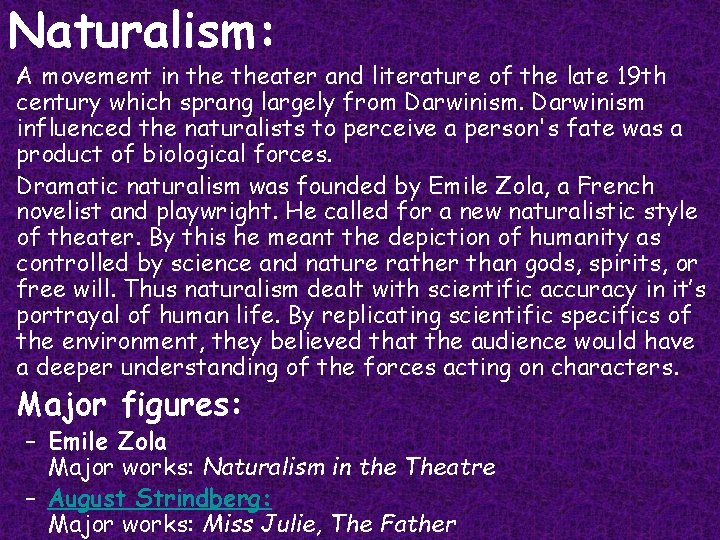
Naturalism: A movement in theater and literature of the late 19 th century which sprang largely from Darwinism influenced the naturalists to perceive a person's fate was a product of biological forces. Dramatic naturalism was founded by Emile Zola, a French novelist and playwright. He called for a new naturalistic style of theater. By this he meant the depiction of humanity as controlled by science and nature rather than gods, spirits, or free will. Thus naturalism dealt with scientific accuracy in it’s portrayal of human life. By replicating scientific specifics of the environment, they believed that the audience would have a deeper understanding of the forces acting on characters. • Major figures: – Emile Zola Major works: Naturalism in the Theatre – August Strindberg: Major works: Miss Julie, The Father
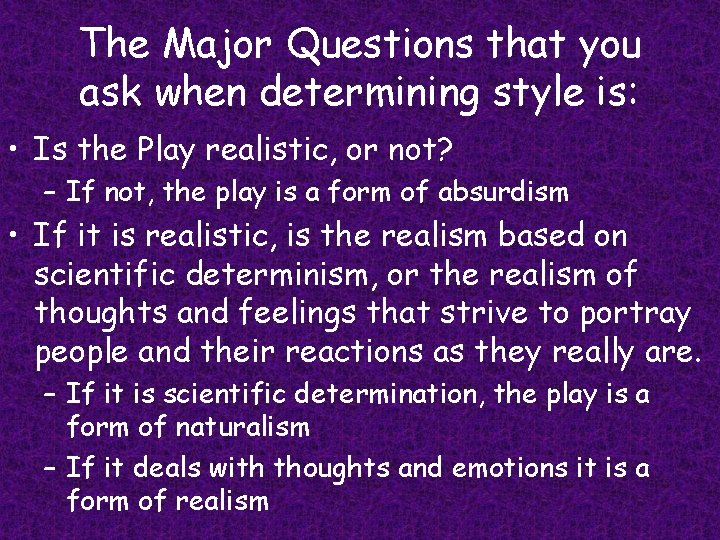
The Major Questions that you ask when determining style is: • Is the Play realistic, or not? – If not, the play is a form of absurdism • If it is realistic, is the realism based on scientific determinism, or the realism of thoughts and feelings that strive to portray people and their reactions as they really are. – If it is scientific determination, the play is a form of naturalism – If it deals with thoughts and emotions it is a form of realism