
STYLE SHIFTING CODESWITCHING Joan Swann Book 1 Chapter
STYLE SHIFTING, CODESWITCHING Joan Swann Book 1 Chapter 8 Presentation: Dr. Faisal AL-Qahtani Dr. Fasial AL-Qahatni 1
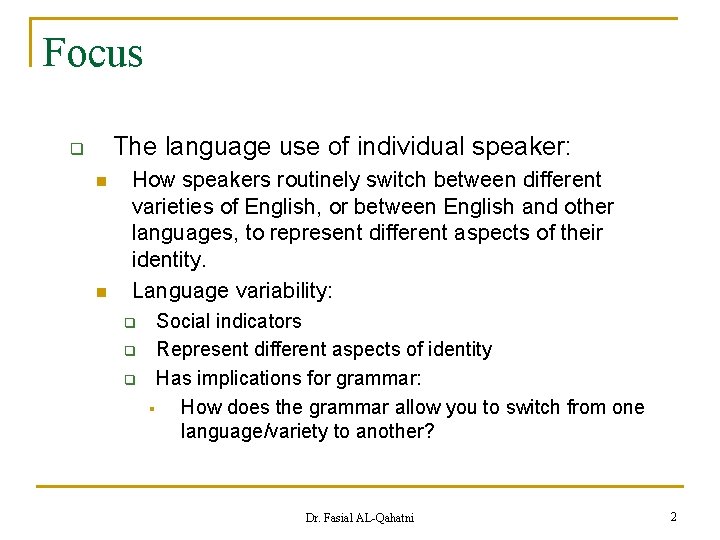
Focus The language use of individual speaker: q n n How speakers routinely switch between different varieties of English, or between English and other languages, to represent different aspects of their identity. Language variability: q q q Social indicators Represent different aspects of identity Has implications for grammar: § How does the grammar allow you to switch from one language/variety to another? Dr. Fasial AL-Qahatni 2

Stylistic variation in English n Style and audience: n Audience Design theory: (Allan Bell) q q n people or a person you speak to will have the greatest effect on the type of language you use. Someone’s speech is affected by the addressee and anyone else involved in the interaction. Accommodation theory (Giles et al. 1970 s) q q people tend to “converge” towards the speech of their interlocutors to reduce social distance. People also diverge when they want to increase social distance. Dr. Fasial AL-Qahatni 3
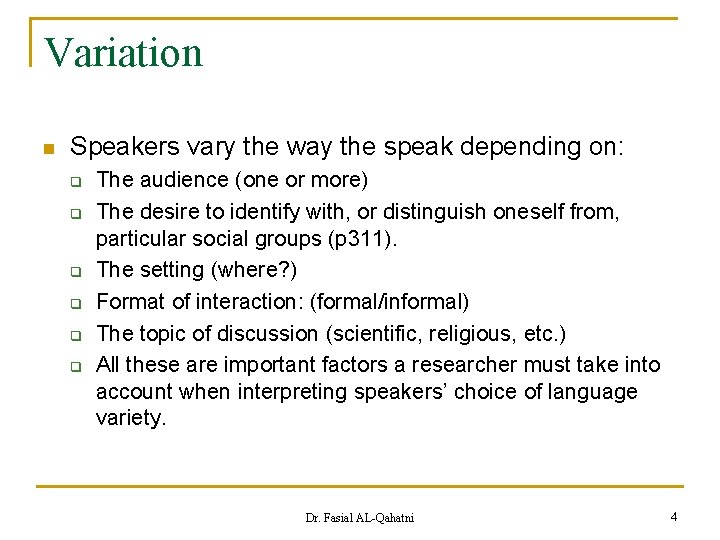
Variation n Speakers vary the way the speak depending on: q q q The audience (one or more) The desire to identify with, or distinguish oneself from, particular social groups (p 311). The setting (where? ) Format of interaction: (formal/informal) The topic of discussion (scientific, religious, etc. ) All these are important factors a researcher must take into account when interpreting speakers’ choice of language variety. Dr. Fasial AL-Qahatni 4
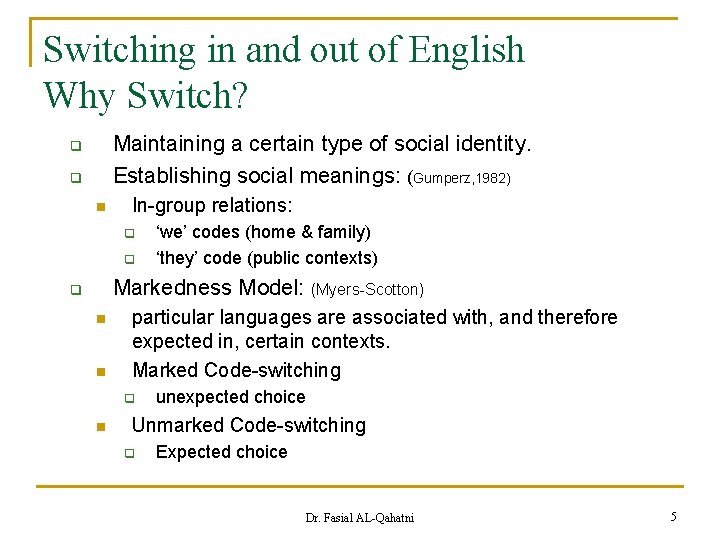
Switching in and out of English Why Switch? Maintaining a certain type of social identity. Establishing social meanings: (Gumperz, 1982) q q n In-group relations: q q ‘we’ codes (home & family) ‘they’ code (public contexts) Markedness Model: (Myers-Scotton) q n n particular languages are associated with, and therefore expected in, certain contexts. Marked Code-switching q n unexpected choice Unmarked Code-switching q Expected choice Dr. Fasial AL-Qahatni 5

Switching and Grammar: Switches follow certain patterns and constraints: n Shana Poplack (p. 318): q n Switches between languages occur between two languages having the same surface structure. n Switches here doesn’t violate the word order of either language. Matrix language frame model (Myers-Scotton p. 319): q n Matrix language (ML): q n the main language, language providing the syntactic frame. Embedded Language (EL): q Language providing the insertions. n ML supplies system morphemes (function words: a, the, any, etc. ) n EL supplies content morphemes (nouns, adjectives, verbs, etc. ) n The structure of ML provides the frame of the code-switching. Dr. Fasial AL-Qahatni 6
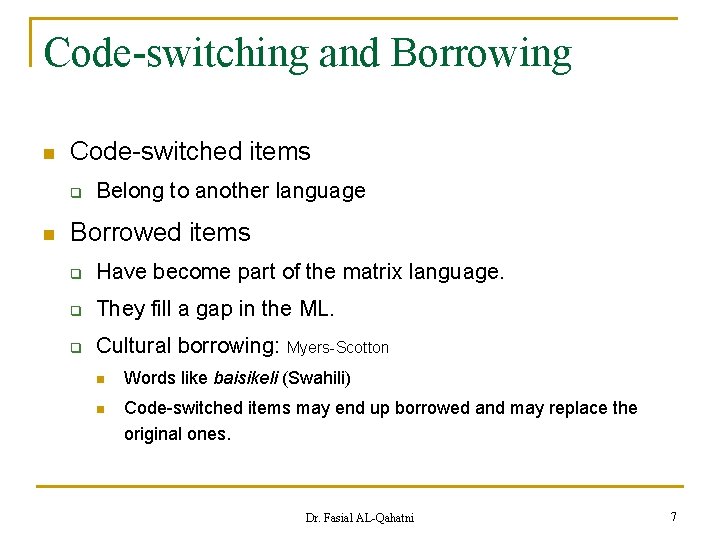
Code-switching and Borrowing n Code-switched items q n Belong to another language Borrowed items q Have become part of the matrix language. q They fill a gap in the ML. q Cultural borrowing: Myers-Scotton n Words like baisikeli (Swahili) n Code-switched items may end up borrowed and may replace the original ones. Dr. Fasial AL-Qahatni 7
- Slides: 7