
Style and Appropriateness Formal or informal Formal academic
- Slides: 6
Style and Appropriateness Formal or informal? Formal: academic, official, business
Written academic English will not normally contain the followings • Contractions – ‘it did not’ instead of ‘it didn’t’ or ‘they have’ not ‘they’ve’ • Hesitation Fillers – er, um well, you know… • Familiar Language – personal pronouns: I, you, we – impersonal pronouns: it, there, one; passive tenses
Exercise: Informal/Formal I • • We’ll finish the job next year. The project will be completed next year. I wonder why he put up with those terrible conditions for so long. It is not clear why such terrible conditions were tolerated for so long. • He’ll have to do another 5 tests before he can stop the experiment. • Five more tests will be necessary before the experiment can be concluded.
Exercise: Informal/Formal II • I showed that his arguments did not hold water. • It has been proved that the arguments so far are without foundation. • There a number of reasons why the questionnaire should be revised. • It is possible to consider the results from a different viewpoint.
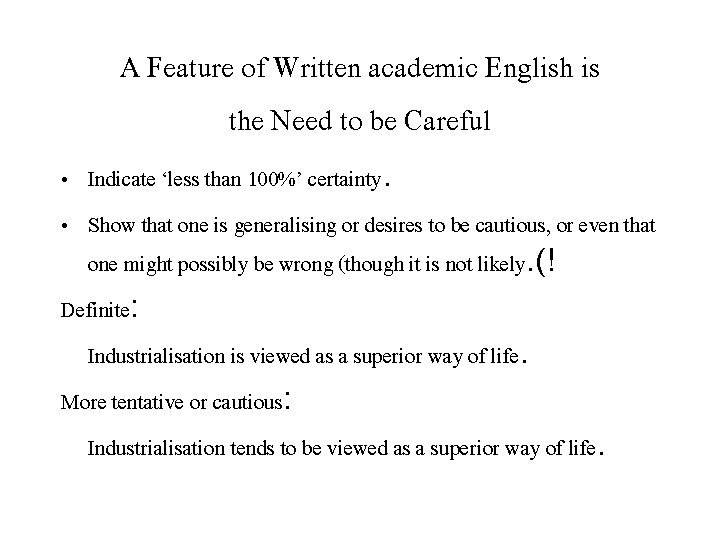
A Feature of Written academic English is the Need to be Careful • Indicate ‘less than 100%’ certainty. • Show that one is generalising or desires to be cautious, or even that one might possibly be wrong (though it is not likely. (! Definite: Industrialisation is viewed as a superior way of life. More tentative or cautious: Industrialisation tends to be viewed as a superior way of life.
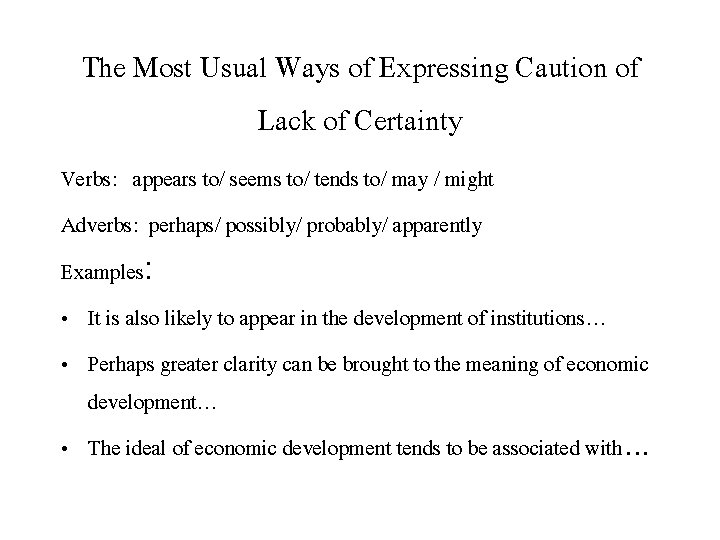
The Most Usual Ways of Expressing Caution of Lack of Certainty Verbs: appears to/ seems to/ tends to/ may / might Adverbs: perhaps/ possibly/ probably/ apparently Examples: • It is also likely to appear in the development of institutions… • Perhaps greater clarity can be brought to the meaning of economic development… • The ideal of economic development tends to be associated with. . .