
Studying the New California English Language Development Standards






- Slides: 21
Studying the New California English Language Development Standards
A Little Context English Language Development Standards? —A difficult task. Variance among English Learners in terms of • the age and grade when they enter a U. S. school • prior and/or current exposure to English outside of school • their first language and its similarities to and/or differences from English • their academic proficiency in their home language
Why New ELD Standards? • With new ELA/Literacy standards (Common Core), by law, ELD standards had to be updated • The intent in CA to learn from the past and improve the ELD standards English Language Arts/English Language Development Framework for California Public Schools: Transitional Kindergarten 1 Through Grade Twelve (ELA/ELD Framework)
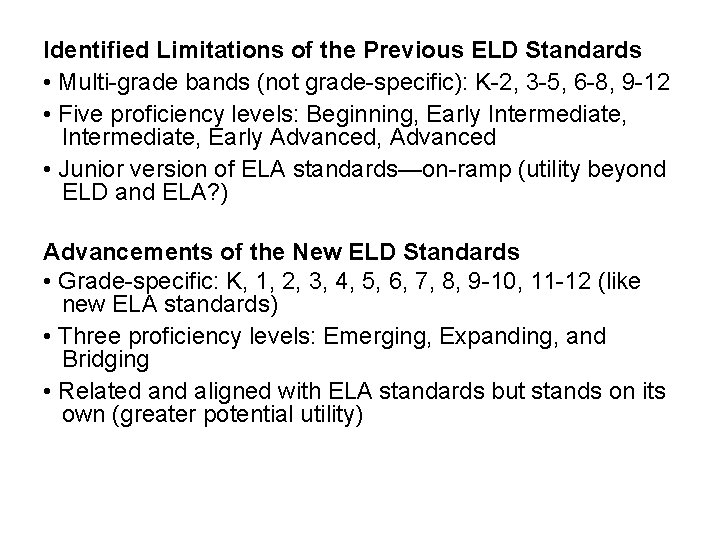
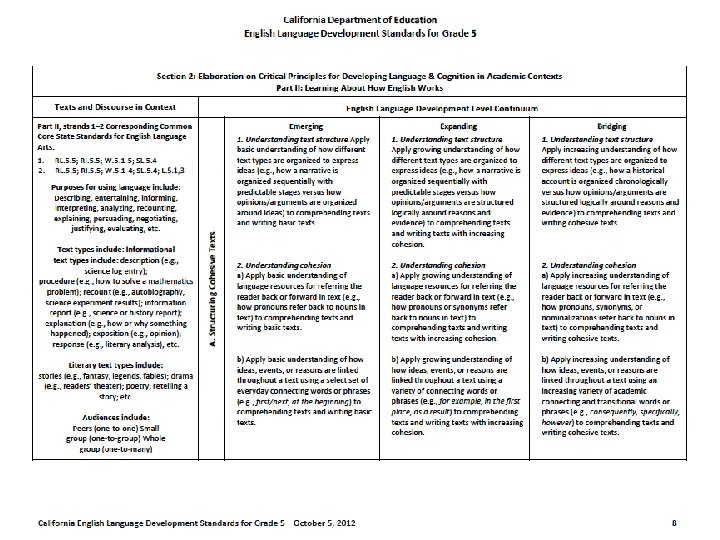
Identified Limitations of the Previous ELD Standards • Multi-grade bands (not grade-specific): K-2, 3 -5, 6 -8, 9 -12 • Five proficiency levels: Beginning, Early Intermediate, Early Advanced, Advanced • Junior version of ELA standards—on-ramp (utility beyond ELD and ELA? ) Advancements of the New ELD Standards • Grade-specific: K, 1, 2, 3, 4, 5, 6, 7, 8, 9 -10, 11 -12 (like new ELA standards) • Three proficiency levels: Emerging, Expanding, and Bridging • Related and aligned with ELA standards but stands on its own (greater potential utility)
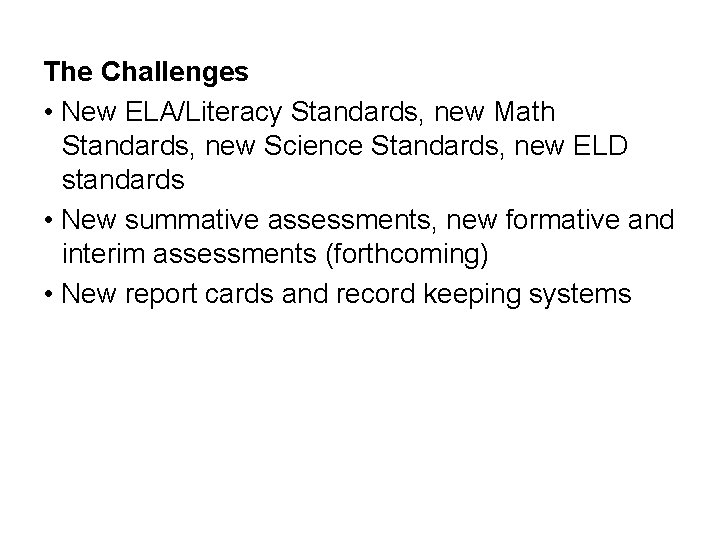
The Challenges • New ELA/Literacy Standards, new Math Standards, new Science Standards, new ELD standards • New summative assessments, new formative and interim assessments (forthcoming) • New report cards and record keeping systems
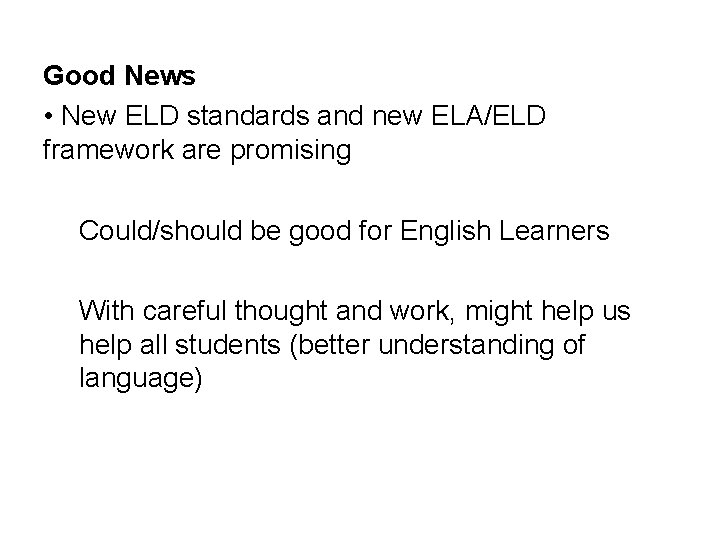
Good News • New ELD standards and new ELA/ELD framework are promising Could/should be good for English Learners With careful thought and work, might help us help all students (better understanding of language)
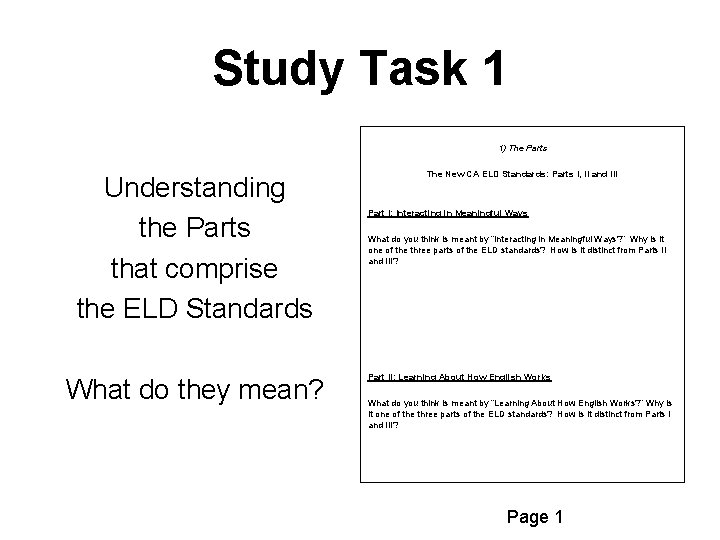
Study Task 1 1) The Parts Understanding the Parts that comprise the ELD Standards What do they mean? The New CA ELD Standards: Parts I, II and III Part I: Interacting in Meaningful Ways What do you think is meant by “Interacting in Meaningful Ways? ” Why is it one of the three parts of the ELD standards? How is it distinct from Parts II and III? Part II: Learning About How English Works What do you think is meant by “Learning About How English Works? ” Why is it one of the three parts of the ELD standards? How is it distinct from Parts I and III? Page 1
Study Task 2 2) The Modes or Processes That Comprise Each Part Understanding the Communicative Modes that comprise Part 1 What are these about? Page 2
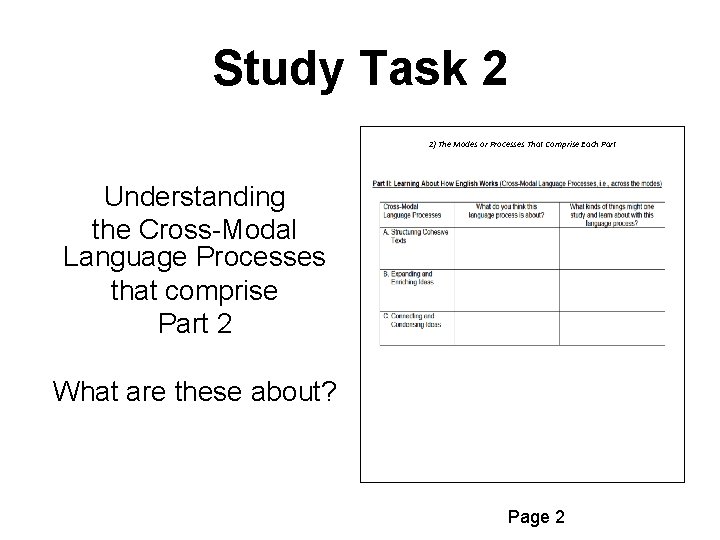
Study Task 2 2) The Modes or Processes That Comprise Each Part Understanding the Cross-Modal Language Processes that comprise Part 2 What are these about? Page 2
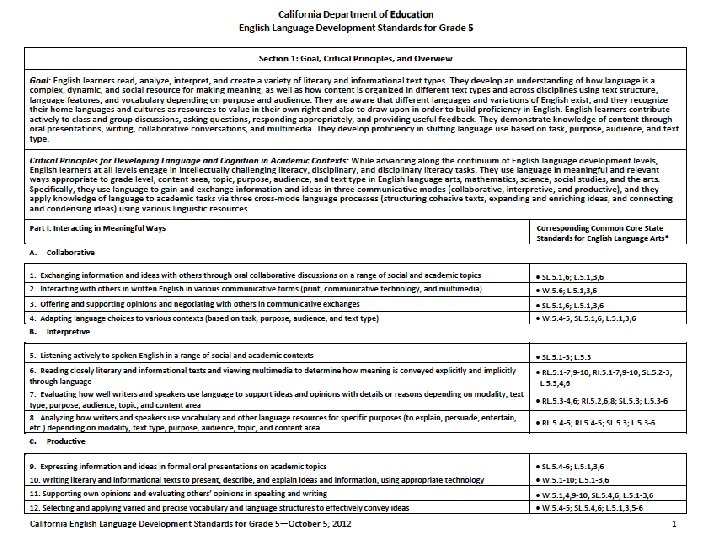
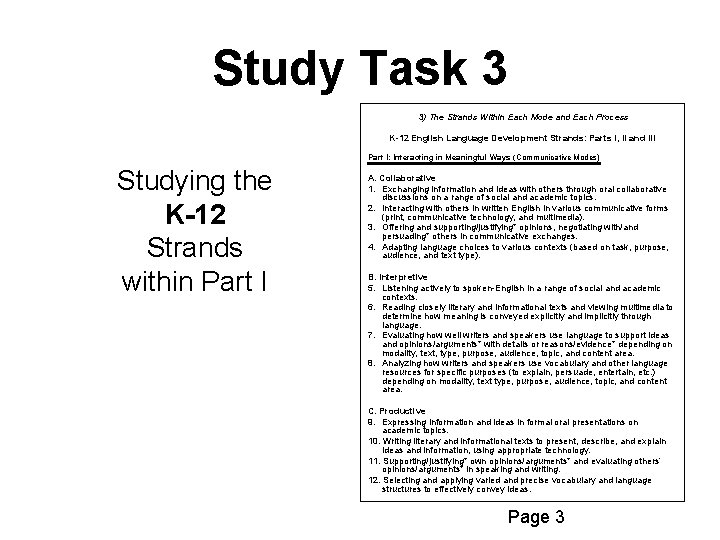
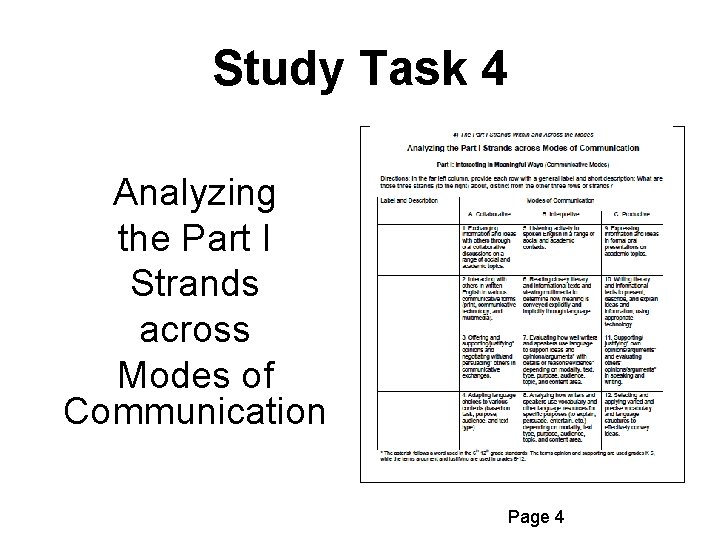
Study Task 3 3) The Strands Within Each Mode and Each Process K-12 English Language Development Strands: Parts I, II and III Studying the K-12 Strands within Part I: Interacting in Meaningful Ways (Communicative Modes) A. Collaborative 1. Exchanging information and ideas with others through oral collaborative discussions on a range of social and academic topics. 2. Interacting with others in written English in various communicative forms (print, communicative technology, and multimedia). 3. Offering and supporting/justifying* opinions, negotiating with/and persuading* others in communicative exchanges. 4. Adapting language choices to various contexts (based on task, purpose, audience, and text type). B. Interpretive 5. Listening actively to spoken-English in a range of social and academic contexts. 6. Reading closely literary and informational texts and viewing multimedia to determine how meaning is conveyed explicitly and implicitly through language. 7. Evaluating how well writers and speakers use language to support ideas and opinions/arguments* with details or reasons/evidence* depending on modality, text, type, purpose, audience, topic, and content area. 8. Analyzing how writers and speakers use vocabulary and other language resources for specific purposes (to explain, persuade, entertain, etc. ) depending on modality, text type, purpose, audience, topic, and content area. C. Productive 9. Expressing information and ideas in formal oral presentations on academic topics. 10. Writing literary and informational texts to present, describe, and explain ideas and information, using appropriate technology. 11. Supporting/justifying* own opinions/arguments* and evaluating others’ opinions/arguments* in speaking and writing. 12. Selecting and applying varied and precise vocabulary and language structures to effectively convey ideas. Page 3
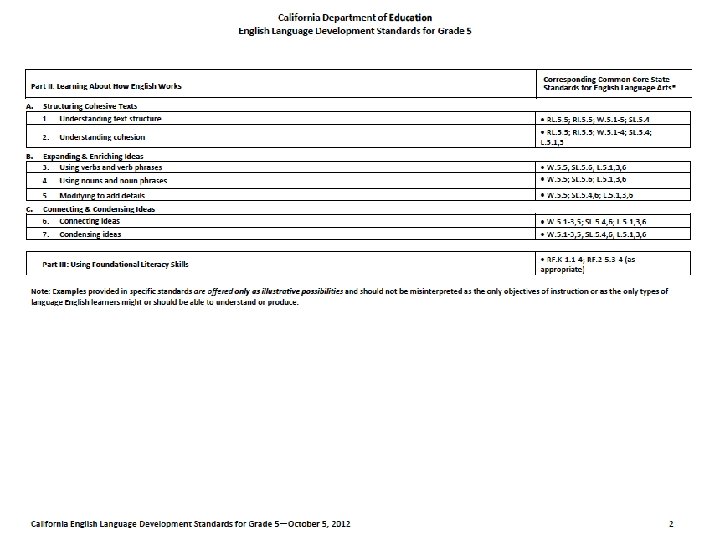
Study Task 3 3) The Strands Within Each Mode and Each Process Studying the K-12 Strands within Part II K-12 English Language Development Strands: Parts I, II and III Part II: Learning About How English Works (Cross-Modal Language Processes) A. Structuring Cohesive Texts 1. Understanding text structure 2. Understanding cohesion B. Expanding and Enriching Ideas 3. Using verbs and verb phrases 4. Using nouns and noun phrases 5. Modifying to add details C. Connecting and Condensing Ideas 6. Connecting ideas 7. Condensing ideas Page 3
Study Task 4 Analyzing the Part I Strands across Modes of Communication Page 4
Study Task 5 Note the tag phrase for each strand 5) The Part I Strands with Tag Phrases K-12 English Language Development Strands: Parts I, II and III Part I: Interacting in Meaningful Ways (Communicative Modes) A. Collaborative 1. Exchanging information/ideas—Exchanging information and ideas with others through oral collaborative discussions on a range of social and academic topics. 2. Interacting via written English—Interacting with others in written English in various communicative forms (print, communicative technology, and multimedia). 3. Offering opinions/Supporting opinions and persuading others*—Offering and supporting/justifying* opinions, negotiating with/and persuading* others in communicative exchanges. 4. Adapting language choices—Adapting language choices to various contexts (based on task, purpose, audience, and text type). B. Interpretive 5. Listening actively—Listening actively to spoken-English in a range of social and academic contexts. 6. Reading/viewing closely—Reading closely literary and informational texts and viewing multimedia to determine how meaning is conveyed explicitly and implicitly through language. 7. Evaluating language choices—Evaluating how well writers and speakers use language to support ideas and opinions/arguments* with details or reasons/evidence* depending on modality, text, type, purpose, audience, topic, and content area. 8. Analyzing language choices—Analyzing how writers and speakers use vocabulary and other language resources for specific purposes (to explain, persuade, entertain, etc. ) depending on modality, text type, purpose, audience, topic, and content area. C. Productive 9. Presenting—Expressing information and ideas in formal oral presentations on academic topics. 10. Writing—Writing literary and informational texts to present, describe, and explain ideas and information, using appropriate technology. 11. Supporting opinions/Justifying-arguing—Supporting/justifying* own opinions/arguments* and evaluating others’ opinions/arguments* in speaking and writing. 12. Selecting language resources—Selecting and applying varied and precise vocabulary and language structures to effectively convey ideas. Page 5
Study Task 6 Studying grade-specific ELD Standards and the descriptors (Emerging, Expanding, Bridging) in order to better understand articulate the Part II strands. Page 6
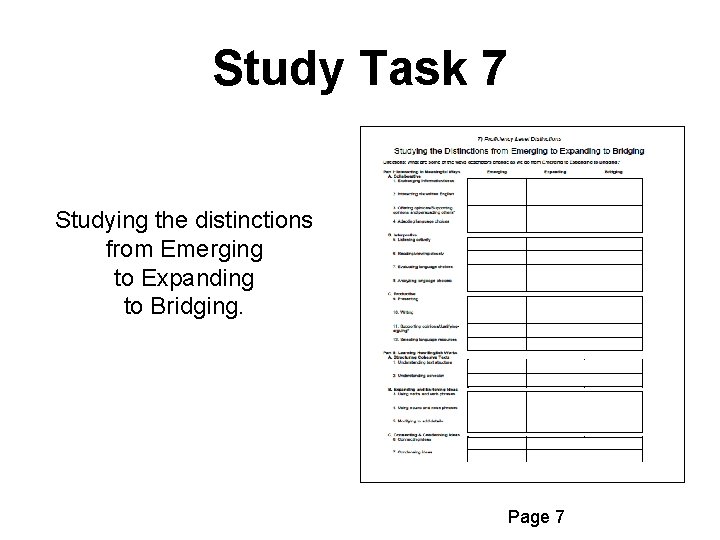
Study Task 7 Studying the distinctions from Emerging to Expanding to Bridging. Page 7