
Studying Photon Structure at ElectronIonCollider Xiaoxuan Chu Central
- Slides: 24
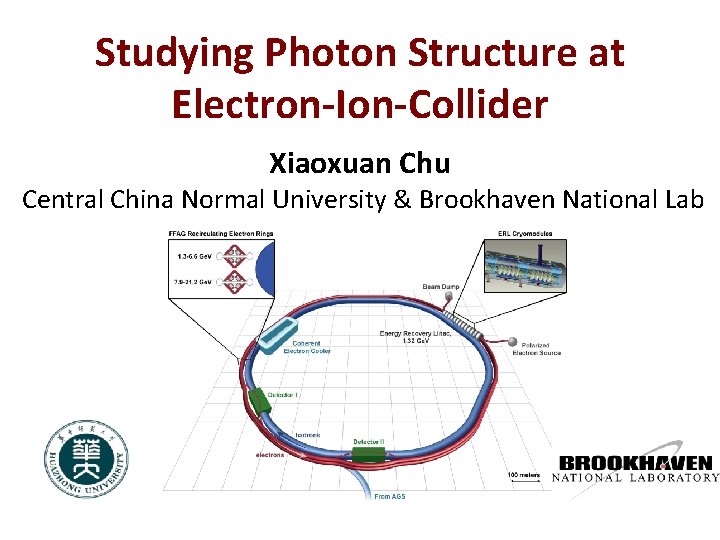
Studying Photon Structure at Electron-Ion-Collider Xiaoxuan Chu Central China Normal University & Brookhaven National Lab
Outline • Introduction • Photon structure at EIC Ø Di-jet & Di-hadron method Ø Validating Monte Carlo with HERA data Ø Separation of direct and resolved process Ø Reconstruct Ø Jets from photon side & jets from proton side • Summary EIC Users' Meeting, July 2016 2
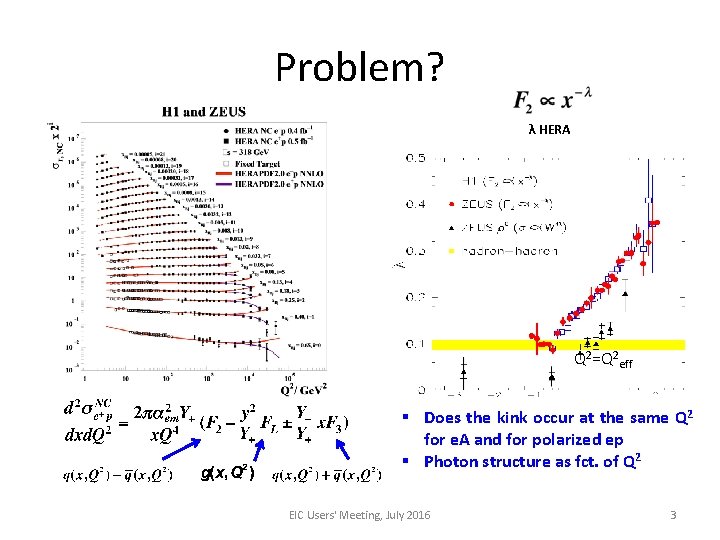
Problem? λ HERA Q 2=Q 2 eff § Does the kink occur at the same Q 2 for e. A and for polarized ep § Photon structure as fct. of Q 2 EIC Users' Meeting, July 2016 3
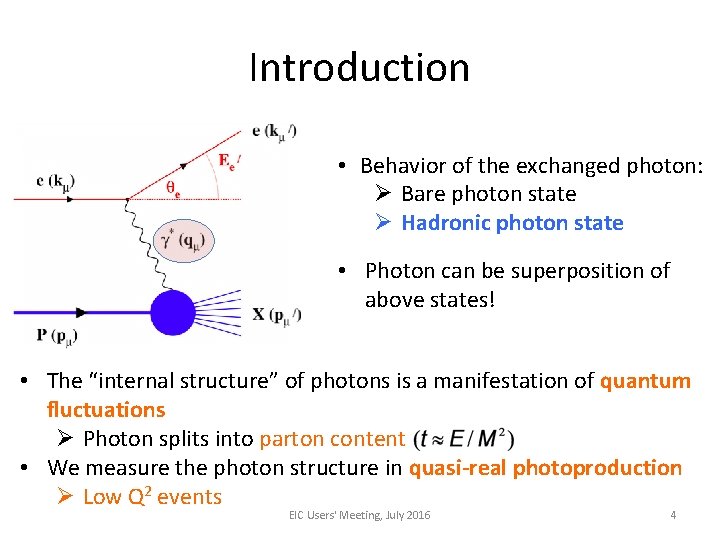
Introduction • Behavior of the exchanged photon: Ø Bare photon state Ø Hadronic photon state • Photon can be superposition of above states! • The “internal structure” of photons is a manifestation of quantum fluctuations Ø Photon splits into parton content • We measure the photon structure in quasi-real photoproduction Ø Low Q 2 events EIC Users' Meeting, July 2016 4
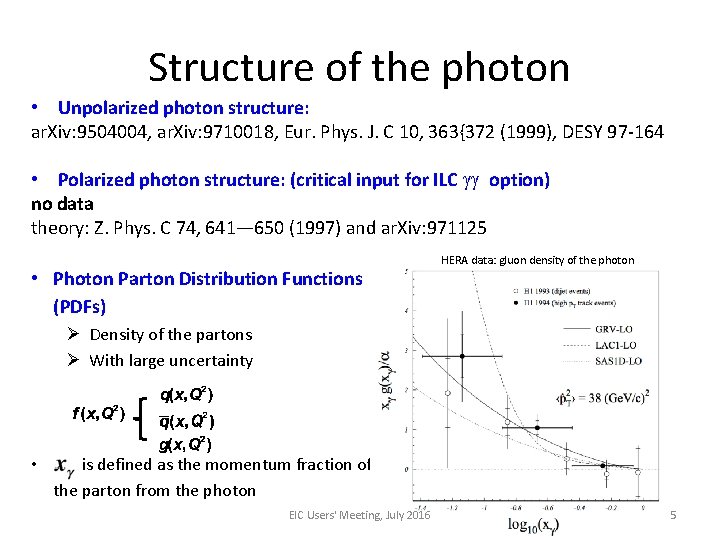
Structure of the photon • Unpolarized photon structure: ar. Xiv: 9504004, ar. Xiv: 9710018, Eur. Phys. J. C 10, 363{372 (1999), DESY 97 -164 • Polarized photon structure: (critical input for ILC gg option) no data theory: Z. Phys. C 74, 641— 650 (1997) and ar. Xiv: 971125 • Photon Parton Distribution Functions (PDFs) HERA data: gluon density of the photon Ø Density of the partons Ø With large uncertainty • is defined as the momentum fraction of the parton from the photon EIC Users' Meeting, July 2016 5
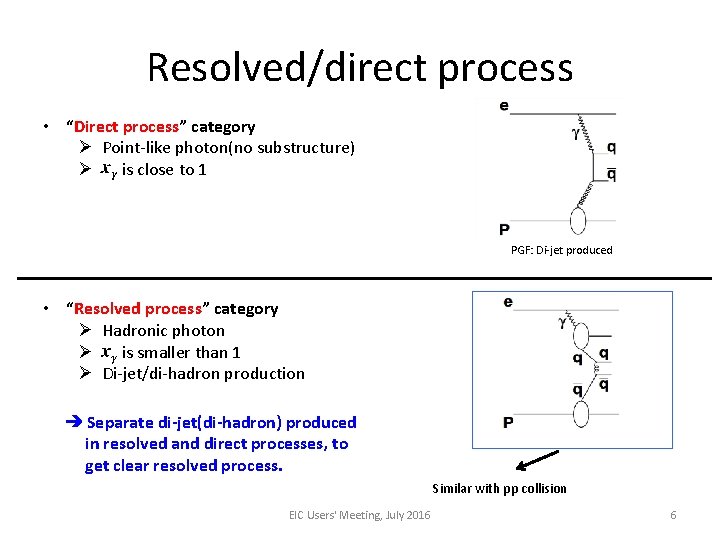
Resolved/direct process • “Direct process” category Ø Point-like photon(no substructure) Ø is close to 1 PGF: Di-jet produced • “Resolved process” category Ø Hadronic photon Ø is smaller than 1 Ø Di-jet/di-hadron production ➔ Separate di-jet(di-hadron) produced in resolved and direct processes, to get clear resolved process. Similar with pp collision EIC Users' Meeting, July 2016 6
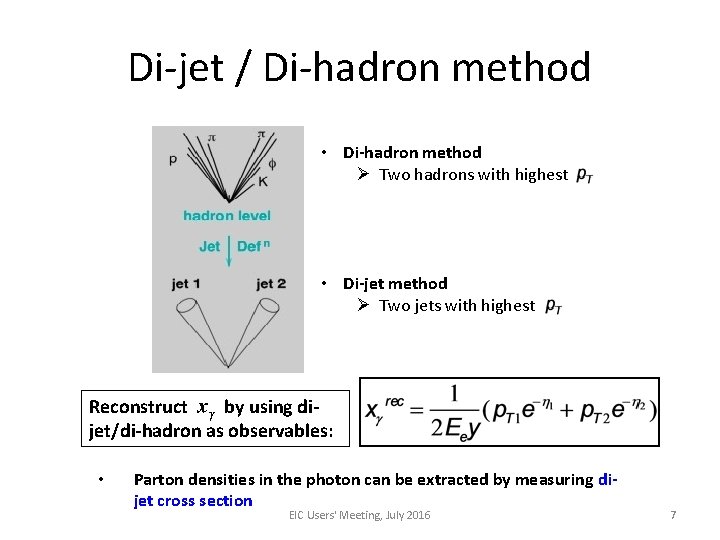
Di-jet / Di-hadron method • Di-hadron method Ø Two hadrons with highest • Di-jet method Ø Two jets with highest Reconstruct by using dijet/di-hadron as observables: • Parton densities in the photon can be extracted by measuring dijet cross section EIC Users' Meeting, July 2016 7
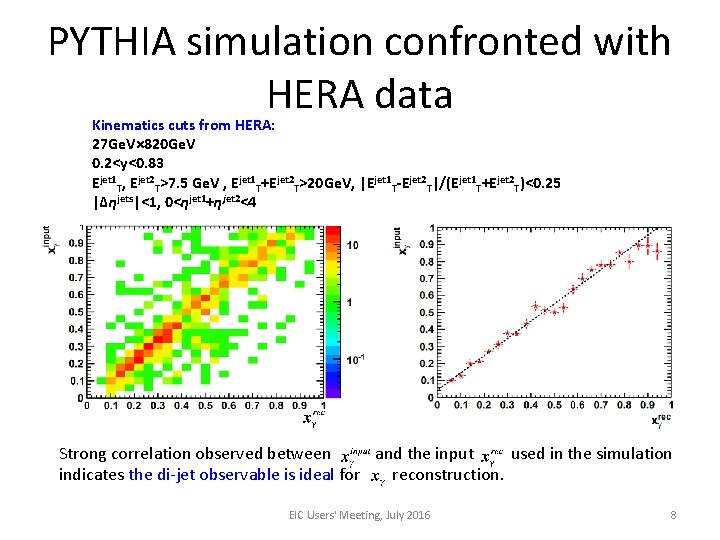
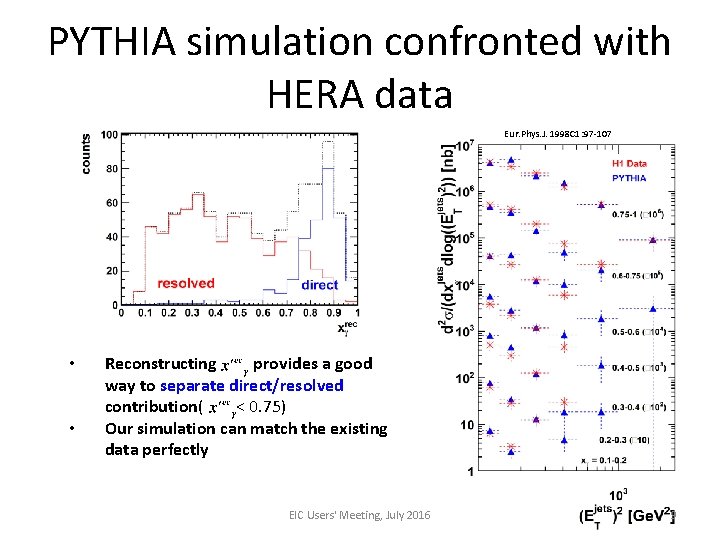
PYTHIA simulation confronted with HERA data Kinematics cuts from HERA: 27 Ge. V× 820 Ge. V 0. 2<y<0. 83 Ejet 1 T, Ejet 2 T>7. 5 Ge. V , Ejet 1 T+Ejet 2 T>20 Ge. V, |Ejet 1 T-Ejet 2 T|/(Ejet 1 T+Ejet 2 T)<0. 25 |Δηjets|<1, 0<ηjet 1+ηjet 2<4 Strong correlation observed between and the input used in the simulation indicates the di-jet observable is ideal for reconstruction. EIC Users' Meeting, July 2016 8
PYTHIA simulation confronted with HERA data Eur. Phys. J. 1998 C 1: 97 -107 • • Reconstructing provides a good way to separate direct/resolved contribution( < 0. 75) Our simulation can match the existing data perfectly EIC Users' Meeting, July 2016 9
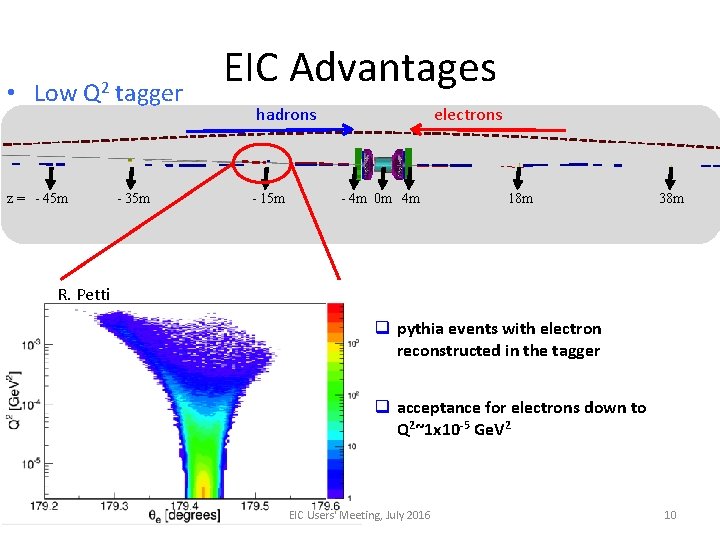
• Low Q 2 z = - 45 m tagger - 35 m EIC Advantages hadrons - 15 m electrons - 4 m 0 m 4 m 18 m 38 m R. Petti q pythia events with electron reconstructed in the tagger q acceptance for electrons down to Q 2~1 x 10 -5 Ge. V 2 EIC Users' Meeting, July 2016 10
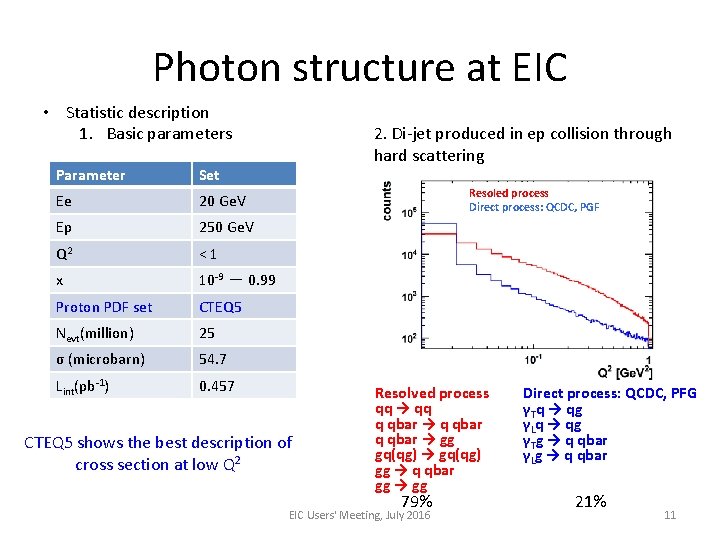
Photon structure at EIC • Statistic description 1. Basic parameters Parameter Set Ee 20 Ge. V Ep 250 Ge. V Q 2 <1 x 10 -9 - 0. 99 Proton PDF set CTEQ 5 Nevt(million) 25 σ (microbarn) 54. 7 Lint(pb-1) 0. 457 2. Di-jet produced in ep collision through hard scattering Resoled process Direct process: QCDC, PGF CTEQ 5 shows the best description of cross section at low Q 2 Resolved process qq → qq q qbar → gg gq(qg) → gq(qg) gg → q qbar gg → gg 79% EIC Users' Meeting, July 2016 Direct process: QCDC, PFG γTq → qg γLq → qg γTg → q qbar γLg → q qbar 21% 11
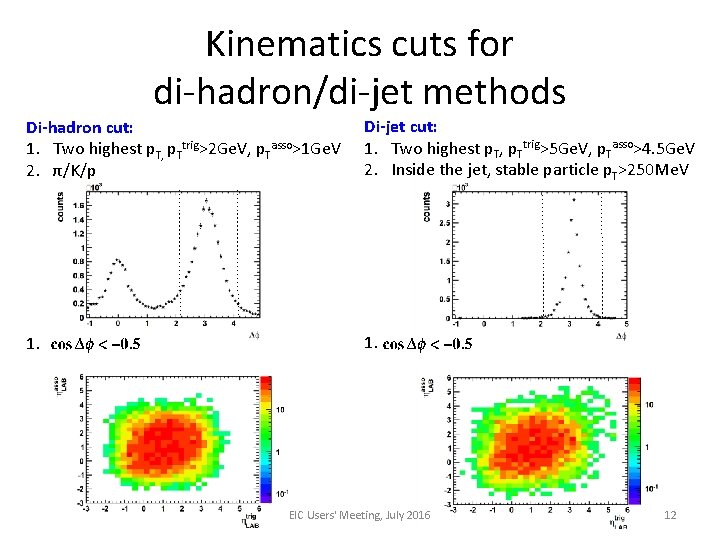
Kinematics cuts for di-hadron/di-jet methods Di-hadron cut: 1. Two highest p. T, p. Ttrig>2 Ge. V, p. Tasso>1 Ge. V 2. π/K/p Di-jet cut: 1. Two highest p. T, p. Ttrig>5 Ge. V, p. Tasso>4. 5 Ge. V 2. Inside the jet, stable particle p. T>250 Me. V 1. EIC Users' Meeting, July 2016 12
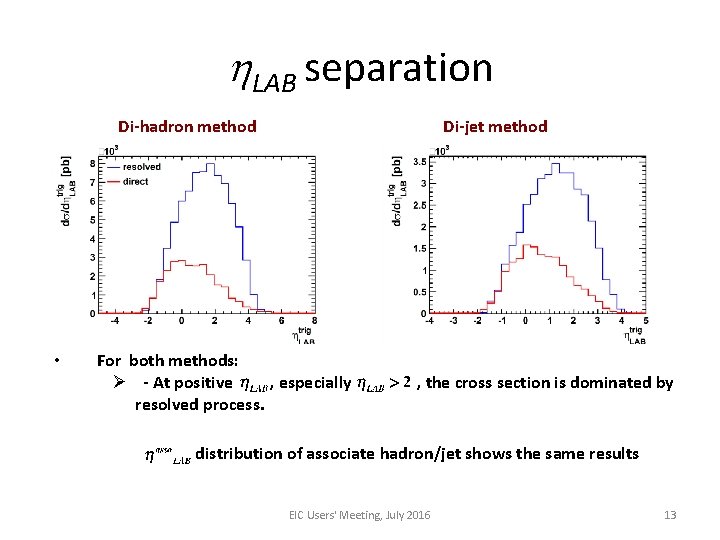
h. LAB separation Di-hadron method • Di-jet method For both methods: Ø - At positive , especially resolved process. , the cross section is dominated by distribution of associate hadron/jet shows the same results EIC Users' Meeting, July 2016 13
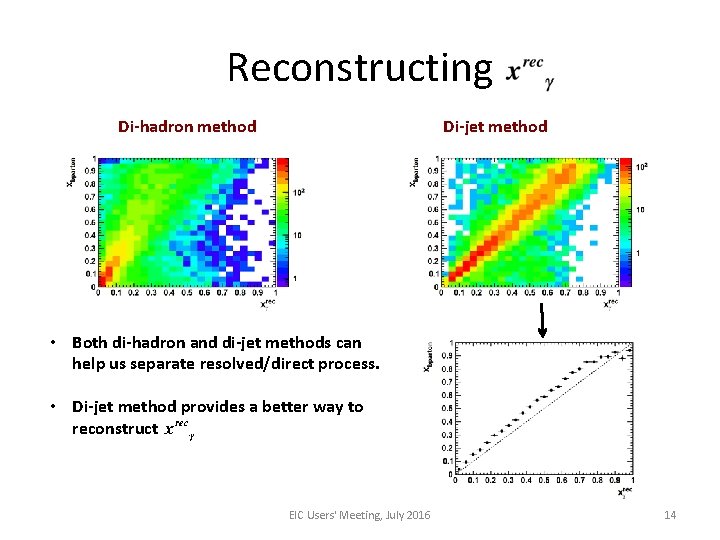
Reconstructing Di-hadron method Di-jet method • Both di-hadron and di-jet methods can help us separate resolved/direct process. • Di-jet method provides a better way to reconstruct EIC Users' Meeting, July 2016 14
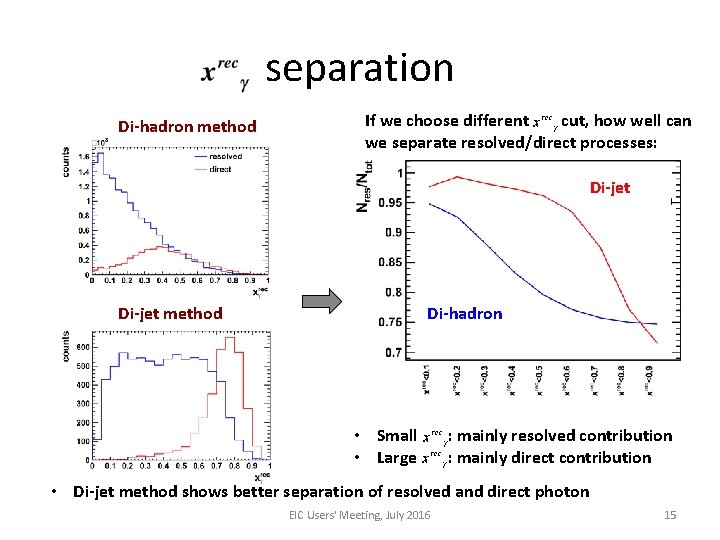
separation Di-hadron method If we choose different cut, how well can we separate resolved/direct processes: Di-jet Di-hadron Di-jet method • Small • Large : mainly resolved contribution : mainly direct contribution • Di-jet method shows better separation of resolved and direct photon EIC Users' Meeting, July 2016 15
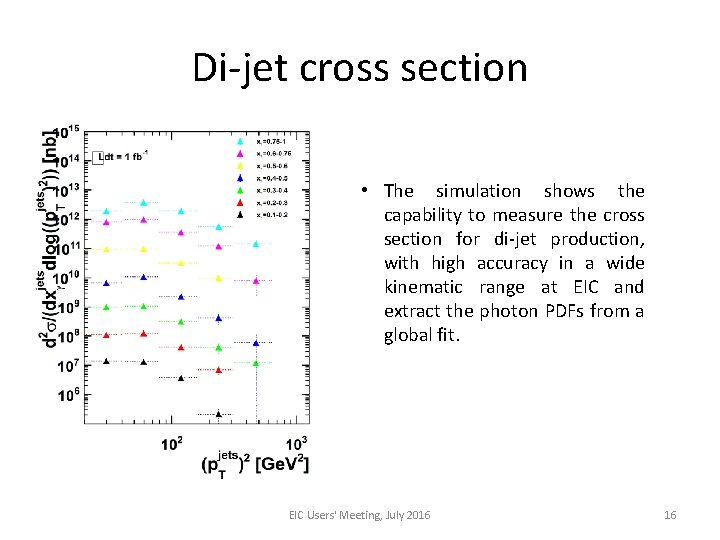
Di-jet cross section • The simulation shows the capability to measure the cross section for di-jet production, with high accuracy in a wide kinematic range at EIC and extract the photon PDFs from a global fit. EIC Users' Meeting, July 2016 16
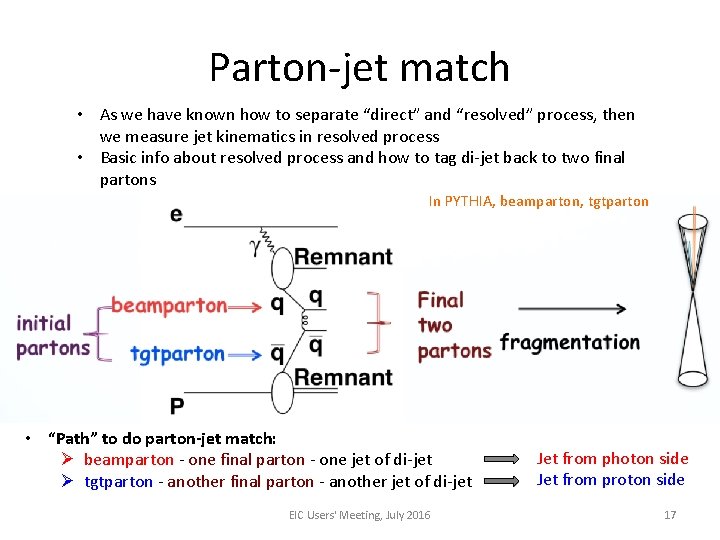
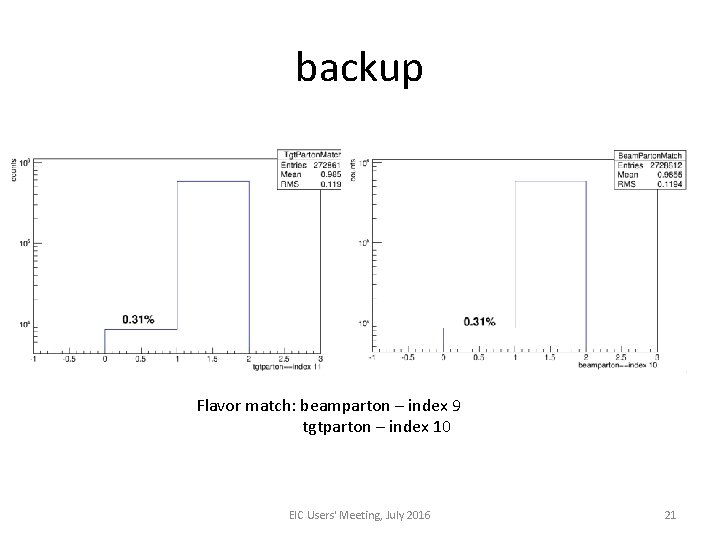
Parton-jet match • As we have known how to separate “direct” and “resolved” process, then we measure jet kinematics in resolved process • Basic info about resolved process and how to tag di-jet back to two final partons In PYTHIA, beamparton, tgtparton • “Path” to do parton-jet match: Ø beamparton - one final parton - one jet of di-jet Ø tgtparton - another final parton - another jet of di-jet EIC Users' Meeting, July 2016 Jet from photon side Jet from proton side 17
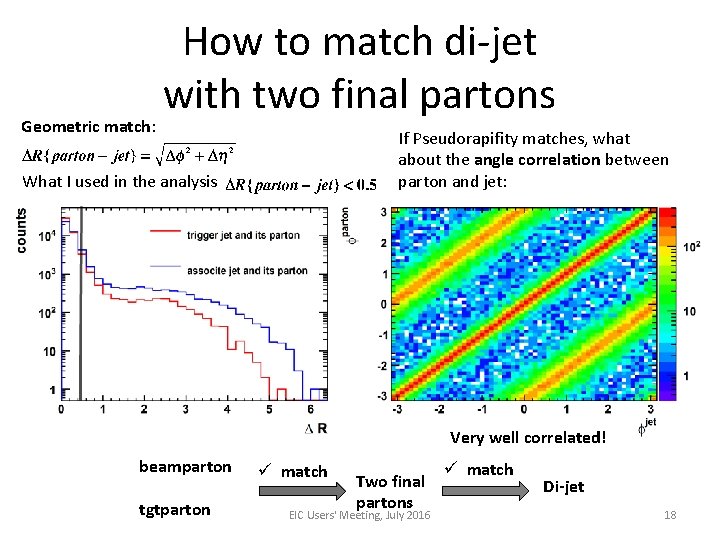
Geometric match: How to match di-jet with two final partons If Pseudorapifity matches, what about the angle correlation between parton and jet: What I used in the analysis Very well correlated! beamparton tgtparton ü match Two final partons EIC Users' Meeting, July 2016 ü match Di-jet 18
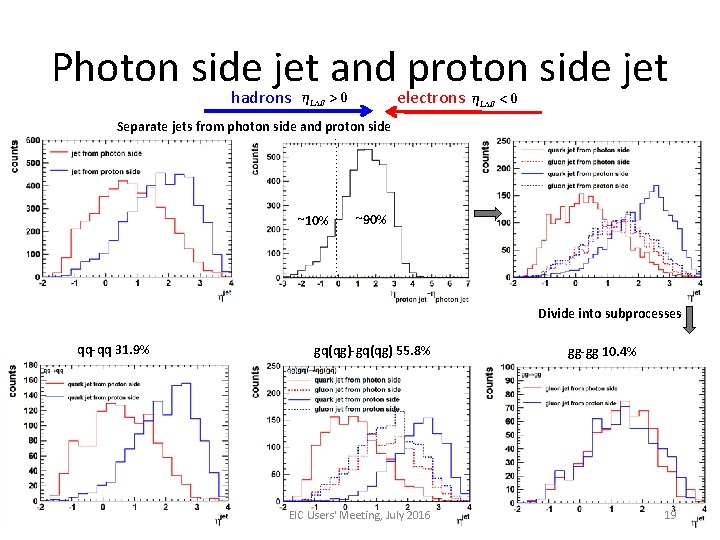
Photon side jet and proton side jet hadrons electrons Separate jets from photon side and proton side ~10% ~90% Divide into subprocesses qq-qq 31. 9% gq(qg)-gq(qg) 55. 8% EIC Users' Meeting, July 2016 gg-gg 10. 4% 19
Summary • In resolved processes, photon has a hadronic structure Ø Di-jets produced in resolved and direct process can be well separated at EIC • Photon PDFs can be extracted by reconstructing Ø is correlated with input Ø We can effectively access the underlying photon PDFs by measuring di-jet cross section in quasi-real photoproduction at EIC • Jet from photon side goes more to negative rapidity Ø Distinguish jets from beam side and target side • Will use LHC jet variables to separate gluon and quark jets statistically EIC Users' Meeting, July 2016 20
backup Flavor match: beamparton – index 9 tgtparton – index 10 EIC Users' Meeting, July 2016 21
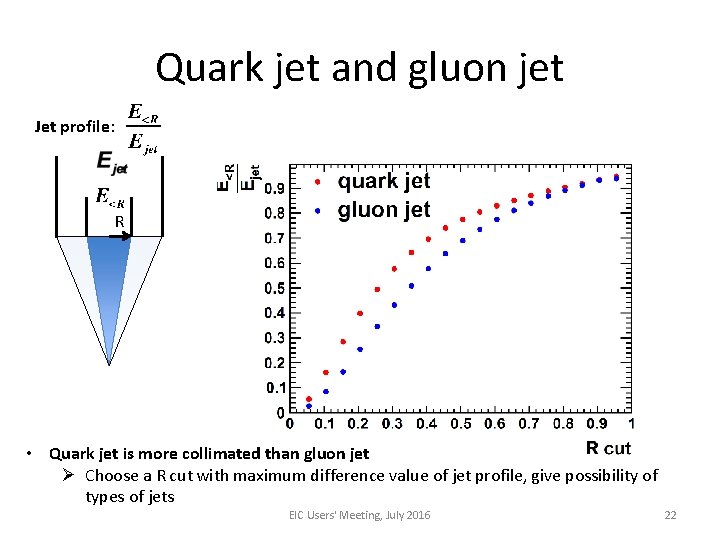
Quark jet and gluon jet Jet profile: R • Quark jet is more collimated than gluon jet Ø Choose a R cut with maximum difference value of jet profile, give possibility of types of jets EIC Users' Meeting, July 2016 22
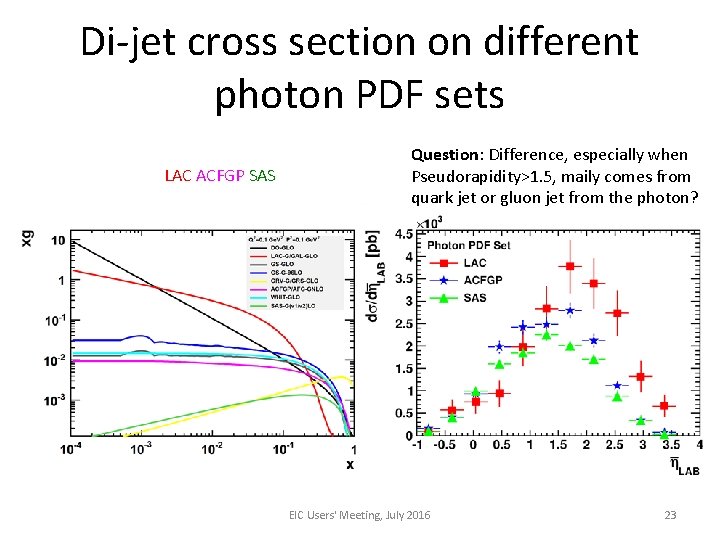
Di-jet cross section on different photon PDF sets LAC ACFGP SAS Question: Difference, especially when Pseudorapidity>1. 5, maily comes from quark jet or gluon jet from the photon? EIC Users' Meeting, July 2016 23
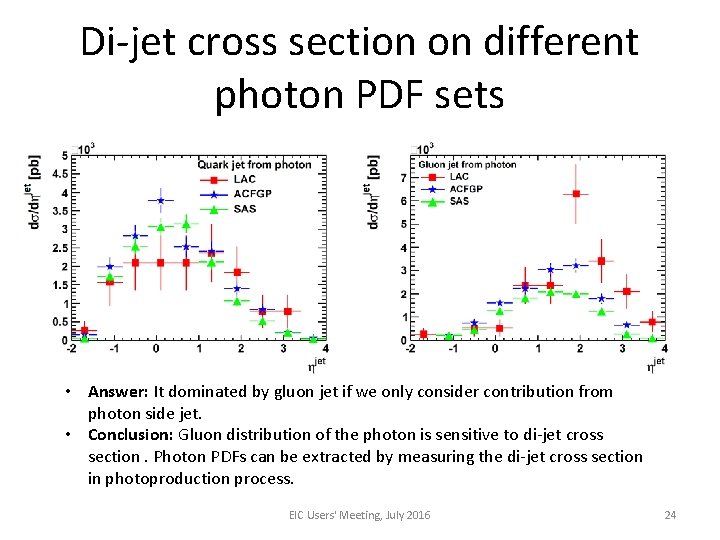
Di-jet cross section on different photon PDF sets • Answer: It dominated by gluon jet if we only consider contribution from photon side jet. • Conclusion: Gluon distribution of the photon is sensitive to di-jet cross section. Photon PDFs can be extracted by measuring the di-jet cross section in photoproduction process. EIC Users' Meeting, July 2016 24