Studying Meaning Semantic information and pragmatic considerations in

- Slides: 11
Studying Meaning
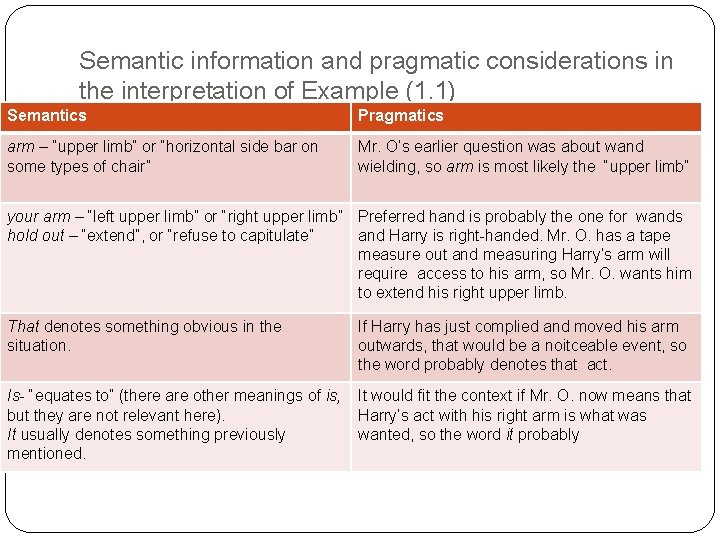
Semantic information and pragmatic considerations in the interpretation of Example (1. 1) Semantics Pragmatics arm – “upper limb” or “horizontal side bar on some types of chair” Mr. O’s earlier question was about wand wielding, so arm is most likely the “upper limb” your arm – “left upper limb” or “right upper limb” Preferred hand is probably the one for wands hold out – “extend”, or “refuse to capitulate” and Harry is right-handed. Mr. O. has a tape measure out and measuring Harry’s arm will require access to his arm, so Mr. O. wants him to extend his right upper limb. That denotes something obvious in the situation. If Harry has just complied and moved his arm outwards, that would be a noitceable event, so the word probably denotes that act. Is- “equates to” (there are other meanings of is, but they are not relevant here). It usually denotes something previously mentioned. It would fit the context if Mr. O. now means that Harry’s act with his right arm is what was wanted, so the word it probably
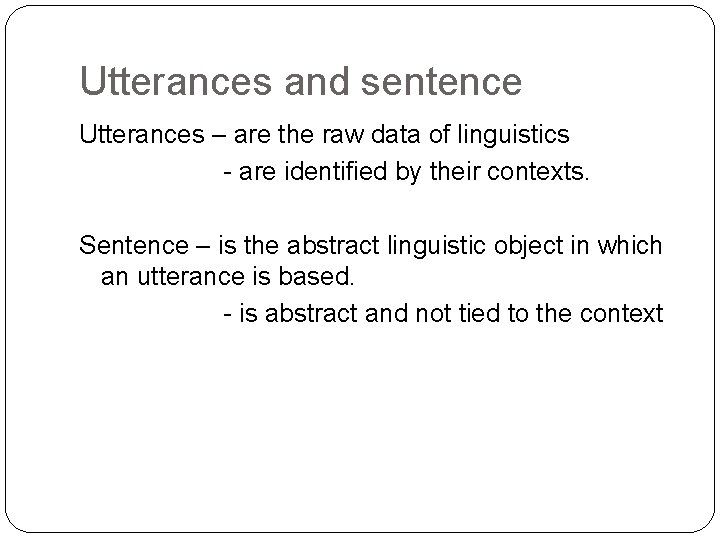
Utterances and sentence Utterances – are the raw data of linguistics - are identified by their contexts. Sentence – is the abstract linguistic object in which an utterance is based. - is abstract and not tied to the context
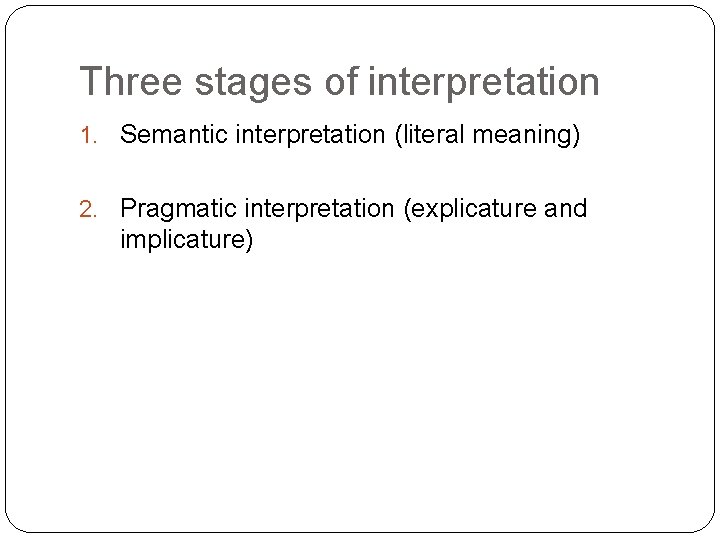
Three stages of interpretation 1. Semantic interpretation (literal meaning) 2. Pragmatic interpretation (explicature and implicature)
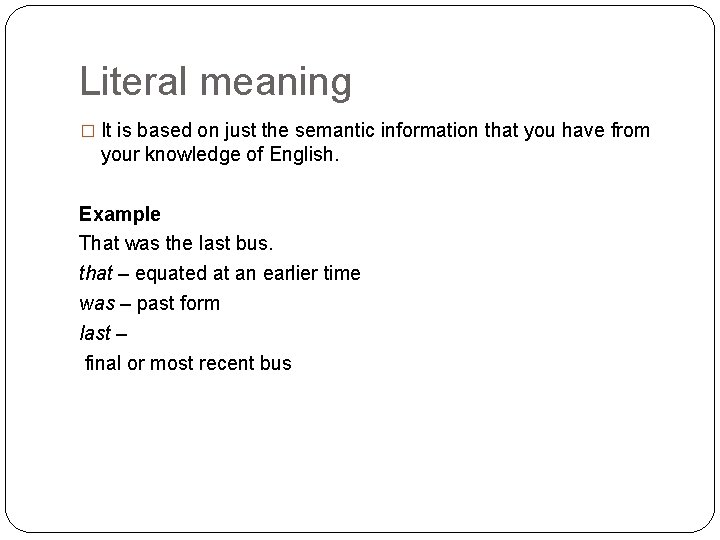
Literal meaning � It is based on just the semantic information that you have from your knowledge of English. Example That was the last bus. that – equated at an earlier time was – past form last – final or most recent bus
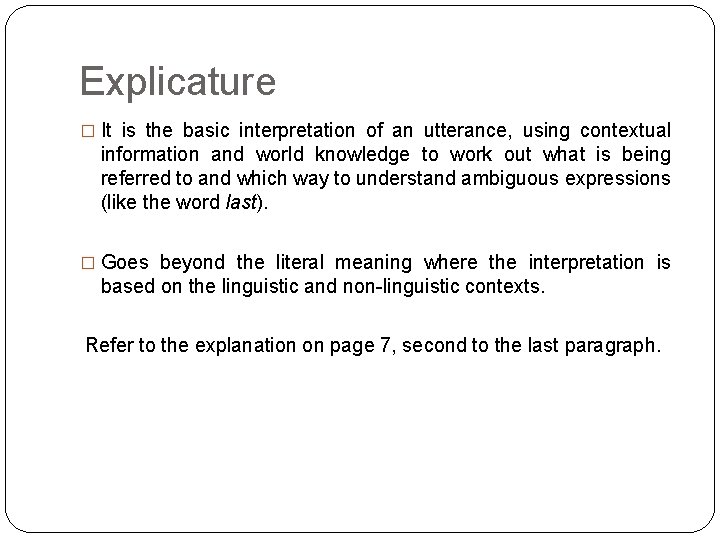
Explicature � It is the basic interpretation of an utterance, using contextual information and world knowledge to work out what is being referred to and which way to understand ambiguous expressions (like the word last). � Goes beyond the literal meaning where the interpretation is based on the linguistic and non-linguistic contexts. Refer to the explanation on page 7, second to the last paragraph.
Implicature �Refers to further interpretation and what hinted at by an utterance in its particular context.
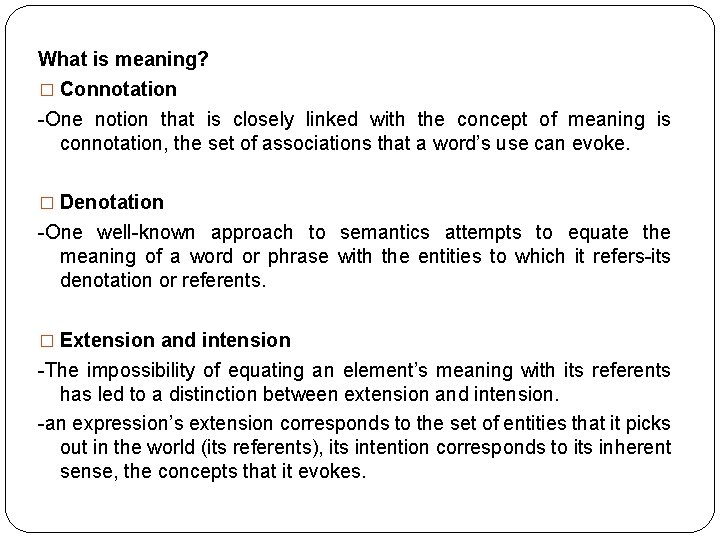
What is meaning? � Connotation -One notion that is closely linked with the concept of meaning is connotation, the set of associations that a word’s use can evoke. � Denotation -One well-known approach to semantics attempts to equate the meaning of a word or phrase with the entities to which it refers-its denotation or referents. � Extension and intension -The impossibility of equating an element’s meaning with its referents has led to a distinction between extension and intension. -an expression’s extension corresponds to the set of entities that it picks out in the world (its referents), its intention corresponds to its inherent sense, the concepts that it evokes.
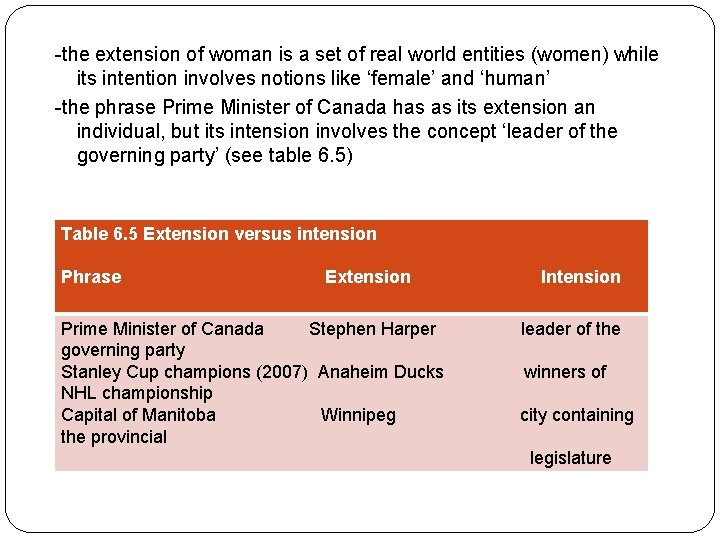
-the extension of woman is a set of real world entities (women) while its intention involves notions like ‘female’ and ‘human’ -the phrase Prime Minister of Canada has as its extension an individual, but its intension involves the concept ‘leader of the governing party’ (see table 6. 5) Table 6. 5 Extension versus intension Phrase Extension Prime Minister of Canada Stephen Harper governing party Stanley Cup champions (2007) Anaheim Ducks NHL championship Capital of Manitoba Winnipeg the provincial Intension leader of the winners of city containing legislature
Types of Meaning �Sender’s meaning – is the meaning that the speaker or writer intends to convey by means of an utterance.