
Study the QCD Phase Structure in HighEnergy Nuclear
![Outline (1) Introduction (2) Recent Results from BES-I [i] Collectivity; [ii] Criticality; [iii] Chirality](https://slidetodoc.com/presentation_image/fd67390b4f721c3f2ce867bdebe54d67/image-2.jpg "Outline (1) Introduction (2) Recent Results from BES-I [i] Collectivity; [ii] Criticality; [iii] Chirality")

- Slides: 33
Study the QCD Phase Structure in High-Energy Nuclear Collisions SN 0493 and SN 0598 Nu Xu(1, 2) May Thanks to Organizers! (1) College Nu Xu of Physical Science & Technology, Central China Normal University, China (2) Nuclear Science Division, Lawrence Berkeley National Laboratory, USA “NICA Days” WUT, Warsaw, Nov. 3 – 7, 2015 1/27
Outline (1) Introduction (2) Recent Results from BES-I [i] Collectivity; [ii] Criticality; [iii] Chirality (3) Physics Program in BES-II Nu Xu “NICA Days” WUT, Warsaw, Nov. 3 – 7, 2015 2/27
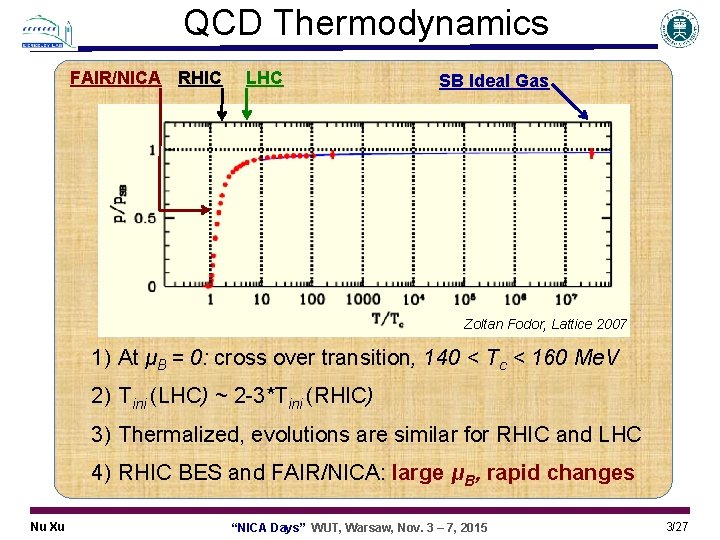
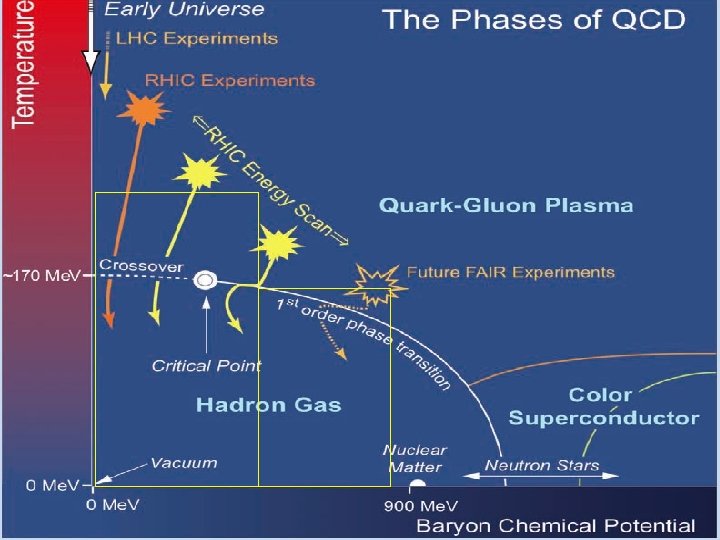
QCD Thermodynamics FAIR/NICA RHIC LHC SB Ideal Gas Zoltan Fodor, Lattice 2007 1) At μB = 0: cross over transition, 140 < Tc < 160 Me. V 2) Tini (LHC) ~ 2 -3*Tini (RHIC) 3) Thermalized, evolutions are similar for RHIC and LHC 4) RHIC BES and FAIR/NICA: large μB, rapid changes Nu Xu “NICA Days” WUT, Warsaw, Nov. 3 – 7, 2015 3/27
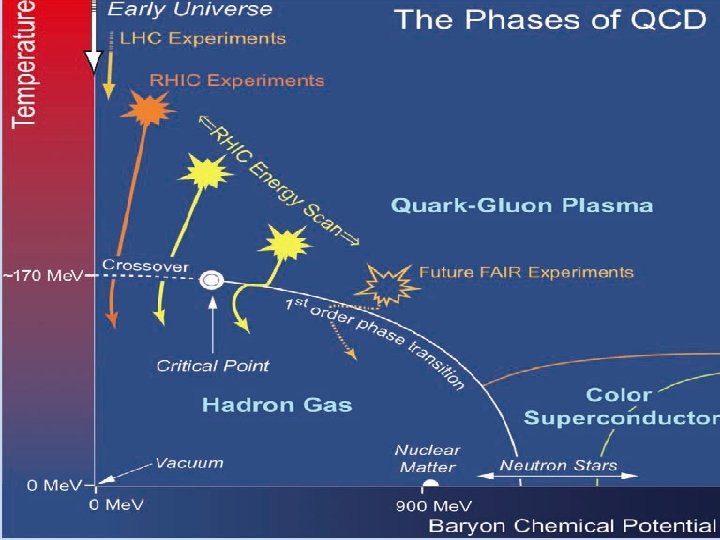
Beam Energy Scan at RHIC Study QCD Phase Structure 2000 - 2010: Top energy programs Discovery of s. QGP 2010 – 2014: BES-I (7. 7, 11. 5, 14. 5, 19. 6, 27, 39 Ge. V ) - Phase boundary and CP - Chiral symmetry 2019 – 2020: BES-II √s. NN ≤ 20 Ge. V (1) Collectivity (2) Critical point* (critical region) (3) Global Chiral effects Nu Xu “NICA Days” WUT, Warsaw, Nov. 3 – 7, 2015 4/27
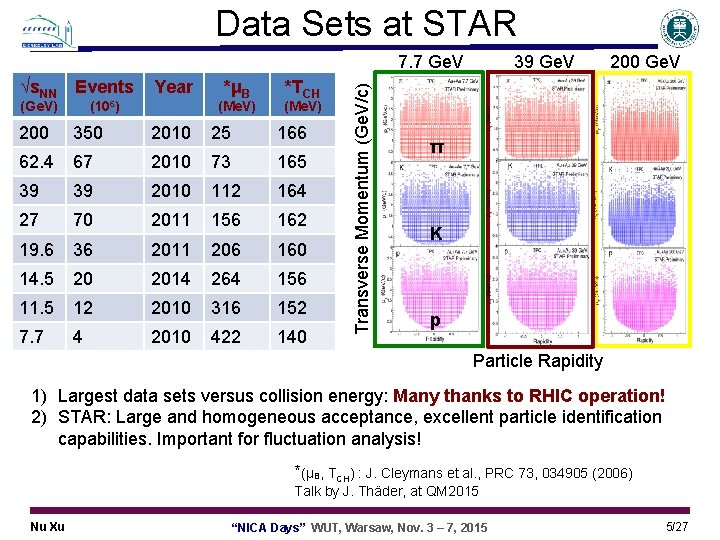
Data Sets at STAR √s. NN Events 200 350 2010 25 166 62. 4 67 2010 73 165 39 39 2010 112 164 27 70 2011 156 162 19. 6 36 2011 206 160 14. 5 20 2014 264 156 11. 5 12 2010 316 152 7. 7 4 2010 422 140 (Ge. V) Year (106) *μB (Me. V) *TCH (Me. V) Transverse Momentum (Ge. V/c) 7. 7 Ge. V 39 Ge. V 200 Ge. V π K p Particle Rapidity 1) Largest data sets versus collision energy: Many thanks to RHIC operation! 2) STAR: Large and homogeneous acceptance, excellent particle identification capabilities. Important for fluctuation analysis! *(μB, TCH) : J. Cleymans et al. , PRC 73, 034905 (2006) Talk by J. Thäder, at QM 2015 Nu Xu “NICA Days” WUT, Warsaw, Nov. 3 – 7, 2015 5/27
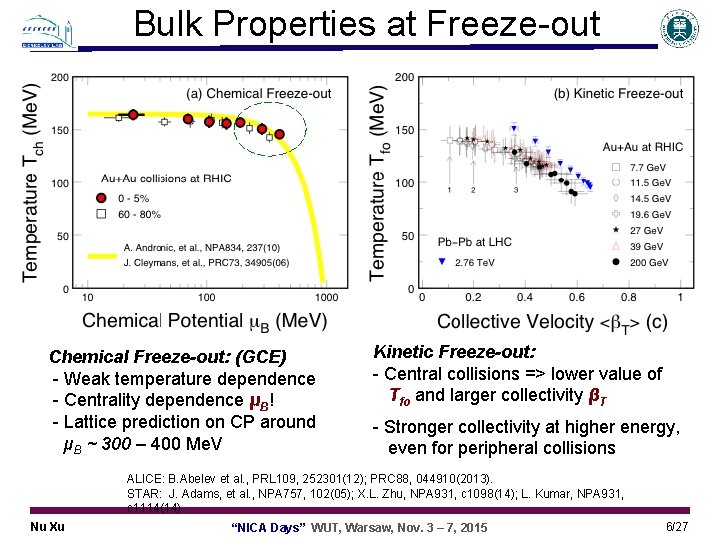
Bulk Properties at Freeze-out Chemical Freeze-out: (GCE) - Weak temperature dependence - Centrality dependence μB! - Lattice prediction on CP around μB ~ 300 – 400 Me. V Kinetic Freeze-out: - Central collisions => lower value of Tfo and larger collectivity βT - Stronger collectivity at higher energy, even for peripheral collisions ALICE: B. Abelev et al. , PRL 109, 252301(12); PRC 88, 044910(2013). STAR: J. Adams, et al. , NPA 757, 102(05); X. L. Zhu, NPA 931, c 1098(14); L. Kumar, NPA 931, c 1114(14) Nu Xu “NICA Days” WUT, Warsaw, Nov. 3 – 7, 2015 6/27
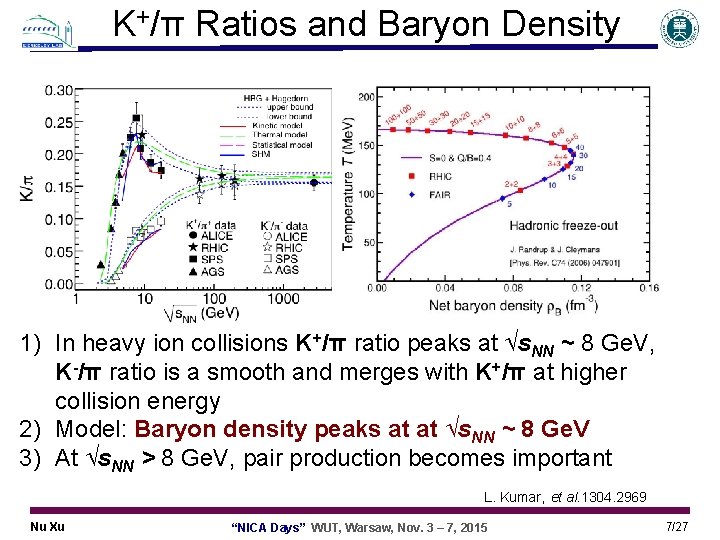
K+/π Ratios and Baryon Density 1) In heavy ion collisions K+/π ratio peaks at √s. NN ~ 8 Ge. V, K-/π ratio is a smooth and merges with K+/π at higher collision energy 2) Model: Baryon density peaks at at √s. NN ~ 8 Ge. V 3) At √s. NN > 8 Ge. V, pair production becomes important L. Kumar, et al. 1304. 2969 Nu Xu “NICA Days” WUT, Warsaw, Nov. 3 – 7, 2015 7/27
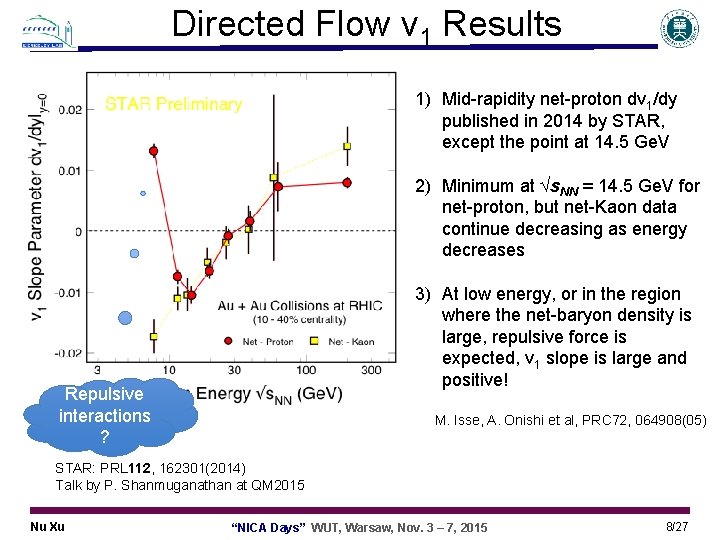
Directed Flow v 1 Results 1) Mid-rapidity net-proton dv 1/dy published in 2014 by STAR, except the point at 14. 5 Ge. V 2) Minimum at √s. NN = 14. 5 Ge. V for net-proton, but net-Kaon data continue decreasing as energy decreases 3) At low energy, or in the region where the net-baryon density is large, repulsive force is expected, v 1 slope is large and positive! Repulsive interactions ? M. Isse, A. Onishi et al, PRC 72, 064908(05) STAR: PRL 112, 162301(2014) Talk by P. Shanmuganathan at QM 2015 Nu Xu “NICA Days” WUT, Warsaw, Nov. 3 – 7, 2015 8/27
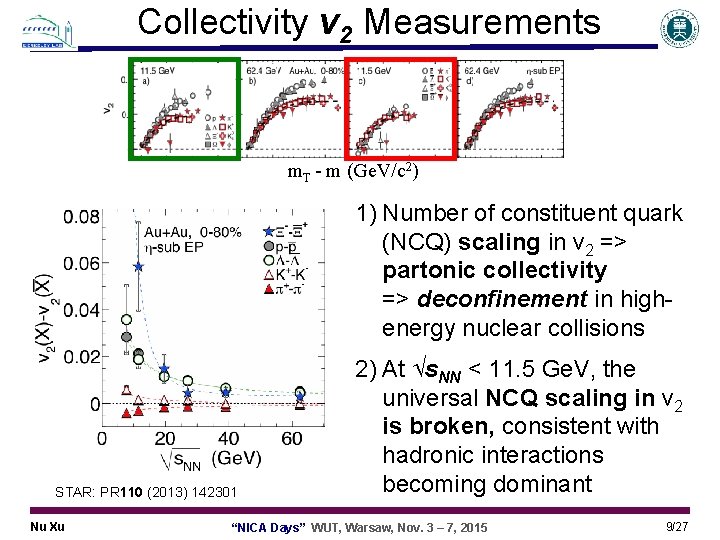
Collectivity v 2 Measurements m. T - m (Ge. V/c 2) 1) Number of constituent quark (NCQ) scaling in v 2 => partonic collectivity => deconfinement in highenergy nuclear collisions STAR: PR 110 (2013) 142301 Nu Xu 2) At √s. NN < 11. 5 Ge. V, the universal NCQ scaling in v 2 is broken, consistent with hadronic interactions becoming dominant “NICA Days” WUT, Warsaw, Nov. 3 – 7, 2015 9/27
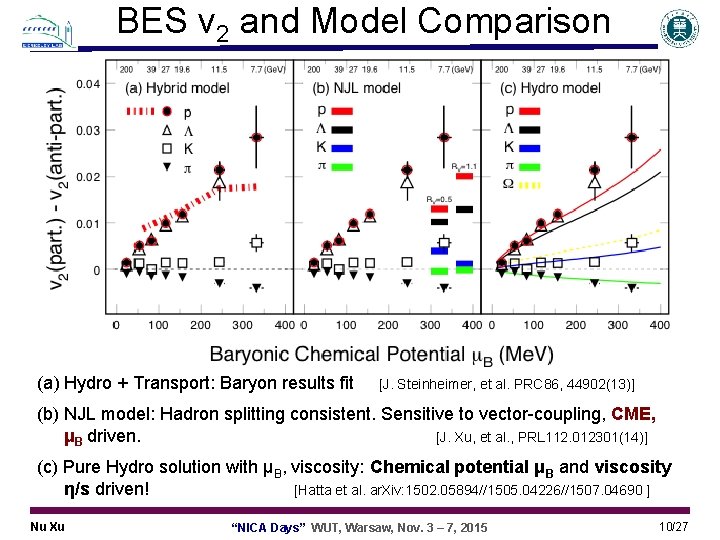
BES v 2 and Model Comparison (a) Hydro + Transport: Baryon results fit [J. Steinheimer, et al. PRC 86, 44902(13)] (b) NJL model: Hadron splitting consistent. Sensitive to vector-coupling, CME, μB driven. [J. Xu, et al. , PRL 112. 012301(14)] (c) Pure Hydro solution with μB, viscosity: Chemical potential μB and viscosity η/s driven! [Hatta et al. ar. Xiv: 1502. 05894//1505. 04226//1507. 04690 ] Nu Xu “NICA Days” WUT, Warsaw, Nov. 3 – 7, 2015 10/27
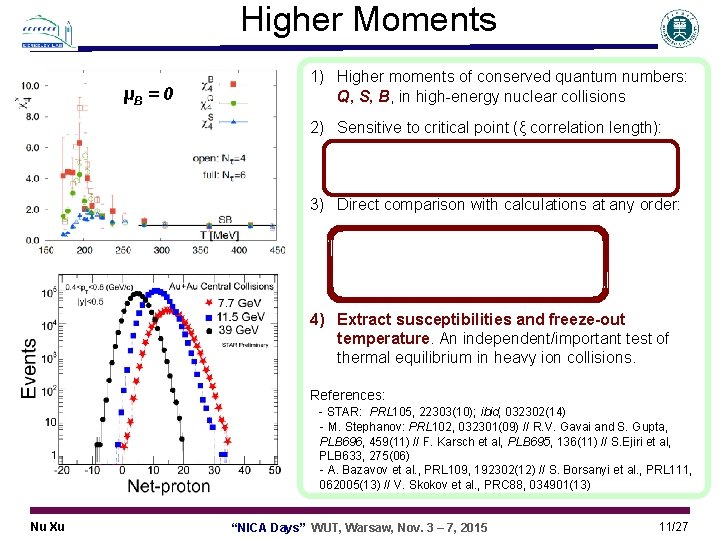
Higher Moments μB = 0 1) Higher moments of conserved quantum numbers: Q, S, B, in high-energy nuclear collisions 2) Sensitive to critical point (ξ correlation length): 3) Direct comparison with calculations at any order: 4) Extract susceptibilities and freeze-out temperature. An independent/important test of thermal equilibrium in heavy ion collisions. References: - STAR: PRL 105, 22303(10); ibid, 032302(14) - M. Stephanov: PRL 102, 032301(09) // R. V. Gavai and S. Gupta, PLB 696, 459(11) // F. Karsch et al, PLB 695, 136(11) // S. Ejiri et al, PLB 633, 275(06) - A. Bazavov et al. , PRL 109, 192302(12) // S. Borsanyi et al. , PRL 111, 062005(13) // V. Skokov et al. , PRC 88, 034901(13) Nu Xu “NICA Days” WUT, Warsaw, Nov. 3 – 7, 2015 11/27
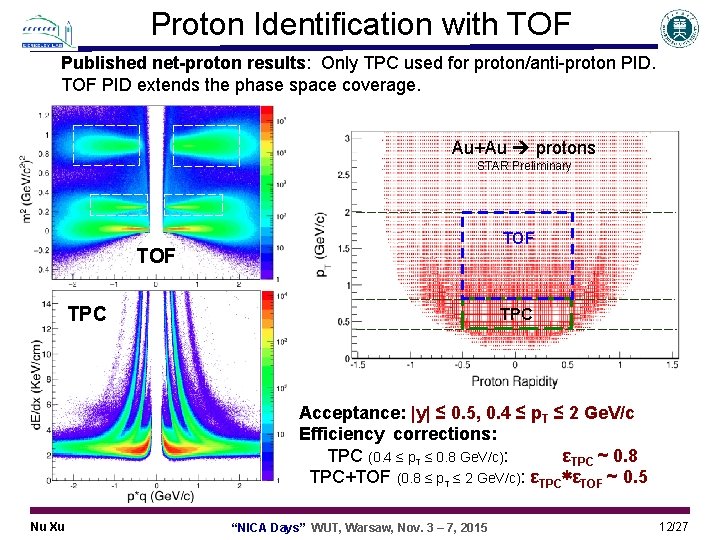
Proton Identification with TOF Published net-proton results: Only TPC used for proton/anti-proton PID. TOF PID extends the phase space coverage. Au+Au protons STAR Preliminary TOF TPC Acceptance: |y| ≤ 0. 5, 0. 4 ≤ p. T ≤ 2 Ge. V/c Efficiency corrections: TPC (0. 4 ≤ p. T ≤ 0. 8 Ge. V/c): εTPC ~ 0. 8 TPC+TOF (0. 8 ≤ p. T ≤ 2 Ge. V/c): εTPC*εTOF ~ 0. 5 Nu Xu “NICA Days” WUT, Warsaw, Nov. 3 – 7, 2015 12/27
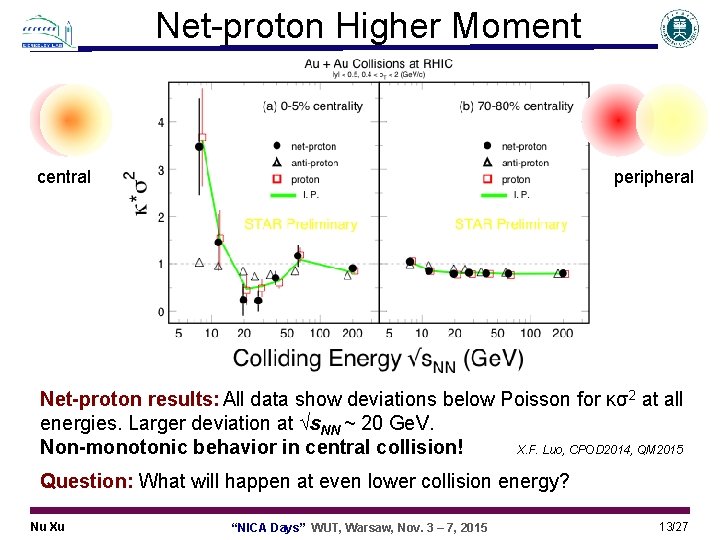
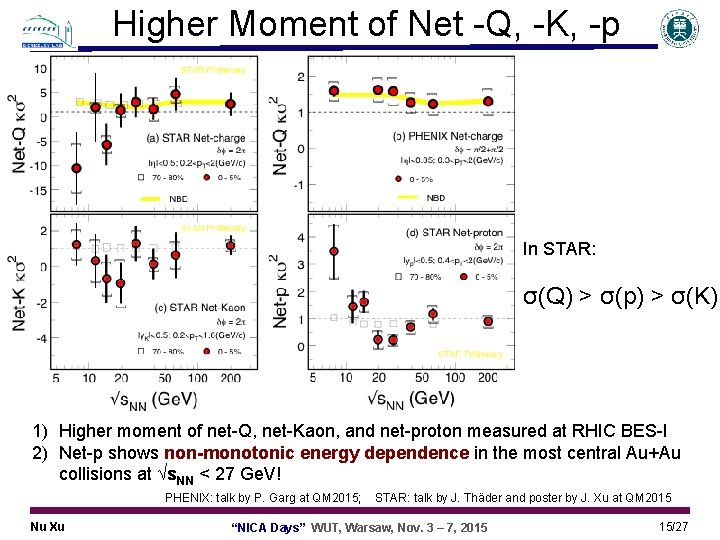
Net-proton Higher Moment central peripheral Net-proton results: All data show deviations below Poisson for κσ2 at all energies. Larger deviation at √s. NN ~ 20 Ge. V. Non-monotonic behavior in central collision! X. F. Luo, CPOD 2014, QM 2015 Question: What will happen at even lower collision energy? Nu Xu “NICA Days” WUT, Warsaw, Nov. 3 – 7, 2015 13/27
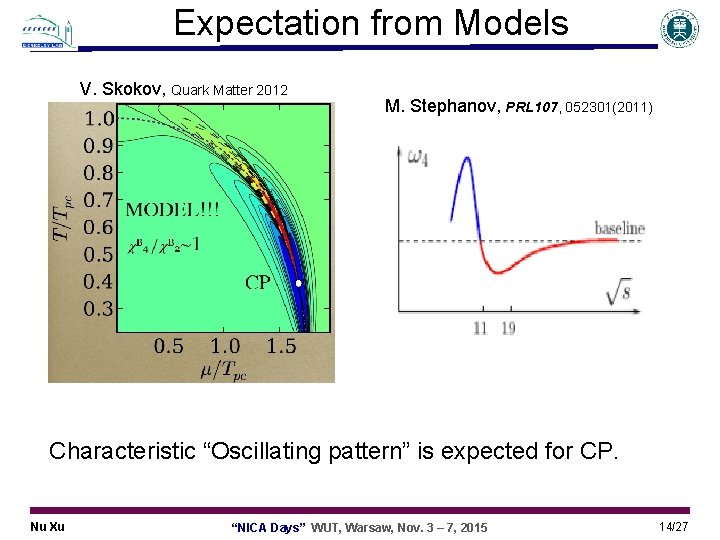
Expectation from Models V. Skokov, Quark Matter 2012 M. Stephanov, PRL 107, 052301(2011) Characteristic “Oscillating pattern” is expected for CP. Nu Xu “NICA Days” WUT, Warsaw, Nov. 3 – 7, 2015 14/27
Higher Moment of Net -Q, -K, -p In STAR: σ(Q) > σ(p) > σ(K) 1) Higher moment of net-Q, net-Kaon, and net-proton measured at RHIC BES-I 2) Net-p shows non-monotonic energy dependence in the most central Au+Au collisions at √s. NN < 27 Ge. V! PHENIX: talk by P. Garg at QM 2015; Nu Xu STAR: talk by J. Thäder and poster by J. Xu at QM 2015 “NICA Days” WUT, Warsaw, Nov. 3 – 7, 2015 15/27
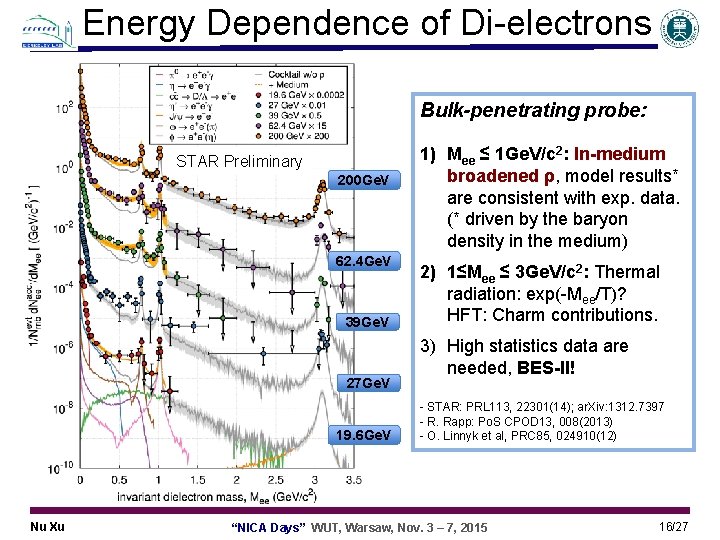
Energy Dependence of Di-electrons Bulk-penetrating probe: STAR Preliminary 200 Ge. V 62. 4 Ge. V 39 Ge. V 27 Ge. V 19. 6 Ge. V Nu Xu 1) Mee ≤ 1 Ge. V/c 2: In-medium broadened ρ, model results* are consistent with exp. data. (* driven by the baryon density in the medium) 2) 1≤Mee ≤ 3 Ge. V/c 2: Thermal radiation: exp(-Mee/T)? HFT: Charm contributions. 3) High statistics data are needed, BES-II! - STAR: PRL 113, 22301(14); ar. Xiv: 1312. 7397 - R. Rapp: Po. S CPOD 13, 008(2013) - O. Linnyk et al, PRC 85, 024910(12) “NICA Days” WUT, Warsaw, Nov. 3 – 7, 2015 16/27
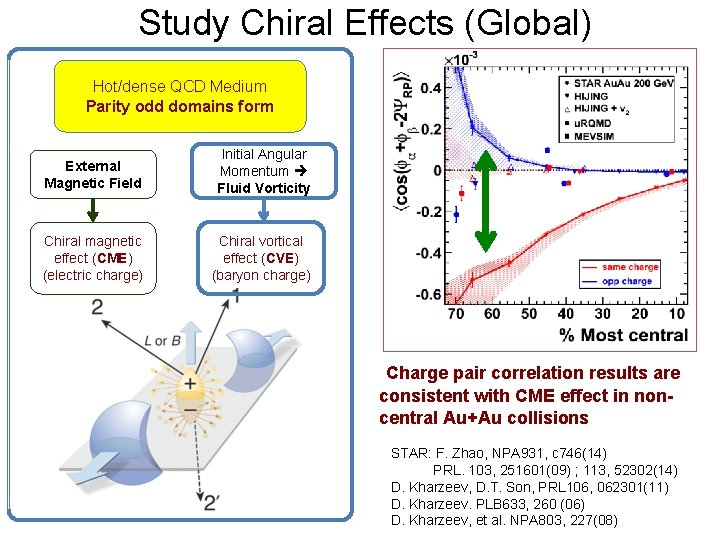
Study Chiral Effects (Global) Hot/dense QCD Medium Parity odd domains form External Magnetic Field Initial Angular Momentum Fluid Vorticity Chiral magnetic effect (CME) (electric charge) Chiral vortical effect (CVE) (baryon charge) Charge pair correlation results are consistent with CME effect in noncentral Au+Au collisions STAR: F. Zhao, NPA 931, c 746(14) PRL. 103, 251601(09) ; 113, 52302(14) D. Kharzeev, D. T. Son, PRL 106, 062301(11) D. Kharzeev. PLB 633, 260 (06) D. Kharzeev, et al. NPA 803, 227(08)
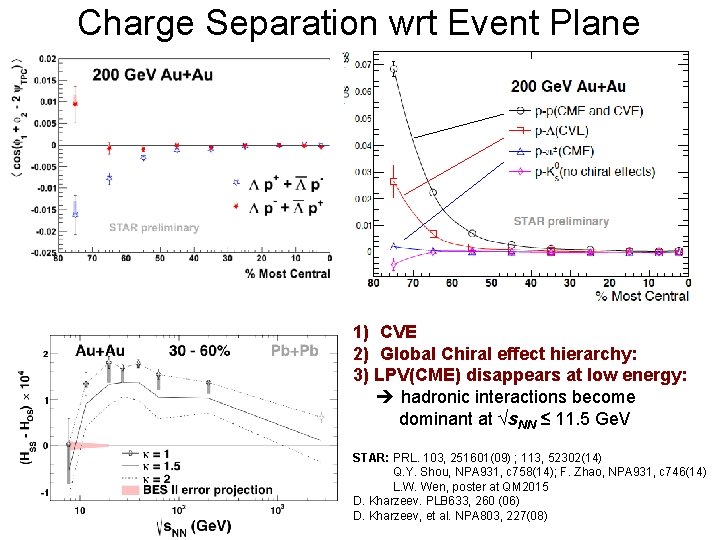
Charge Separation wrt Event Plane 1) CVE 2) Global Chiral effect hierarchy: 3) LPV(CME) disappears at low energy: hadronic interactions become dominant at √s. NN ≤ 11. 5 Ge. V STAR: PRL. 103, 251601(09) ; 113, 52302(14) Q. Y. Shou, NPA 931, c 758(14); F. Zhao, NPA 931, c 746(14) L. W. Wen, poster at QM 2015 D. Kharzeev. PLB 633, 260 (06) D. Kharzeev, et al. NPA 803, 227(08)
The BES-II Program at RHIC
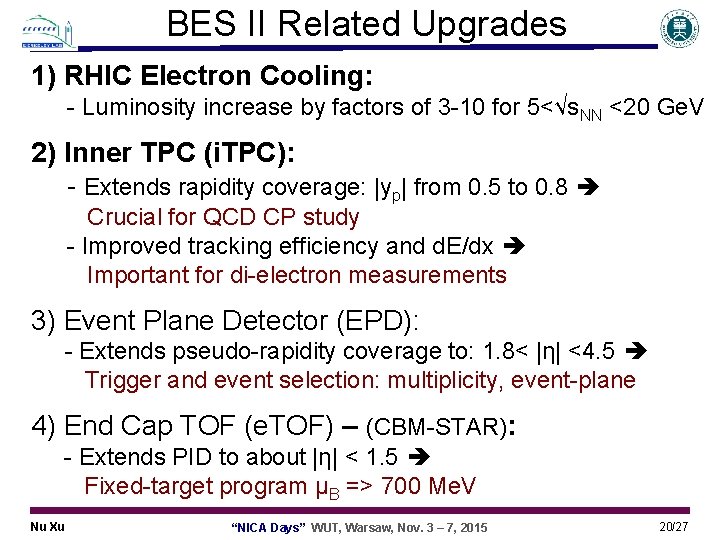
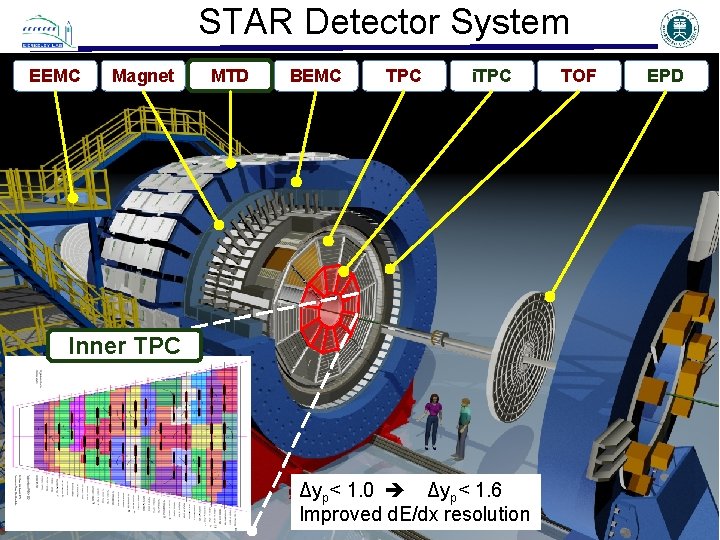
BES II Related Upgrades 1) RHIC Electron Cooling: - Luminosity increase by factors of 3 -10 for 5<√s. NN <20 Ge. V 2) Inner TPC (i. TPC): - Extends rapidity coverage: |yp| from 0. 5 to 0. 8 Crucial for QCD CP study - Improved tracking efficiency and d. E/dx Important for di-electron measurements 3) Event Plane Detector (EPD): - Extends pseudo-rapidity coverage to: 1. 8< |η| <4. 5 Trigger and event selection: multiplicity, event-plane 4) End Cap TOF (e. TOF) – (CBM-STAR): - Extends PID to about |η| < 1. 5 Fixed-target program μB => 700 Me. V Nu Xu “NICA Days” WUT, Warsaw, Nov. 3 – 7, 2015 20/27
STAR Detector System EEMC Magnet MTD BEMC TPC i. TPC TOF EPD Inner TPC Nu Xu Δyp< 1. 0 Δyp< 1. 6 Improved d. E/dx resolution “NICA Days” WUT, Warsaw, Nov. 3 – 7, 2015 21/27
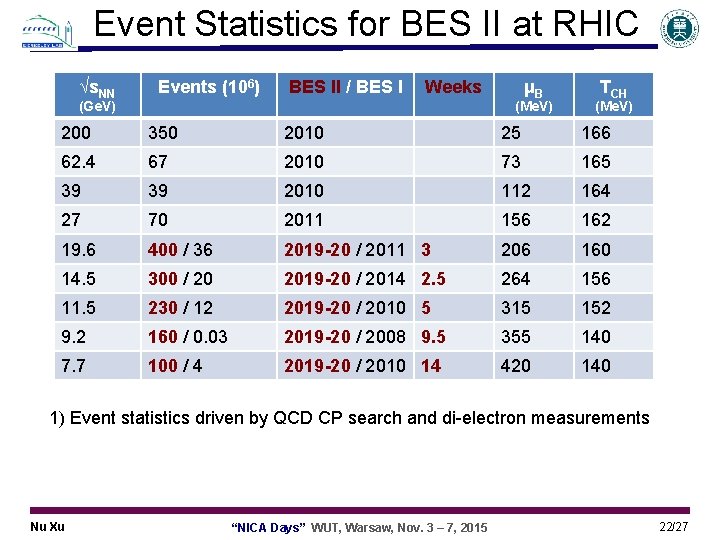
Event Statistics for BES II at RHIC √s. NN Events (106) BES II / BES I Weeks (Ge. V) μB (Me. V) TCH (Me. V) 200 350 2010 25 166 62. 4 67 2010 73 165 39 39 2010 112 164 27 70 2011 156 162 19. 6 400 / 36 2019 -20 / 2011 3 206 160 14. 5 300 / 20 2019 -20 / 2014 2. 5 264 156 11. 5 230 / 12 2019 -20 / 2010 5 315 152 9. 2 160 / 0. 03 2019 -20 / 2008 9. 5 355 140 7. 7 100 / 4 2019 -20 / 2010 14 420 140 1) Event statistics driven by QCD CP search and di-electron measurements Nu Xu “NICA Days” WUT, Warsaw, Nov. 3 – 7, 2015 22/27
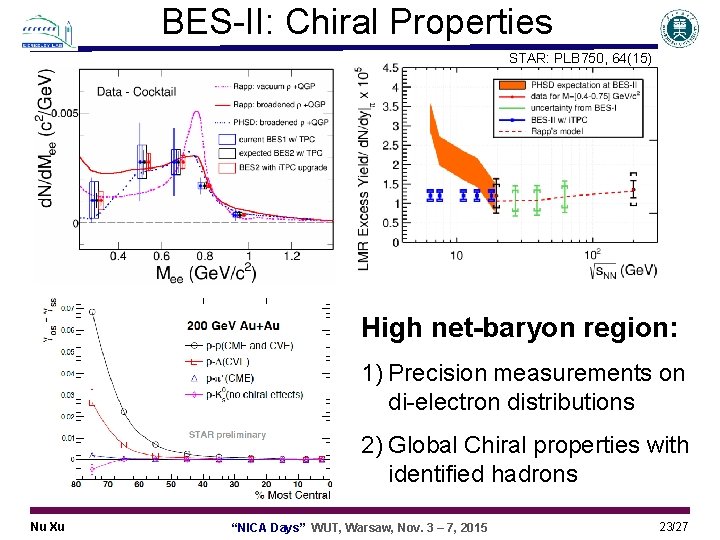
BES-II: Chiral Properties STAR: PLB 750, 64(15) High net-baryon region: 1) Precision measurements on di-electron distributions 2) Global Chiral properties with identified hadrons Nu Xu “NICA Days” WUT, Warsaw, Nov. 3 – 7, 2015 23/27
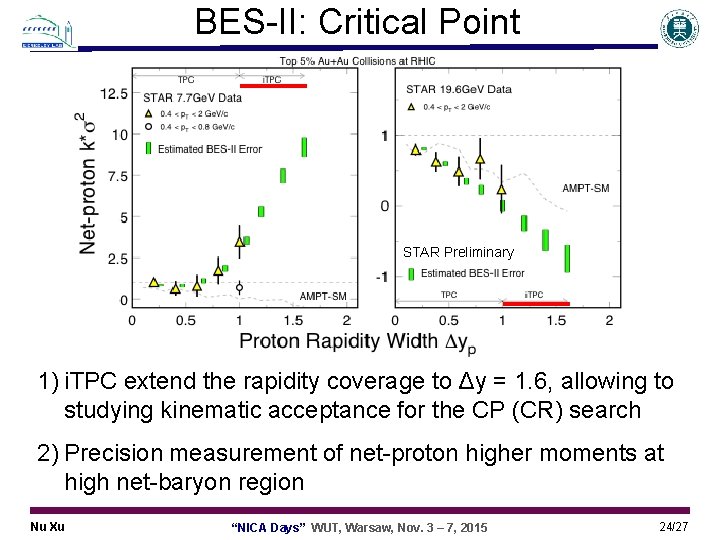
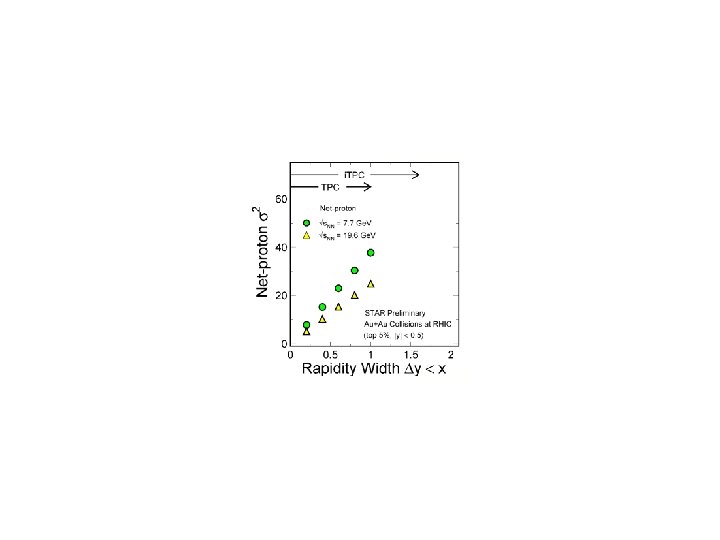
BES-II: Critical Point STAR Preliminary 1) i. TPC extend the rapidity coverage to Δy = 1. 6, allowing to studying kinematic acceptance for the CP (CR) search 2) Precision measurement of net-proton higher moments at high net-baryon region Nu Xu “NICA Days” WUT, Warsaw, Nov. 3 – 7, 2015 24/27
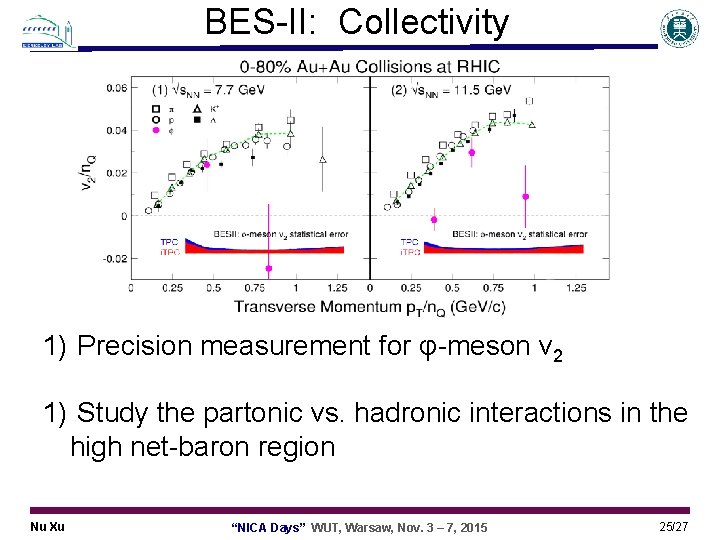
BES-II: Collectivity 1) Precision measurement for φ-meson v 2 1) Study the partonic vs. hadronic interactions in the high net-baron region Nu Xu “NICA Days” WUT, Warsaw, Nov. 3 – 7, 2015 25/27
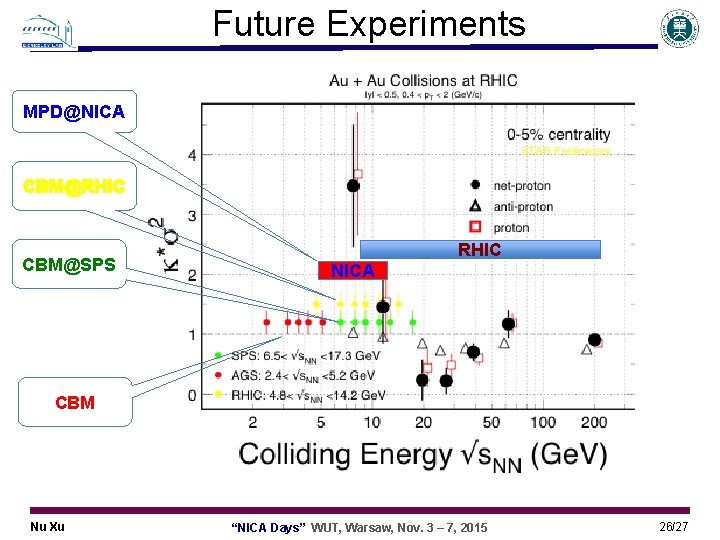
Future Experiments MPD@NICA CBM@RHIC CBM@SPS RHIC NICA CBM Nu Xu “NICA Days” WUT, Warsaw, Nov. 3 – 7, 2015 26/27
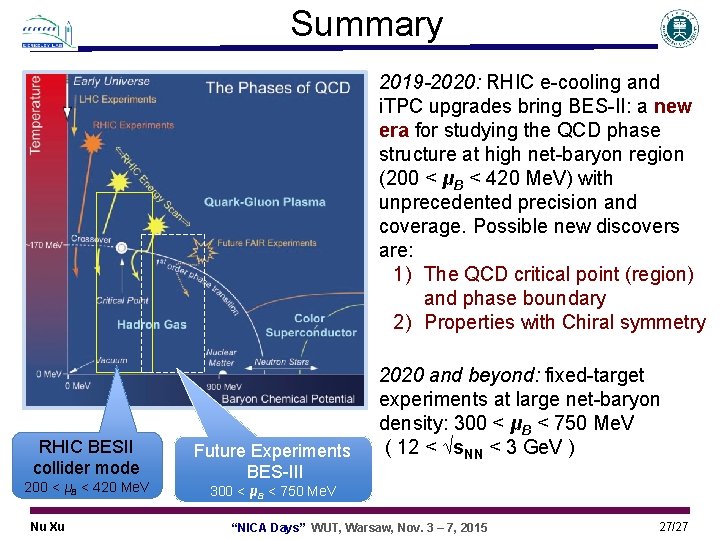
Summary 2019 -2020: RHIC e-cooling and i. TPC upgrades bring BES-II: a new era for studying the QCD phase structure at high net-baryon region (200 < μB < 420 Me. V) with unprecedented precision and coverage. Possible new discovers are: 1) The QCD critical point (region) and phase boundary 2) Properties with Chiral symmetry RHIC BESII collider mode 200 < μB < 420 Me. V Nu Xu Future Experiments BES-III 2020 and beyond: fixed-target experiments at large net-baryon density: 300 < μB < 750 Me. V ( 12 < √s. NN < 3 Ge. V ) 300 < μB < 750 Me. V “NICA Days” WUT, Warsaw, Nov. 3 – 7, 2015 27/27
Thank You!
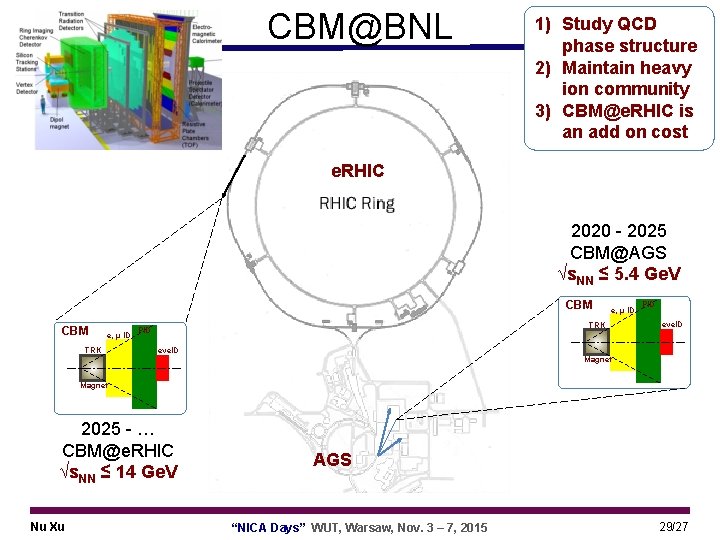
CBM@BNL 1) Study QCD phase structure 2) Maintain heavy ion community 3) CBM@e. RHIC is an add on cost e. RHIC 2020 - 2025 CBM@AGS √s. NN ≤ 5. 4 Ge. V CBM e, μ ID E, eve. ID TRK PID Magnet E, Magnet 2025 - … CBM@e. RHIC √s. NN ≤ 14 Ge. V Nu Xu AGS “NICA Days” WUT, Warsaw, Nov. 3 – 7, 2015 29/27
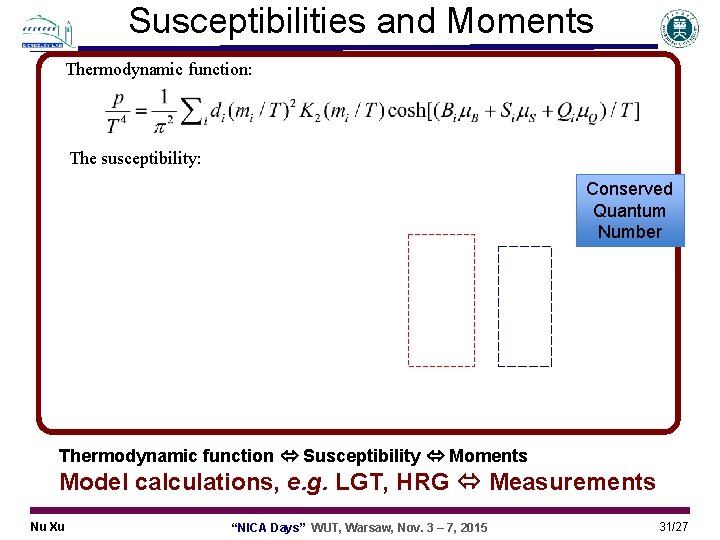
Susceptibilities and Moments Thermodynamic function: The susceptibility: Conserved Quantum Number Thermodynamic function Susceptibility Moments Model calculations, e. g. LGT, HRG Measurements Nu Xu “NICA Days” WUT, Warsaw, Nov. 3 – 7, 2015 31/27
The End of the Talk Beginning of New Era The Nu Xu “NICA Days” WUT, Warsaw, Nov. 3 – 7, 2015 32/27
Beam Energy Scan at RHIC Study QCD Phase Structure 2000 - 2010: Top energy programs Discovery of s. QGP 2010 – 2014: BES-I (7. 7, 11. 5, 14. 5, 19. 6, 27, 39 Ge. V ) - Phase boundary and CP - Chiral symmetry 2019 – 2020: BES-II √s. NN ≤ 20 Ge. V (1) Collectivity (2) Critical point* (critical region) (3) Chiral effects Nu Xu “NICA Days” WUT, Warsaw, Nov. 3 – 7, 2015 33/27