
Study Team Strategies Carousel Dyad Hot Potato Hot

- Slides: 30
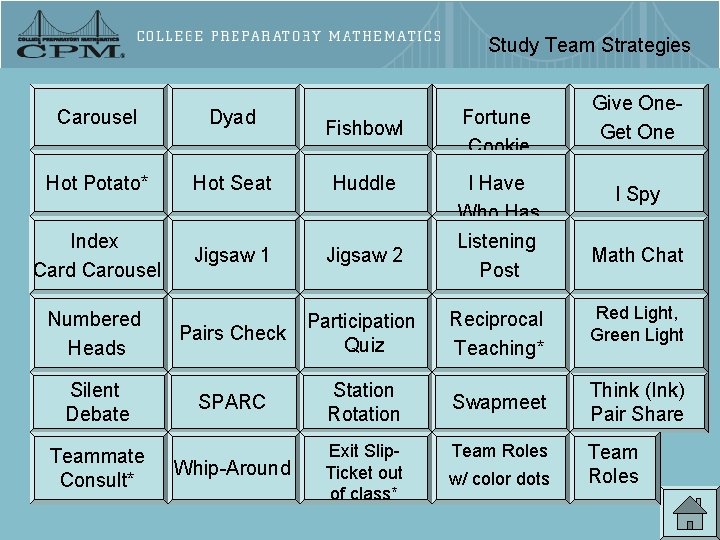
Study Team Strategies Carousel Dyad Hot Potato* Hot Seat Huddle Index Card Carousel Jigsaw 1 Jigsaw 2 Numbered Heads Pairs Check Participation Quiz Reciprocal Teaching* Silent Debate SPARC Station Rotation Swapmeet Whip-Around Exit Slip. Ticket out of class* Teammate Consult* Fishbowl Fortune Cookie I Have Who Has Listening Post Team Roles w/ color dots Give One. Get One I Spy Math Chat Red Light, Green Light Think (Ink) Pair Share Team Roles
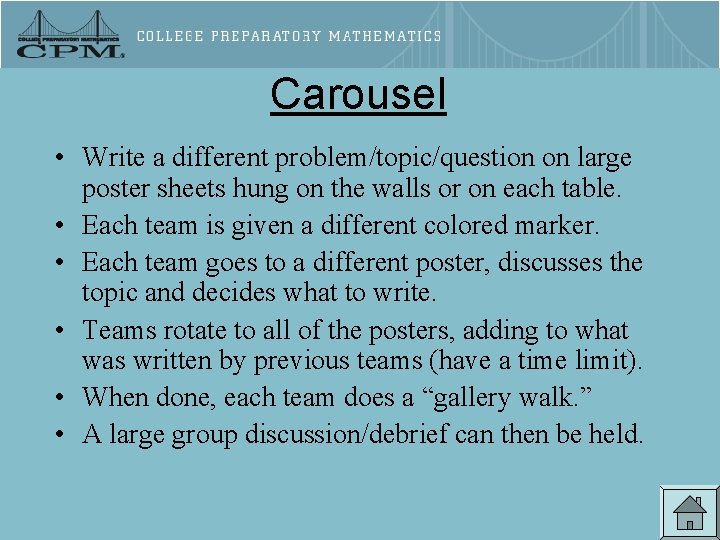
Carousel • Write a different problem/topic/question on large poster sheets hung on the walls or on each table. • Each team is given a different colored marker. • Each team goes to a different poster, discusses the topic and decides what to write. • Teams rotate to all of the posters, adding to what was written by previous teams (have a time limit). • When done, each team does a “gallery walk. ” • A large group discussion/debrief can then be held.
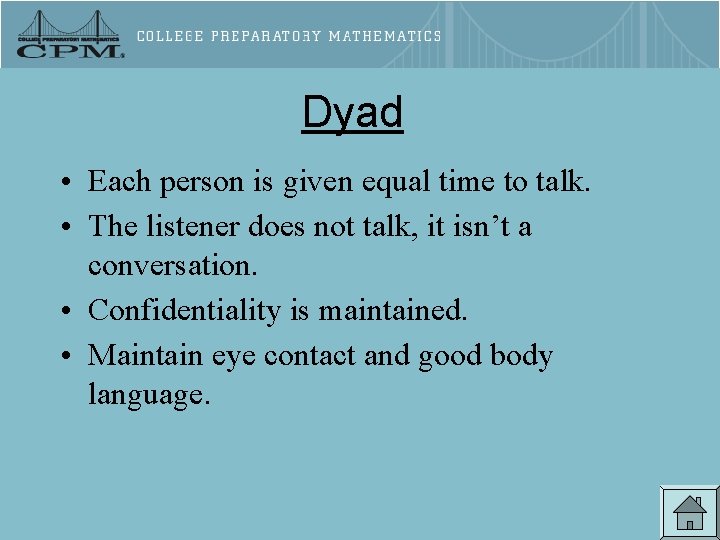
Dyad • Each person is given equal time to talk. • The listener does not talk, it isn’t a conversation. • Confidentiality is maintained. • Maintain eye contact and good body language.
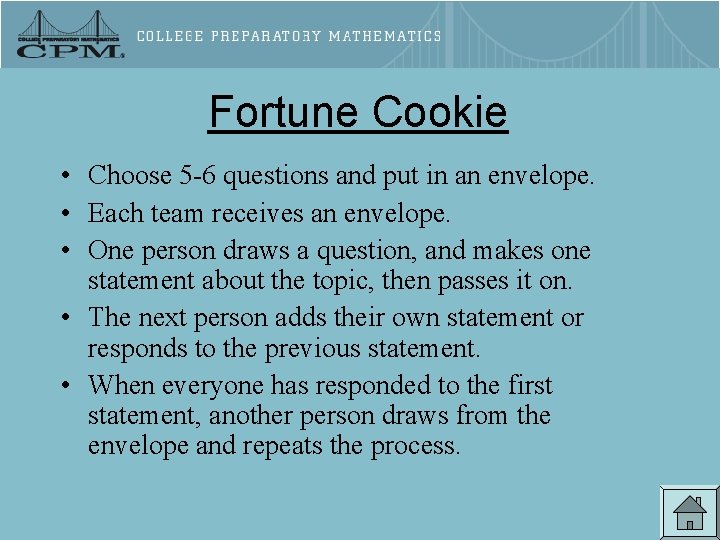
Fortune Cookie • Choose 5 -6 questions and put in an envelope. • Each team receives an envelope. • One person draws a question, and makes one statement about the topic, then passes it on. • The next person adds their own statement or responds to the previous statement. • When everyone has responded to the first statement, another person draws from the envelope and repeats the process.
Give One-Get One • Record three ideas to share related to a certain topic. • Circulate and share ideas; for every idea given they receive one in return and record these on a piece of paper – including the name of the author. • Begin group sharing by inviting a volunteer to share one idea received citing the author. The named person then continues the sharing process.
Hot Potato • Every team has one sheet of paper and each student has a different colored pencil. • A problem is given to the group. • Person 1 writes the first step of the solution process, explaining aloud, and passes the paper on to Person 2. • Person 2 makes any corrections and adds the next step, explaining aloud, and passes the paper on. • Process continues until the problem is competed.
Hot Seat • One chair/desk per team is set up in the front of the room. • Using Numbered Heads, Person #1 from each team comes to the front of the room and sits. • Teacher gives everyone a problem to work on in a specified amount of time. • Teams can talk, but not the individuals in front. • Check individual and team answers; two points for correct individual answers and 1 point for correct team answers. • Person #2 from each team is up next and repeat.
Huddle • One person from each team (teacher’s choice) is called to the front of the room. • Teacher gives a piece of information, checks for understanding…. • Student goes back to team to share.
I Have… Who Has • Each student has one card with problem and an answer to a different problem. • Student 1 asks “Who has…” and states the problem. • The person with the solution says “I have …. ” and states the answer. • The responding student then poses his problem and the student with the answer on his card responds. • The process continues until all the questions and responses have been given.
Index Card Carousel • Have the participants write one thing that they really need help with in their classroom - management, homework, getting kids to work, etc. • The card gets passed around with the other participants offering suggestions on how to solve the problem.
Jigsaw #1 • Each study team is assigned a different part of a larger topic/task. • The team researches and discusses the topic/task. • The team determines how to organize and present the information. • Each study team presents its part to the whole class.
Jigsaw #2 • Each study team member is assigned a different part of a task/topic. • Each member researches/learns about the task/topic (possibly with others with same topic). • Each member then presents the information to the others in his/her study team.
Listening Post • Students #1 and #2 work on a math problem aloud in their team. • Student #3 listens to the discussion and can ask clarifying math questions. • Student #4 only records what is discussed and verbalized (looks for attitudes) and may not talk. • After 15 minutes, work stops and student #4 shares notes and observations. • A variation is Students #1, #2, and #3 work and #4 observes and then shares.
Math Chat (Chalk Talk) • On poster paper, put the “center” topic of a concept map at the middle of each poster. • Students are given markers. • Without talking, students move from poster to poster adding to each concept map. • Give a warning when to stop writing. Then allow students to revisit each poster. • When it’s done, it’s done… No discussion.
Numbered Heads • Students number off in study team. • The team is given a problem to solve. • When the team finishes, use random numbers (1 -4) to ask questions or have team members share the solution process. • The numbers can also be used to assign roles.
Pairs Check • Each pair has one paper and pencil. • Student #1 writes what Student #2 explains OR Student #1 does the first problem while Student #2 only watches, listens and asks questions. • Then roles are reversed for the second problem. • Then each pair checks their work with the other study team pair. • Continue on to the next pair of problems.
Participation Quiz • Pick a group worthy task. • Tell students which norm you are focusing on. – Show teams how you are keeping track (overhead, posters, chalkboard). • Record comments while students are working. • Debrief (Do not need to record everything).
Reciprocal Teaching • In pairs, Person A pretends that Person B was absent and explains a concept. • Switch roles and continue.
Silent Debate • • • Student pairs: One is “pro”, the other “con. ” Each pair has one pencil and one sheet of paper. A topic is given, the pro goes first. The pro makes a supportive statement in writing. The con reads the statement and then writes a comment against the topic. • The process repeats 3 -4 times.
SPARC • • • Start promptly. Peer support expected within each team. Assignments due each day. Respond to group rather than individuals. Circulate.
Station Rotation • Have 1 -2 more stations than the number of student groups. • Place a sheet of review problems (4 -6) at each station. (Good idea to use a sheet protector). • Have a blank answer sheet at each station for each group. • The students work the problems as a group when they finish they turn in the station paper to the teacher and move to the next available station.
Swapmeet • When a group task is partially finished, one pair from each team rotates to the next team. • Pairs from the two teams share ideas, solutions, thinking… • Pairs return to their original teams and share what they learned.
Think-(Ink)-Pair-Share • Teacher poses a question/problem. • Without pencils, students think for 1 -2 minutes. • Students may then use pencil to begin working…without talking to partner. • Students then share their thinking and answer(s) with their partner. • Pairs then may share with larger group.
Teammates Consult • • • All pencils and calculators are set aside. Students read the problem or question. Give students individual think/work time. The problem is discussed by the team for clarity. Possible strategies are shared. Teacher gives okay for pencils to be picked up and written work to begin.
Whip-Around • Topic or question is presented. • Participants randomly have an opportunity to say something briefly about it. • Everyone does not have to comment but are encouraged to do so.
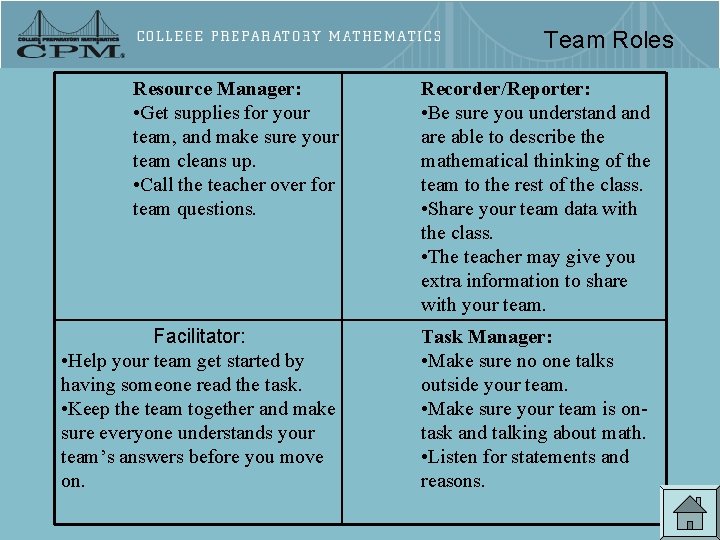
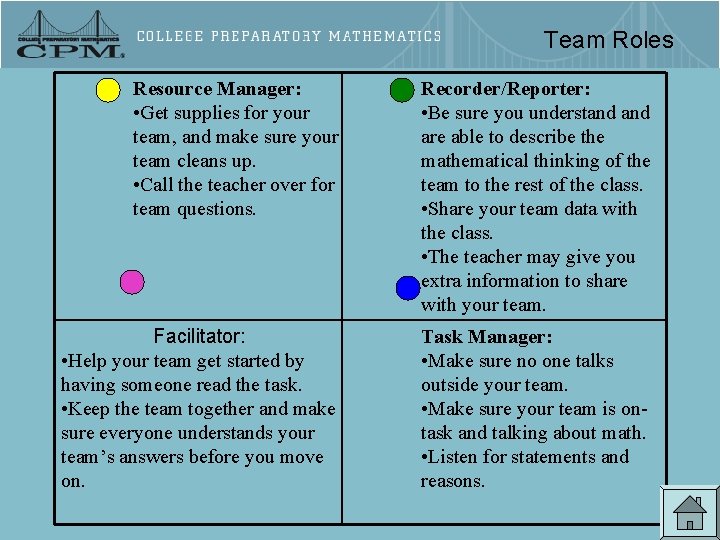
Team Roles Resource Manager: • Get supplies for your team, and make sure your team cleans up. • Call the teacher over for team questions. Facilitator: • Help your team get started by having someone read the task. • Keep the team together and make sure everyone understands your team’s answers before you move on. Recorder/Reporter: • Be sure you understand are able to describe the mathematical thinking of the team to the rest of the class. • Share your team data with the class. • The teacher may give you extra information to share with your team. Task Manager: • Make sure no one talks outside your team. • Make sure your team is ontask and talking about math. • Listen for statements and reasons.
Fishbowl • Used to model to whole class expected behaviors/norms • One or two teams sit in the middle of the class and works on the math problem • Rest of class stands near the team and observes or takes notes of how the team works, questions that are asked…. . • After 5 -10 minutes, the teams return to their own tables and work on the math problem
I Spy • When the team is stuck, one student (the Resource Manager) can go around to another team and listen in • Student reports back to the team what was learned
Red Light, Green Light • The team works together on a problem or set of problems. • When they finish the problem, then they must Stop. • The teacher verifies the work/answer with questions. • The team is then given permission to Go to the next problem or set of problems.
Team Roles Resource Manager: • Get supplies for your team, and make sure your team cleans up. • Call the teacher over for team questions. Facilitator: • Help your team get started by having someone read the task. • Keep the team together and make sure everyone understands your team’s answers before you move on. Recorder/Reporter: • Be sure you understand are able to describe the mathematical thinking of the team to the rest of the class. • Share your team data with the class. • The teacher may give you extra information to share with your team. Task Manager: • Make sure no one talks outside your team. • Make sure your team is ontask and talking about math. • Listen for statements and reasons.