
Study Skills Topic 14 Reading Rate Power Point


- Slides: 11
Study Skills Topic 14 Reading Rate Power. Point by Jo. Ann Yaworski © 2003 Pearson Education, Inc. , publishing as Longman Publishers.
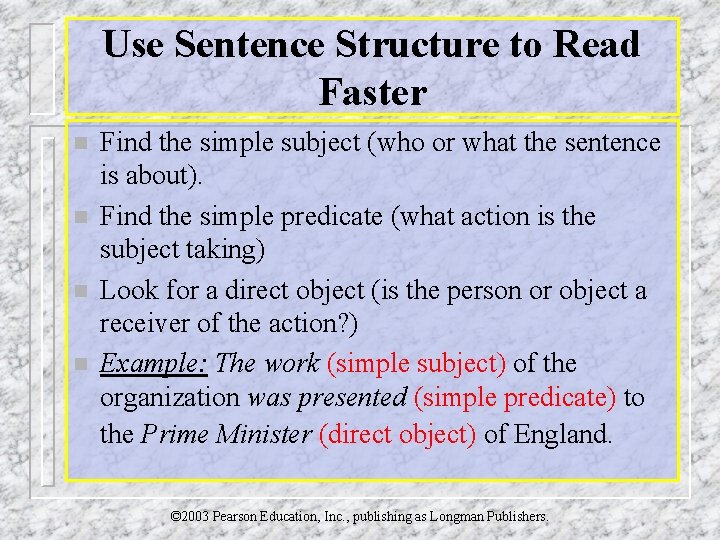
Use Sentence Structure to Read Faster n n Find the simple subject (who or what the sentence is about). Find the simple predicate (what action is the subject taking) Look for a direct object (is the person or object a receiver of the action? ) Example: The work (simple subject) of the organization was presented (simple predicate) to the Prime Minister (direct object) of England. © 2003 Pearson Education, Inc. , publishing as Longman Publishers.
Cluster Reading Increases Speed Mentally, break up each sentence into thought groups or clusters. n Example: n (The internet) (provides access) (to a world) (of knowledge. ) (It is easier now) (to find information) (than ever before. ) n © 2003 Pearson Education, Inc. , publishing as Longman Publishers.
Preview for Main Points Preview for main points by reading the: n Introduction or Chapter Objectives n Chapter headings n Chapter sub-headings n First and last sentences of paragraphs n Graphics (charts, graphs, diagrams, etc. ) n Summary or Conclusion © 2003 Pearson Education, Inc. , publishing as Longman Publishers.
Search for Examples are used to explain a point. As soon as the point and example are clear, move on to the next point. The following phrases introduce examples: § § § To illustrate For example Suppose For instance Such as © 2003 Pearson Education, Inc. , publishing as Longman Publishers.
Key Word Reading Skim for words that are related to the topic, or key words. n Scan for key words that are related to major headings and sub-headings. n Don’t read non-meaning words such as “a, ” “the, ” or “an. ” n Stop and read complete sentences only when more detail is necessary for understanding. n © 2003 Pearson Education, Inc. , publishing as Longman Publishers.
Skim to discover the Author’s Outline Determine the author’s outline by determining the overall textbook pattern for each section. n Common textbook patterns include: n – – – Term, Definition, and Example Topic with a List Cause/ Effect Comparison/ Contrast Problem/ Solution © 2003 Pearson Education, Inc. , publishing as Longman Publishers.
Suggestions for Increasing Speed (1) n Pace your reading with an index card, pen, or pencil. n Keep track of your speed with a timer or alarm clock. n Keep a record of your time, the amount your read, and your words per minute. © 2003 Pearson Education, Inc. , publishing as Longman Publishers.
Suggestions for Increasing Speed (2) n n Slow reading speed if comprehension is below 70%. Maintain your reading speed if your comprehension is between 70% and 90%. Push yourself to read faster if your comprehension is above 90%. Start with material that is highly interesting and gradually choose material that is more difficult or less interesting. © 2003 Pearson Education, Inc. , publishing as Longman Publishers.
Rereading for Rate Increase n n n Read an article or passage as you normally would. Time yourself and compute your speed in words per minute. Take a break and then reread the same selection. Push yourself to read faster than you had read the first time. Time yourself and compute your speed once again. © 2003 Pearson Education, Inc. , publishing as Longman Publishers.
Visit the Longman Study Skills Web Site http: //www. ablongman. com/studyskills © 2003 Pearson Education, Inc. , publishing as Longman Publishers.