
Study skills TESTTAKING STRATEGIES TestTaking Strategies Five Day





- Slides: 50
Study skills TEST-TAKING STRATEGIES
Test-Taking Strategies Five Day Test Preparation Plan Multiple Choice Tests True/False Tests Matching Tests Completion Tests QUOTE Strategy for Taking Tests 2
Five Day Test Preparation Plan Day 5 Read textbook & class notes Look at any handouts from your class Highlight the information in your notes & handouts that you will need to know Day 4 Use mnemonic techniques and practice what you will need to know 3
Five Day Test Preparation Plan Day 3 Rewrite the information in a brief form using the fewest words possible Use the mnemonic strategies to review your rewritten notes at least twice per day Day 2 Think of questions your teacher might ask you on the test Write each question and answer 4
Five Day Test Preparation Plan Day 1 The Day of the test! Review rewritten notes from day 3 Review questions & answers from day 2 You can do these things while eating breakfast, riding to school, or eating lunch Just before the test, go over any information you are having difficulty remembering 5
Multiple Choice Tests Weeding out absolute words; Recognizing “umbrella” (or “fusion” ) questions; 6
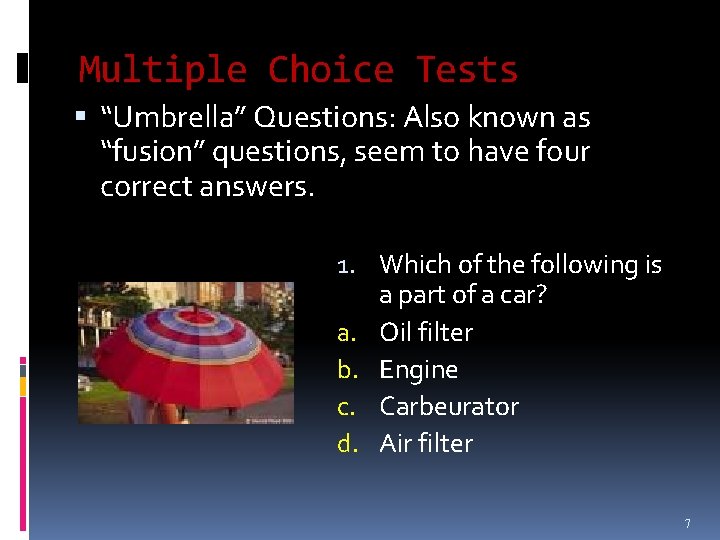
Multiple Choice Tests “Umbrella” Questions: Also known as “fusion” questions, seem to have four correct answers. 1. Which of the following is a part of a car? a. Oil filter b. Engine c. Carbeurator d. Air filter 7
Multiple Choice Tests The correct answer is “B”, engine. You probably noticed that all of these choices look like “good” answers. This is a clue that you have an umbrella, or “fusion” question. The clue is that three of the answers fit within the category of the fourth. In this case, carbeurator, air filter and oil filter are all parts of the engine, so “engine” is the correct answer. You may also notice that “engine” is a more general term than the others. Let’s try another… 8
Which of the following is a part of the human leg? a. The femur b. The thigh Right away, you probably recognized that these are ALL part of a leg, so how do you decide. This is an example of another “umbrella” question. c. The quadriceps d. The hamstrings 9
The Answer Is… “B”, the thigh, because the others are all part of the thigh, which again is also the most general of the terms. 10
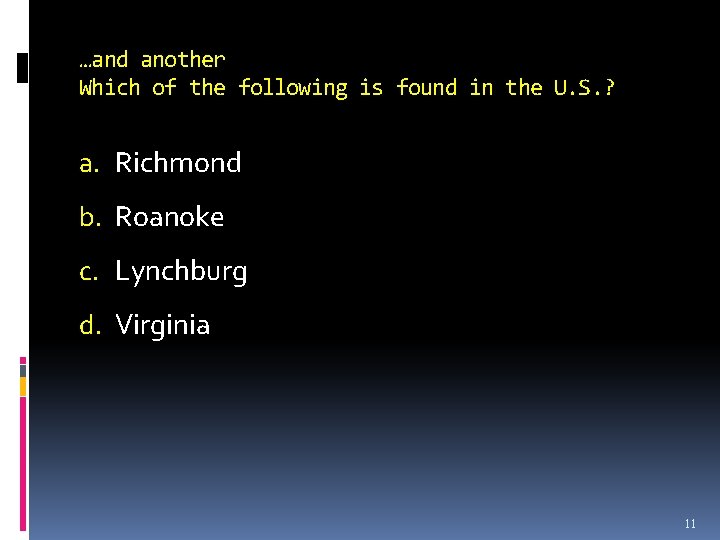
…and another Which of the following is found in the U. S. ? a. Richmond b. Roanoke c. Lynchburg d. Virginia 11
And the Answer IS… You probably got that one right! It’s “D”, Virginia, because the others are located in Virginia. 12
Absolute Words Another obstacle to taking multiple choice tests is when absolute words appear in the choices. At the right is a list of some absolute words. These usually make a sentence false. None Never All Always Every day Only Must 13
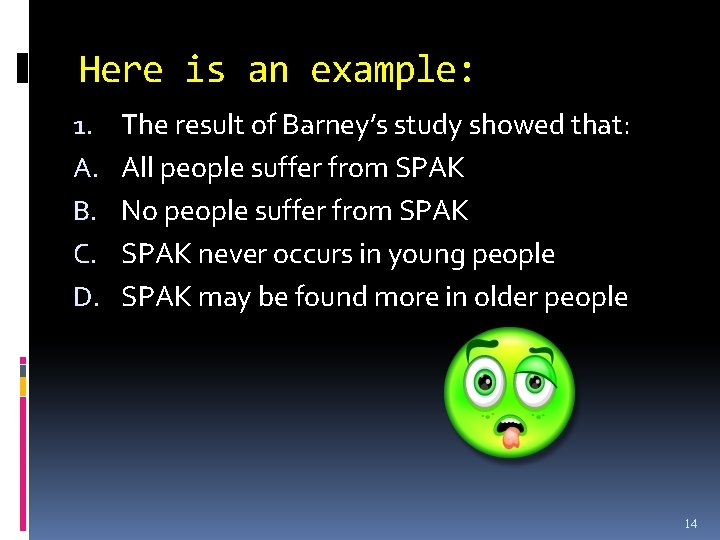
Here is an example: 1. A. B. C. D. The result of Barney’s study showed that: All people suffer from SPAK No people suffer from SPAK never occurs in young people SPAK may be found more in older people 14
The answer is “ 4” Did you notice that choices 1, 2 and 3 contained the absolute words “all”, “no”, and “never”. In general, absolute words limit too many options to be good choices for an answer. The correct choice, however, was more general – it contained the word “may”. 15
Here is another example: People with chronic disease can be described as: a. Inevitably in pain b. Always grouchy c. Never able to walk d. Needing more assistance 16
The Answer is… Can we really say that these people are ALWAYS grouchy or INEVITABLY in pain or NEVER able to walk? Of course not. The correct answer is “D”, “needing more assistance. ” 17
What about unfamiliar words? Some MP questions are phrased using words you have never heard. They may even be made-up words. Most students “freak out” when they see those words, and decide to guess at the answer. However, this is another test of your deductive reasoning. If you ignore the strange word, does the question still make sense? Can you answer it without knowing what the word means? …. 18
Let’s take a look…. You are treating a patient with Kupe’s disease. When comparing cotylenol to bitylenol, which of the following would be the most appropriate intervention for this patient? a. Cotylenol is more appropriate b. Bitylenol is more appropriate c. Bitylenol is not as appropriate d. Both a and b 19
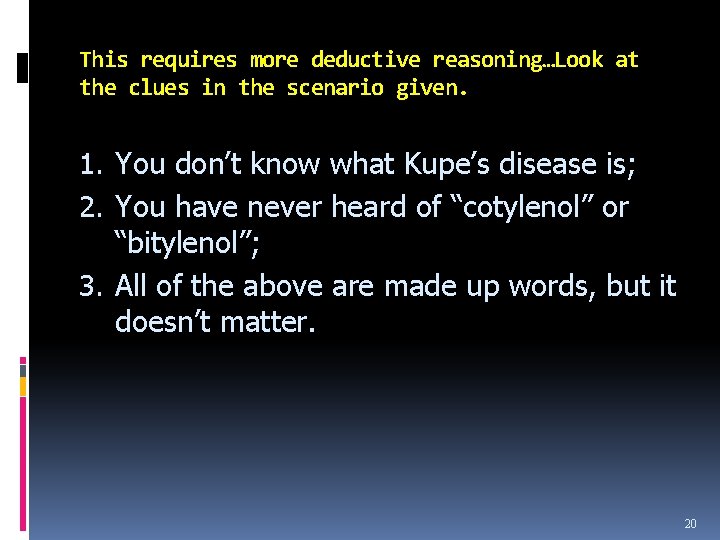
This requires more deductive reasoning…Look at the clues in the scenario given. 1. You don’t know what Kupe’s disease is; 2. You have never heard of “cotylenol” or “bitylenol”; 3. All of the above are made up words, but it doesn’t matter. 20
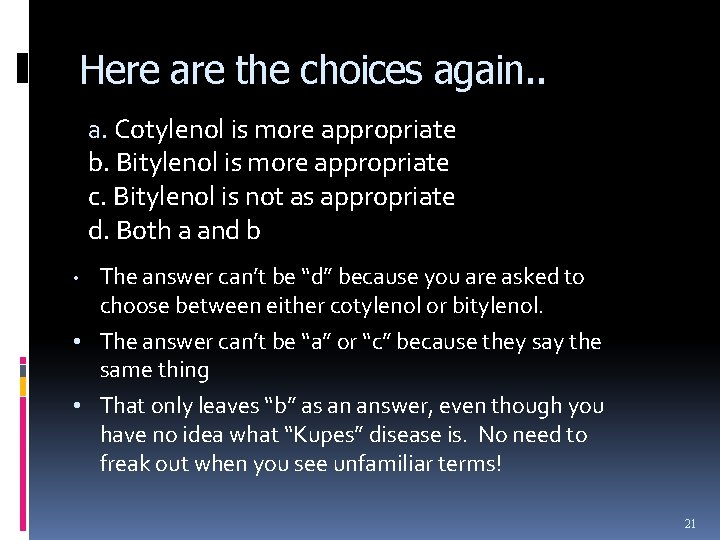
Here are the choices again. . a. Cotylenol is more appropriate b. Bitylenol is more appropriate c. Bitylenol is not as appropriate d. Both a and b The answer can’t be “d” because you are asked to choose between either cotylenol or bitylenol. • The answer can’t be “a” or “c” because they say the same thing • That only leaves “b” as an answer, even though you have no idea what “Kupes” disease is. No need to freak out when you see unfamiliar terms! • 21
The more complex question asks you to: Prioritize the answers in some order (most important, best, last, first, initial, etc. ); Use deductive reasoning; Also use your content knowledge; Compare only the answers that are given 22
The Power of Panic A person who panics… Relies on instincts instead of knowledge Lacks an understanding of exam content What happens when you panic? Memory is inhibited Ability to focus decreases Tend to overlook stated facts Easily become confused Emotions take precedence over reason Guessing is not strategic 23
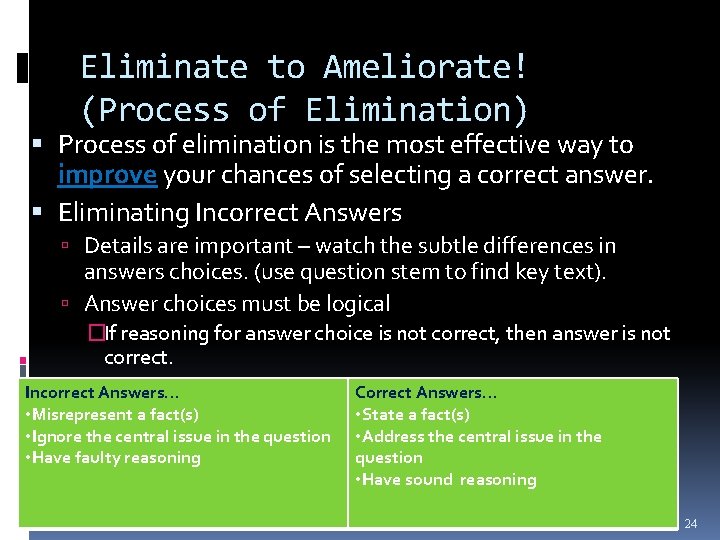
Eliminate to Ameliorate! (Process of Elimination) Process of elimination is the most effective way to improve your chances of selecting a correct answer. Eliminating Incorrect Answers Details are important – watch the subtle differences in answers choices. (use question stem to find key text). Answer choices must be logical �If reasoning for answer choice is not correct, then answer is not correct. Incorrect Answers… • Misrepresent a fact(s) • Ignore the central issue in the question • Have faulty reasoning Correct Answers… • State a fact(s) • Address the central issue in the question • Have sound reasoning 24
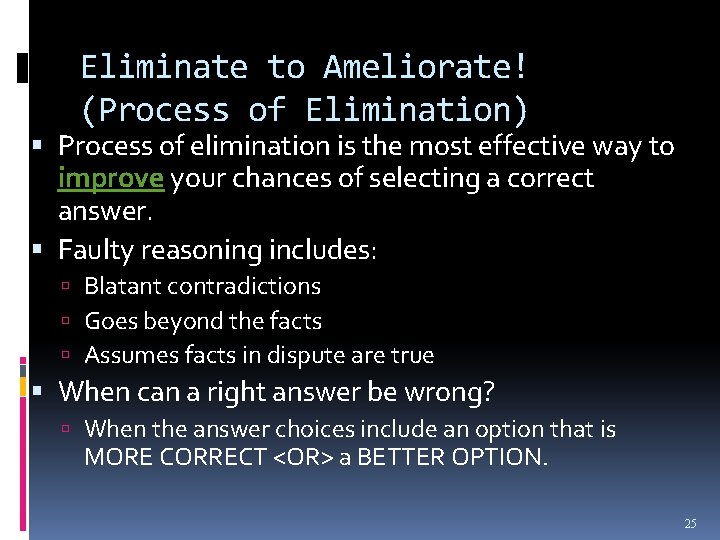
Eliminate to Ameliorate! (Process of Elimination) Process of elimination is the most effective way to improve your chances of selecting a correct answer. Faulty reasoning includes: Blatant contradictions Goes beyond the facts Assumes facts in dispute are true When can a right answer be wrong? When the answer choices include an option that is MORE CORRECT <OR> a BETTER OPTION. 25
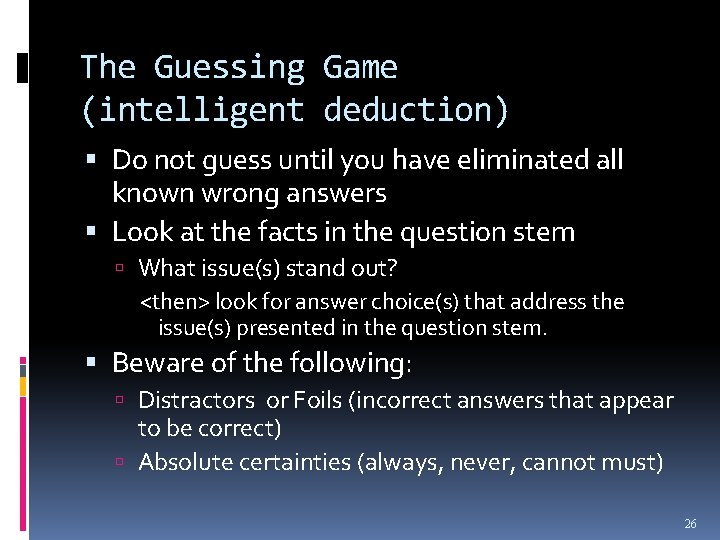
The Guessing Game (intelligent deduction) Do not guess until you have eliminated all known wrong answers Look at the facts in the question stem What issue(s) stand out? <then> look for answer choice(s) that address the issue(s) presented in the question stem. Beware of the following: Distractors or Foils (incorrect answers that appear to be correct) Absolute certainties (always, never, cannot must) 26
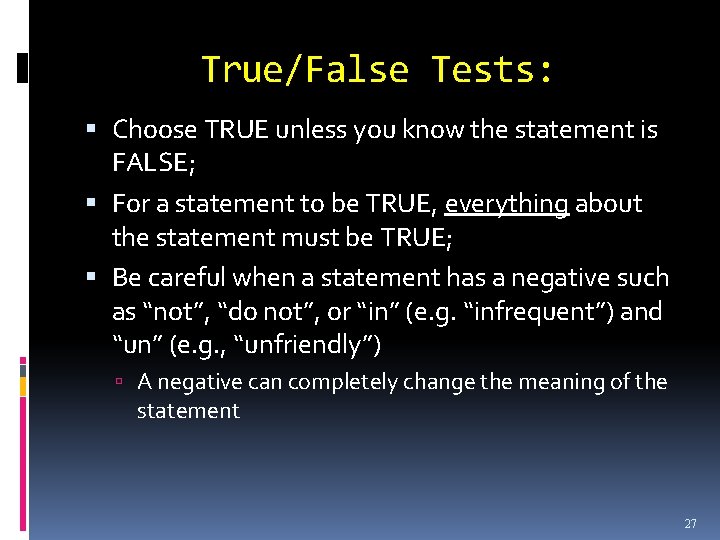
True/False Tests: Choose TRUE unless you know the statement is FALSE; For a statement to be TRUE, everything about the statement must be TRUE; Be careful when a statement has a negative such as “not”, “do not”, or “in” (e. g. “infrequent”) and “un” (e. g. , “unfriendly”) A negative can completely change the meaning of the statement 27
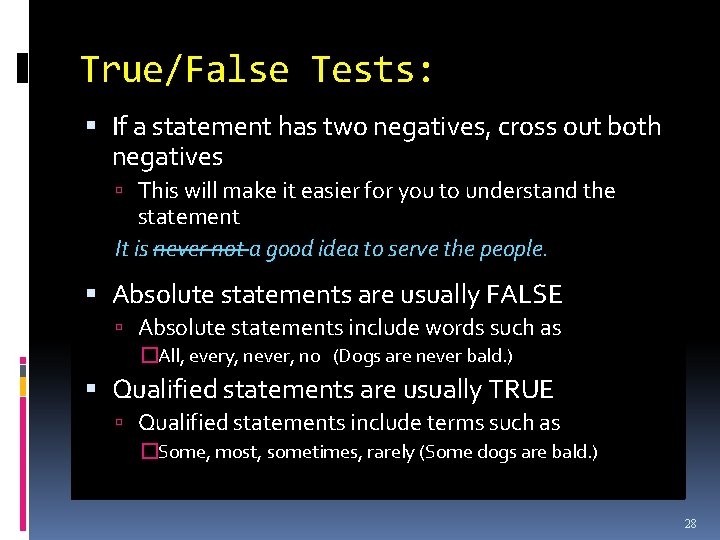
True/False Tests: If a statement has two negatives, cross out both negatives This will make it easier for you to understand the statement It is never not a good idea to serve the people. Absolute statements are usually FALSE Absolute statements include words such as �All, every, never, no (Dogs are never bald. ) Qualified statements are usually TRUE Qualified statements include terms such as �Some, most, sometimes, rarely (Some dogs are bald. ) 28
Answer these T/F questions: It is never not a bad idea to sleep late. People in the middle ages were always short. Some of the Shawnee Indians were astrologers. All of the students have a GPA over 2. 5. None of the scientists believe in God. 29
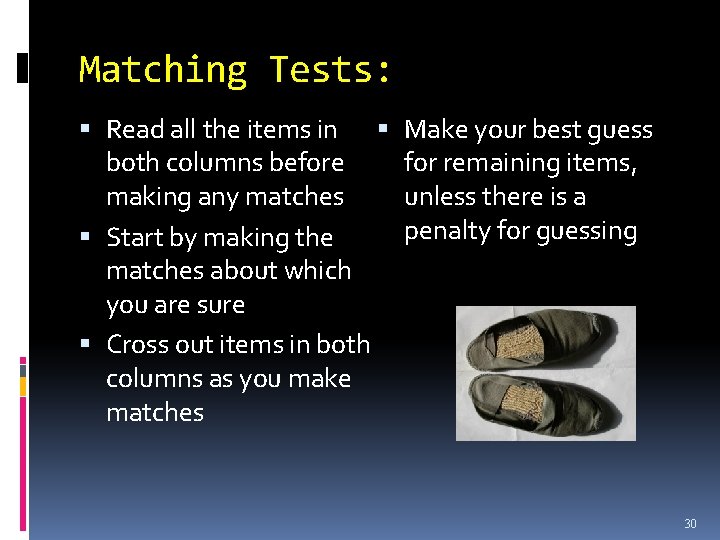
Matching Tests: Read all the items in both columns before making any matches Start by making the matches about which you are sure Cross out items in both columns as you make matches Make your best guess for remaining items, unless there is a penalty for guessing 30
Completion Tests: Read the item and think about what is missing Write an answer that logically completes the item Be sure your answer fits the item grammatically Use the length of the line as a clue to the length of the answer Unless the length of the blank is the same for all answers After you write the answer, read the entire answer to make sure it makes sense. 31
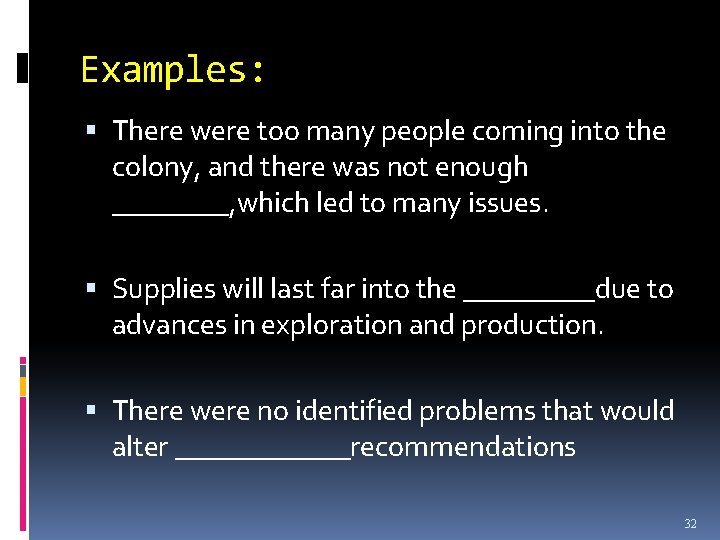
Examples: There were too many people coming into the colony, and there was not enough ____, which led to many issues. Supplies will last far into the _____due to advances in exploration and production. There were no identified problems that would alter ______recommendations 32
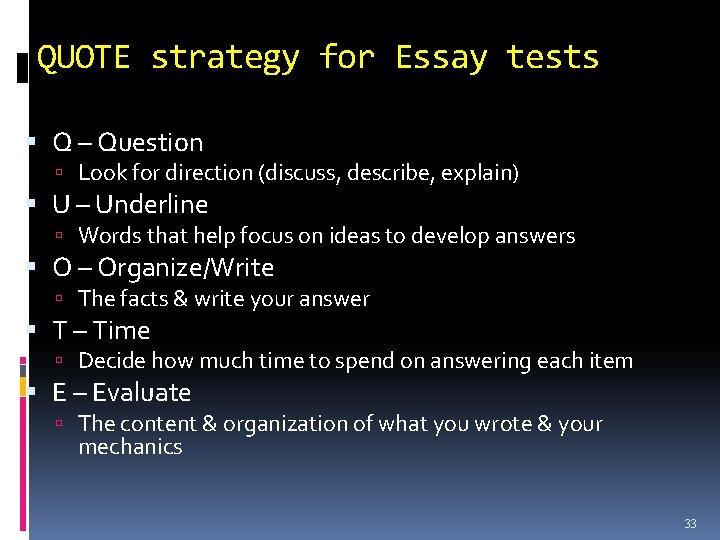
QUOTE strategy for Essay tests Q – Question Look for direction (discuss, describe, explain) U – Underline Words that help focus on ideas to develop answers O – Organize/Write The facts & write your answer T – Time Decide how much time to spend on answering each item E – Evaluate The content & organization of what you wrote & your mechanics 33
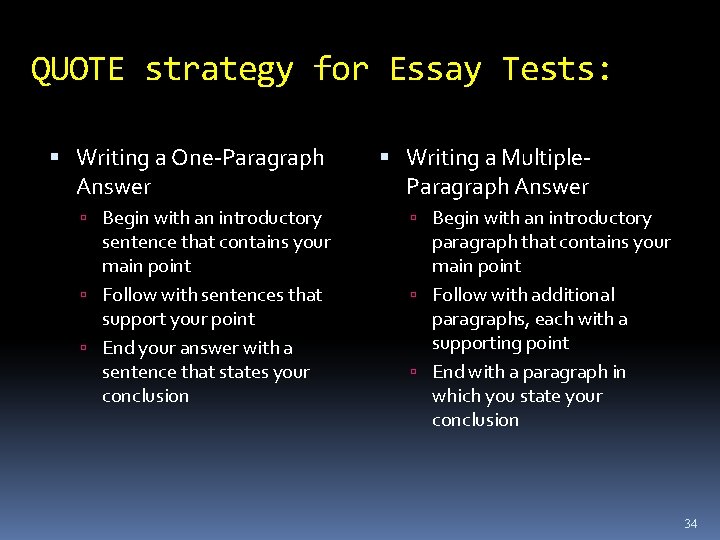
QUOTE strategy for Essay Tests: Writing a One-Paragraph Answer Begin with an introductory sentence that contains your main point Follow with sentences that support your point End your answer with a sentence that states your conclusion Writing a Multiple. Paragraph Answer Begin with an introductory paragraph that contains your main point Follow with additional paragraphs, each with a supporting point End with a paragraph in which you state your conclusion 34
Mnemonics The Art of Remembering
Mnemonics A weird word that means “memory tool”. Mnemonics are methods for remembering information that is otherwise difficult to recall. Mnemonics use as many of the best functions of your brain as possible to store information. 36
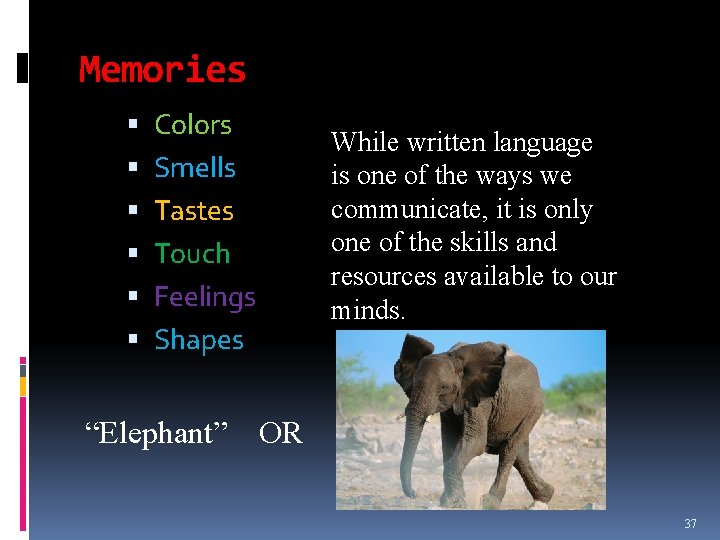
Memories Colors Smells Tastes Touch Feelings Shapes “Elephant” While written language is one of the ways we communicate, it is only one of the skills and resources available to our minds. OR 37
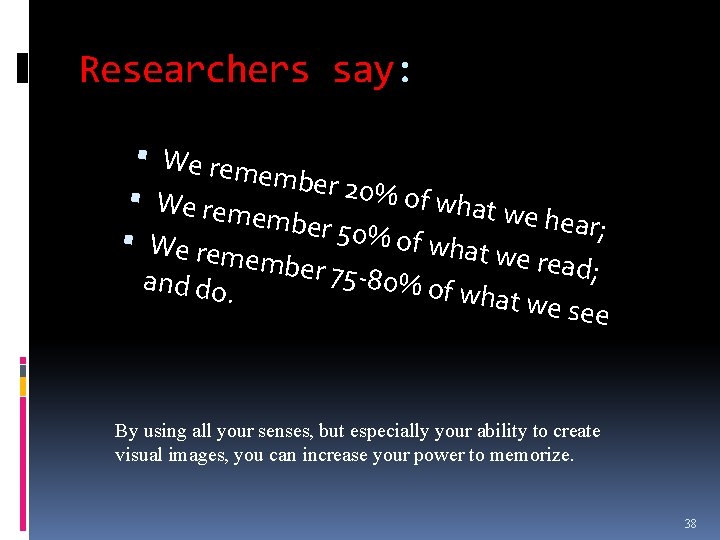
Researchers say: We re member 20% of w We re hat we h member e ar; 5 0 % of what We re we read member ; 75 -80% and do. of what we see By using all your senses, but especially your ability to create visual images, you can increase your power to memorize. 38
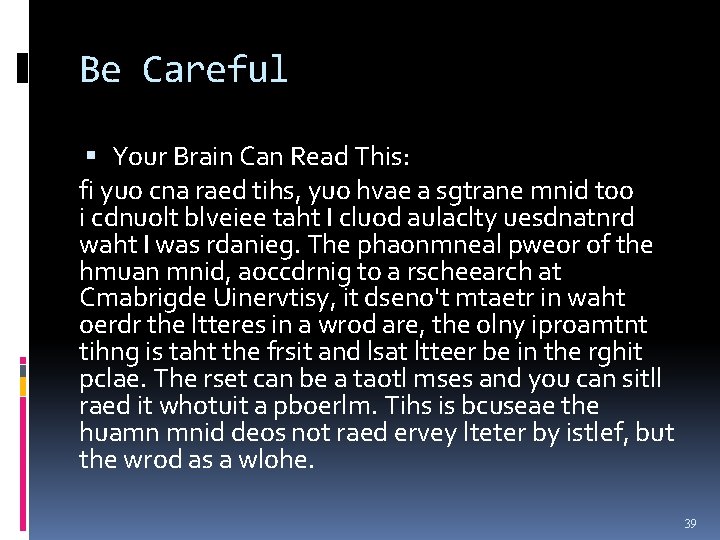
Be Careful Your Brain Can Read This: fi yuo cna raed tihs, yuo hvae a sgtrane mnid too i cdnuolt blveiee taht I cluod aulaclty uesdnatnrd waht I was rdanieg. The phaonmneal pweor of the hmuan mnid, aoccdrnig to a rscheearch at Cmabrigde Uinervtisy, it dseno't mtaetr in waht oerdr the ltteres in a wrod are, the olny iproamtnt tihng is taht the frsit and lsat ltteer be in the rghit pclae. The rset can be a taotl mses and you can sitll raed it whotuit a pboerlm. Tihs is bcuseae the huamn mnid deos not raed ervey lteter by istlef, but the wrod as a wlohe. 39
What tricks do you use? “I before e, except after c” HOMES S-U-C-C-E-S-S “ 30 days hath September…. ” Tying a string around your finger 40
Now you can start making up your own mnemonic devices Recommended: Breakthrough Learning (1995) by Scott Bornstein • Use positive pleasant images • Use vivid colorful silly images • Use three-dimensional images • Exaggerate the size of the images • Use humor • Use symbols (traffic lights, pointing finger) 41
Some Mnemonic Devices 1. The Similar Traits Technique 2. Peg Systems 3. Forming Sentences from the 1 st letters of the words 4. The Link & Story Method 42
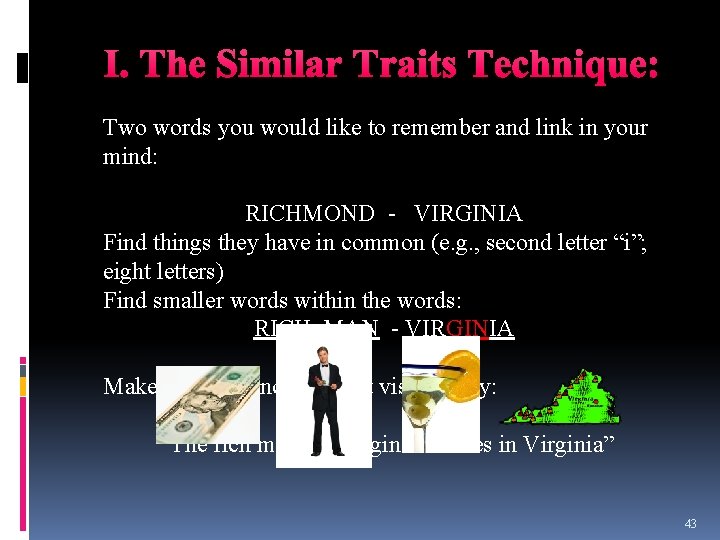
I. The Similar Traits Technique: Two words you would like to remember and link in your mind: RICHMOND - VIRGINIA Find things they have in common (e. g. , second letter “i”; eight letters) Find smaller words within the words: RICH MAN - VIRGINIA Make up a sentence or short visual/story: “The rich man drinks gin and lives in Virginia” 43
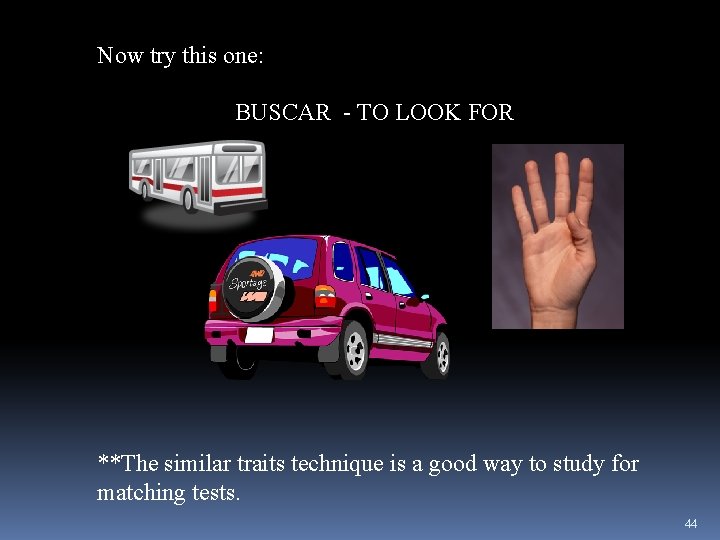
Now try this one: BUSCAR - TO LOOK FOR **The similar traits technique is a good way to study for matching tests. 44
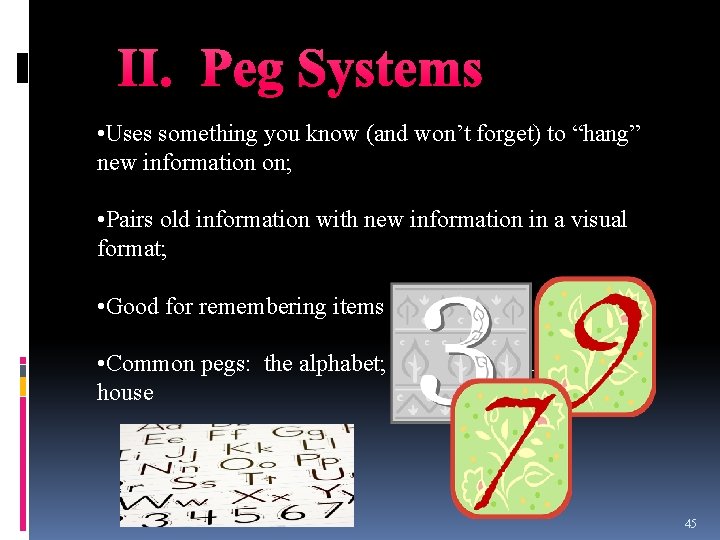
II. Peg Systems • Uses something you know (and won’t forget) to “hang” new information on; • Pairs old information with new information in a visual format; • Good for remembering items in order; • Common pegs: the alphabet; numbers; furniture in your house 45
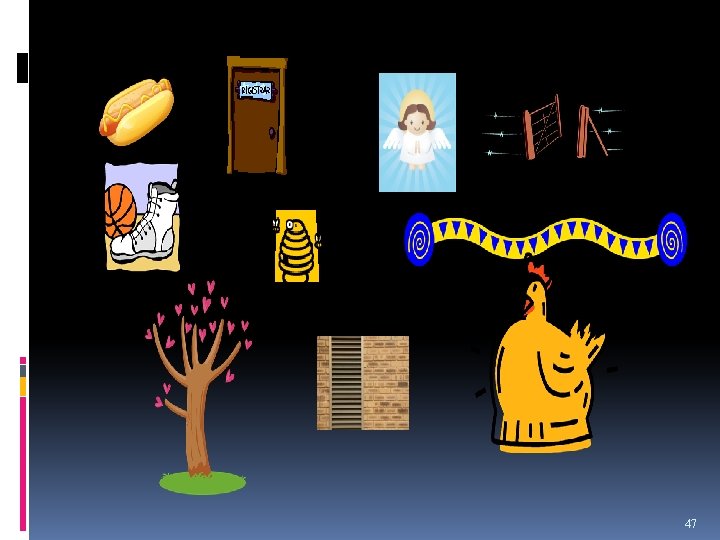
A. The Number-Rhyme Peg System You need to remember: 1. Bun (“one is a bun”) 6. Bricks 2. Shoe (“two is a shoe”) 7. Heaven 3. Tree (“three is a tree”) 8. Gate 4. Door “etc. 9. Line 5. Hive 10. Hen Form a picture in your mind of each item. Make the picture vivid, detailed, and colorful. 46
47
II. Forming Sentences with First Letters In this technique, which most students have learned in school, the first letters of a list of words that need to be remembered are taken out to form a silly sentence or another word that is easy to remember. For example, if one is trying to remember the planets of the solar system: Mercury, Venus, Earth, Mars, Jupiter Saturn, Uranus, Neptune, Pluto 48
The Great Lakes: Huron, Ontario, Michigan, Eerie, Superior =H O M E S 49
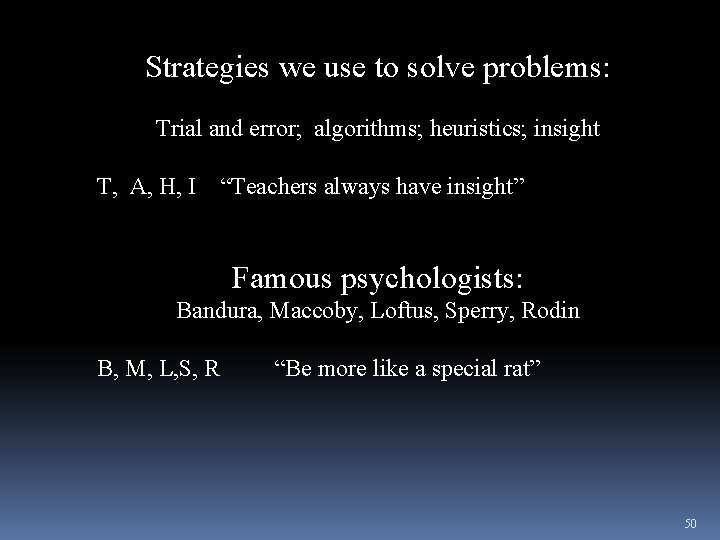
Strategies we use to solve problems: Trial and error; algorithms; heuristics; insight T, A, H, I “Teachers always have insight” Famous psychologists: Bandura, Maccoby, Loftus, Sperry, Rodin B, M, L, S, R “Be more like a special rat” 50