
Study Skills NoteTaking to Remember Critical Reading for
Study Skills Note-Taking to Remember Critical Reading for Learning
Cornell Notes Note-Taking to Remember “Typically, I just jot down some notes but the memories of these notes are fleeting. With Cornell notes, I actually had to slow myself down and think about what I wrote and what I remembered to complete the actual notes. ” --Eric, Allen High School 11 th Grader

The Curve of Forgetting University of Waterloo, Counselling Services, adapted by AVID
Why Cornell notes? This is about mastering information, not just recording facts. Adapted from AVID “When this class first started, I absolutely dreaded doing Cornell Notes. But as we started to practice Cornell Notes, I realized they weren’t so bad. I actually really liked the idea of going back daily to study the notes and writing a summary to cover the whole idea. I like them so much that I even bought a Cornell Notes journal…”

What do Cornell notes look like? Before After
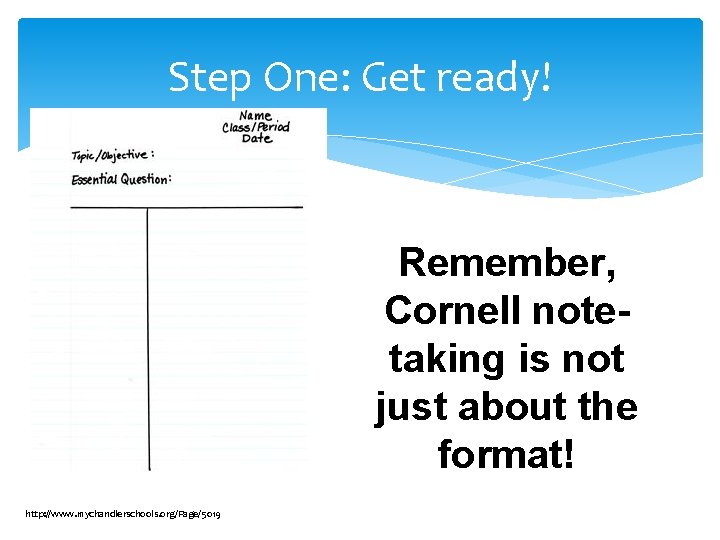
Step One: Get ready! Remember, Cornell notetaking is not just about the format! http: //www. mychandlerschools. org/Page/5019
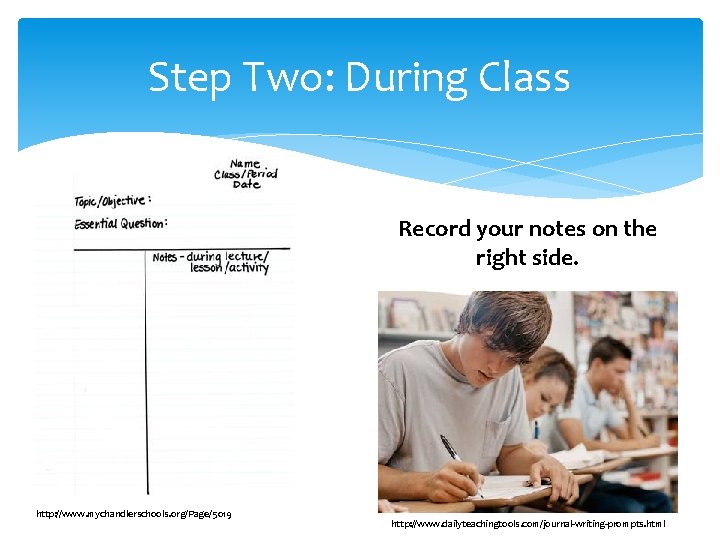
Step Two: During Class Record your notes on the right side. http: //www. mychandlerschools. org/Page/5019 http: //www. dailyteachingtools. com/journal-writing-prompts. html
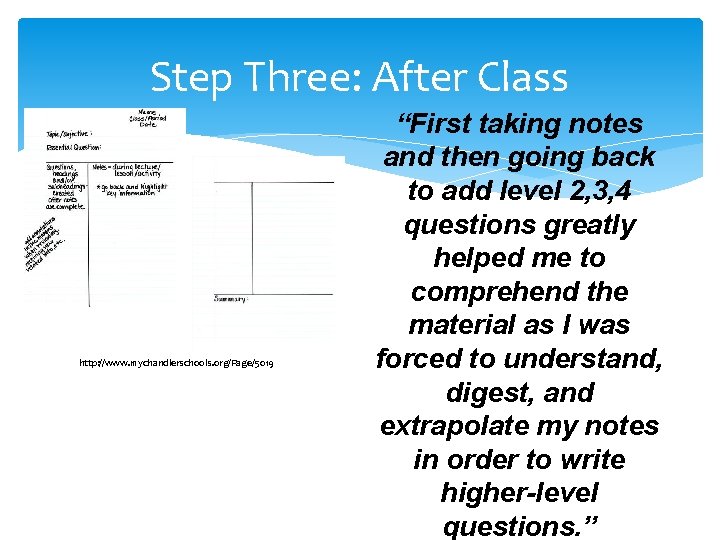
Step Three: After Class http: //www. mychandlerschools. org/Page/5019 “First taking notes and then going back to add level 2, 3, 4 questions greatly helped me to comprehend the material as I was forced to understand, digest, and extrapolate my notes in order to write higher-level questions. ”

Step Four: Recite, Review, Reflect http: //www. helpingwritersbecomeauthors. com/2013/03/why-youneed-to-be-excited-about-every. html http: //www. mychandlerschools. org/Page/5019 “Since I do a first round of notes, then the 2 nd round for questions, + the 3 rd round for summary, I get to review the information 3 times to enhance my understanding. ”
Resources for More Information Dartmouth College: http: //www. dartmouth. edu/~acskills/success/notes. html University of Texas Medical Branch: https: //shp. utmb. edu/asa/Forms/cornell%20 note%20 taking%20 system. pdf Cornell University: http: //lsc. cornell. edu/LSC_Resources/cornellsystem. pdf University of Texas at Dallas: http: //www. utdallas. edu/~dodge/ECS 1200/Lec 3. pdf Texas A&M University: http: //www. tamusa. tamus. edu/studentengagementsuccess/jaguaracademicguideforsucc ess/studytipsandtechniques. html Harvard University: http: //hilt. harvard. edu/blog/note-taking-tools-and-tips Costa’s Levels of Thinking and Questioning: http: //hms. d 300. org/sites/hms. d 300. org/files/documents/costa-question-starters 0. pdf
Critical Reading & Annotation “Before… all I did was highlight because I was terrified of deciding what was important. Now I completely forego the highlighter and my notes on the side, as well as my underlining, tell me not only what information I found important but why I found it essential to my learning. ” - Hayley, AHS 11 th grader
Critical Reading = Active engagement and interaction with texts Research shows that students who read deliberately retain more information and “I may be retain it longer. reading texts slower, but I Makes reading meaningful and only have to eliminates need to re-read. [read] once. A Increases comprehension in every single, subject. efficient run Takes practice (and modeling) to learn to through is better than do steps simultaneously and quickly. several hasty Slows reading, giving time to speed reads. ” - Vincent, comprehend and process information.
Previewing Are there headnotes, an abstract or prefatory material? Do you know the author? Do his credentials provide information about him or the topic? Does the editor provide introductory information? What is the layout of the text? Is the text broken into meaningful subtopics? Does the organization tell you anything about the line of inquiry?
Annotating Throw away your highlighter! Mark up the margins of the text with words and phrases: ideas that occur to you, noting what is important, connections with other ideas, and questions you have. Develop your own symbol system: * a key idea, or use an ! for surprising ideas. Your personal set of consistent hieroglyphics allows you to mark important insights quickly as you read. Get in the habit of hearing yourself ask questions and write those in the margins.
Outline, Summarize, Analyze Outlining enables you to see the skeleton of the argument (right “It helps me column). tie information Summarizing takes the skeleton and into Cornell makes connections through paragraph Notes, as I get form (summary). the nonsense out of the Analyzing adds an evaluation of the way. ” writers assertions and supporting - Evan, AHS evidence and then allows you to apply 11 th grader your own reaction to the ideas (left column).
Look for Repetitions and Patterns How is the language chosen, used and positioned in the text? Look for recurring images, repeated words or phrases, consistent ways of characterizing people or events. This may signal important points or possible author biases.
Contextualize Consider the information in the context of historical, cultural, material, or intellectual circumstances. Does this inform your understanding or how you view the information? “When I do this, I become more active and enjoy the stuff I am reading about. ” - Eric, AHS 11 th grader
Compare and Contrast How does this support main themes in the course? “This helped Does it affirm or contrast with other me readings? Does it expand on prior understand that my readings or shift the course of inquiry? response to a Why do you think your teacher assigned piece has value, and this reading at this point in the course? should be Has your thinking been altered by this recorded as reading? well. ” - Madison, AHS 11 th
The best way to ensure your students are reading critically and processing information in meaningful ways in your course is to: • Model these steps with a class text. • Demonstrate a verbal “think aloud” to model the thinking behind annotating.
- Slides: 19