
Study Skills Chapter 8 9 Learning from Textbooks
Study Skills- Chapter 8 & 9 Learning from Textbooks and Lectures
Contents I. Learning and Studying Strategies II. Learning from Textbooks III. Learning from Lectures
I. Learning and Studying Strategies Preparation Motivation Note-taking and long-term memory Steps in learning strategies: before, during and after.
Trọng tâm của phần phát triển chiến lược học tập trung vào những phương pháp cụ thể để phát huy khả năng học, ghi nhớ, chuẩn bị và thi cử. Cần lưu ý những điều sau: - Sự chuẩn bị thi cử: Sự chuẩn bị này nên bắt đầu ngay khi sinh viên ghi chú và đọc chương đầu tiên của môn học chứ không phải bắt đầu khi giáo viên công bố lịch thi. Sinh viên càng nắm rõ nội dung của từng bài học trong khóa học thì sự chuẩn bị cho thi cử càng dễ dàng hơn. - Động lực: Hãy luôn tự hỏi mục tiêu của khóa học là gì? Tôi hiểu bài học này tới mức độ nào và có khả năng giải thích nội dung cho người khác không? - Ghi chú: Lưu ý rằng việc ghi chú tài liệu và việc ghi nhớ những ghi chú ấy hoàn toàn khác biệt. Bạn đọc và ghi chú nhiều không có nghĩa là bạn nhớ tất cả những ghi chú ấy. Bạn cần phát triển từng bước học những ghi chú đó và tổ chức các thông tin sao chúng được lưu trữ vào bộ nhớ lâu dài. - 3 bước trong chiến lược học mà bạn cần ghi nhớ: trước khi học, trong khi học và sau khi học xong. Điều này bao gồm chuẩn bị bài học, tập trung vào những dấu hiệu bài giảng để nắm bắt ý chính và sau đó nhìn lại toàn bộ cấu trúc bài giảng hoặc tài liệu. Hãy nhớ rằng người học có thể học tốt nhất khi nhận ra cấu trúc tổ chức nội dung hơn là học thuộc những thông tin riêng lẻ.
II. Learning from Textbooks 1. What does research tell us about good readers? 2. What learning strategies can I use to improve my reading comprehension and retention?
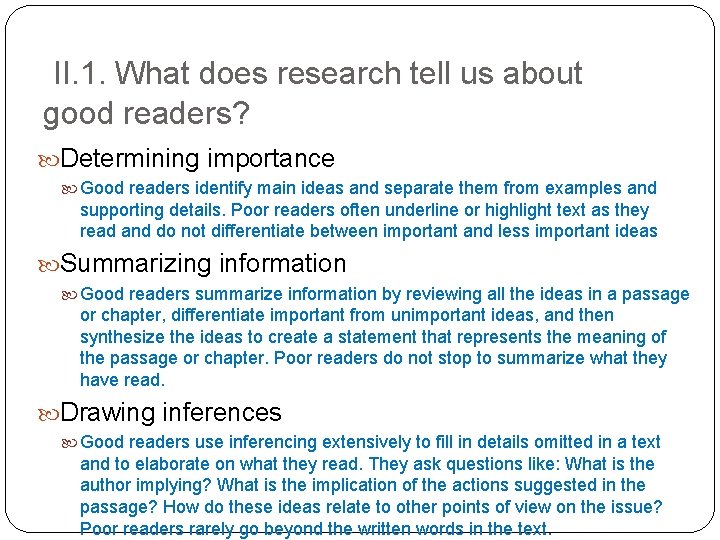
II. 1. What does research tell us about good readers? Determining importance Good readers identify main ideas and separate them from examples and supporting details. Poor readers often underline or highlight text as they read and do not differentiate between important and less important ideas Summarizing information Good readers summarize information by reviewing all the ideas in a passage or chapter, differentiate important from unimportant ideas, and then synthesize the ideas to create a statement that represents the meaning of the passage or chapter. Poor readers do not stop to summarize what they have read. Drawing inferences Good readers use inferencing extensively to fill in details omitted in a text and to elaborate on what they read. They ask questions like: What is the author implying? What is the implication of the actions suggested in the passage? How do these ideas relate to other points of view on the issue? Poor readers rarely go beyond the written words in the text.
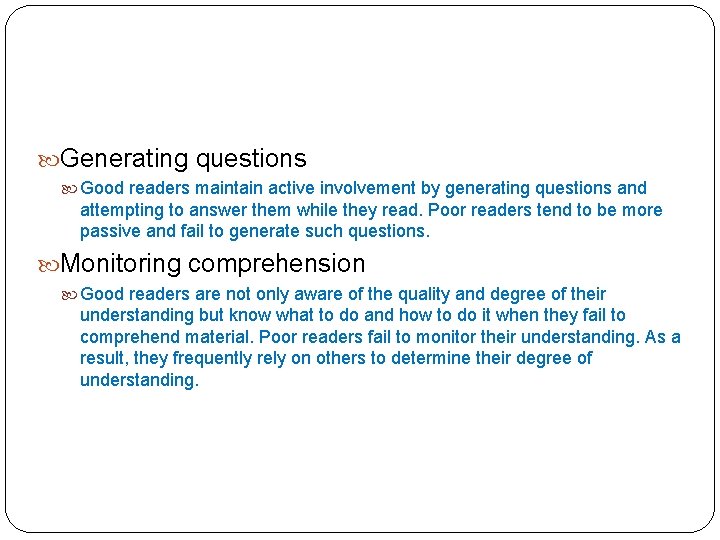
Generating questions Good readers maintain active involvement by generating questions and attempting to answer them while they read. Poor readers tend to be more passive and fail to generate such questions. Monitoring comprehension Good readers are not only aware of the quality and degree of their understanding but know what to do and how to do it when they fail to comprehend material. Poor readers fail to monitor their understanding. As a result, they frequently rely on others to determine their degree of understanding.
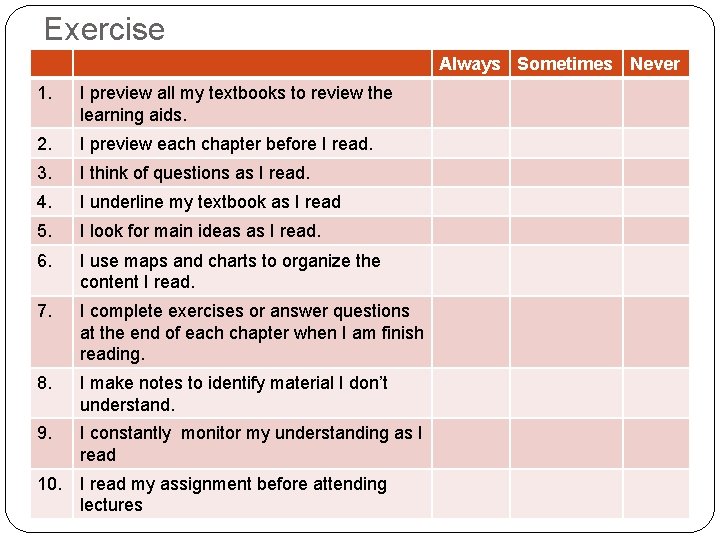
Exercise Always Sometimes Never 1. I preview all my textbooks to review the learning aids. 2. I preview each chapter before I read. 3. I think of questions as I read. 4. I underline my textbook as I read 5. I look for main ideas as I read. 6. I use maps and charts to organize the content I read. 7. I complete exercises or answer questions at the end of each chapter when I am finish reading. 8. I make notes to identify material I don’t understand. 9. I constantly monitor my understanding as I read 10. I read my assignment before attending lectures
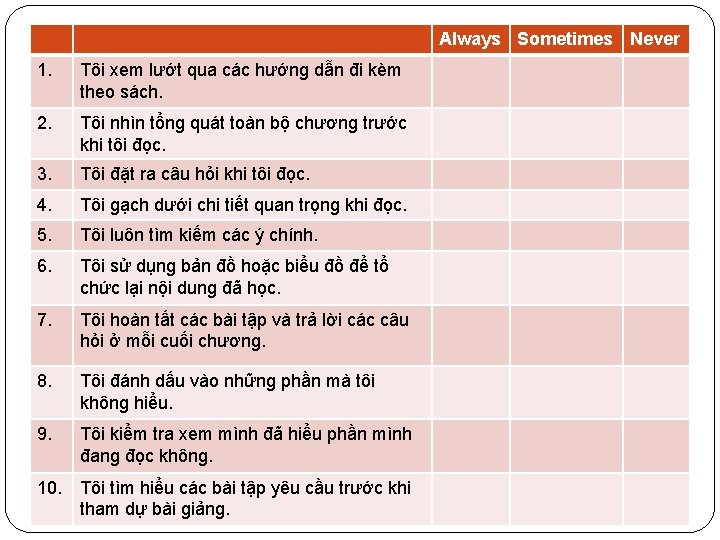
Always Sometimes Never 1. Tôi xem lướt qua các hướng dẫn đi kèm theo sách. 2. Tôi nhìn tổng quát toàn bộ chương trước khi tôi đọc. 3. Tôi đặt ra câu hỏi khi tôi đọc. 4. Tôi gạch dưới chi tiết quan trọng khi đọc. 5. Tôi luôn tìm kiếm các ý chính. 6. Tôi sử dụng bản đồ hoặc biểu đồ để tổ chức lại nội dung đã học. 7. Tôi hoàn tất các bài tập và trả lời các câu hỏi ở mỗi cuối chương. 8. Tôi đánh dấu vào những phần mà tôi không hiểu. 9. Tôi kiểm tra xem mình đã hiểu phần mình đang đọc không. 10. Tôi tìm hiểu các bài tập yêu cầu trước khi tham dự bài giảng.
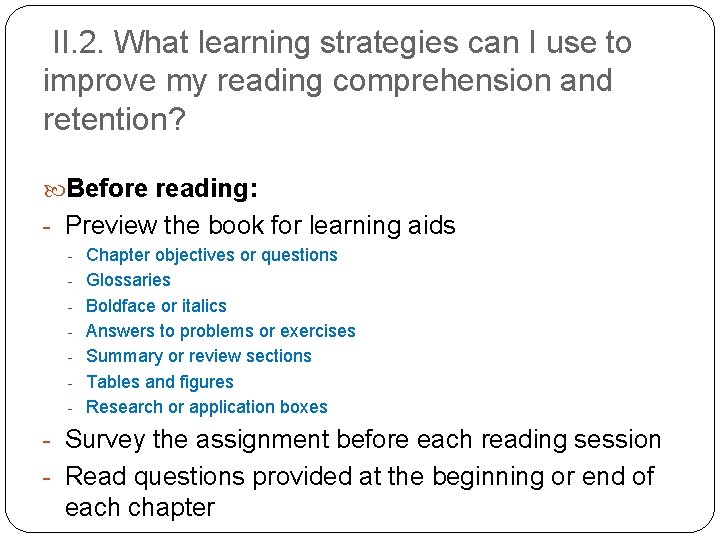
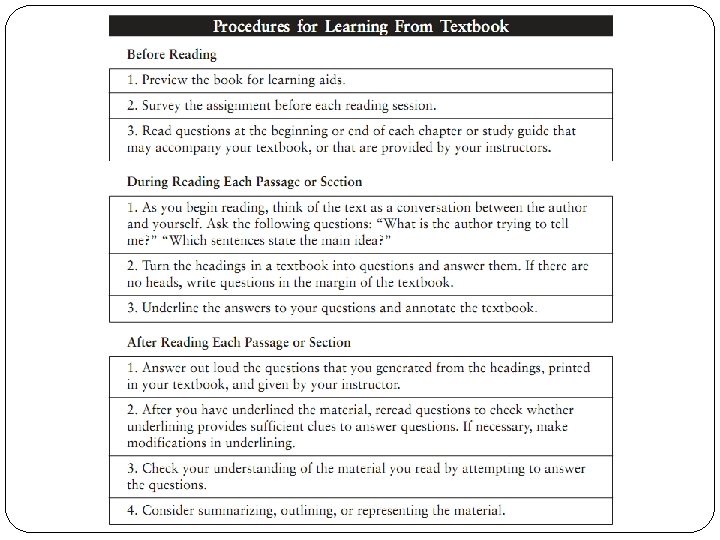
II. 2. What learning strategies can I use to improve my reading comprehension and retention? Before reading: - Preview the book for learning aids - Chapter objectives or questions - Glossaries - Boldface or italics - Answers to problems or exercises - Summary or review sections - Tables and figures - Research or application boxes - Survey the assignment before each reading session - Read questions provided at the beginning or end of each chapter
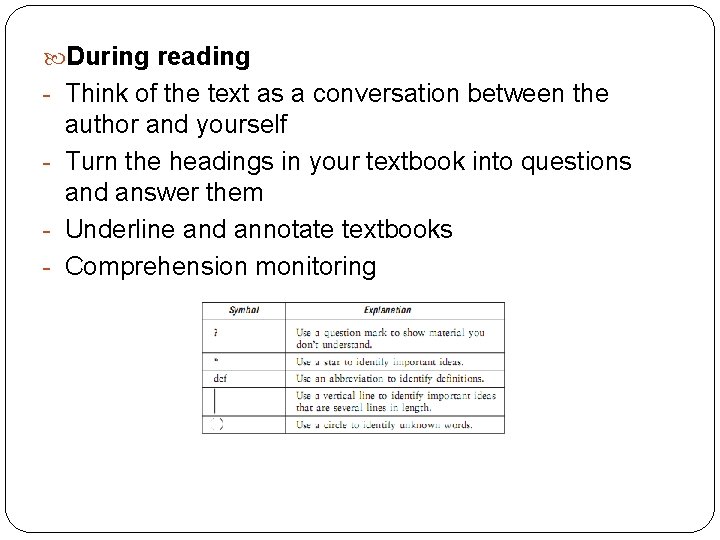
During reading - Think of the text as a conversation between the author and yourself - Turn the headings in your textbook into questions and answer them - Underline and annotate textbooks - Comprehension monitoring
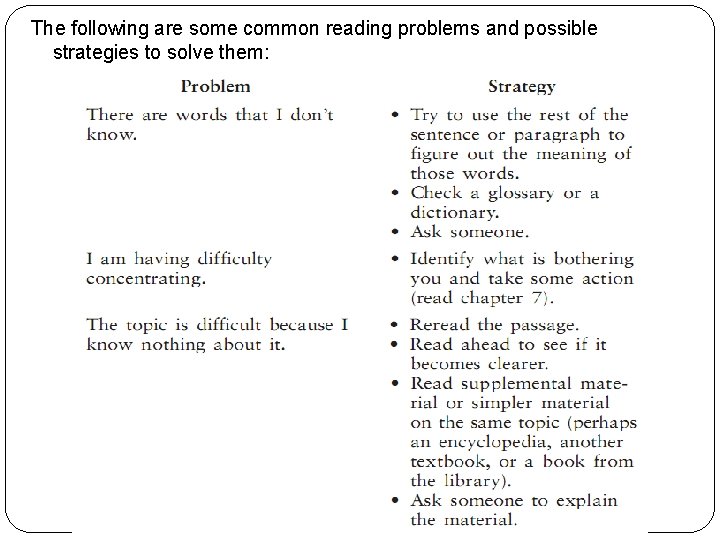
The following are some common reading problems and possible strategies to solve them:
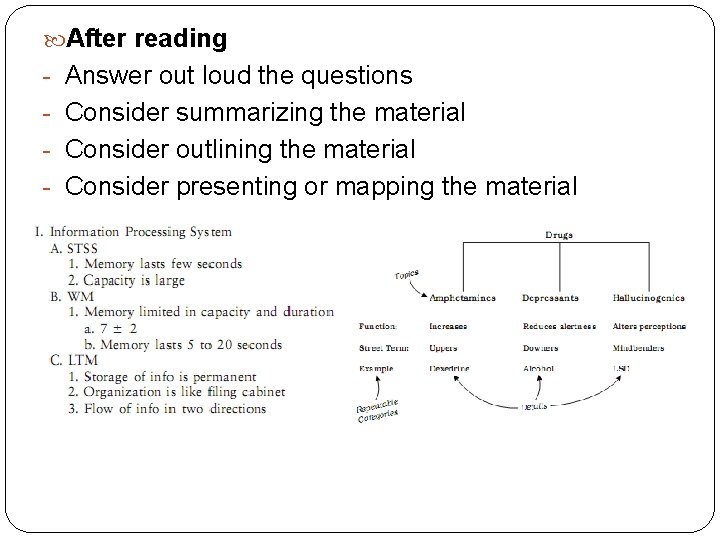
After reading - Answer out loud the questions - Consider summarizing the material - Consider outlining the material - Consider presenting or mapping the material
III. Learning from Lectures 1. Analyzing note-taking strategies 2. Strategies for better notes

III. 1. Analyzing note-taking strategies Always 1. Do you complete the assigned readings before each lecture? 2. Do you try to sit as close as possible to the lecturer? 3. Do you doodle during a lecture? 4. Do you avoid listening when difficult information is presented? 5. Do you condense the main ideas rather than write complete sentences? 6. Do you daydreaming during lectures? 7. Do you make a notation in your notes for information you don’t understand? 8. Do you try to determine the organization of the lecture? 9. Do you review your notes each day after class? 10. Do you understand your notes when you begin preparing for an exam? Sometimes Never
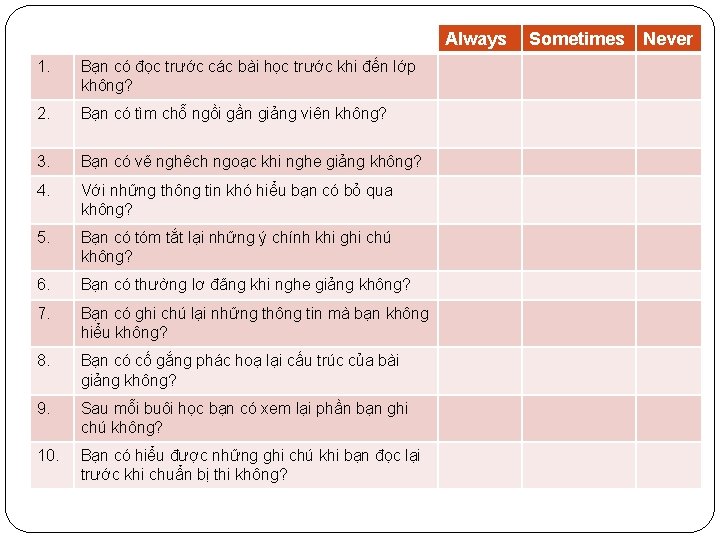
Always 1. Bạn có đọc trước các bài học trước khi đến lớp không? 2. Bạn có tìm chỗ ngồi gần giảng viên không? 3. Bạn có vẽ nghêch ngoạc khi nghe giảng không? 4. Với những thông tin khó hiểu bạn có bỏ qua không? 5. Bạn có tóm tắt lại những ý chính khi ghi chú không? 6. Bạn có thường lơ đãng khi nghe giảng không? 7. Bạn có ghi chú lại những thông tin mà bạn không hiểu không? 8. Bạn có cố gắng phác hoạ lại cấu trúc của bài giảng không? 9. Sau mỗi buôi học bạn có xem lại phần bạn ghi chú không? 10. Bạn có hiểu được những ghi chú khi bạn đọc lại trước khi chuẩn bị thi không? Sometimes Never

III. 2. Strategies for better notes Before the lecture - Complete assigned readings before class - Review notes from the previous class - Bring all necessary materials (e. g. , Notebook, Pen, Handouts, Syllabus, and Textbook) - Sit toward the front of the room if you have difficult concentrating. - Date and number each day’s notes
During the lecture - Listen carefully to the instructors and take notes that focus on main ideas and supporting ideas. - Condense the main ideas by using abbreviations - Use an indenting form for writing notes. - Skip two lines when instructors move to another idea.
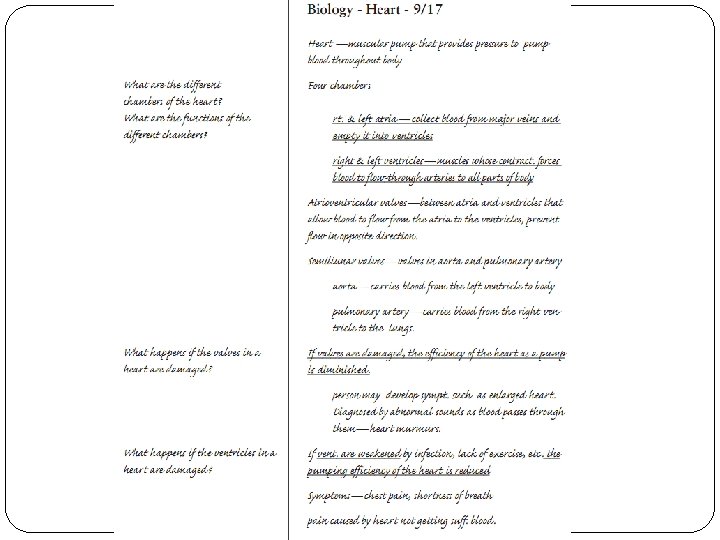
After the lecture - Add any information from the lecturers that you didn’t - write down Locate the information that you didn’t understand Think about notes as answers to questions Underline a key term or phrases that triggers an answer Read the key terms to recall the information Cover the notes with a blank sheet and attempt to answer questions. Write a summary question
- Slides: 21