
Study Skills 2 Modules Active Listening Note Taking
- Slides: 3
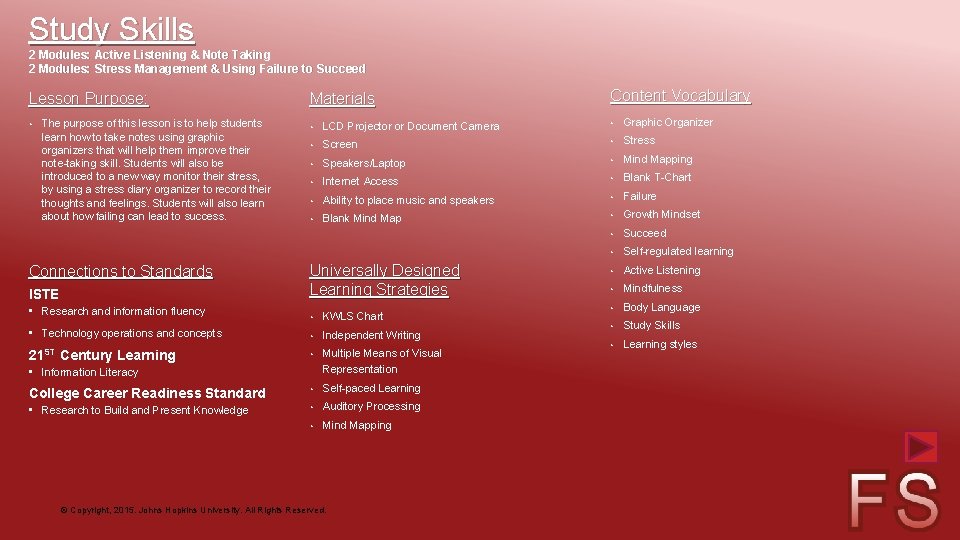
Study Skills 2 Modules: Active Listening & Note Taking 2 Modules: Stress Management & Using Failure to Succeed Lesson Purpose: • The purpose of this lesson is to help students learn how to take notes using graphic organizers that will help them improve their note-taking skill. Students will also be introduced to a new way monitor their stress, by using a stress diary organizer to record their thoughts and feelings. Students will also learn about how failing can lead to success. Connections to Standards ISTE • Research and information fluency Materials Content Vocabulary • LCD Projector or Document Camera • Graphic Organizer • Screen • Stress • Speakers/Laptop • Mind Mapping • Internet Access • Blank T-Chart • Ability to place music and speakers • Failure • Blank Mind Map • Growth Mindset • Succeed • Self-regulated learning • Active Listening • Mindfulness • Body Language • Study Skills • Learning styles Universally Designed Learning Strategies • KWLS Chart • Technology operations and concepts • Independent Writing 21 ST Century Learning • Multiple Means of Visual Representation College Career Readiness Standard • Self-paced Learning • Research to Build and Present Knowledge • Auditory Processing • Mind Mapping • Information Literacy © Copyright, 2015. Johns Hopkins University. All Rights Reserved.
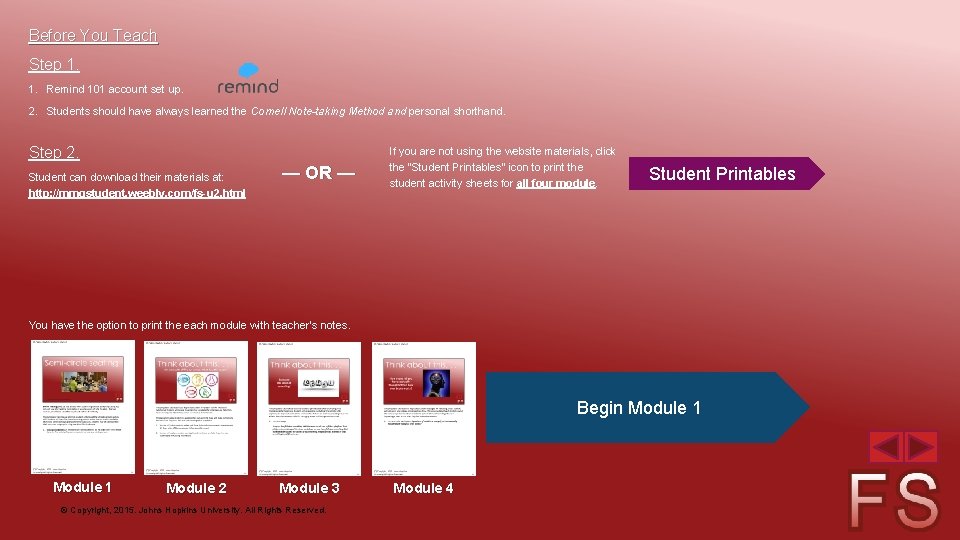
Before You Teach Step 1. 1. Remind 101 account set up. 2. Students should have always learned the Cornell Note-taking Method and personal shorthand. Step 2. Student can download their materials at: http: //mmgstudent. weebly. com/fs-u 2. html — OR — If you are not using the website materials, click the “Student Printables” icon to print the student activity sheets for all four module. Student Printables You have the option to print the each module with teacher’s notes. Begin Module 1 Module 2 Module 3 © Copyright, 2015. Johns Hopkins University. All Rights Reserved. Module 4
PROTOTYPE CREDITS Prototype Lesson Editor: Prototype Design: FS Original Author(s): Cheree Davis Gregg M. Howell Howard Gradet, Tony Gerdes, Nan Starling, Thomas G. Define, Gwen Statham Cheree Davis, Pat Perriello, Bonnie Erickson, Mildred Harris, Gregg M. Howell, Johann Liljengren © Copyright, 2015. The Johns Hopkins University. All Rights Reserved. Talent Development Secondary Center for the Social Organization of Schools Johns Hopkins University School of Education 2701 N. Charles Street Baltimore, MD 21218 410 -516 -8800 telephone 410 -516 -8890 fax www. Talent. Development. Secondary. com All rights reserved. The information, activities, and materials contained in the modules that comprise this lesson are intended for pilot-testing evaluation. Printing of the pilot components are intended for classroom use only. Printed student materials should not exceed the number of students in each class. No other part of this document may be reproduced, in any form or by any means, without permission in writing from the publisher. This manual may contain Internet website IP (Internet Protocol) addresses. At the time this manual was published, any website and/or email addresses were checked for both validity and content as it relates to this lesson’s corresponding topic. The Johns Hopkins University, and its licensors, is not responsible for any changes in content, IP addresses changes, pop advertisements, or redirects. It is further recommended that teachers confirm the validity of the listed addresses if they intend to share such addresses with students. Development of this material was supported by the Institute of Education Sciences, U. S. Department of Education, through Grant R 305 A 080544 to Johns Hopkins University. The opinions expressed are those of the authors and do not represent views of the Institute or the U. S. Department of Education. For more information about Freshman Seminar, please visit our website at: www. Talent. Development. Secondary. com