
Study Project in Global Business General Guidelines Limit

Study Project in Global Business General Guidelines

�Limit your scope �Something that interests you �The topic be academic ◦ Scholar style ◦ Business project style �State or practical your topic June 4 th Choosing a Global Business Topic
� Note the university plagiarism policy � Failure is ok ◦ In business situations usually better to state why an idea would not work than to continue to pursue the idea ◦ Creative ideas typically come after lots of dead ends ◦ You will be evaluated on how well explain your position � Follow the anomalies ◦ Data that does not fit often leads to rewarding avenues ◦ Experts often overlook the unexpected ◦ Reputations and fortunes have been made from spotting anomalies and following them � Stay in scope Philosophical considerations
�Any project will consist of manageable pieces ◦ Set intermediate goals ◦ Applies to individual projects as well as enterprise projects �Stick to your milestones and deliverables �Mountains are climbed one goal at a time Make a plan
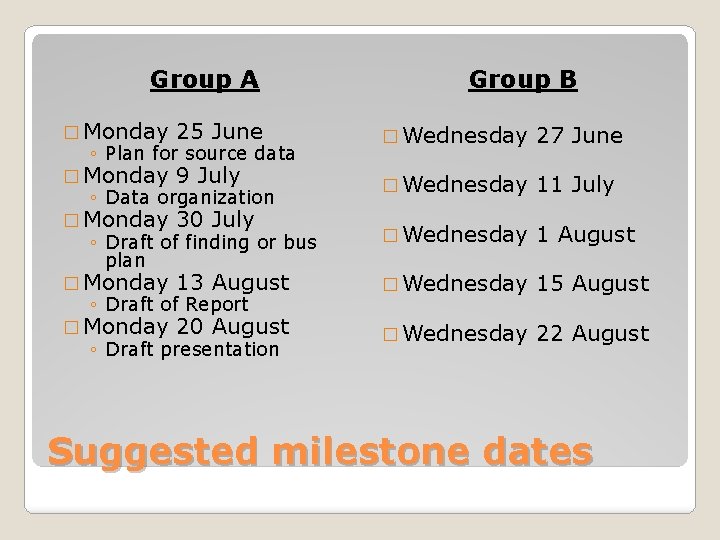
Group A � Monday 25 June ◦ Plan for source data � Monday 9 July ◦ Data organization � Monday 30 July ◦ Draft of finding or bus plan � Monday 13 August ◦ Draft of Report � Monday 20 August ◦ Draft presentation Group B � Wednesday 27 June � Wednesday 11 July � Wednesday 1 August � Wednesday 15 August � Wednesday 22 August Suggested milestone dates
�Large organizations evolve away from transactions orientation ◦ Routine tasks are outsourced ◦ Typical transactions functions �Repetitive �Low skill �Low pay �Move toward project orientation ◦ May have internal consulting organizations ◦ Other staff may form teams for the duration of a project, or for parts of a project ◦ Traditional staff functions like marketing or finance become project oriented Effective Project Management Structure of large organizations
� 1. Identify a need ◦ Request for proposal (RFP) �Written by customer �Contractors respond with ◦ How they might solve the problem ◦ Costs and schedule for the work ◦ Informally - needs defined in meetings or by management �Typically handed off to internal project team �Important to correctly define the need (very often management will have only a vague idea) �Very common for entire departments to be project oriented (example are FP&A or internal consulting) Effective Project Management Project lifecycle
� 2. Develop a solution ◦ Proposal to customer �Contractors submit proposals and bids ◦ Develop approaches to a solution ◦ Estimating types and amounts of resources needed ◦ Estimate of time to design and implement the solution �Internal team responds to management or team defined need or request ◦ Work will be preformed by internal staff ◦ Often parts are contracted out for specialized expertise �Effort in this phase is from contractors or internal project staff ◦ Negotiate and sign a contract (note internal teams often have written agreement) Effective Project Management Project lifecycle
� 3. Perform the Project ◦ Detailed planning ◦ Implement the plan to accomplish the objective ◦ Accomplish the objective �Project complete when it is accepted by the customer ◦ Customer obligation to review or validate results ◦ This is where careful wording of contracts is important �Quality, budget, time Effective Project Management Project lifecycle
� 4. Terminating the project ◦ Confirming all deliverables accepted by customer ◦ Confirming invoices sent to customer and paid (internal projects often transfer priced) ◦ Evaluate performance of the project �Customer feedback �Team feedback Effective Project Management Project lifecycle
�Establish a baseline plan ◦ Define project objective ◦ Divide the project into major packages ◦ Define the specific activities for each work package ◦ Portray the activities in a network diagram �Sequences �Interdependencies ◦ Make time estimates for each activity ◦ Make cost (resource) estimates for each activity ◦ Calculate a project schedule and budget �Adjust scope, time estimates, or resources if necessary �Baseline plan is critical to success of any project Effective Project Management Importance of Planning
◦ Elements of a baseline plan �Start and completion dates for each activity �Amounts of resources for each time period �Budget for each time period and cumulative budget through each period ◦ Monitoring progress through the project �Compare to planned progress �Must know which activities have been started or completed �When the activities began and ended �How much money has been spent or committed ◦ Take corrective action as needed Effective Project Management Importance of Planning
◦ Earned Value �Percent complete for each work package ◦ Subjective estimates ◦ Honesty is critical (avoid overconfidence) ◦ Smaller work packages are better �Multiply percent complete against Total Budgeted Cost=EV �Compare with Cumulative Actual Cost to see if value of work performed is keeping up with cost. �Cost performance index (CPI)= CEV/CAC ◦ Earned value divided by actual cost ◦ Use this to estimate forecast cost at completion ◦ Forecast cost to completion = Total budget cost/CPI ◦ Method assumes continuing efficiencies or inefficiencies ◦ Hazard of becoming PM mid-project = false % complete Effective Project Management Importance of Planning
◦ Cumulative actual cost (CAV) �Total amount spent at a point in time �Could be low or high due to % completion ◦ Cumulative budget cost (CBC) �Amount budgeted to a given point in time �Assumes work is on schedule ◦ Cumulative earned value (CEV) �Value of work actually performed so far �Adjusts the budget amount for % completion ◦ Cost Variance = CEV – CAC ($ gap between work performed and actual cost) ◦ Assuming budgeted efficiency going forward: �FCAC=CAC + (TBC-CEV) �Actual cost so far plus total budgeted minus earned value �Implies any efficiencies or inefficiencies so far will go away �Contrast with TBC/CPI approach (continues efficiencies or inefficiencies) Effective Project Management Managing the Project
�Plans, organizes and controls the work to accomplish the project objective �Assures that the customer is satisfied that objectives are achieved ◦ On time ◦ In budget ◦ Right quality �Develops plans or leads others to develop ◦ Reviews with the customer ◦ Sets up a tracking mechanism �Organizes the work ◦ Gets commitments or signs contracts ◦ Assigns accountability �Tracks actual progress against plan Project Manager Responsibilities
� Ability to handle stress ◦ Conditions change constantly �Conflicts �Technical problems �Customer requests ◦ The PM has to be calm ◦ Help project team handle their stress � Problem-solving ◦ Early identification of problems �Accurate information �Open communication ◦ Analytical skills ◦ Big picture view � Effective time management ◦ Self-disciplined ◦ Organized ◦ Willing to delegate Skills of a Project Manager
� Changes can be caused by ◦ Customer ◦ Project team ◦ Unexpected events ◦ User of the project results � Change later in a project has greater impact � Create procedures for documenting and authorizing changes ◦ ◦ Communication between PM and customer Communication between PM and project staff Always put changes in writing Avoid doing slight enhancements for free � Managing end-user change (procedures) ◦ Often very difficult ◦ Time and patience to overcome resistance to change ◦ Work with end-users during project design Managing change
�Delegation is assigning responsibility and giving authority to make decisions �Successful delegation requires establishing accountability ◦ PM defines tasks and desired results �Scope �Quality �Budget �Schedule �Expected product ◦ Clearly communicating expectations ◦ Tracking systems ◦ Regular meetings Delegation defined
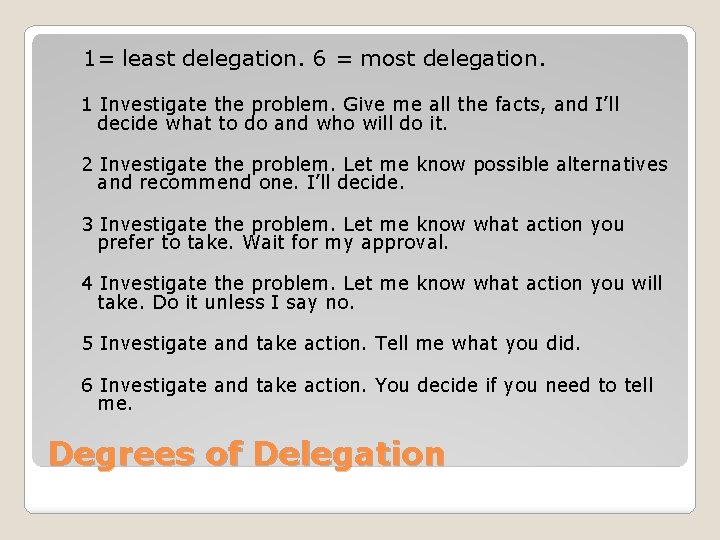
1= least delegation. 6 = most delegation. 1 Investigate the problem. Give me all the facts, and I’ll decide what to do and who will do it. 2 Investigate the problem. Let me know possible alternatives and recommend one. I’ll decide. 3 Investigate the problem. Let me know what action you prefer to take. Wait for my approval. 4 Investigate the problem. Let me know what action you will take. Do it unless I say no. 5 Investigate and take action. Tell me what you did. 6 Investigate and take action. You decide if you need to tell me. Degrees of Delegation
� Allocate sufficient resources ◦ Match skills to the task ◦ Empower individuals to decide how to use budgeted resources ◦ Stretch assignments develop people (look at potential) � Do not tell people how to do the job ◦ They will feel PM lacks confidence in them ◦ They will be less committed to the result ◦ Effective management requires showing confidence in people ◦ People will be more creative when they can decide � Avoid criticizing ◦ Fear of failure causes paralysis ◦ Fear will cause people to ask the manager to approve everything � Establish accountability ◦ Clearly define expectations ◦ Project management information system ◦ Reporting system ◦ Measure and evaluate progress relative to plan Delegation Issues
�Select the right project ◦ Fits the business ◦ Look at alternatives (such as incremental changes) �Find the right people for the project �Select the right contractors when employees lack expertise ◦ Use employees as leaders ◦ Or customer employees as leaders �Use off-the-shelf products where possible �Schedule regular progress meetings �Establish control mechanisms ◦ Keep project within scope ◦ Keep project on schedule and on budget Elements of a Successful Project
Make things happen Let things happen Wonder what happened � Set a positive example ◦ Work late if that is required ◦ Project a positive attitude – enjoying the work ◦ Focus on ways to get the job done ◦ Reward milestones � Create an environment of trust, and of high expectations � Recognize successes, avoid discouraging people � Create a vision for others to follow (goals and benefits) � Delegate and hold people accountable Leading a project
�Timely, honest and direct ◦ Prevents rumors ◦ Builds trust �Share good and bad news quickly �Create an atmosphere that encourages communication open ◦ Accept differing points of view ◦ Allow people to bring issue without fear ◦ Solicit comments and ideas, rather than dominate �High level of communication most important early in project ◦ Builds good working relationships ◦ Establishes clear expectations with the customer Communication
�People gain knowledge and competency from the project ◦ Technical development ◦ Problem solving ◦ Negotiating and time management �Acknowledge that mistakes ◦ No fear of failure ◦ Create stretch assignments �Follow up on formal ◦ Assignments ◦ Presentations happen training Developing people
� Unclear goals � Lack of project structure � Unclear definition of roles � Turnover ◦ PM needs to articulate vision of the goals and expected benefits from the first meeting ◦ The vision needs to be said repeatedly at status review meetings throughout the project ◦ Importance of establishing procedures for communication, approvals, documentation ◦ Provided in written form and reinforced ◦ Ambiguity or overlap of roles ◦ Explanation of how individual roles relate to others’ ◦ Small number of people working on long term is more efficient than large number working short term � Highly important concept � Idea is that putting more human resources on a lagging project commonly does not bring speed ◦ Look for people with versatile skills, can contribute to multiple aspects of the project ◦ Specific expertise for short time commonly contracted out � Bad behavior � Lack of commitment ◦ Hostility, lack of professional comportment, disruptive behavior ◦ Need to follow through with release from project if behavior continues ◦ Recognize accomplishments ◦ Explain importance of each project role Barriers to team effectiveness
� PM sets tone ◦ Does what seems right and fair ◦ Communicates the expectation ◦ Written policy and training on ethics � Types of unethical behavior ◦ Kickbacks on purchased materials ◦ Submitting low bids with intent to raise price later ◦ Dishonest time reporting ◦ False travel expense reports ◦ Plagiarism and taking credit for the work ◦ Bribing inspectors or approving bad test results ◦ Misleading the customer about project status ◦ Taking supplies or equipment for personal use � Need for peer pressure against ‘trying to get away with being caught’ � Unethical behavior erodes trust and entire foundation of integrity Ethical behavior
�Make weekly lists of goals for the next week �Make to-do lists at the end of each day �Read the daily to-do list first thing in the morning �Control interruptions ◦ Set aside blocks of time for e-mails, returning phone calls ◦ Interruptions cause inefficiency �Learn to say no to avoid over-commitment �Use waiting time �Try to handle paperwork only once �Reward yourself at the end of the week (if) Time management
�Work scope �Resource assignments ◦ Requests for more resources ◦ Requests for different assignments �Schedule – sequence or duration of tasks �Cost – who pays for overruns? �Priorities ◦ People work on multiple tasks ◦ Limited equipment resources �Organizational issues ◦ Ambiguous or inadequate communication ◦ Lack of timely decision making ◦ Leadership style or procedural issues �Personal differences – such as resentments Sources of Conflicts
�Conflict can be beneficial ◦ Raises awareness of problems ◦ Can cause clarity, creativity, or problem solving �Avoid withdrawing from conflict or forcing �Compromise solutions often less than best �Confront issues directly ◦ Problem solving approach �Places high value on outcome and relationships �Open exchange of information (no-one tries to win) �Requires willingness to work in good faith and understand other points of view �Honesty required ◦ Manage emotions (try not to become attached to a point of view) Handling conflict
� � � Develop problem statement – specific Identify possible causes of the problem Gather data and verify likely causes � Identify possible solutions � Evaluate alternative solutions � Determine best solution � Revise the project plan � � Implement the solution Determine of the problem has been solved ◦ Distinguish symptoms from causes ◦ Work on correcting causes ◦ Avoid doing the first or most obvious ◦ Try creativity (brainstorming) ◦ Need weighted criteria for a scorecard ◦ Evaluate each viable solution against the criteria ◦ Scorecard is an input ◦ Use expertise of the team to reach final decision ◦ Will the proposed solution cause problems elsewhere? ◦ Incorporate solution into the project plan Problem solving – nine step approach
- Slides: 30