
Study Points What is a supercluster How are
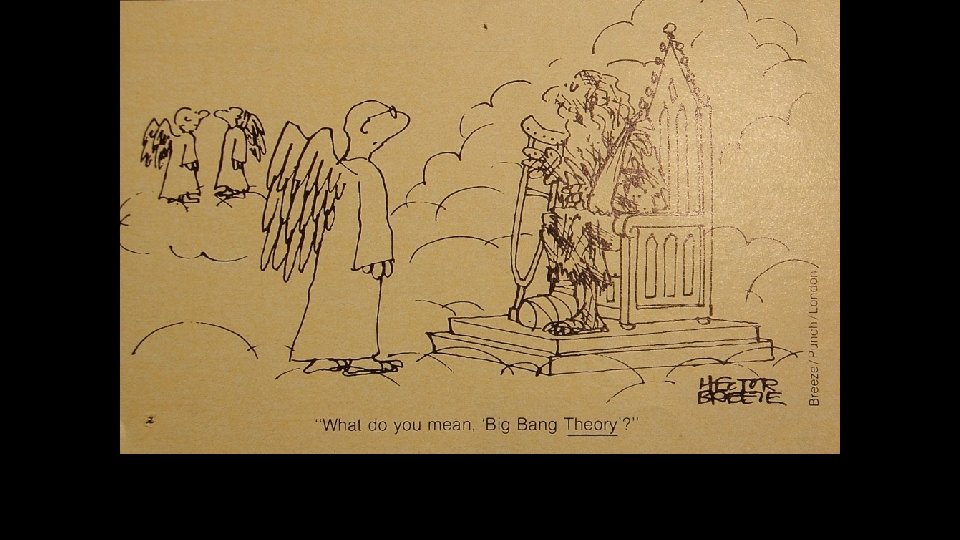
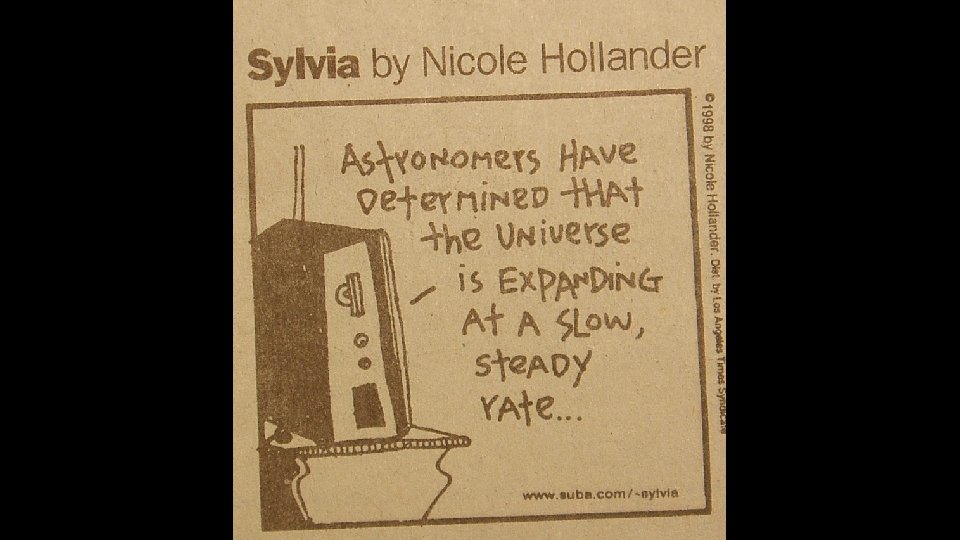
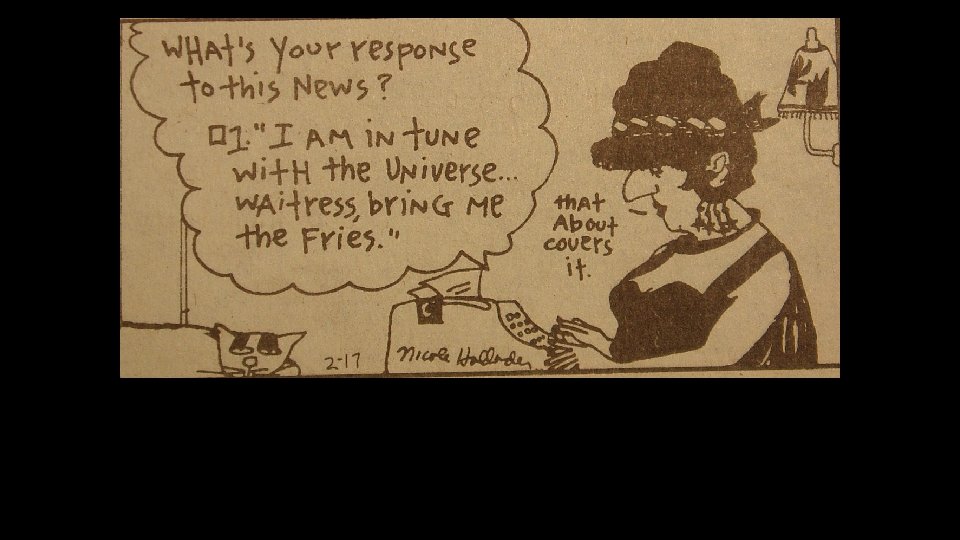
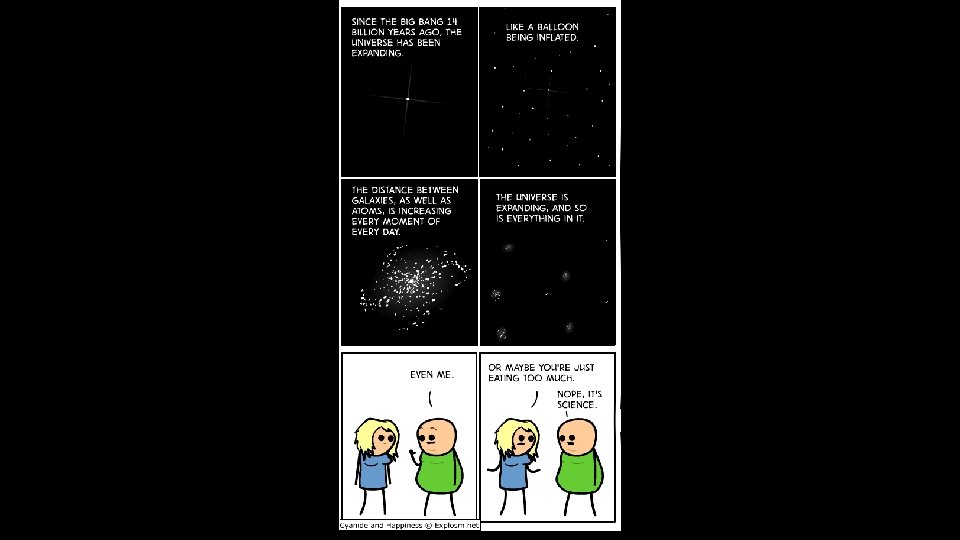



- Slides: 81
Study Points • What is a supercluster? • How are galaxies distributed in the universe? • What is Hubble’ Law? Can you apply it to stars? To galaxies in the Local Group? To more distant galaxies? • How do astronomers calculate distances to galaxies? • What does Hubble’s Law tell us about the origin of the universe? • When we see objects like stars or galaxies in pictures, are we seeing them as they look now or in the past? Why? • Is the red shift caused by galaxies moving through space or by space-time expanding? • Is the universe expanding, contracting or neither? How do we know? Is the universe cooling? • Discuss the raisin bread model or balloon model to explain why we do not have to be at the center of the universe. • What is the name of theory of how the universe evolved? • Give a brief timeline for the formation of the universe (BB, first stars, our galaxy, our solar system). • How old is our universe? How old is our solar system?
Hubble’s Law • Review – Cluster of Galaxies • The Local Group • • Superclusters Hubble’s Law Red Shift of galaxies Big Bang model
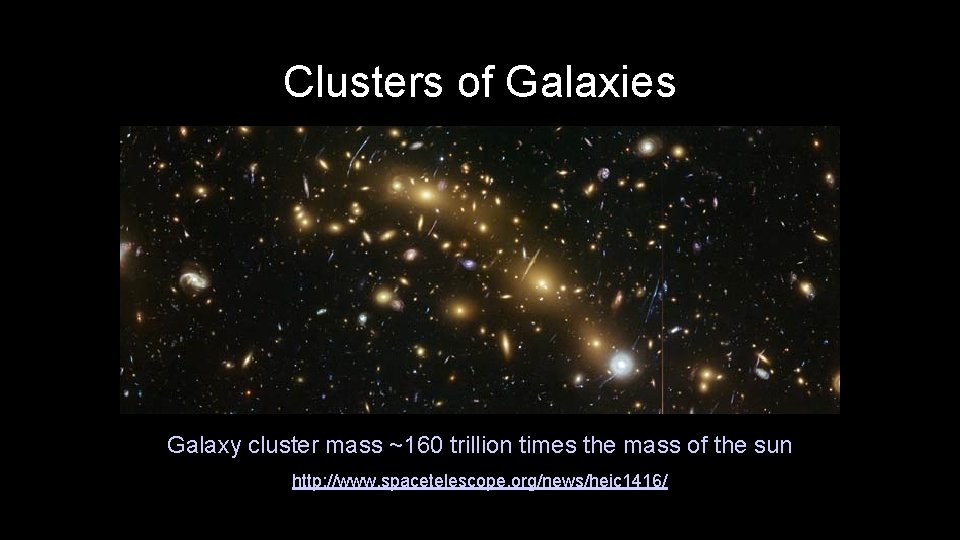
Clusters of Galaxies Galaxy cluster mass ~160 trillion times the mass of the sun http: //www. spacetelescope. org/news/heic 1416/
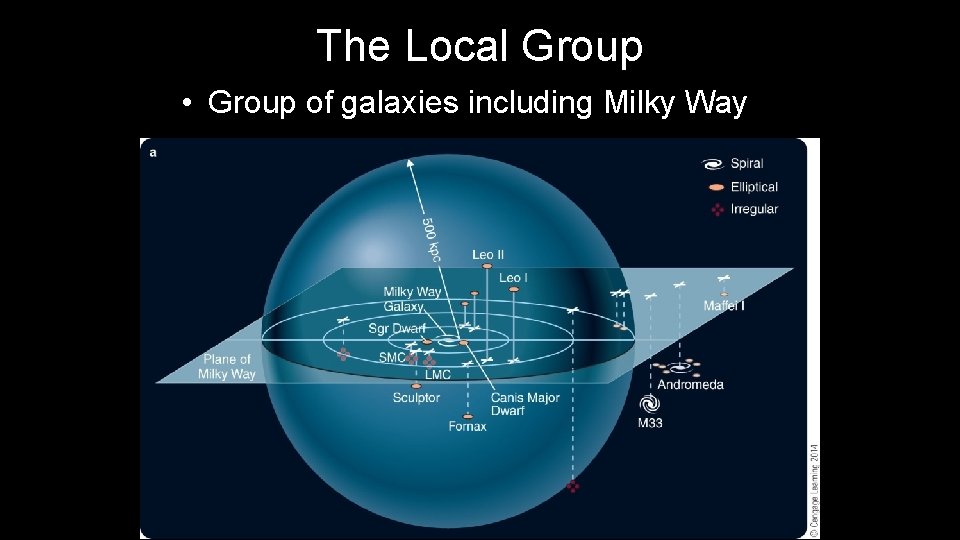
The Local Group • Group of galaxies including Milky Way
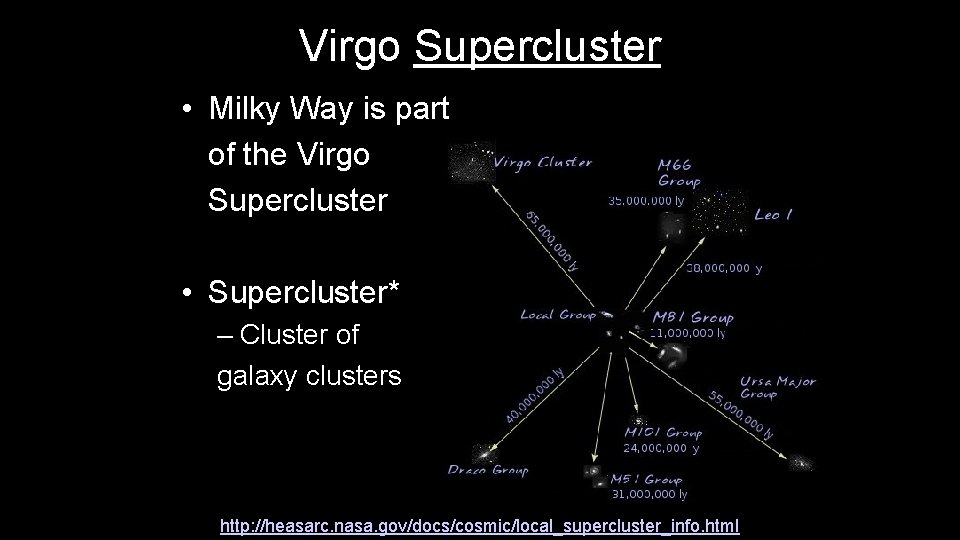
Virgo Supercluster • Milky Way is part of the Virgo Supercluster • Supercluster* – Cluster of galaxy clusters http: //heasarc. nasa. gov/docs/cosmic/local_supercluster_info. html
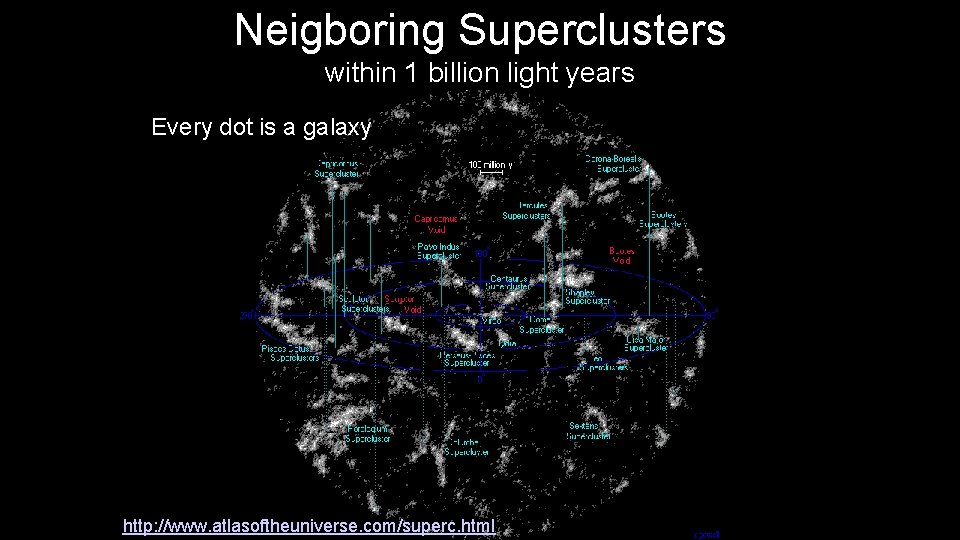
Neigboring Superclusters within 1 billion light years Every dot is a galaxy http: //www. atlasoftheuniverse. com/superc. html
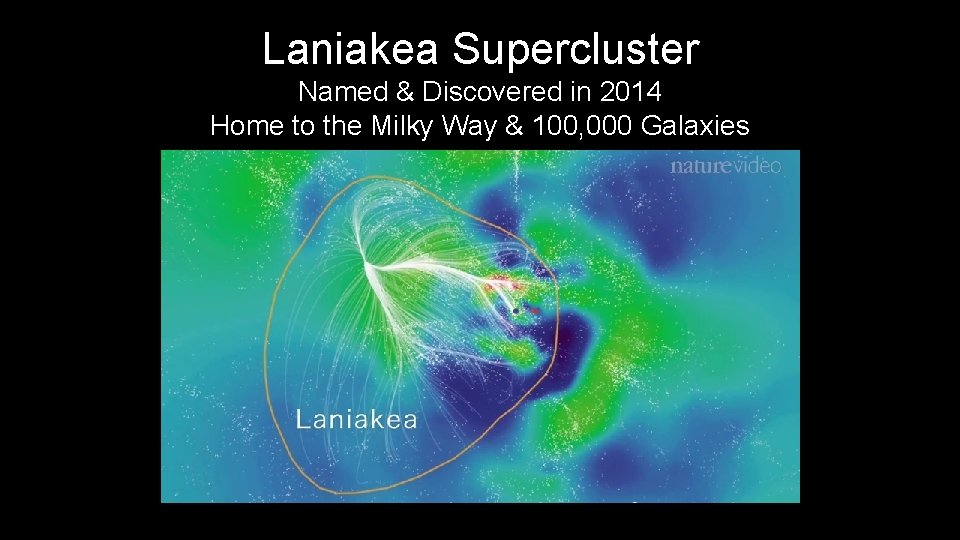
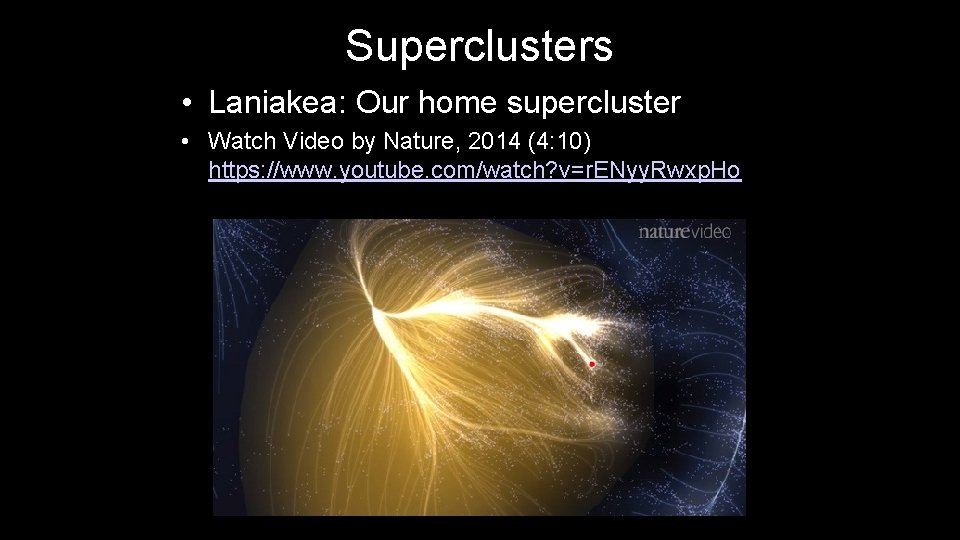
Laniakea Supercluster Named & Discovered in 2014 Home to the Milky Way & 100, 000 Galaxies
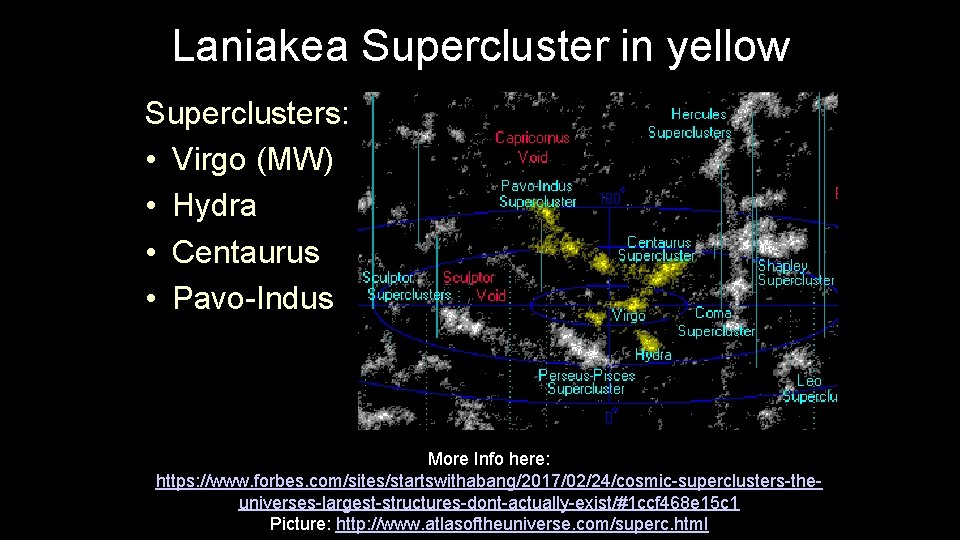
Laniakea Supercluster in yellow Superclusters: • Virgo (MW) • Hydra • Centaurus • Pavo-Indus More Info here: https: //www. forbes. com/sites/startswithabang/2017/02/24/cosmic-superclusters-theuniverses-largest-structures-dont-actually-exist/#1 ccf 468 e 15 c 1 Picture: http: //www. atlasoftheuniverse. com/superc. html
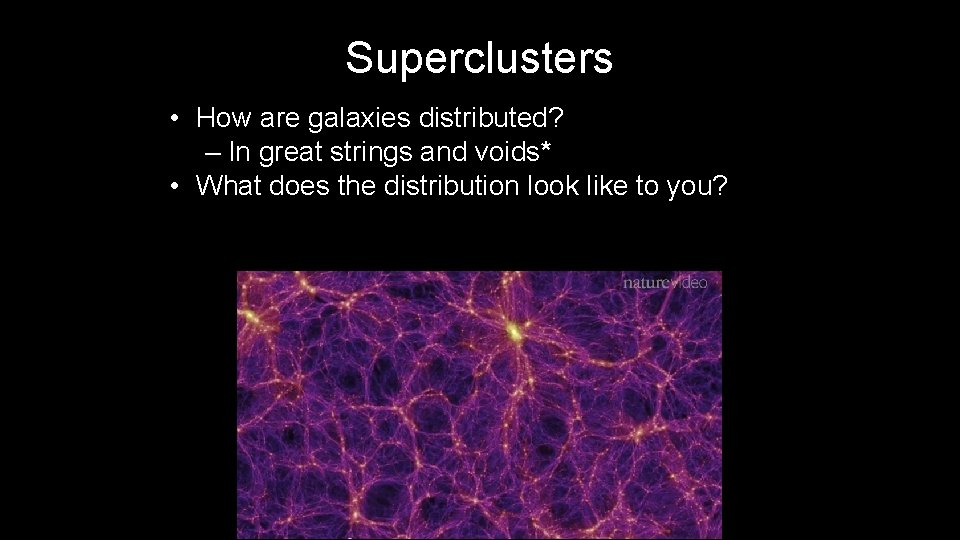
Superclusters • How are galaxies distributed? – In great strings and voids* • What does the distribution look like to you?
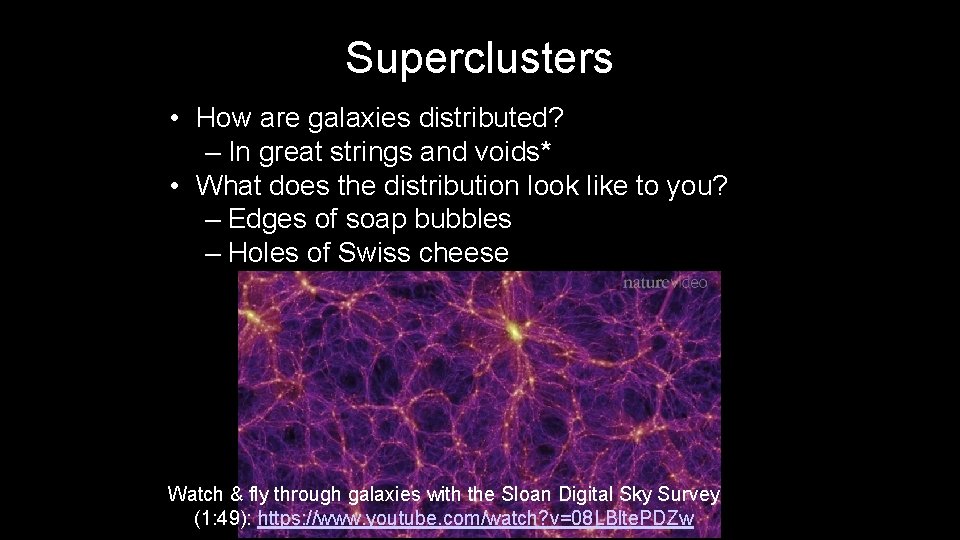
Superclusters • How are galaxies distributed? – In great strings and voids* • What does the distribution look like to you? – Edges of soap bubbles – Holes of Swiss cheese Watch & fly through galaxies with the Sloan Digital Sky Survey (1: 49): https: //www. youtube. com/watch? v=08 LBlte. PDZw
Superclusters • Laniakea: Our home supercluster • Watch Video by Nature, 2014 (4: 10) https: //www. youtube. com/watch? v=r. ENyy. Rwxp. Ho
Doppler Effect • What does the red shift or blue shift tell you?
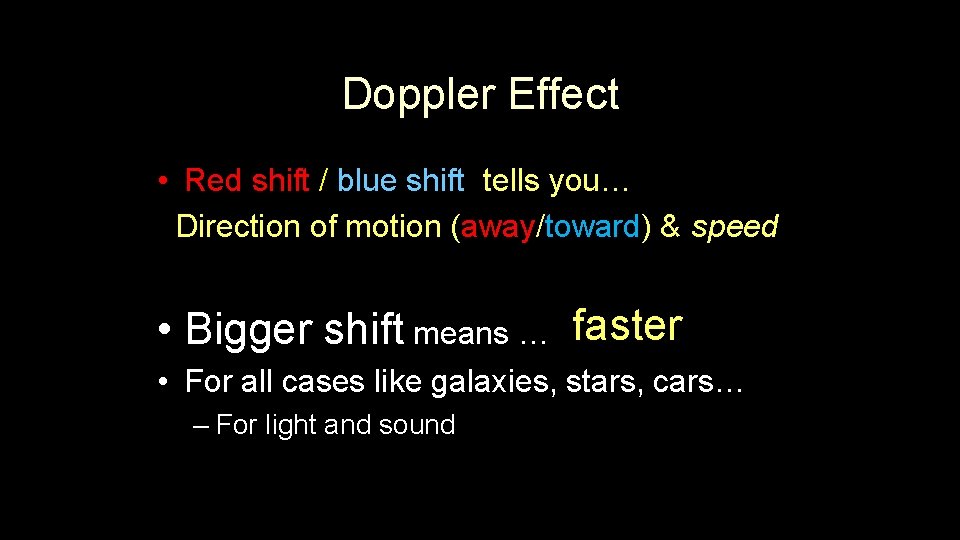
Doppler Effect • Red shift / blue shift tells you… Direction of motion (away/toward) & speed • Bigger shift means … faster • For all cases like galaxies, stars, cars… – For light and sound
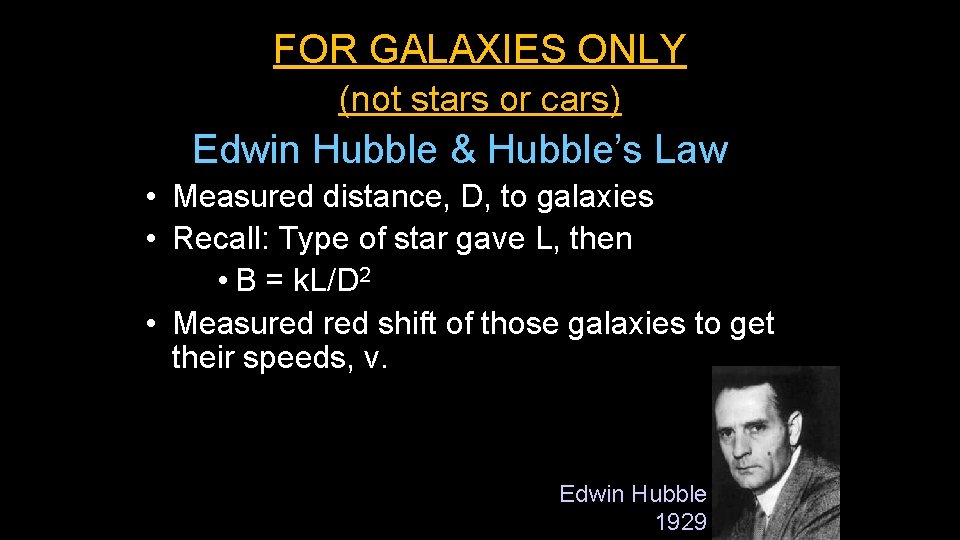
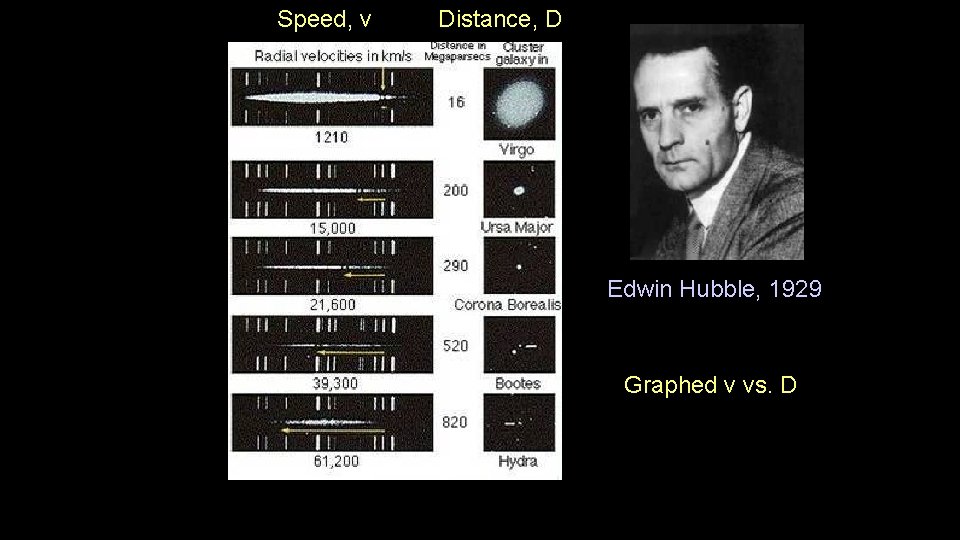
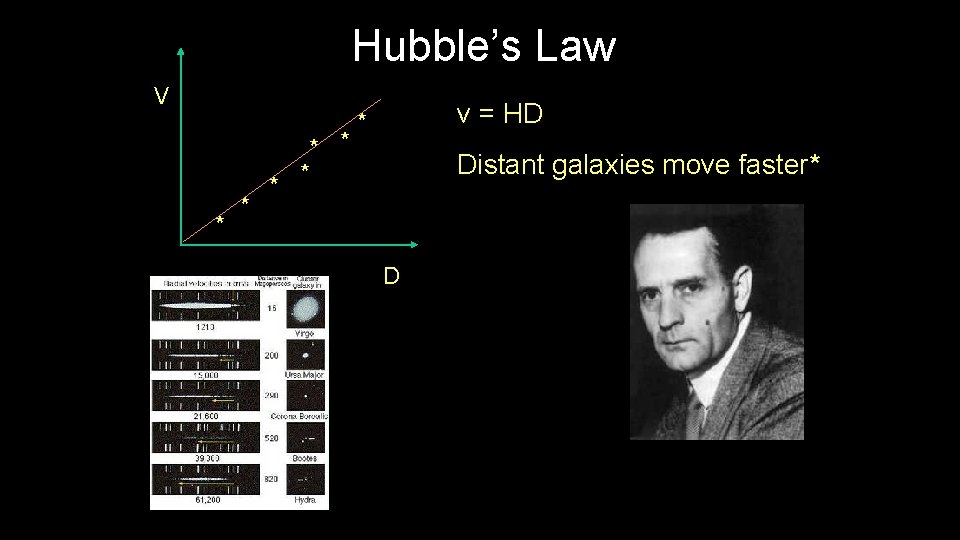
FOR GALAXIES ONLY (not stars or cars) Edwin Hubble & Hubble’s Law • Measured distance, D, to galaxies • Recall: Type of star gave L, then • B = k. L/D 2 • Measured shift of those galaxies to get their speeds, v. Edwin Hubble 1929
Speed, v Distance, D Edwin Hubble, 1929 Graphed v vs. D
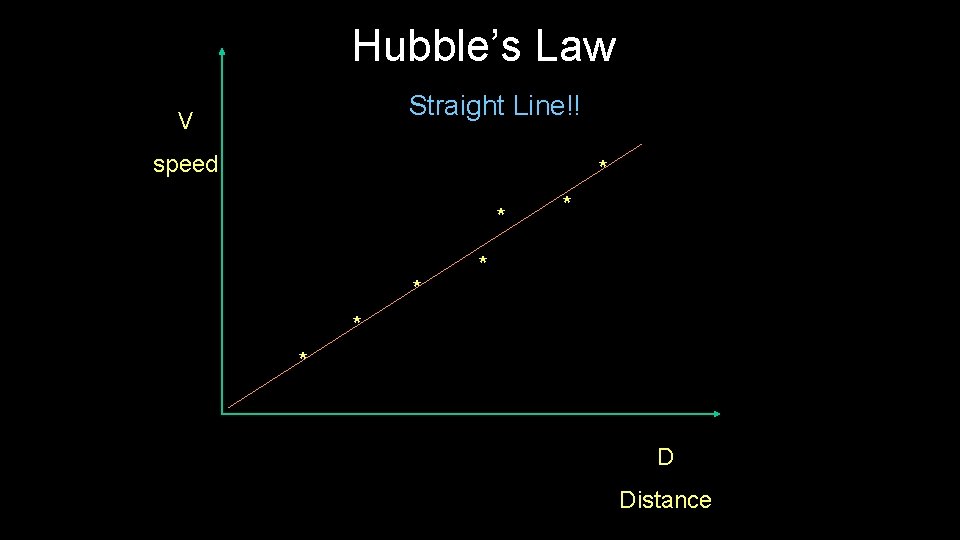
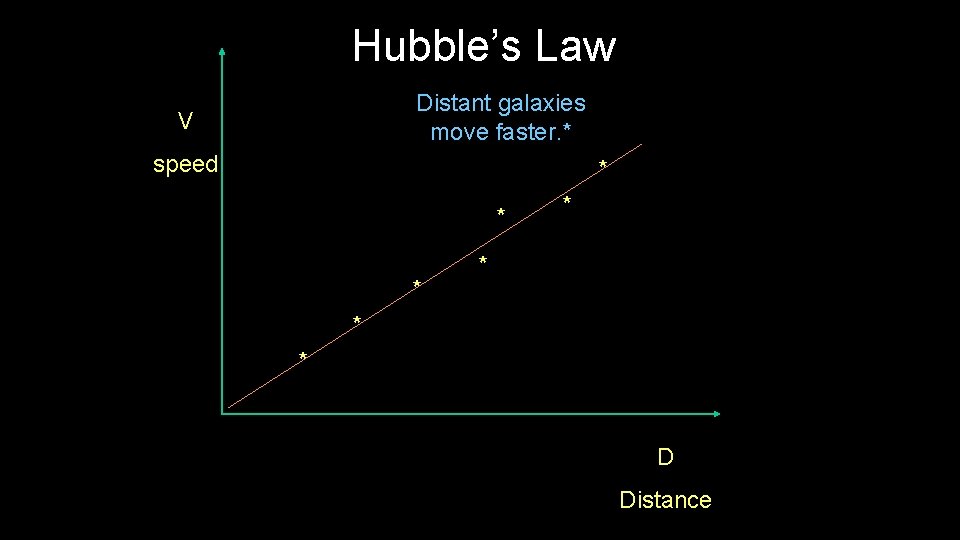
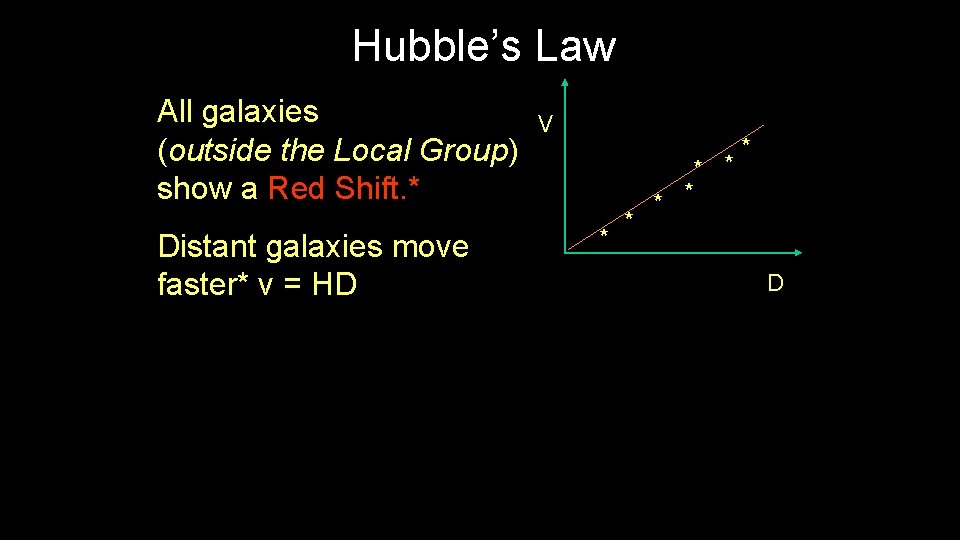
Hubble’s Law Straight Line!! V speed * * * * D Distance
Hubble’s Law Distant galaxies move faster. * V speed * * * * D Distance
Hubble’s Law V * * * v = HD * Distant galaxies move faster* D
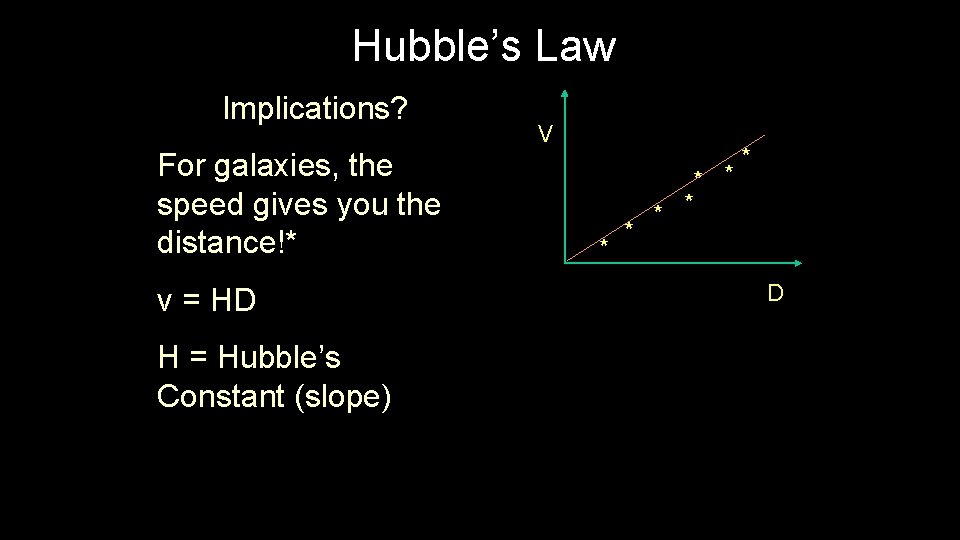
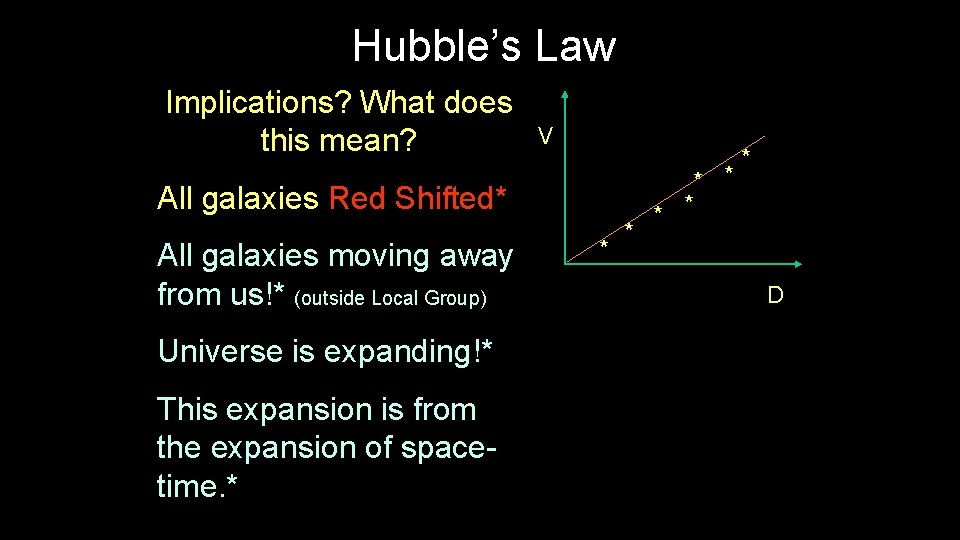
Hubble’s Law Implications? For galaxies, the speed gives you the distance!* v = HD H = Hubble’s Constant (slope) V * * * * D
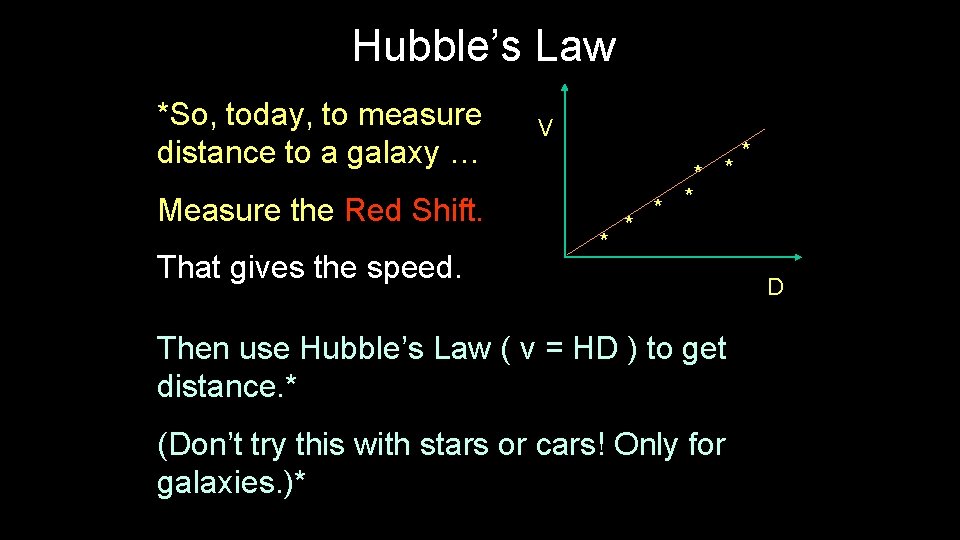
Hubble’s Law *So, today, to measure distance to a galaxy … V Measure the Red Shift. That gives the speed. * * * Then use Hubble’s Law ( v = HD ) to get distance. * (Don’t try this with stars or cars! Only for galaxies. )* * D
Hubble’s Law All galaxies (outside the Local Group) show a Red Shift. * Distant galaxies move faster* v = HD V * * * * D
Hubble’s Law Implications? What does this mean? V All galaxies Red Shifted* All galaxies moving away from us!* (outside Local Group) Universe is expanding!* This expansion is from the expansion of spacetime. * * * * D
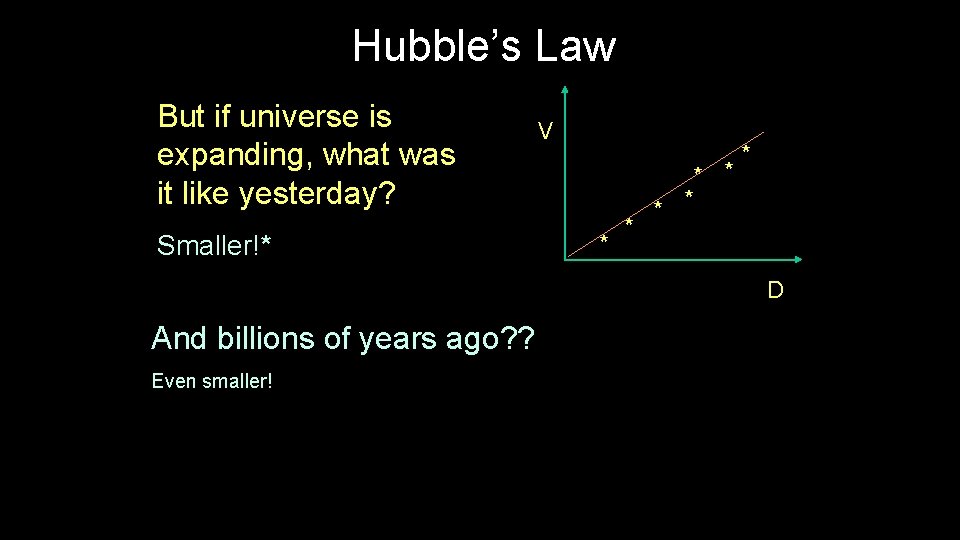
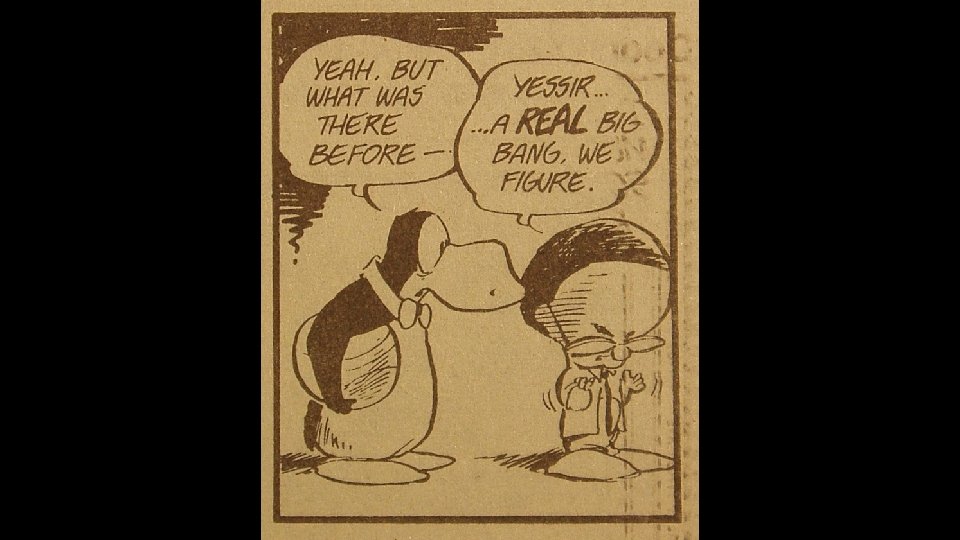
Hubble’s Law But if universe is expanding, what was it like yesterday? Smaller!* V * * * * D And billions of years ago? ? Even smaller!
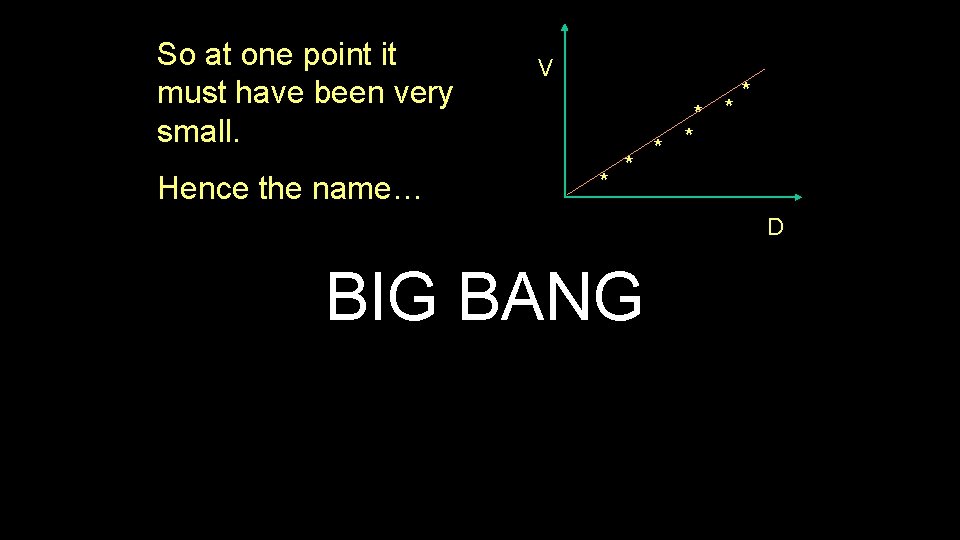
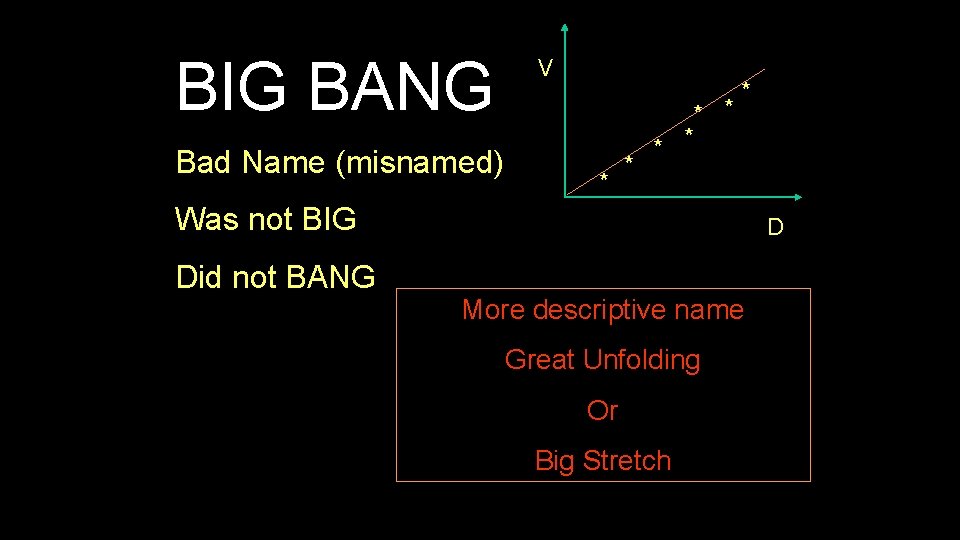
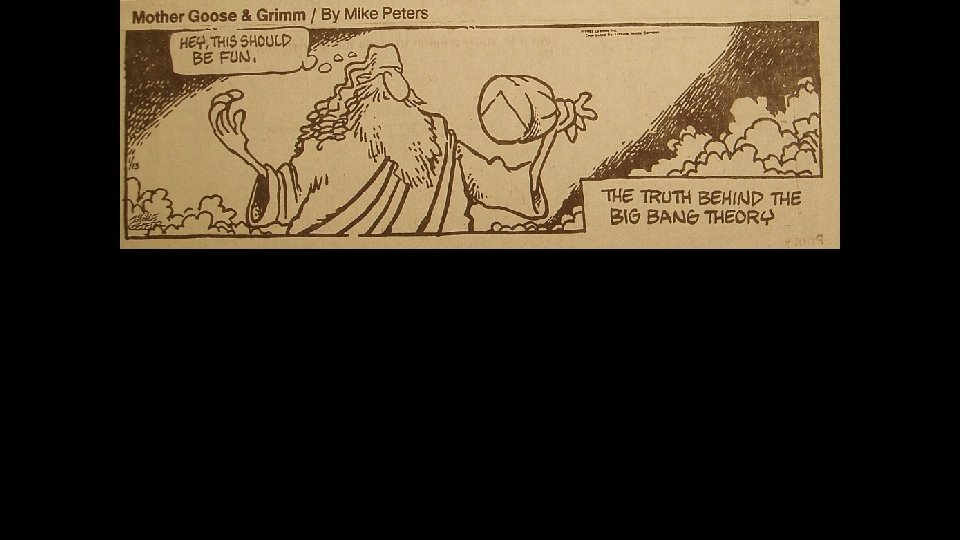
So at one point it must have been very small. Hence the name… V * * * * D BIG BANG
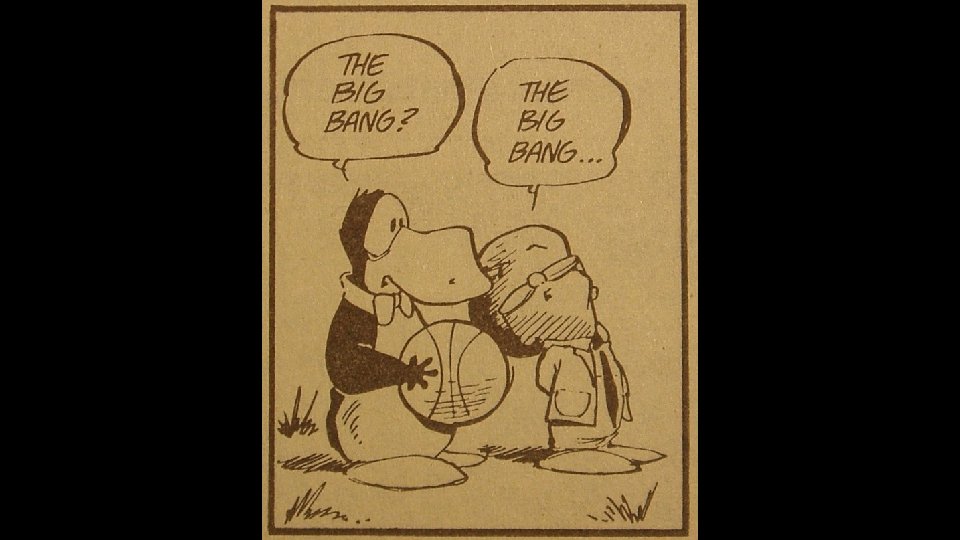
BIG BANG Bad Name (misnamed) V * * * * Was not BIG Did not BANG D More descriptive name Great Unfolding Or Big Stretch
Warning: The Astronomy General has determined that this image may be hazardous to your misconceptions. BIG BANG
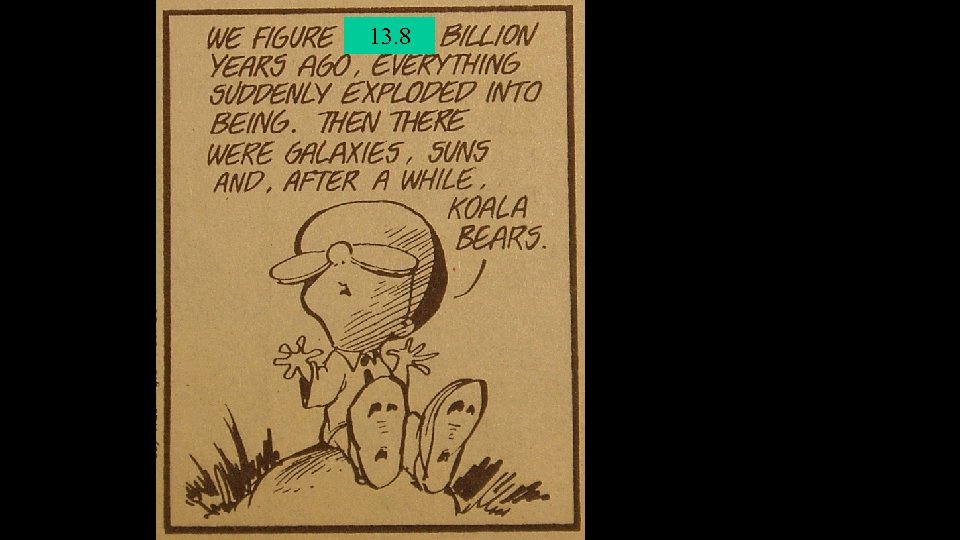
13. 8
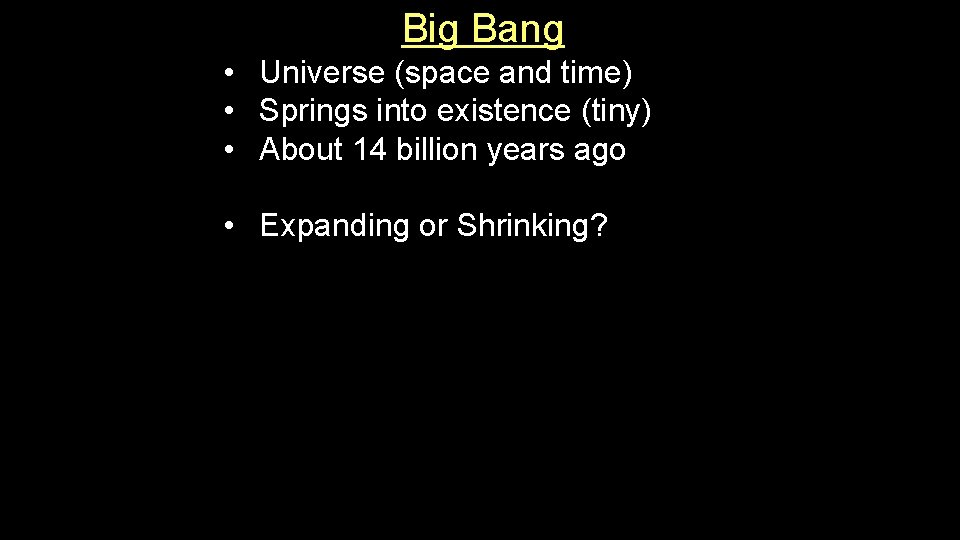
Big Bang • Universe (space and time) • Springs into existence (tiny) • About 14 billion years ago • Expanding or Shrinking?
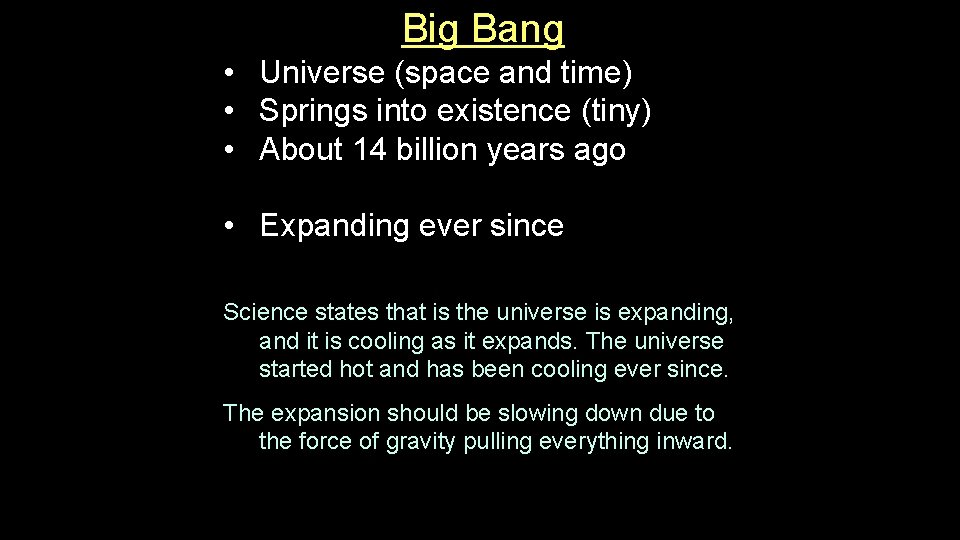
Big Bang • Universe (space and time) • Springs into existence (tiny) • About 14 billion years ago • Expanding ever since Science states that is the universe is expanding, and it is cooling as it expands. The universe started hot and has been cooling ever since. The expansion should be slowing down due to the force of gravity pulling everything inward.
Big Bang • Universe (space and time) • Springs into existence (tiny) • About 14 billion years ago • Expanding, cooling ever since • Expansion slowing due to gravity
Big Bang • Universe (space and time) • Springs into existence (tiny) • About 14 billion years ago • Expanding, cooling ever since • Expansion slowing due to gravity What is the rate of expansion now? Is the rate… a) Slowing down b) Speeding up c) Not changing
Big Bang • Universe (space and time) • Springs into existence (tiny) • About 14 billion years ago • Expanding, cooling ever since • Expansion slowing due to gravity What is the rate of expansion now? Is the rate… a) Slowing down due to gravity Old Model b) Speeding up c) Not changing
Big Bang • Universe (space and time) • Springs into existence (tiny) • About 14 billion years ago • Expanding, cooling ever since • Expansion slowing due to gravity What is the rate of expansion now? Is the rate… a) Slowing down due to gravity Old Model b) Speeding up Current Model* c) Not changing
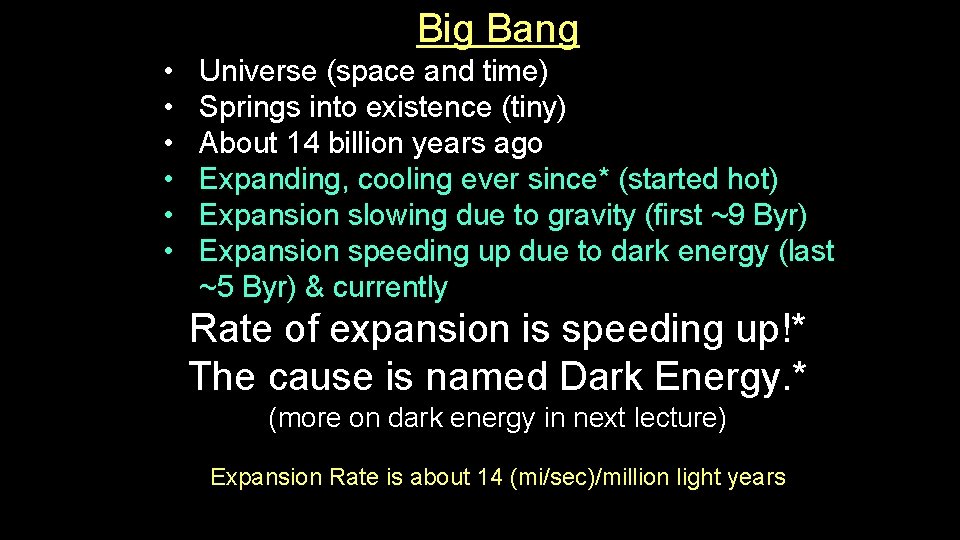
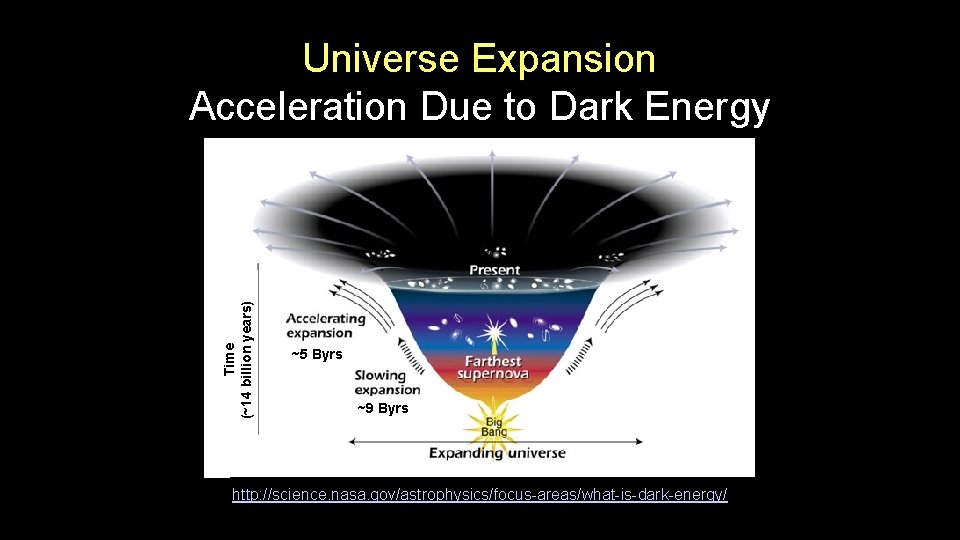
Big Bang • • • Universe (space and time) Springs into existence (tiny) About 14 billion years ago Expanding, cooling ever since* (started hot) Expansion slowing due to gravity (first ~9 Byr) Expansion speeding up due to dark energy (last ~5 Byr) & currently Rate of expansion is speeding up!* The cause is named Dark Energy. * (more on dark energy in next lecture) Expansion Rate is about 14 (mi/sec)/million light years
Time (~14 billion years) Universe Expansion Acceleration Due to Dark Energy ~5 Byrs ~9 Byrs http: //science. nasa. gov/astrophysics/focus-areas/what-is-dark-energy/
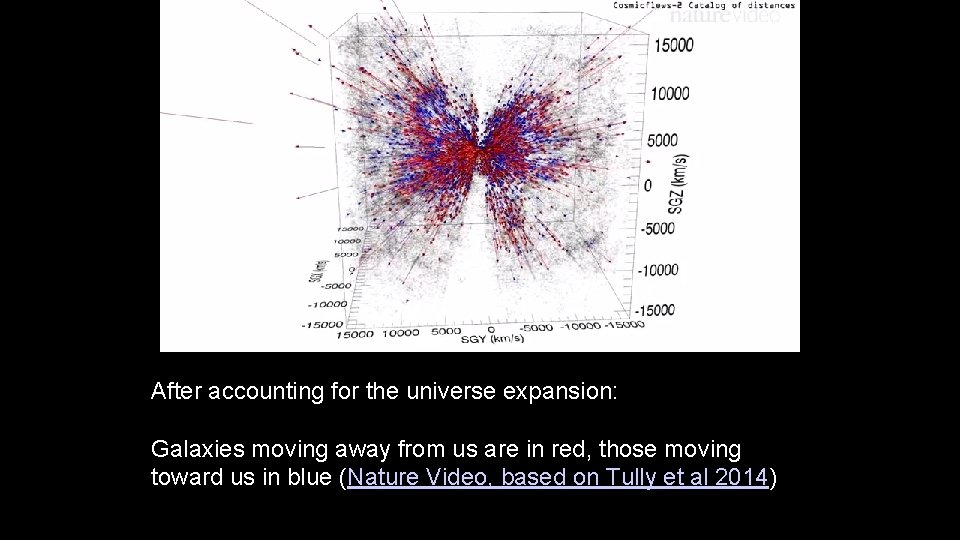
After accounting for the universe expansion: Galaxies moving away from us are in red, those moving toward us in blue (Nature Video, based on Tully et al 2014)
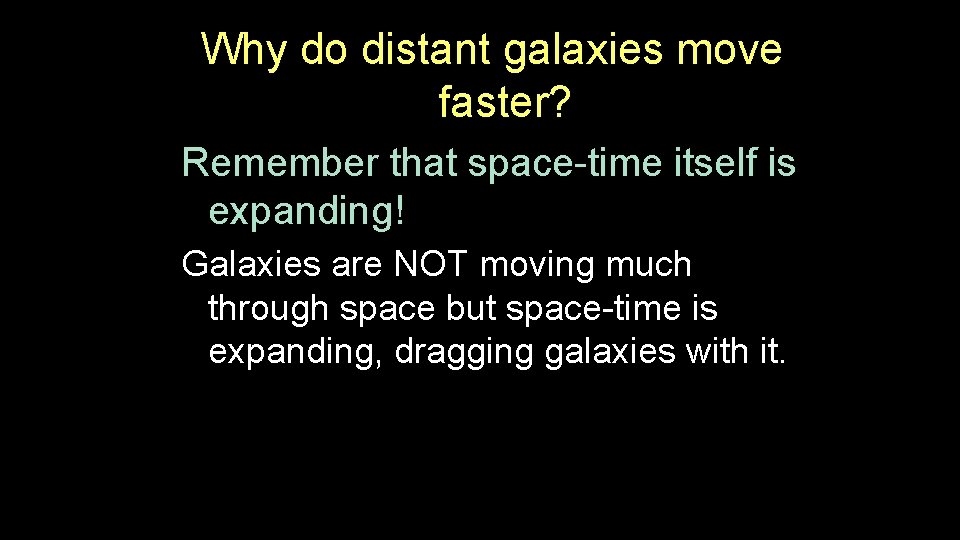
Why do distant galaxies move faster? Remember that space-time itself is expanding! Galaxies are NOT moving much through space but space-time is expanding, dragging galaxies with it.
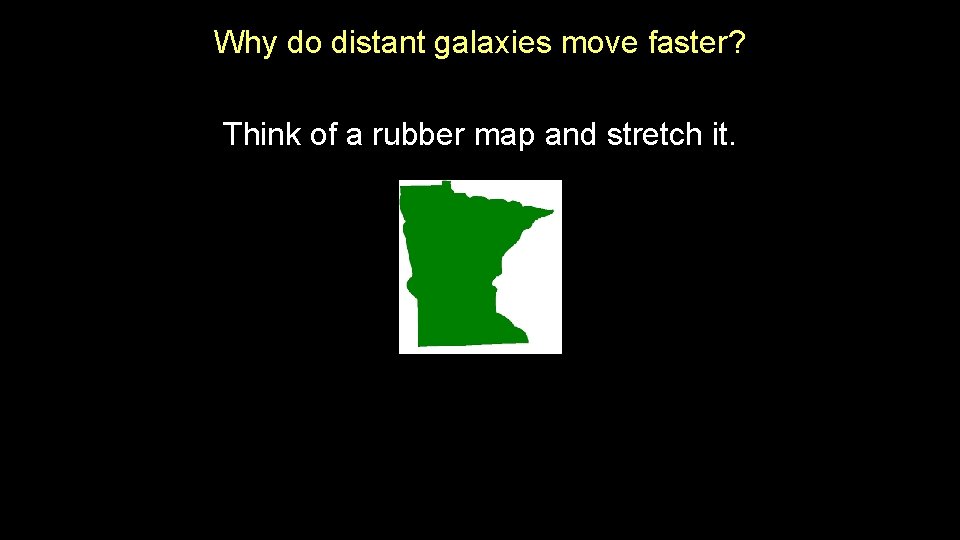
Why do distant galaxies move faster? Think of a rubber map and stretch it.
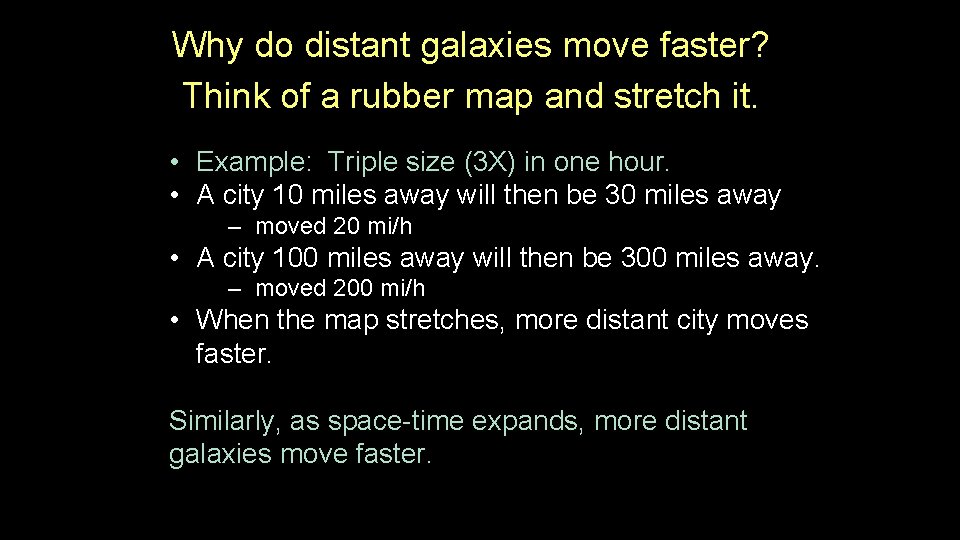
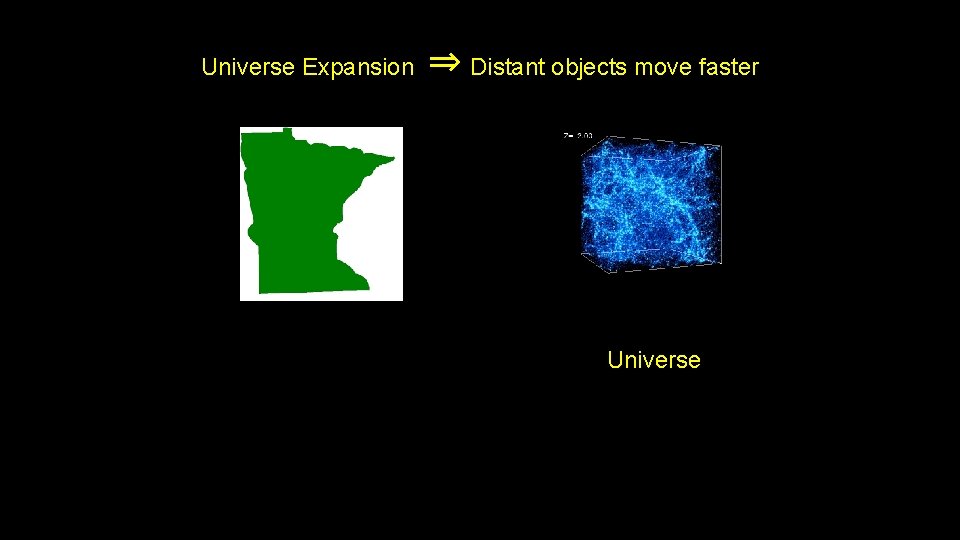
Why do distant galaxies move faster? Think of a rubber map and stretch it. • Example: Triple size (3 X) in one hour. • A city 10 miles away will then be 30 miles away – moved 20 mi/h • A city 100 miles away will then be 300 miles away. – moved 200 mi/h • When the map stretches, more distant city moves faster. Similarly, as space-time expands, more distant galaxies move faster.
Universe Expansion ⇒ Distant objects move faster Universe
Doesn’t seeing a Red Shift of ALL galaxies imply that we are at the center of the universe? (all moving away? ) NO! But why?
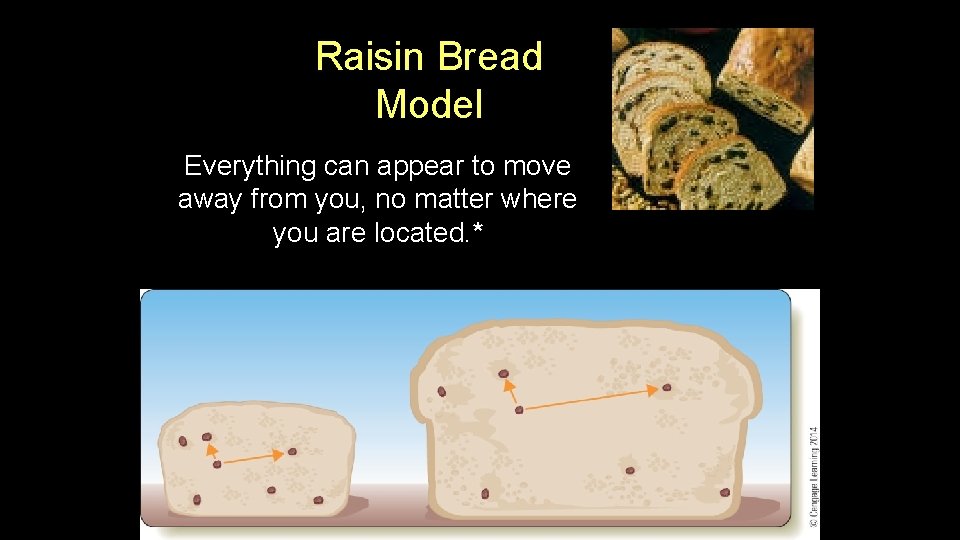
Raisin Bread Model Everything can appear to move away from you, no matter where you are located. *
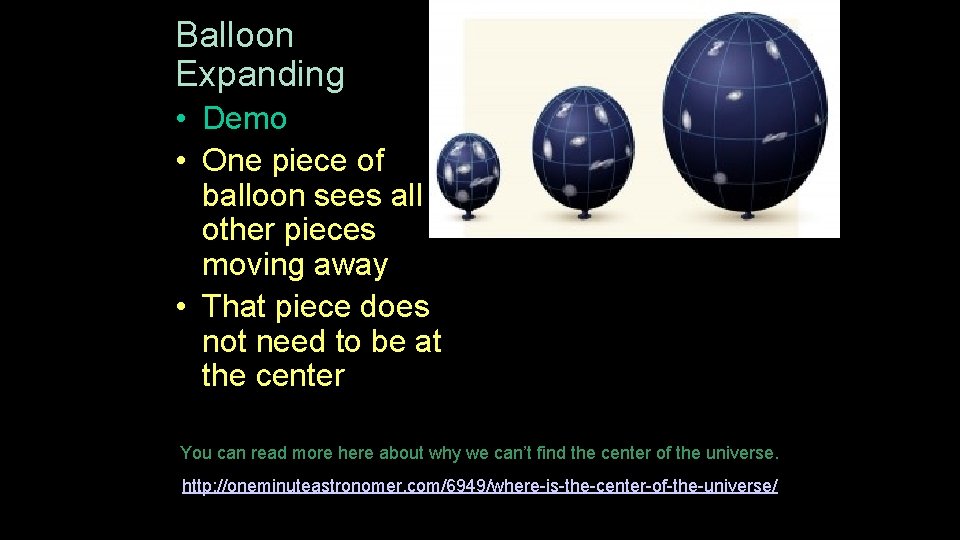
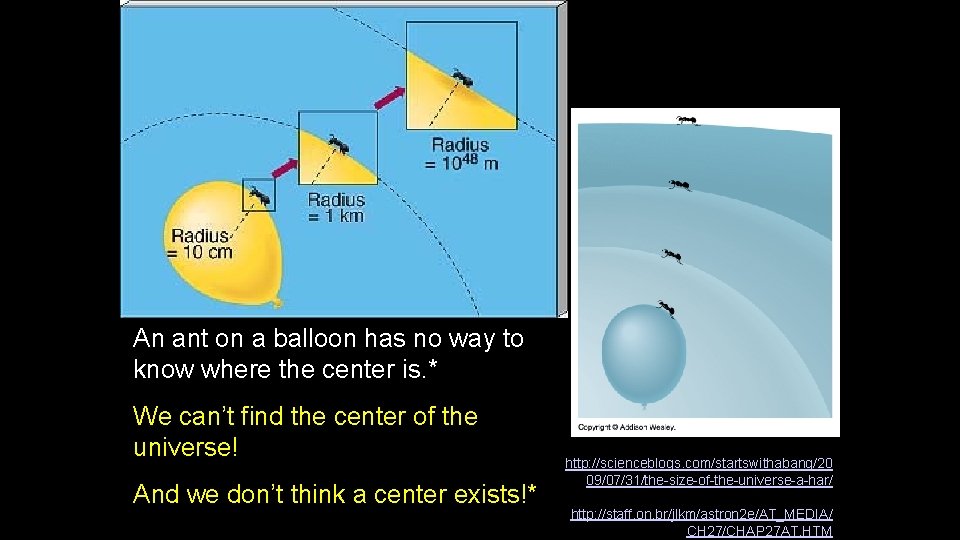
Balloon Expanding • Demo • One piece of balloon sees all other pieces moving away • That piece does not need to be at the center You can read more here about why we can’t find the center of the universe. http: //oneminuteastronomer. com/6949/where-is-the-center-of-the-universe/
Doesn’t seeing a Red Shift of ALL galaxies imply that we are at the center of the universe? (all moving away? ) NO! Expansion You see all other parts moving away You are not at center
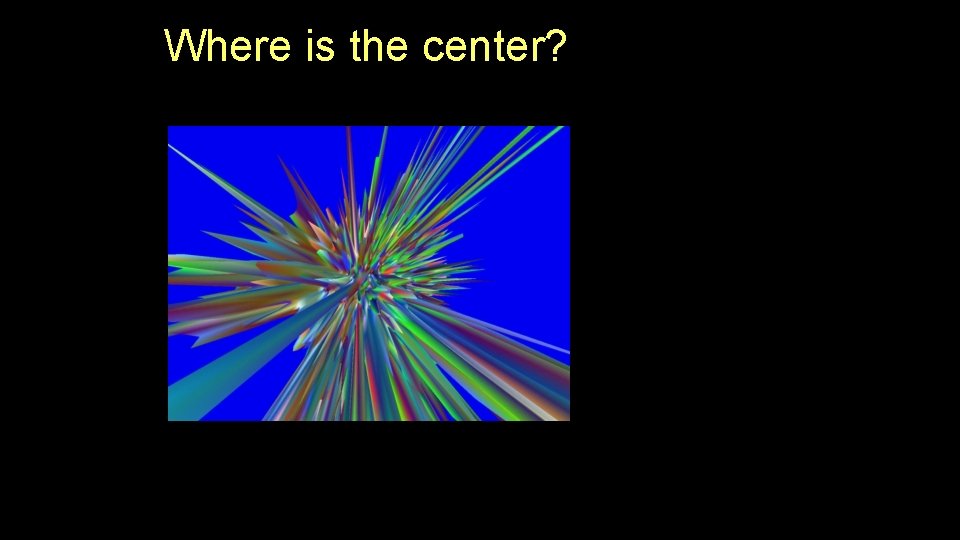
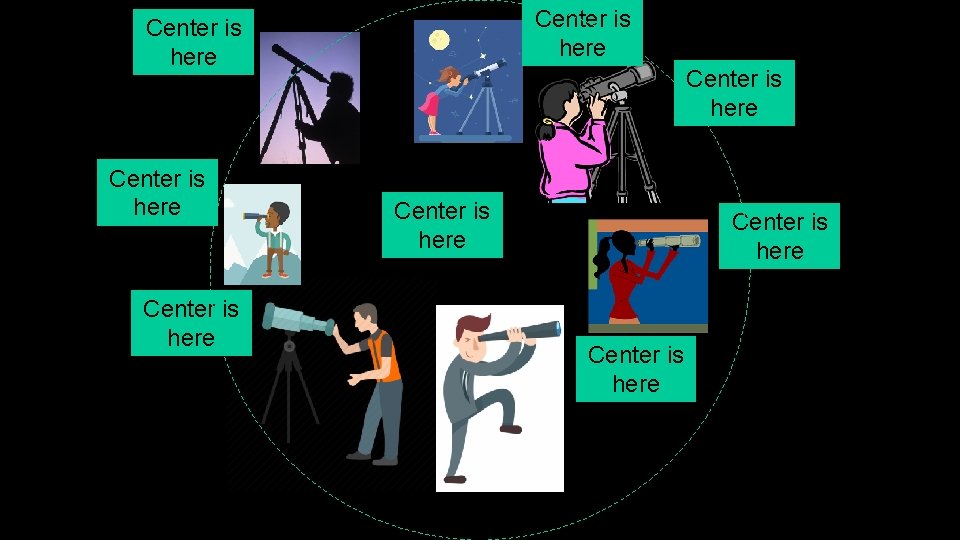
Where is the center?
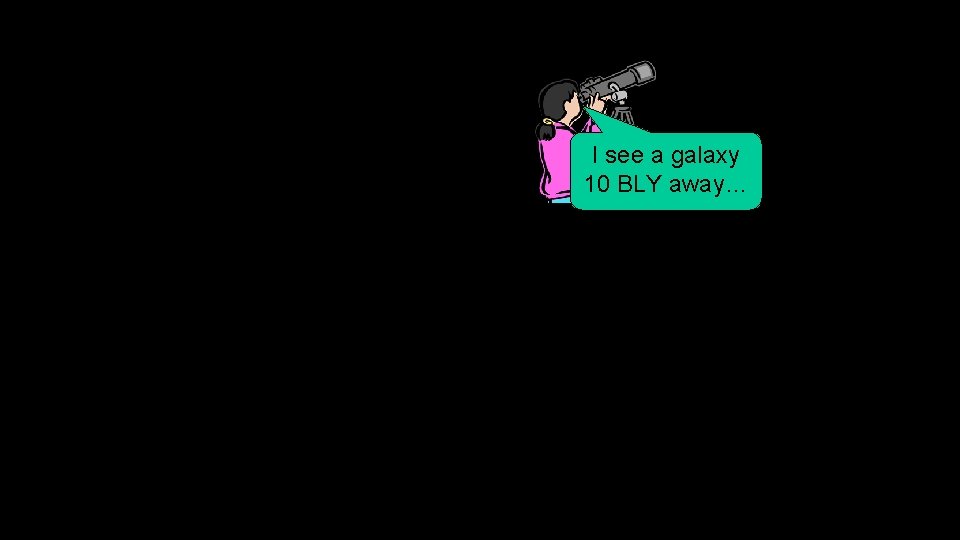
I see a galaxy 10 BLY away…
…as it was 10 Byrs ago…
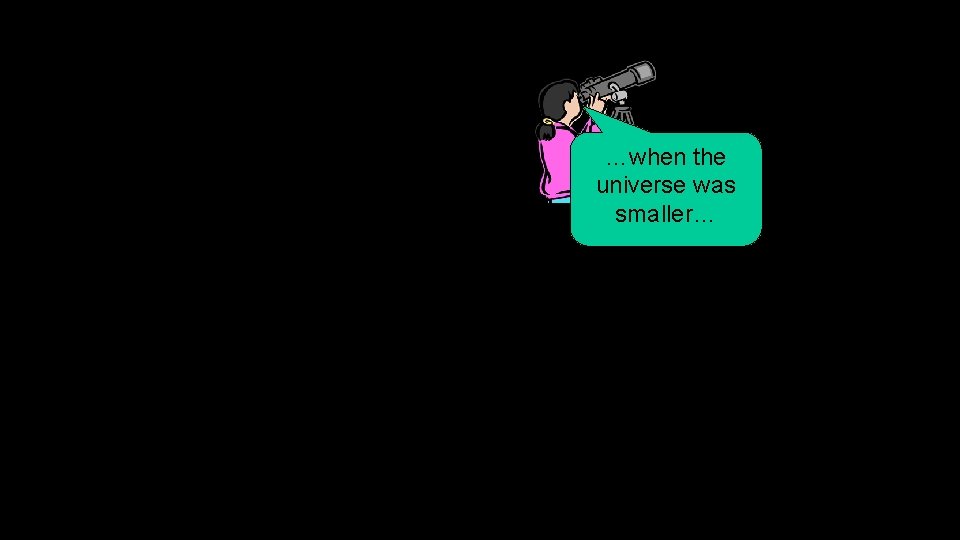
…when the universe was smaller…
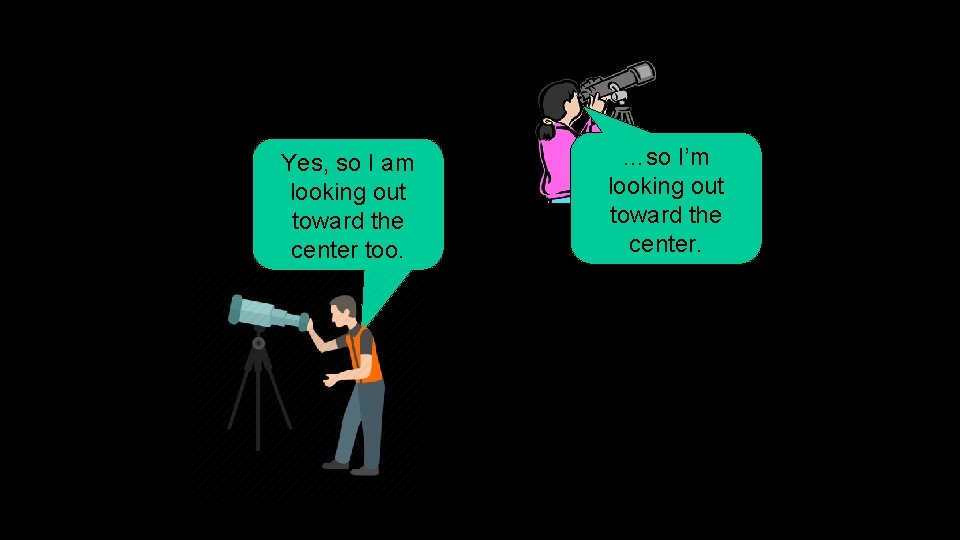
…so I’m looking back toward the center.
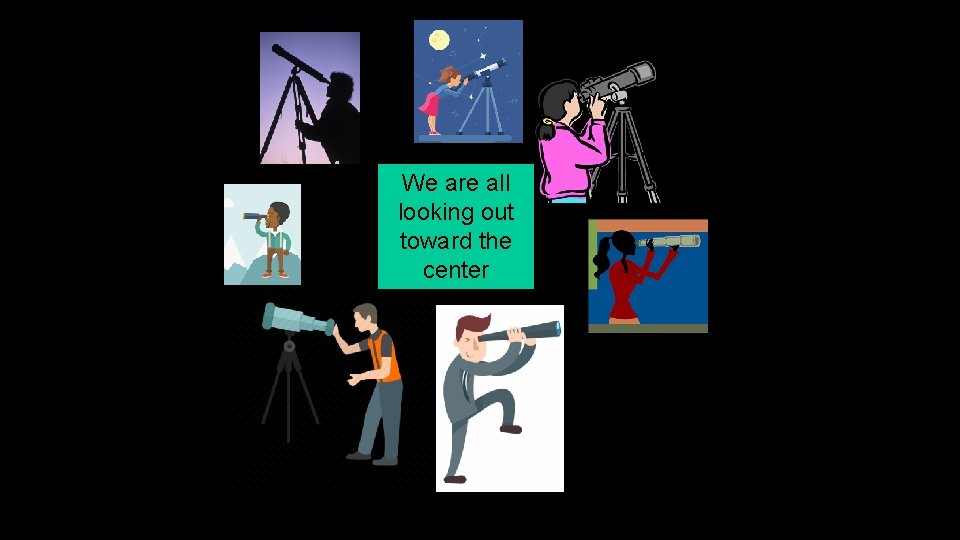
Yes, so I am looking out toward the center too. …so I’m looking out toward the center.
We are all looking out toward the center
Center is here Center is here
An ant on a balloon has no way to know where the center is. * We can’t find the center of the universe! And we don’t think a center exists!* http: //scienceblogs. com/startswithabang/20 09/07/31/the-size-of-the-universe-a-har/ http: //staff. on. br/jlkm/astron 2 e/AT_MEDIA/ CH 27/CHAP 27 AT. HTM
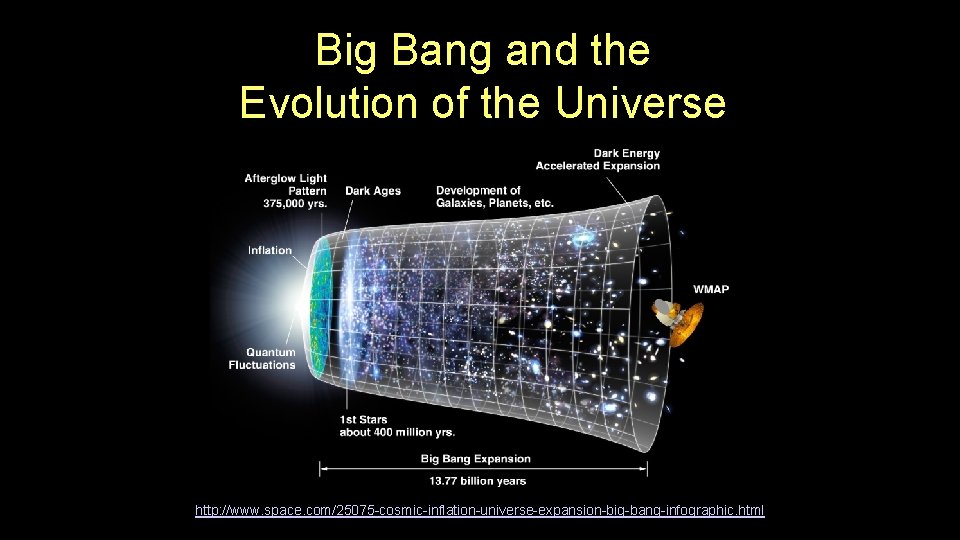
Big Bang and the Evolution of the Universe http: //www. space. com/25075 -cosmic-inflation-universe-expansion-big-bang-infographic. html
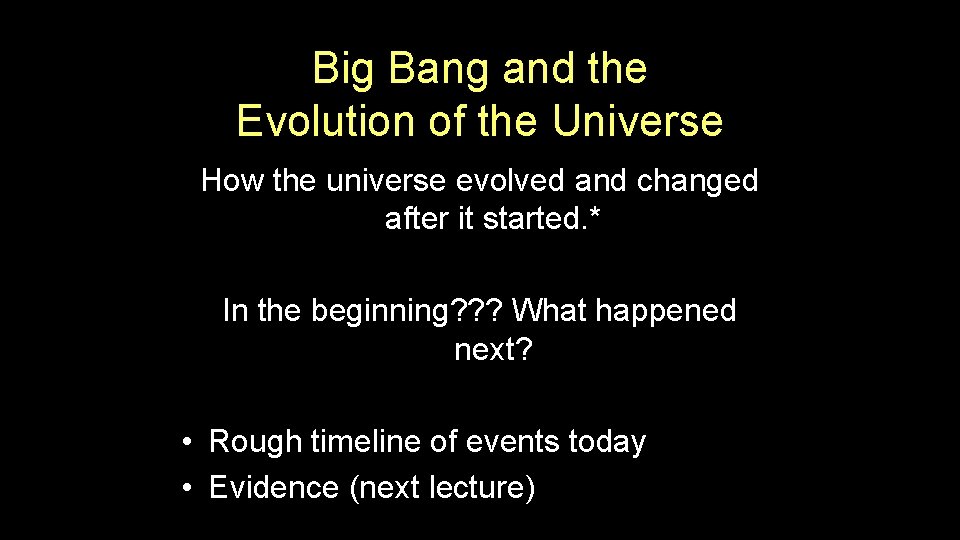
Big Bang and the Evolution of the Universe How the universe evolved and changed after it started. * In the beginning? ? ? What happened next? • Rough timeline of events today • Evidence (next lecture)
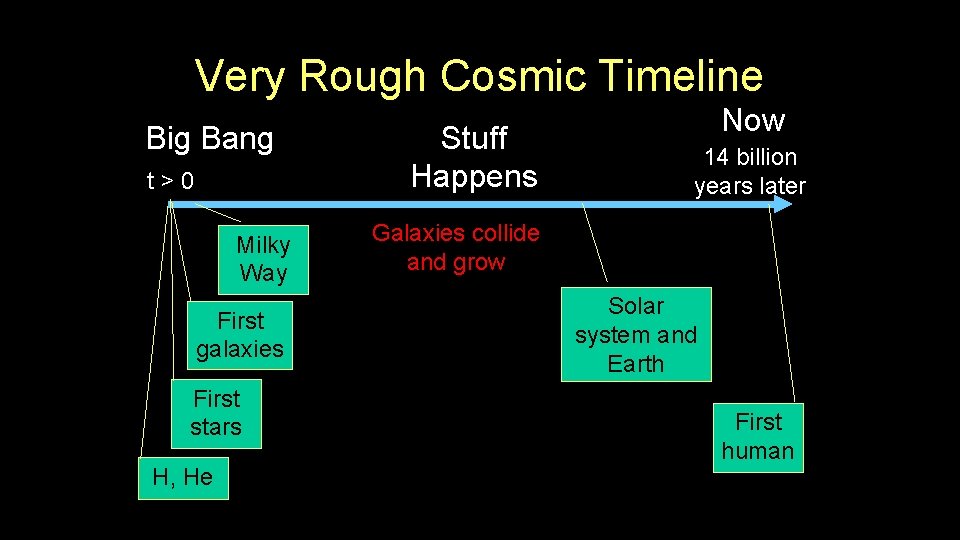
Very Rough Cosmic Timeline Big Bang t > 0 Milky Way First galaxies First stars H, He Stuff Happens Now 14 billion years later Galaxies collide and grow Solar system and Earth First human s
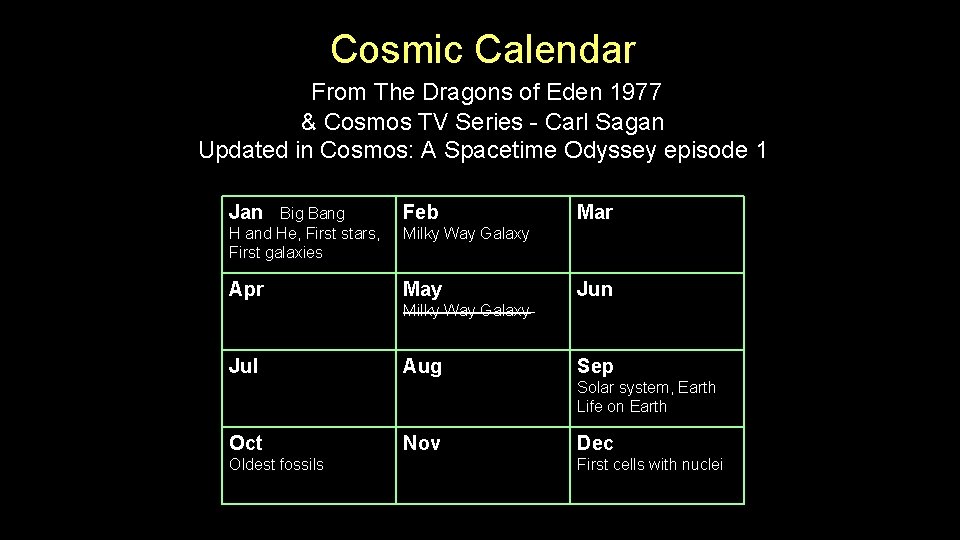
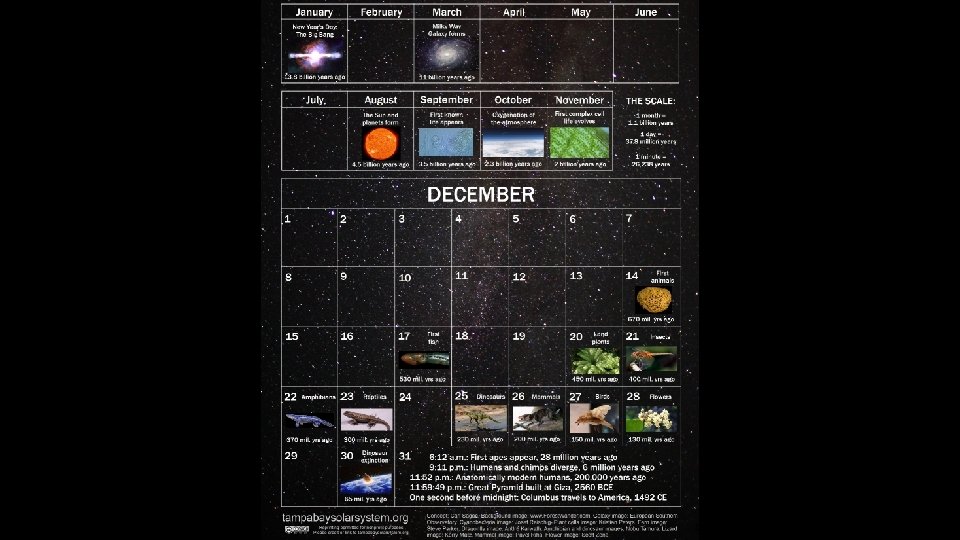
Cosmic Calendar From The Dragons of Eden 1977 & Cosmos TV Series - Carl Sagan Updated in Cosmos: A Spacetime Odyssey episode 1 Jan Big Bang H and He, First stars, First galaxies Feb Apr May Mar Milky Way Galaxy Jun Milky Way Galaxy Jul Aug Sep Solar system, Earth Life on Earth Oct Oldest fossils Nov Dec First cells with nuclei
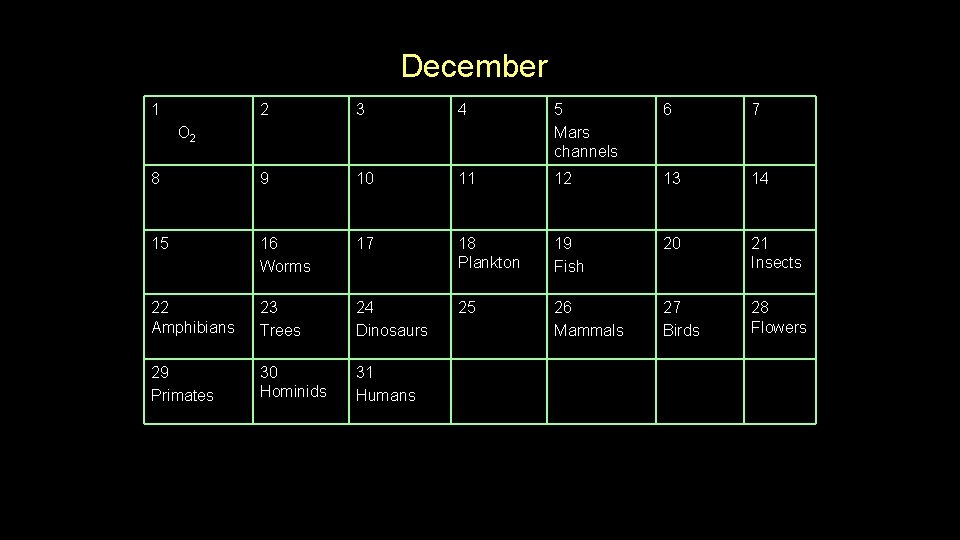
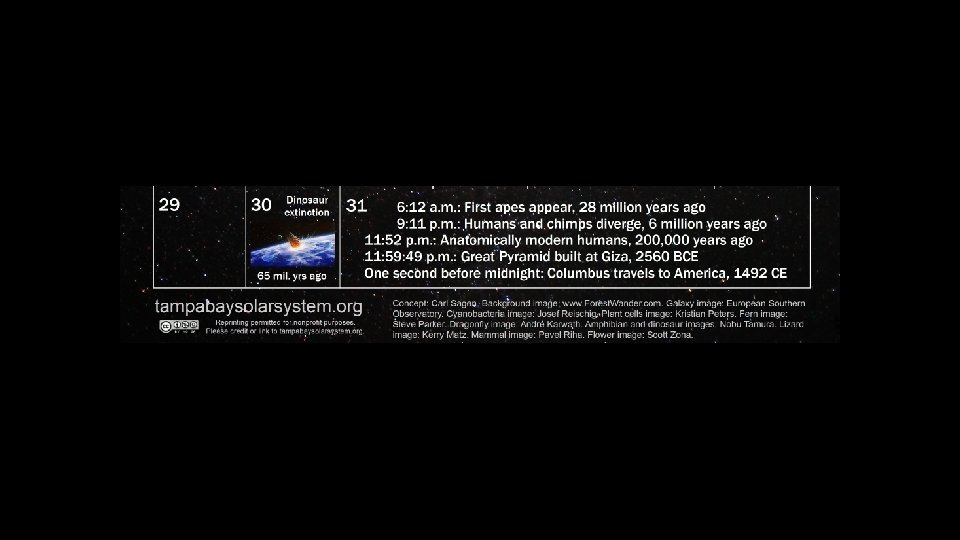
December 1 O 2 2 3 4 5 Mars channels 6 7 8 9 10 11 12 13 14 15 16 Worms 17 18 Plankton 19 Fish 20 21 Insects 22 Amphibians 23 Trees 24 Dinosaurs 25 26 Mammals 27 Birds 28 Flowers 29 Primates 30 Hominids 31 Humans
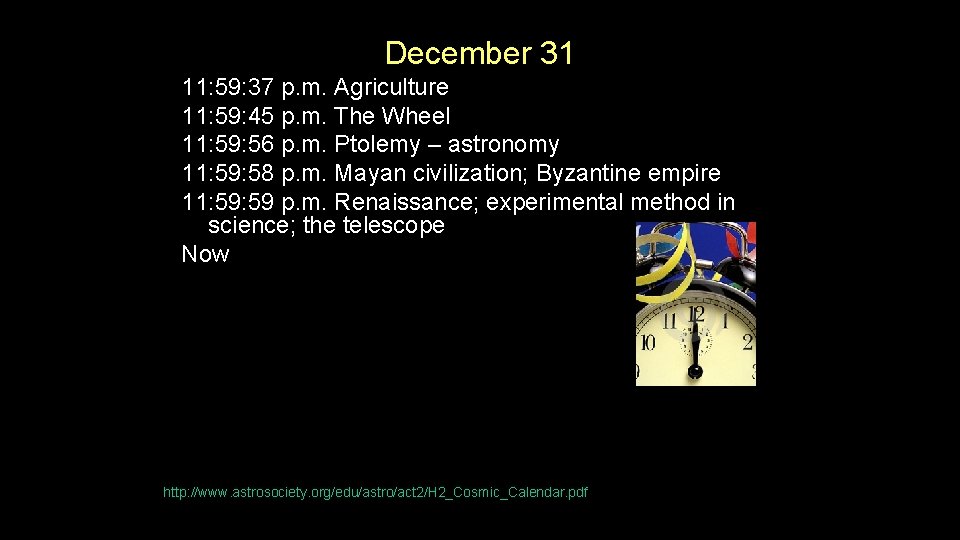
December 31 11: 59: 37 p. m. Agriculture 11: 59: 45 p. m. The Wheel 11: 59: 56 p. m. Ptolemy – astronomy 11: 59: 58 p. m. Mayan civilization; Byzantine empire 11: 59 p. m. Renaissance; experimental method in science; the telescope Now http: //www. astrosociety. org/edu/astro/act 2/H 2_Cosmic_Calendar. pdf
About how old is our universe? *
About how old is our universe? * 14 billion years*
About how old is our Milky Way Galaxy?
About how old is our Milky Way Galaxy? 13 billion years
About how old is our solar system? *
About how old is our solar system? * 5 billion years* (same age as our Sun)*
Homework & Updates • Keep up with Study Points • D 2 L Quiz 9 -12 available; Quizzes 9 -13 for Test 3 • Optional – watch: • The Big Bang, Cosmology part 1: Crash Course Astronomy #42 • A Brief History of the Universe: Crash Course Astronomy #44 • Observations: Astrophysics Lecture Due TODAY Dec. 3 (10 pts) Write report Planetarium Due TODAY Dec. 3 (10 pts) Go to a planetarium show Optional – watch: Astronomy News Evalution Due Dec. 10 (20 pts) Evaluate astronomy news • The Big Bang, Cosmology part 1: Crash Course Astronomy #42 nd picture of sunset in same place Sunset – Part 2 Due Dec. 10 (10 points) Take 2 • A Brief History of the Universe: Crash Course Astronomy #44 • Take picture about 4 pm; sunsets about 4: 40 pm • Stargazing Due Dec. 17 (20 pts) Go stargazing & write report • Telescope Due Dec. 17 (20 pts) Look through a telescope • Look at calendar options & weather • Moon Craters Due Dec. 17 (10 pts) Look at magnified moon craters • Borrow binoculars from Lab room • • • Pick up lab notebooks and test today • Let Raquel know if you want to take the optional Lab Test 2 on Dec. 10 or 12 • Grade calculator on website to try out different grades.
Calendar Summary • Tuesday, 11/26: No lecture or lab. Work on observations. • Tuesday, 12/3: Hubble’s Law & Galaxies & pick up lab notebooks in lecture • Thursday, 12/5: Big Bang • Tuesday, 12/10: Life in the Universe (optional Lab Test 2) • Thursday, 12/12: Test 3 (60 multiple choice questions) – – Based on last 8 lectures & 5 D 2 L quizzes 9 -13 Some questions from D 2 L quizzes Bring pencil, no calculator needed Optional Lab Test 2 during lab time • Tuesday, 12/17: Final Test today & handback Test 3 – – – Based on all 23 lectures & 13 D 2 L quizzes (the whole semester) Many questions from D 2 L quizzes Bring pencil & calculator if you have one (some in classroom for you) Remember lowest of 4 tests is dropped (Test 1, 2, 3, & Final). If you took 3 previous tests and are happy with your grade, then you don’t have to take the Final Test. If you missed a previous test, you must take the Final Test. If you are trying to increase your grade, take the final to hopefully drop a different test. No Astronomy on 12/19.