
STUDY ON COPYRIGHT LIMITATIONS AND EXCEPTIONS FOR MUSEUMS
- Slides: 30
STUDY ON COPYRIGHT LIMITATIONS AND EXCEPTIONS FOR MUSEUMS WIPO Standing Committee on copyright and related rights Thirty-first session 9 December 2015 08/12/15 UGGC/IVi. R 1
Contents § § Research question & methodology Definition of museum Legislative Framework Exceptions and limitations for museums – Specific exceptions – General exceptions – Resale right § Case studies 08/12/15 UGGC/IVi. R 2
Research question § What is the current state of copyright law regarding the use of copyright protected works by museums and their patrons? § Should measures be implemented to facilitate the provision of museum services in compliance with the norms of copyright law? 08/12/15 UGGC/IVi. R 3
Methodology § Review of national legislation – Based on the WIPO Studies on libraries and archives of 2008 and 2014 – Additional key-word search in WIPO-lex database – National copyright laws included only if express mention of ‘museum’ § Survey among ICOM members 08/12/15 UGGC/IVi. R 4
Definition of Museum A museum is a non-profit, permanent institution in the service of society and its development, open to the public, which acquires, conserves, researches, communicates and exhibits the tangible and intangible heritage of humanity and its environment for the purposes of education, study and enjoyment. (ICOM 2007) Mandates : research 08/12/15 (i) acquire and protect (ii) communicate and exhibit (iii) facilitate education, study and UGGC/IVi. R 5
Museum Community § More than 55 000 “museums”, as diverse as possibly imaginable § Conscious of IP and public domain issues § Pursuing core common goals § Distinct from libraries and archives § With specific concerns which are not fully addressed ( 45 countries only) 08/12/15 UGGC/IVi. R 6
Legislative Framework § The cultural heritage dimension - UNESCO Conventions - Regional Conventions and State laws § The Intellectual property framework: 08/12/15 Berne Convention TRIPS Agreement 1994 WIPO Treaties 1996 Regional/EU and national laws UGGC/IVi. R 7
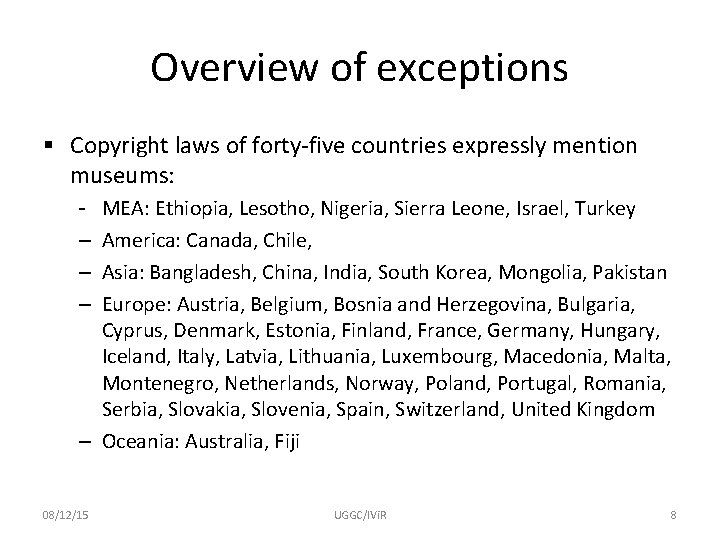
Overview of exceptions § Copyright laws of forty-five countries expressly mention museums: MEA: Ethiopia, Lesotho, Nigeria, Sierra Leone, Israel, Turkey America: Canada, Chile, Asia: Bangladesh, China, India, South Korea, Mongolia, Pakistan Europe: Austria, Belgium, Bosnia and Herzegovina, Bulgaria, Cyprus, Denmark, Estonia, Finland, France, Germany, Hungary, Iceland, Italy, Latvia, Lithuania, Luxembourg, Macedonia, Malta, Montenegro, Netherlands, Norway, Poland, Portugal, Romania, Serbia, Slovakia, Slovenia, Spain, Switzerland, United Kingdom – Oceania: Australia, Fiji – – – 08/12/15 UGGC/IVi. R 8
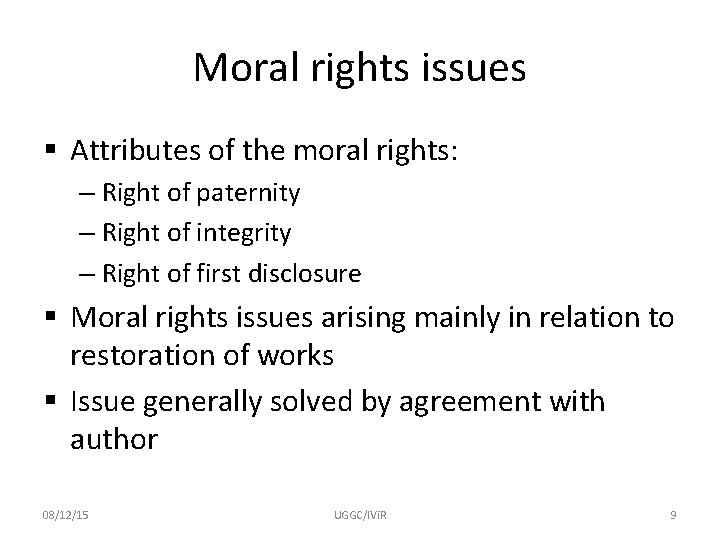
Moral rights issues § Attributes of the moral rights: – Right of paternity – Right of integrity – Right of first disclosure § Moral rights issues arising mainly in relation to restoration of works § Issue generally solved by agreement with author 08/12/15 UGGC/IVi. R 9
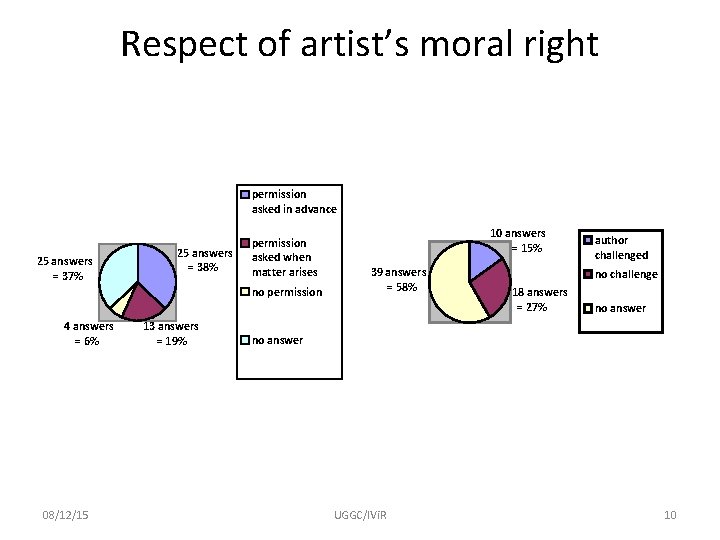
Respect of artist’s moral right permission asked in advance 25 answers = 37% 25 answers = 38% permission asked when matter arises no permission 4 answers = 6% 08/12/15 13 answers = 19% 10 answers = 15% 39 answers = 58% author challenged no challenge 18 answers = 27% no answer UGGC/IVi. R 10
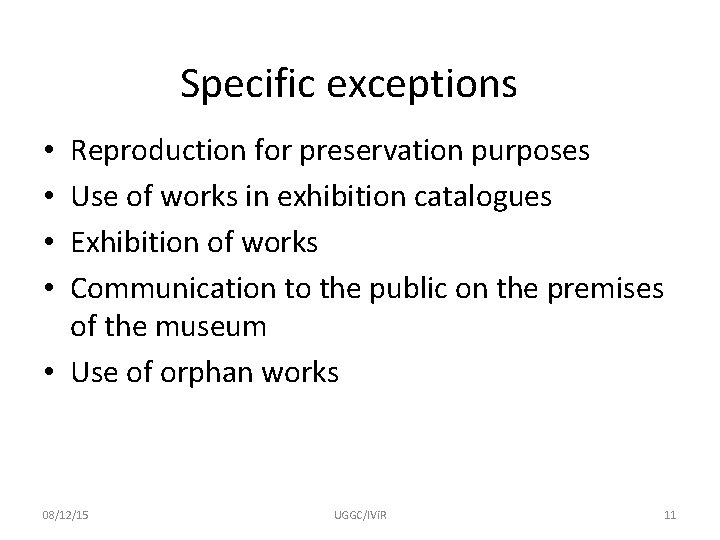
Specific exceptions Reproduction for preservation purposes Use of works in exhibition catalogues Exhibition of works Communication to the public on the premises of the museum • Use of orphan works • • 08/12/15 UGGC/IVi. R 11
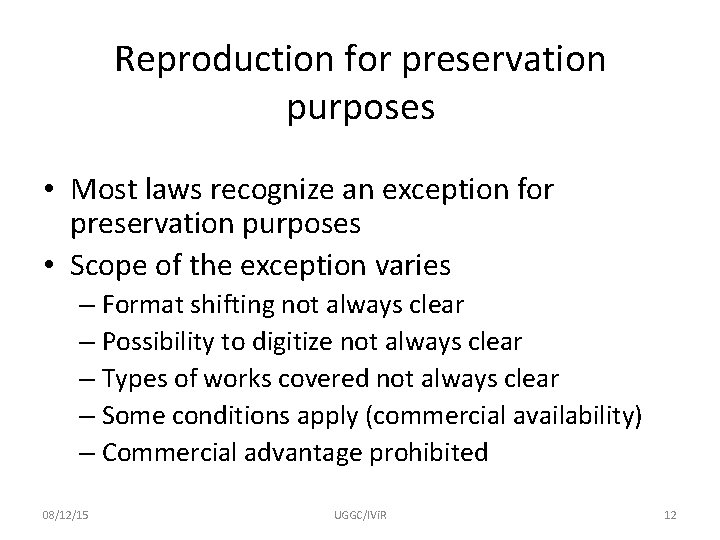
Reproduction for preservation purposes • Most laws recognize an exception for preservation purposes • Scope of the exception varies – Format shifting not always clear – Possibility to digitize not always clear – Types of works covered not always clear – Some conditions apply (commercial availability) – Commercial advantage prohibited 08/12/15 UGGC/IVi. R 12
Use of works in exhibition catalogues • Need for museums to advertise and promote exhibitions • Exception recognized in a number of countries to allow reproduction of works in catalogues • In Europe, art. 5(3)j) Directive 2001/29/EC • Not always clear if museums are covered by the exception (e. g. other than galleries & auctions) 08/12/15 UGGC/IVi. R 13
Exhibition of works • Copyright law does not always allow museums to display works in their collection to the public without permission of the author • Three positions in the law: – Right of exhibition is exclusive to the author; – Exhibition of works is covered by exception; or – Physical ownership of work entails exhibition • Uncertainty creates a burden for museum activities 08/12/15 UGGC/IVi. R 14
Communication to the public • Communication of works to the public is a core mission of museums • Law of most countries is silent on possibility to give access to and communicate works to the public on the premises of the museum • Chile and European Directive 2001/29/EC recognize exception to the benefit of museums 08/12/15 UGGC/IVi. R 15
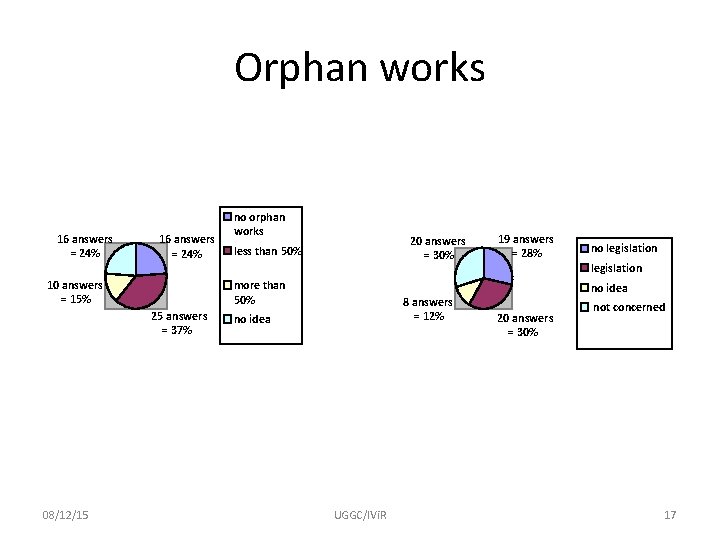
Use of orphan works • Works are deemed orphan if the rights owner cannot be identified or located • Museums sometimes confronted with orphan works issues • Europe adopted Directive 2012/28/EC on orphan works • Other countries have some solution through a licensing authority (Canada, Japan, India, Fiji) 08/12/15 UGGC/IVi. R 16
Orphan works 16 answers = 24% 10 answers = 15% 20 answers = 30% less than 50% more than 50% 25 answers = 37% 08/12/15 no orphan works 8 answers = 12% no idea UGGC/IVi. R 19 answers = 28% no legislation no idea 20 answers = 30% not concerned 17
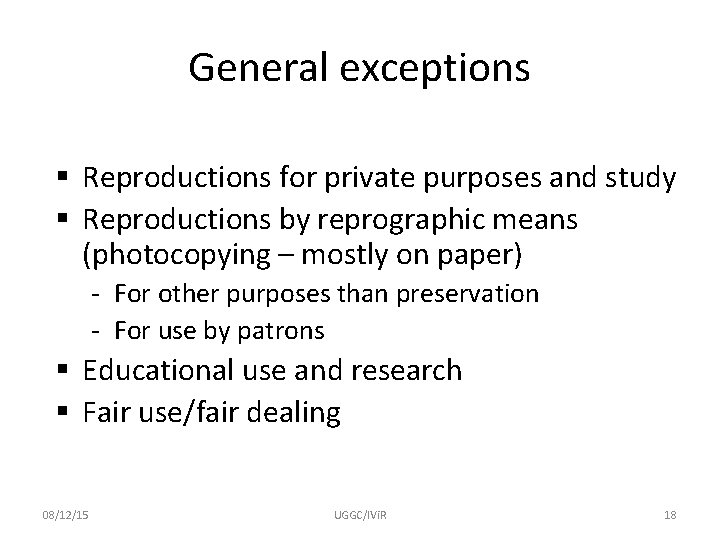
General exceptions § Reproductions for private purposes and study § Reproductions by reprographic means (photocopying – mostly on paper) - For other purposes than preservation - For use by patrons § Educational use and research § Fair use/fair dealing 08/12/15 UGGC/IVi. R 18
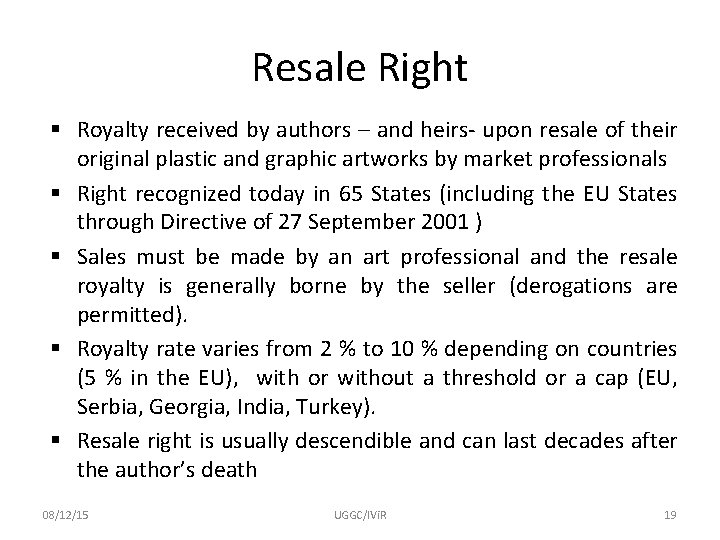
Resale Right § Royalty received by authors – and heirs- upon resale of their original plastic and graphic artworks by market professionals § Right recognized today in 65 States (including the EU States through Directive of 27 September 2001 ) § Sales must be made by an art professional and the resale royalty is generally borne by the seller (derogations are permitted). § Royalty rate varies from 2 % to 10 % depending on countries (5 % in the EU), with or without a threshold or a cap (EU, Serbia, Georgia, India, Turkey). § Resale right is usually descendible and can last decades after the author’s death 08/12/15 UGGC/IVi. R 19
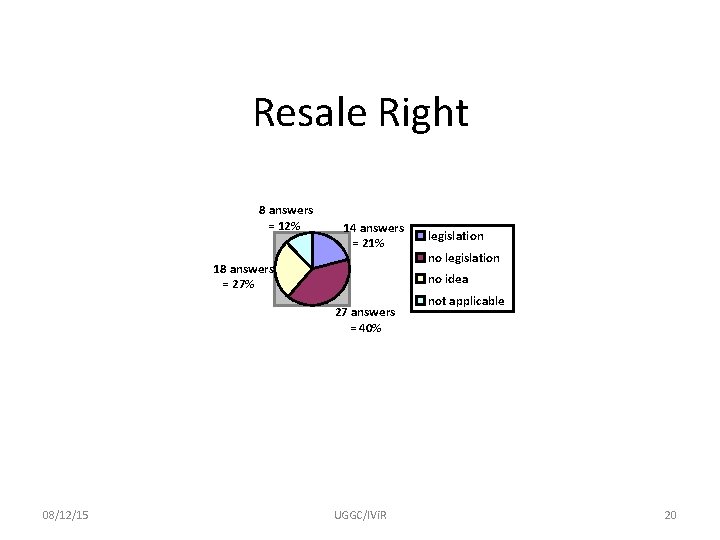
Resale Right 8 answers = 12% 14 answers = 21% 18 answers = 27% no legislation no idea 27 answers = 40% 08/12/15 legislation UGGC/IVi. R not applicable 20
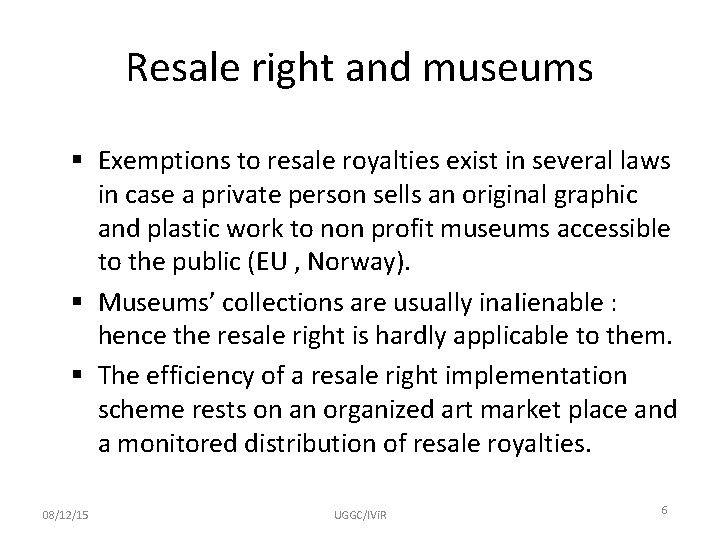
Resale right and museums § Exemptions to resale royalties exist in several laws in case a private person sells an original graphic and plastic work to non profit museums accessible to the public (EU , Norway). § Museums’ collections are usually ina. Iienable : hence the resale right is hardly applicable to them. § The efficiency of a resale right implementation scheme rests on an organized art market place and a monitored distribution of resale royalties. 08/12/15 UGGC/IVi. R 6
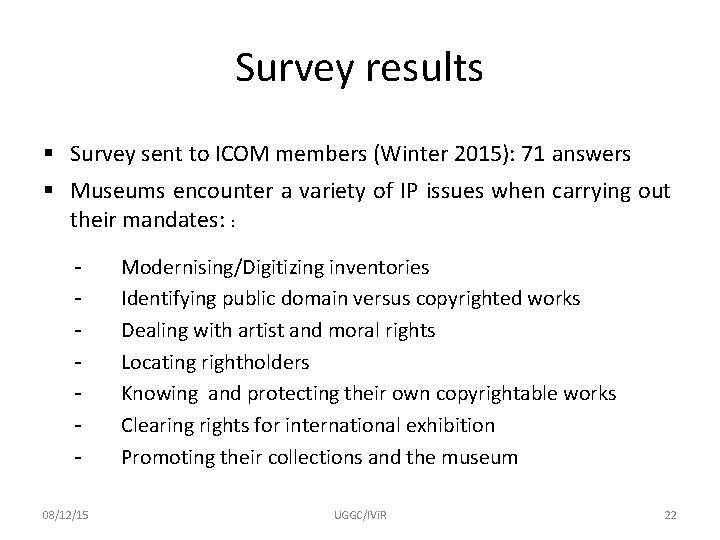
Survey results § Survey sent to ICOM members (Winter 2015): 71 answers § Museums encounter a variety of IP issues when carrying out their mandates: : 08/12/15 Modernising/Digitizing inventories Identifying public domain versus copyrighted works Dealing with artist and moral rights Locating rightholders Knowing and protecting their own copyrightable works Clearing rights for international exhibition Promoting their collections and the museum UGGC/IVi. R 22
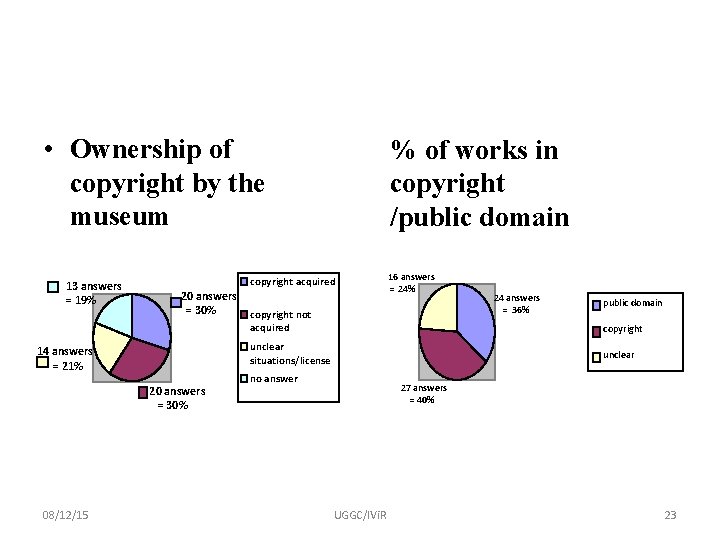
• Ownership of copyright by the museum 13 answers = 19% 20 answers = 30% copyright acquired 16 answers = 24% copyright not acquired 20 answers = 30% 24 answers = 36% public domain copyright unclear situations/license 14 answers = 21% 08/12/15 % of works in copyright /public domain unclear no answer 27 answers = 40% UGGC/IVi. R 23
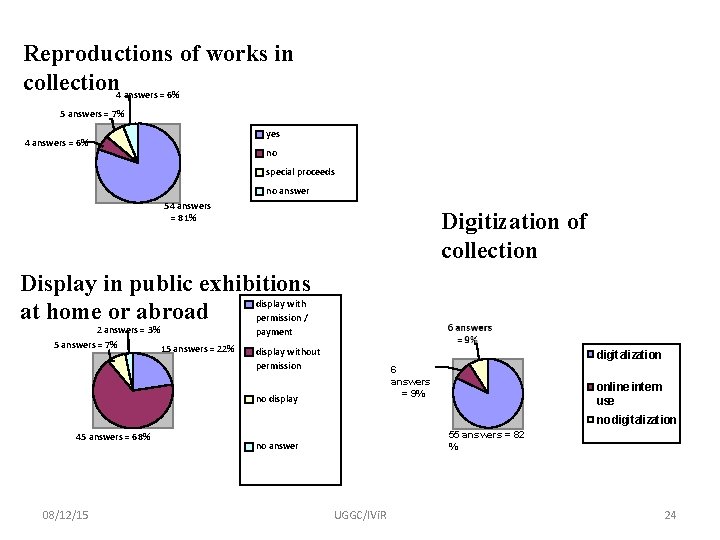
Reproductions of works in collection 4 answers = 6% 5 answers = 7% yes 4 answers = 6% no special proceeds no answer 54 answers = 81% Digitization of collection Display in public exhibitions display with at home or abroad permission / 2 answers = 3% 5 answers = 7% payment 15 answers = 22% display without permission digitalization 6 answers = 9% no display online intern use no digitalization 45 answers = 68% 08/12/15 55 answers = 82 % no answer UGGC/IVi. R 24
Survey results Four priorities identified: 1. Digitization of collections enriched with texts and images to facilitate management and communication 2. Domestic and travelling exhibitions should benefit from more harmonized treatment 3. Addressing changing state of the works of art in collections through time 4. Assuming the growing role of museums in education and research with modern means of communication 08/12/15 UGGC/IVi. R 25
CASE Study 1 Digitization of Museum Collections § Key tool to manage and promote collections: - Issue of prior consent of the rightholder - Orphan and unpublished works - Making available to the public : when and how ? § Guidance and simplification needed on: - Standards for reproduction of images - Licensing by collective societies - Online access to collections and museum activities 08/12/15 UGGC/IVi. R 26
CASE Study 2 Scope of right of exhibition § Diverging laws on the requirement of the consent of the copyright owner (e. g. Canada, Iceland or USA) § Complex issues regarding promotion material for exhibitions (deemed commercial use or not? ) § Need to define how to address the right of exhibition § Consider allowing permanent on line consultation of exhibitions that have ended in the premises 08/12/15 UGGC/IVi. R 27
CASE Study 3 Changing states of works of art § Relates to the preservation mandate § Challenge of ‘storing’ digital, ephemeral creations and the need to repair or restore works in the museum’s collections - Issue often more technical than legal and can be addressed by contract with the author upon acquisition of the work of art § Some national laws allow broad copying of works for preservation purposes - The anticipation of new forms of copyrightable works § Specific status of collective works, orphan and unpublished works 08/12/15 UGGC/IVi. R 28
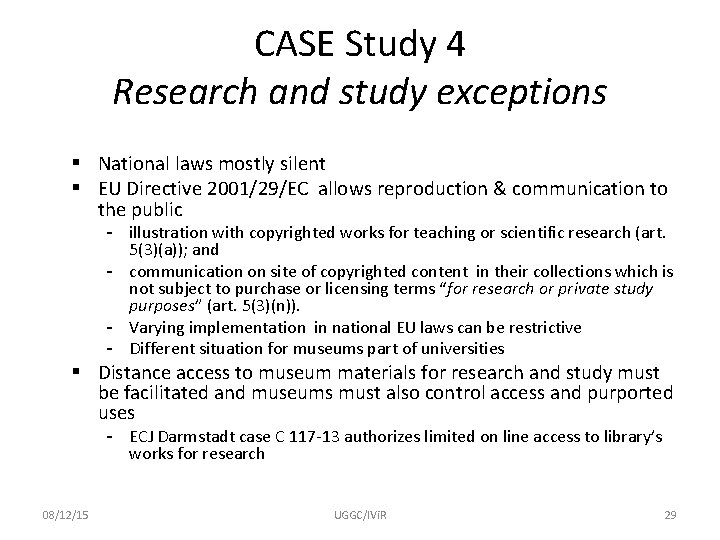
CASE Study 4 Research and study exceptions § National laws mostly silent § EU Directive 2001/29/EC allows reproduction & communication to the public - illustration with copyrighted works for teaching or scientific research (art. 5(3)(a)); and - communication on site of copyrighted content in their collections which is not subject to purchase or licensing terms “for research or private study purposes” (art. 5(3)(n)). - Varying implementation in national EU laws can be restrictive - Different situation for museums part of universities § Distance access to museum materials for research and study must be facilitated and museums must also control access and purported uses - ECJ Darmstadt case C 117 -13 authorizes limited on line access to library’s works for research 08/12/15 UGGC/IVi. R 29
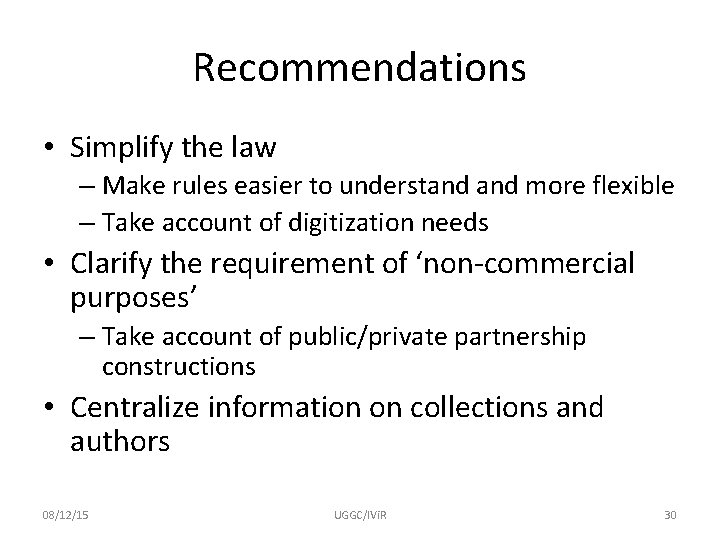
Recommendations • Simplify the law – Make rules easier to understand more flexible – Take account of digitization needs • Clarify the requirement of ‘non-commercial purposes’ – Take account of public/private partnership constructions • Centralize information on collections and authors 08/12/15 UGGC/IVi. R 30