
Study of tunneling twolevel systems and mitigation of
- Slides: 40
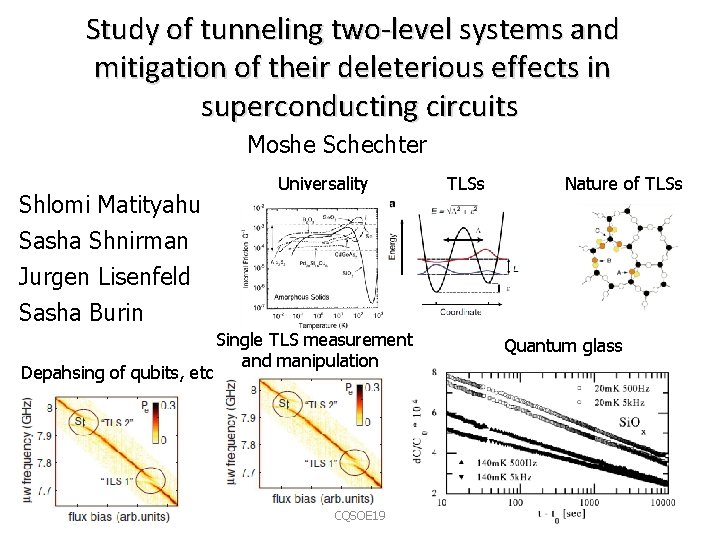
Study of tunneling two-level systems and mitigation of their deleterious effects in superconducting circuits Moshe Schechter Shlomi Matityahu Sasha Shnirman Jurgen Lisenfeld Sasha Burin Depahsing of qubits, etc Universality Single TLS measurement and manipulation CQSOE 19 TLSs Nature of TLSs Quantum glass
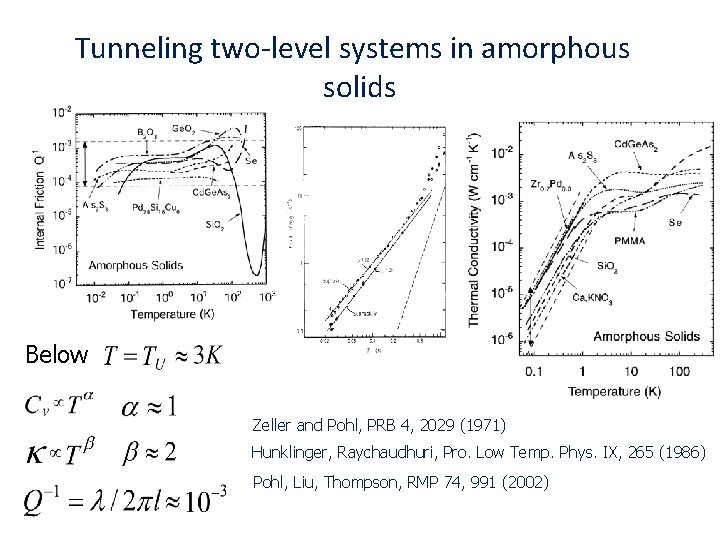
Tunneling two-level systems in amorphous solids Below Zeller and Pohl, PRB 4, 2029 (1971) Hunklinger, Raychaudhuri, Pro. Low Temp. Phys. IX, 265 (1986) Pohl, Liu, Thompson, RMP 74, 991 (2002)
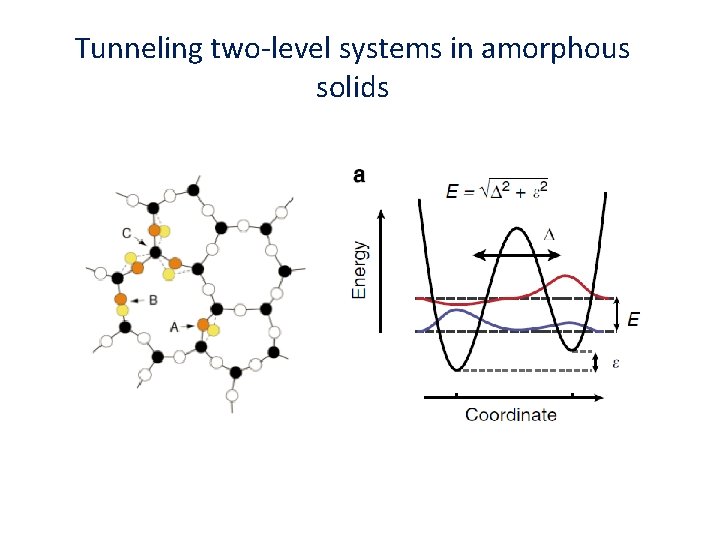
Tunneling two-level systems in amorphous solids
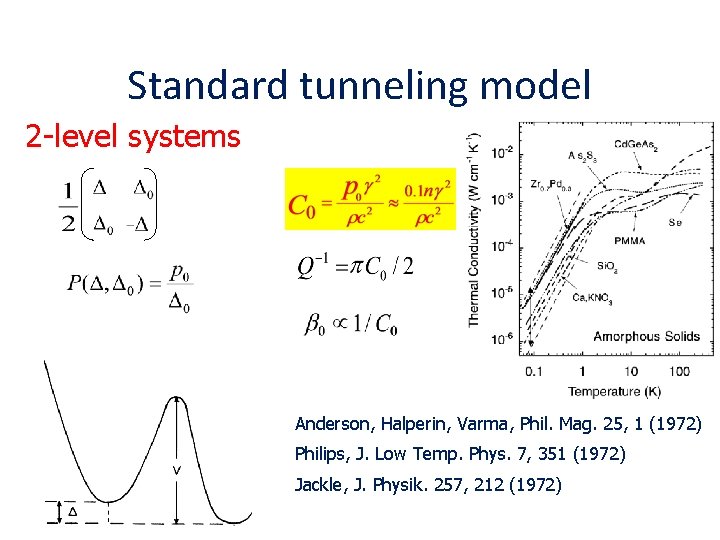
Standard tunneling model 2 -level systems Anderson, Halperin, Varma, Phil. Mag. 25, 1 (1972) Philips, J. Low Temp. Phys. 7, 351 (1972) Jackle, J. Physik. 257, 212 (1972)
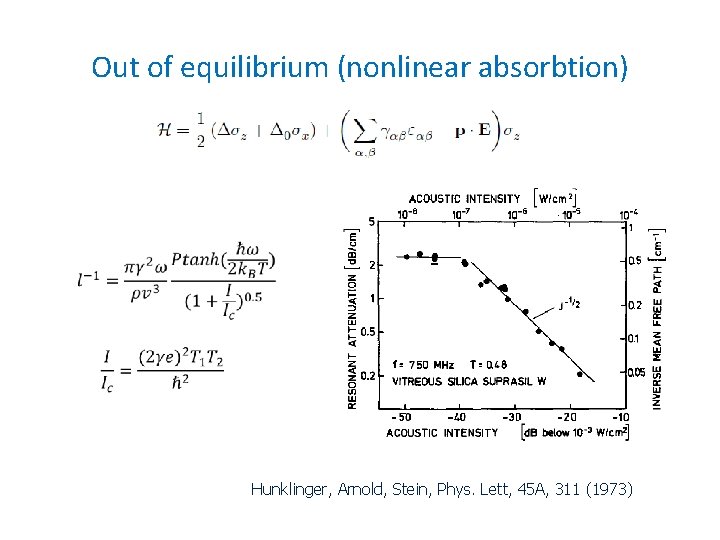
Out of equilibrium (nonlinear absorbtion) Hunklinger, Arnold, Stein, Phys. Lett, 45 A, 311 (1973)
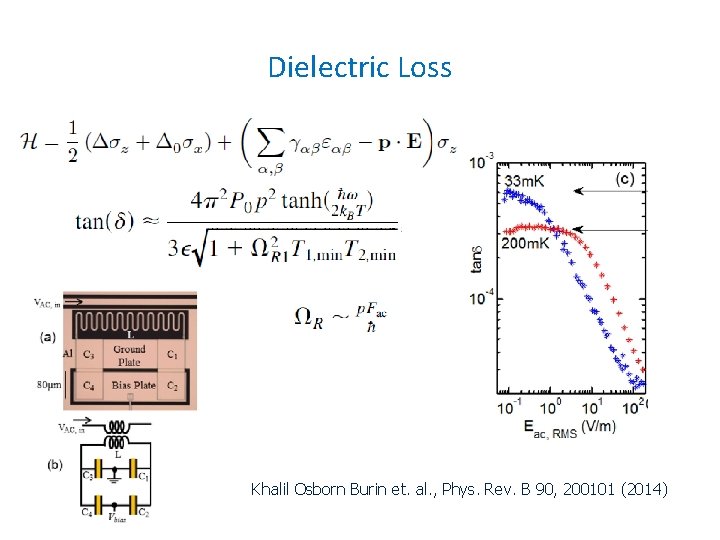
Dielectric Loss Khalil Osborn Burin et. al. , Phys. Rev. B 90, 200101 (2014)
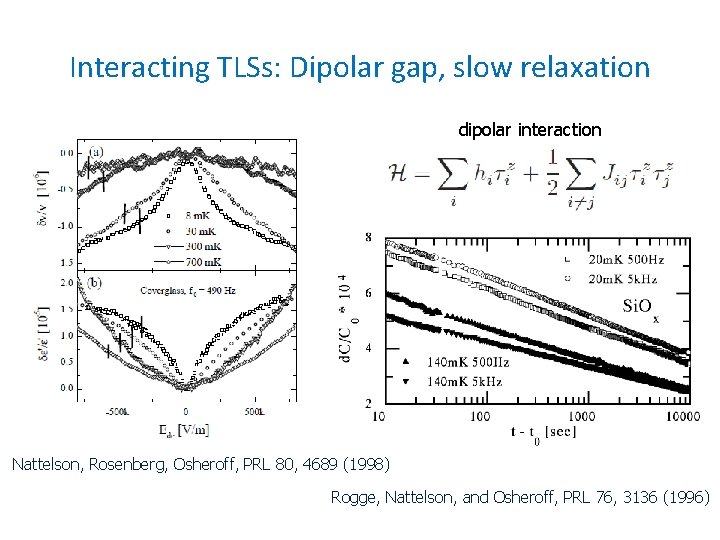
Interacting TLSs: Dipolar gap, slow relaxation dipolar interaction Nattelson, Rosenberg, Osheroff, PRL 80, 4689 (1998) Rogge, Nattelson, and Osheroff, PRL 76, 3136 (1996)
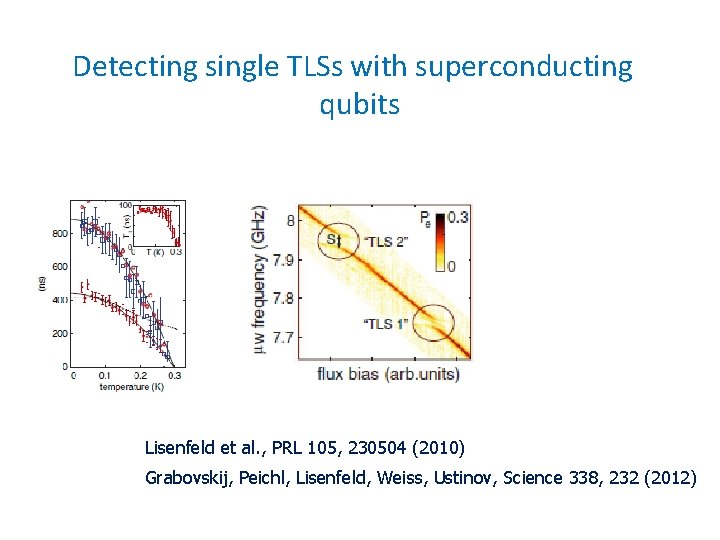
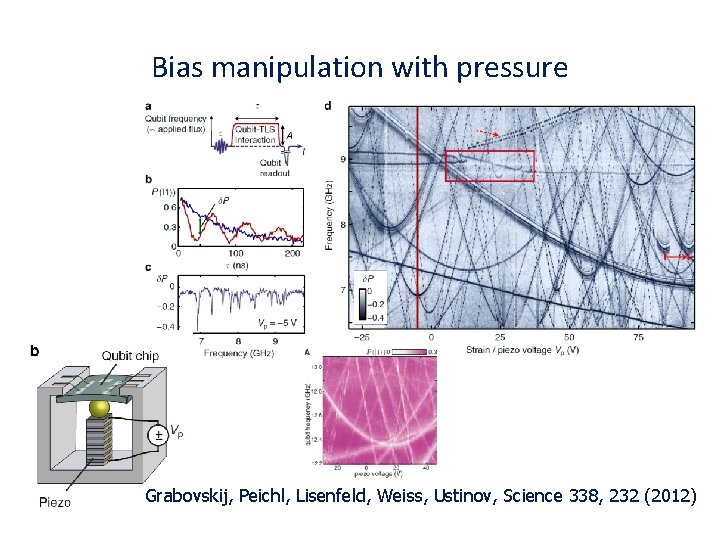
Detecting single TLSs with superconducting qubits Lisenfeld et al. , PRL 105, 230504 (2010) Grabovskij, Peichl, Lisenfeld, Weiss, Ustinov, Science 338, 232 (2012)
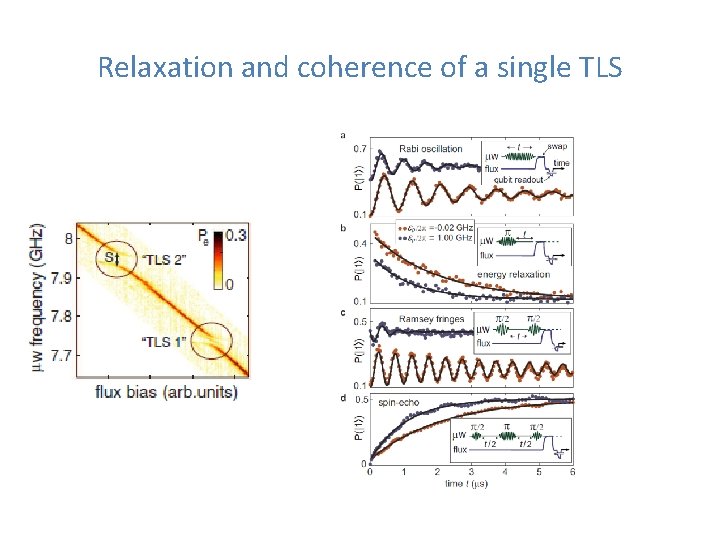
Relaxation and coherence of a single TLS
Bias manipulation with pressure Grabovskij, Peichl, Lisenfeld, Weiss, Ustinov, Science 338, 232 (2012)
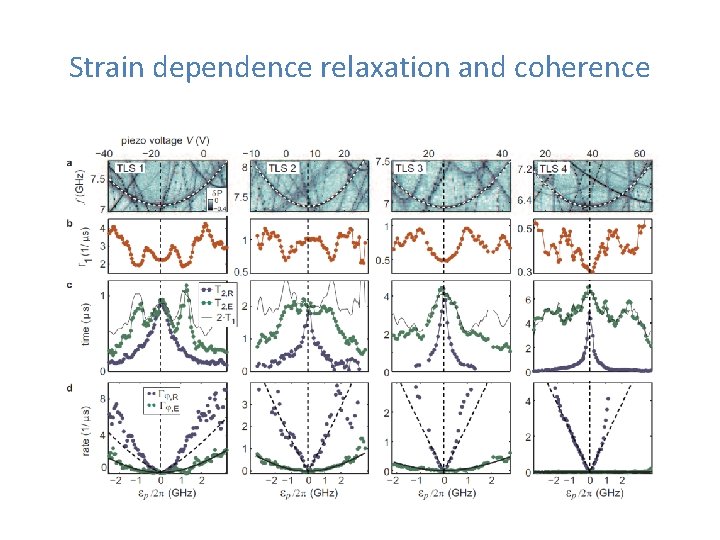
Strain dependence relaxation and coherence
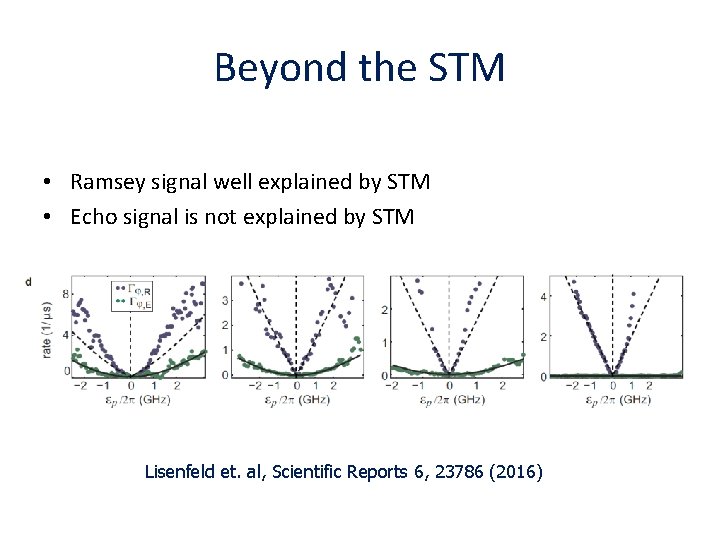
Beyond the STM • Ramsey signal well explained by STM • Echo signal is not explained by STM Lisenfeld et. al, Scientific Reports 6, 23786 (2016)
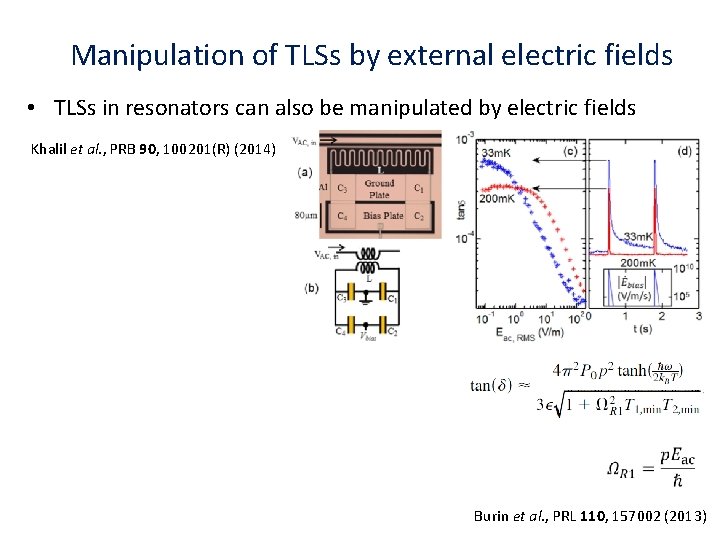
Manipulation of TLSs by external electric fields • TLSs in resonators can also be manipulated by electric fields Khalil et al. , PRB 90, 100201(R) (2014) Burin et al. , PRL 110, 157002 (2013)
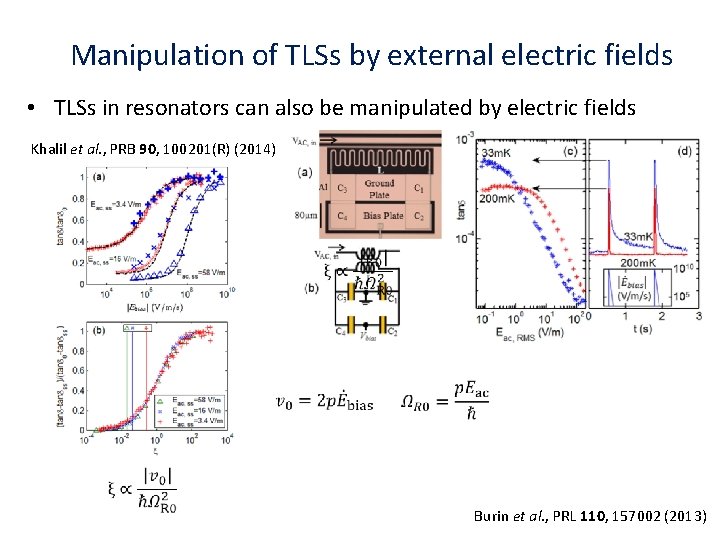
Manipulation of TLSs by external electric fields • TLSs in resonators can also be manipulated by electric fields Khalil et al. , PRB 90, 100201(R) (2014) Burin et al. , PRL 110, 157002 (2013)
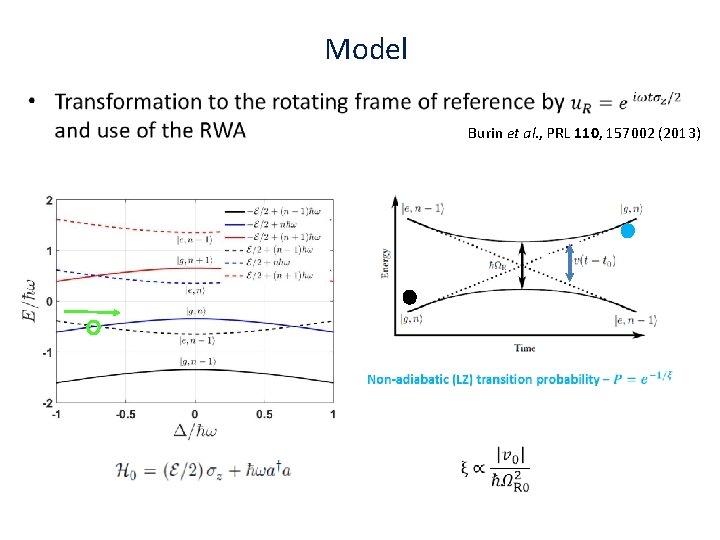
Model • Burin et al. , PRL 110, 157002 (2013)
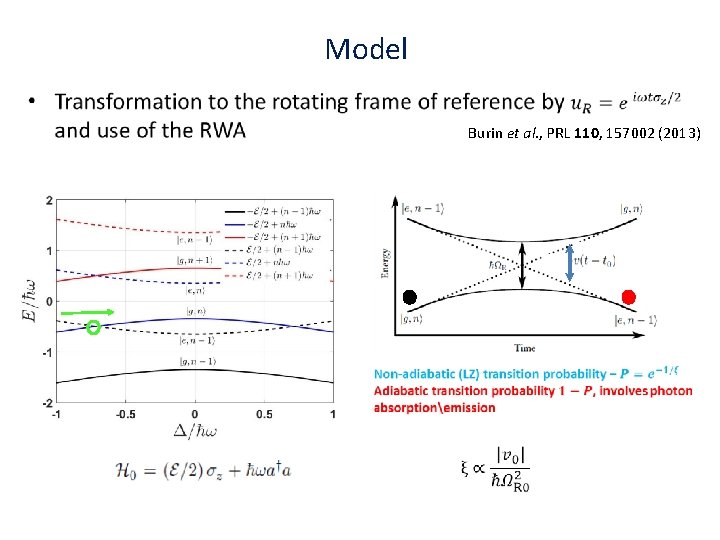
Model • Burin et al. , PRL 110, 157002 (2013)
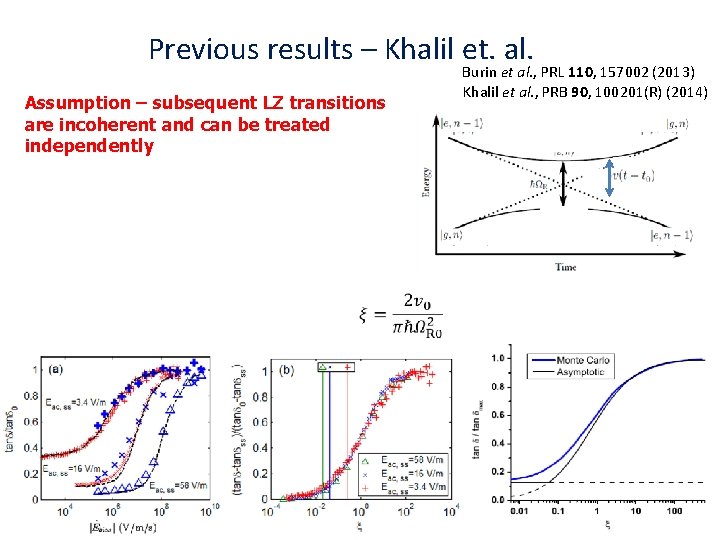
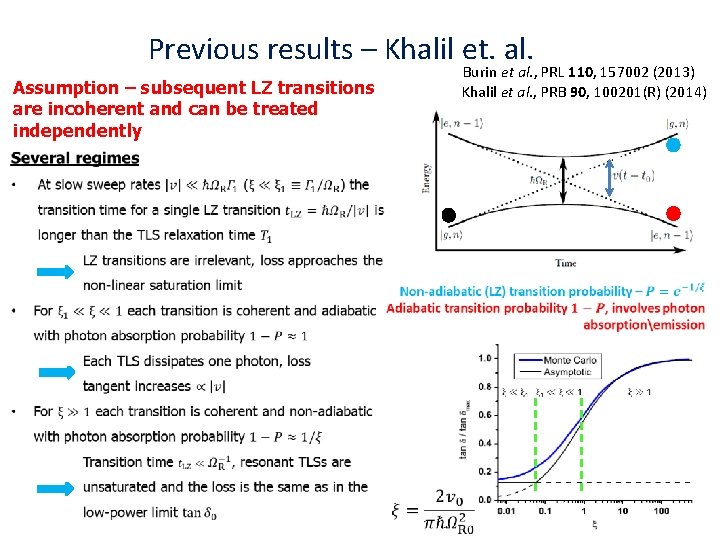
Previous results – Khalil et. al. Burin et al. , PRL 110, 157002 (2013) Khalil et al. , PRB 90, 100201(R) (2014) Assumption – subsequent LZ transitions are incoherent and can be treated independently
Previous results – Khalil et. al. Burin et al. , PRL 110, 157002 (2013) Khalil et al. , PRB 90, 100201(R) (2014) Assumption – subsequent LZ transitions are incoherent and can be treated independently
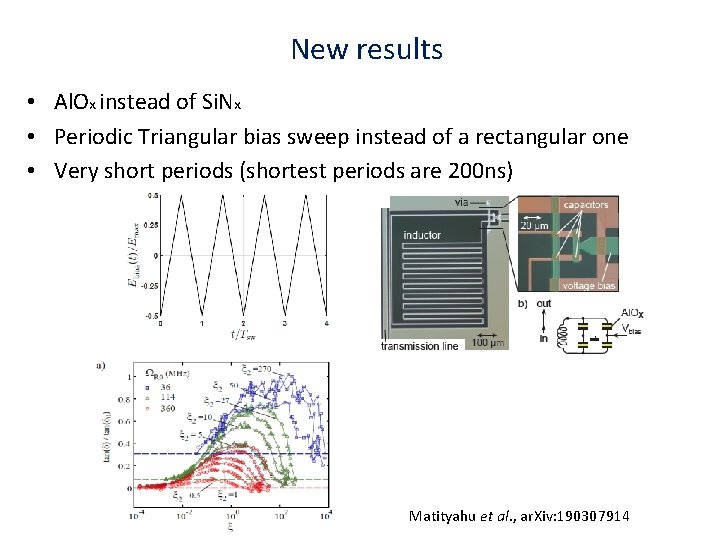
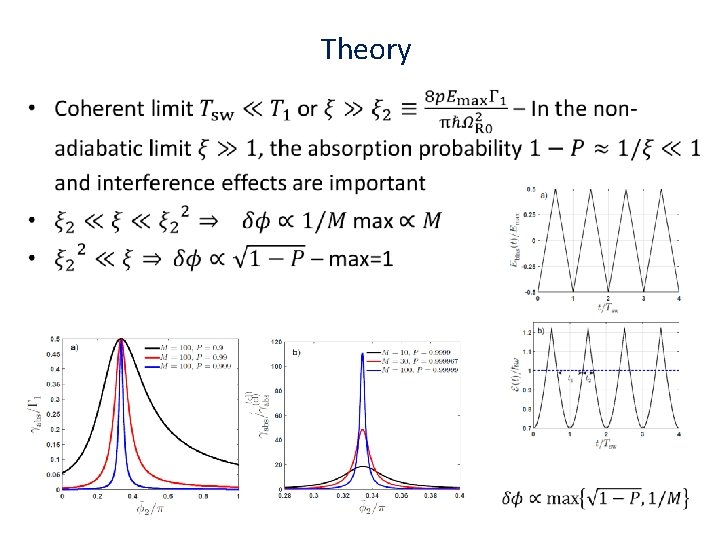
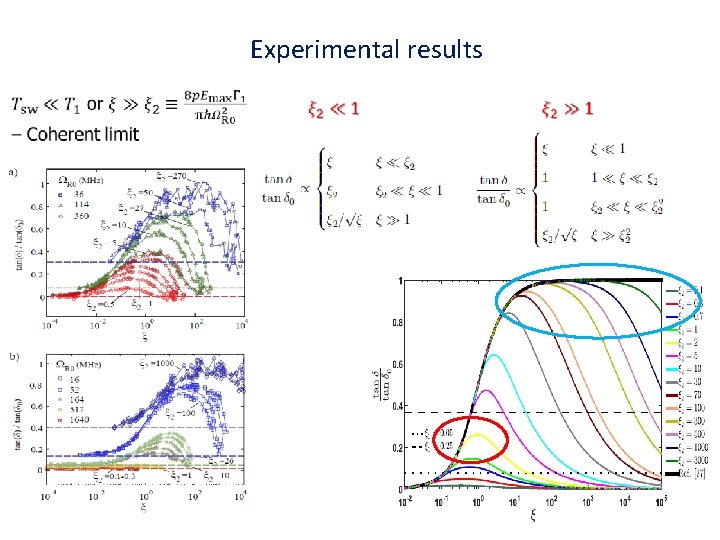
New results • Al. Ox instead of Si. Nx • Periodic Triangular bias sweep instead of a rectangular one • Very short periods (shortest periods are 200 ns) Matityahu et al. , ar. Xiv: 190307914
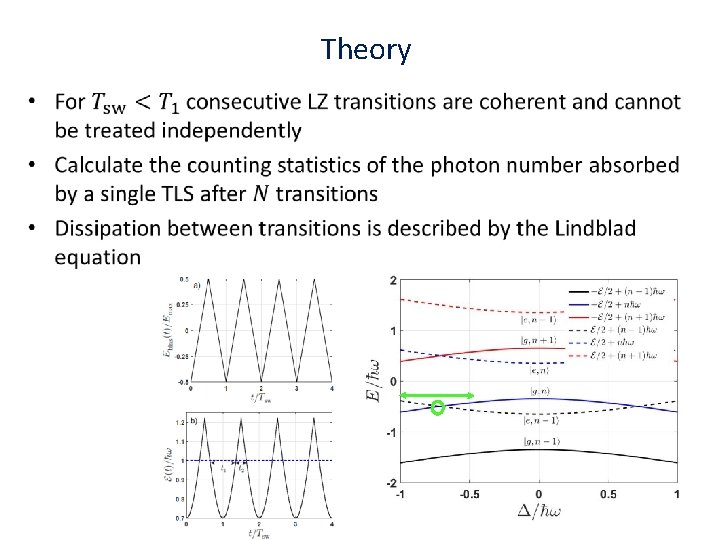
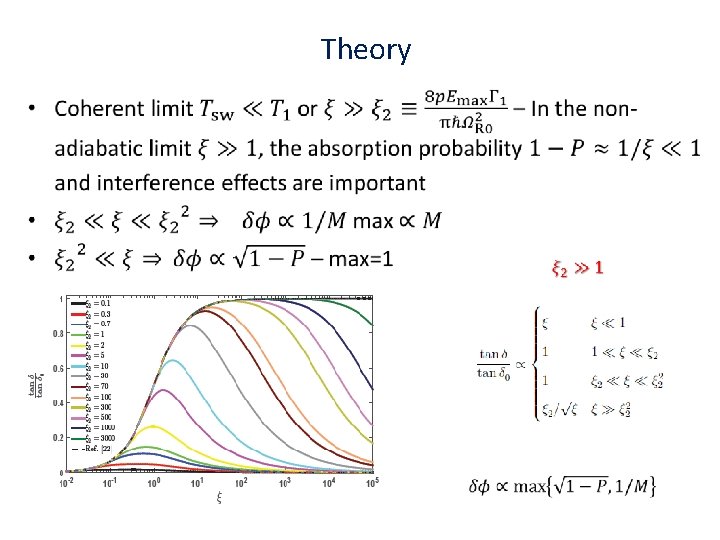
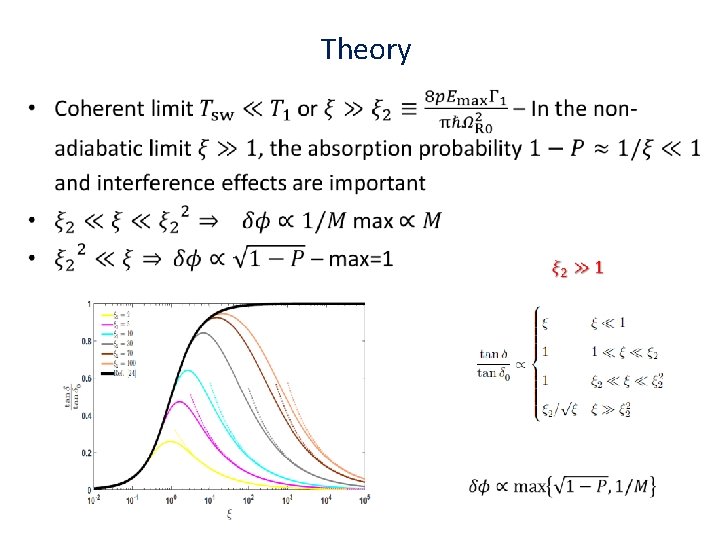
Theory •
Theory •
Theory •
Theory •
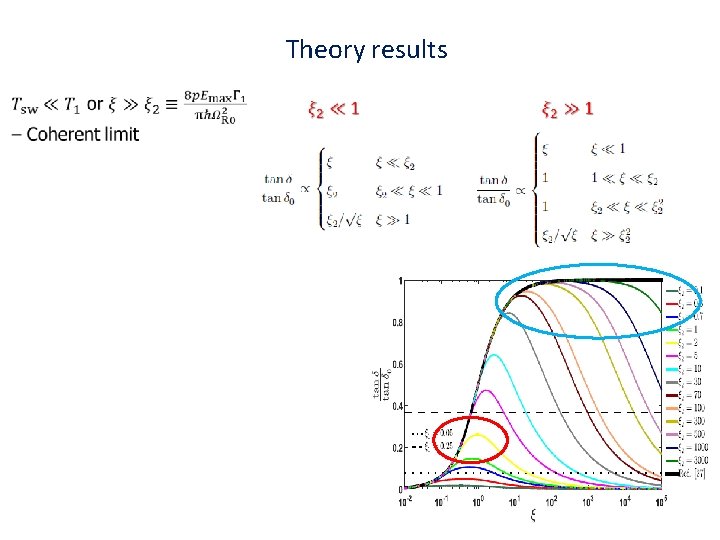
Theory results
Experimental results
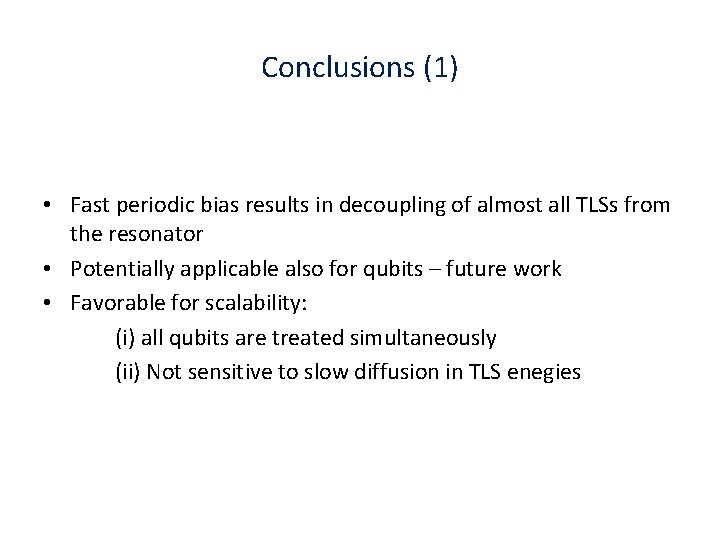
Conclusions (1) • Fast periodic bias results in decoupling of almost all TLSs from the resonator • Potentially applicable also for qubits – future work • Favorable for scalability: (i) all qubits are treated simultaneously (ii) Not sensitive to slow diffusion in TLS enegies
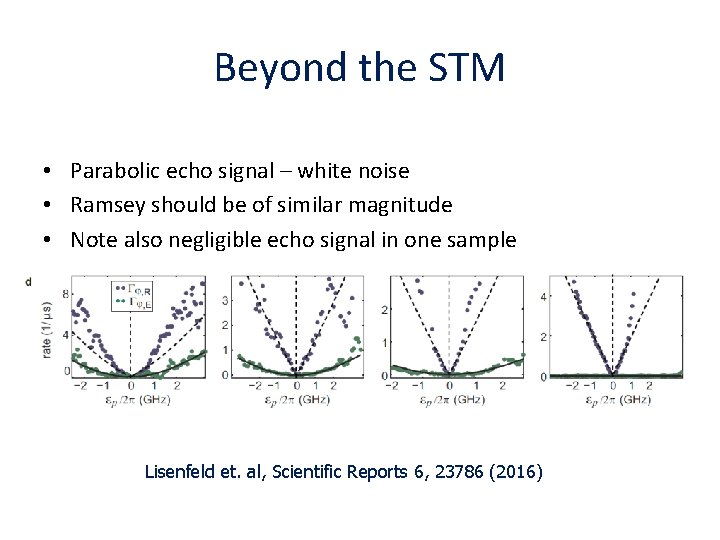
Beyond the STM • Parabolic echo signal – white noise • Ramsey should be of similar magnitude • Note also negligible echo signal in one sample Lisenfeld et. al, Scientific Reports 6, 23786 (2016)
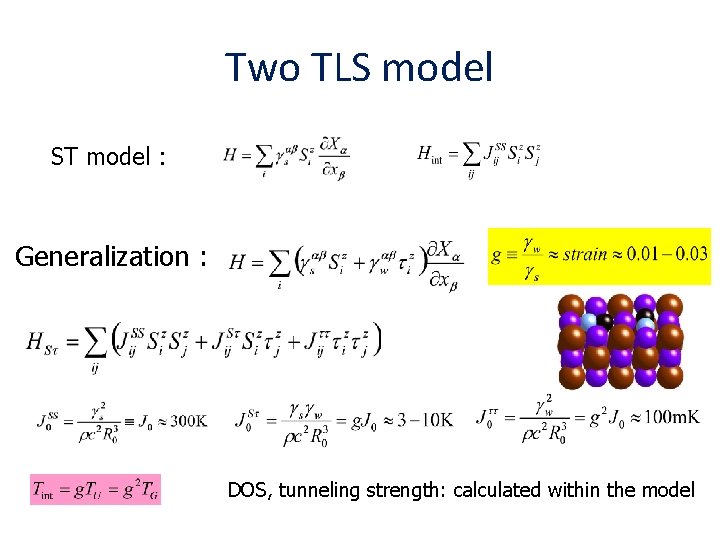
Two TLS model ST model : Generalization : DOS, tunneling strength: calculated within the model
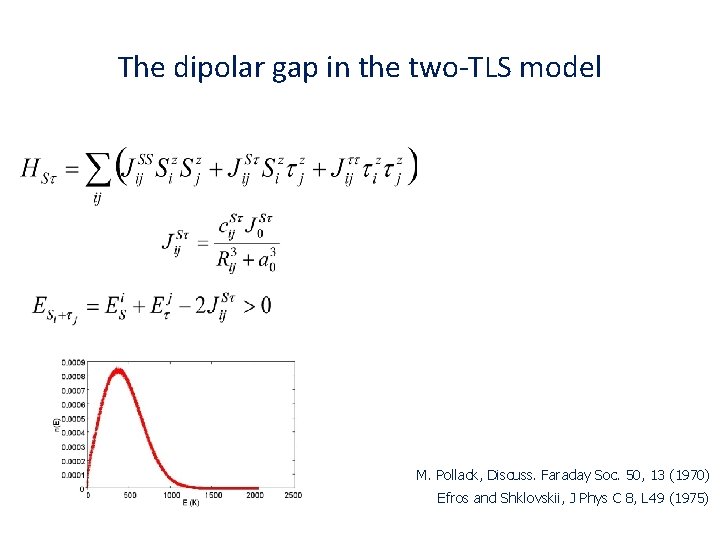
The dipolar gap in the two-TLS model M. Pollack, Discuss. Faraday Soc. 50, 13 (1970) Efros and Shklovskii, J Phys C 8, L 49 (1975)
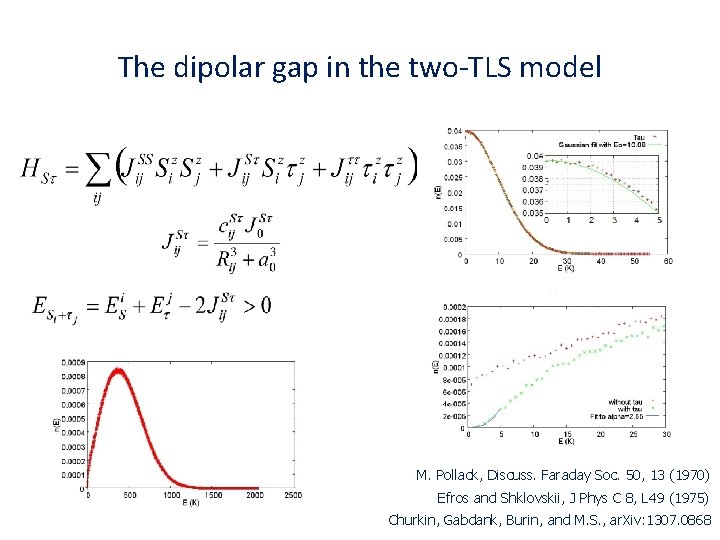
The dipolar gap in the two-TLS model M. Pollack, Discuss. Faraday Soc. 50, 13 (1970) Efros and Shklovskii, J Phys C 8, L 49 (1975) Churkin, Gabdank, Burin, and M. S. , ar. Xiv: 1307. 0868
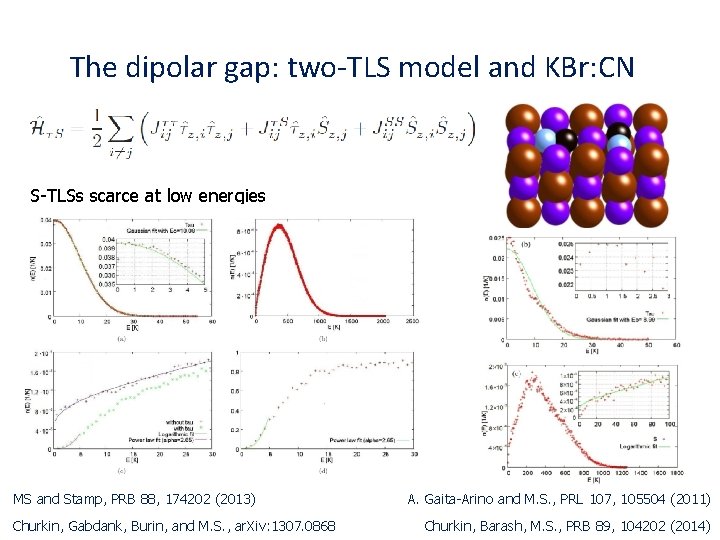
The dipolar gap: two-TLS model and KBr: CN S-TLSs scarce at low energies MS and Stamp, PRB 88, 174202 (2013) Churkin, Gabdank, Burin, and M. S. , ar. Xiv: 1307. 0868 A. Gaita-Arino and M. S. , PRL 107, 105504 (2011) Churkin, Barash, M. S. , PRB 89, 104202 (2014)
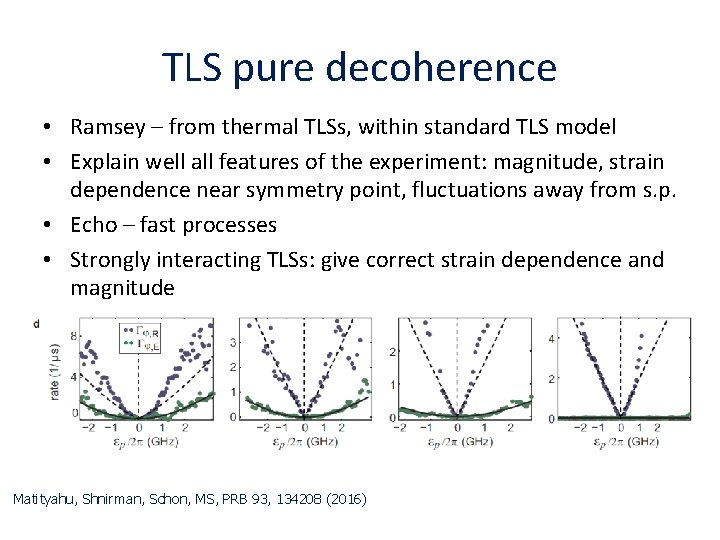
TLS pure decoherence • Ramsey – from thermal TLSs, within standard TLS model • Explain well all features of the experiment: magnitude, strain dependence near symmetry point, fluctuations away from s. p. • Echo – fast processes • Strongly interacting TLSs: give correct strain dependence and magnitude Matityahu, Shnirman, Schon, MS, PRB 93, 134208 (2016)
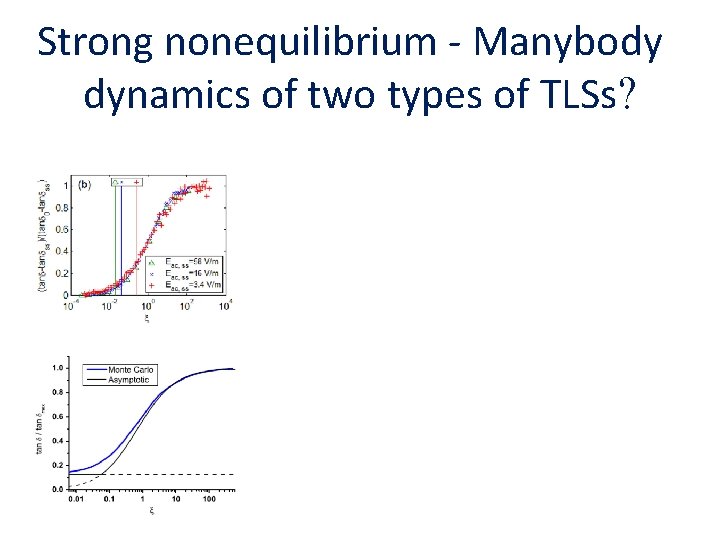
Strong nonequilibrium - Manybody dynamics of two types of TLSs?
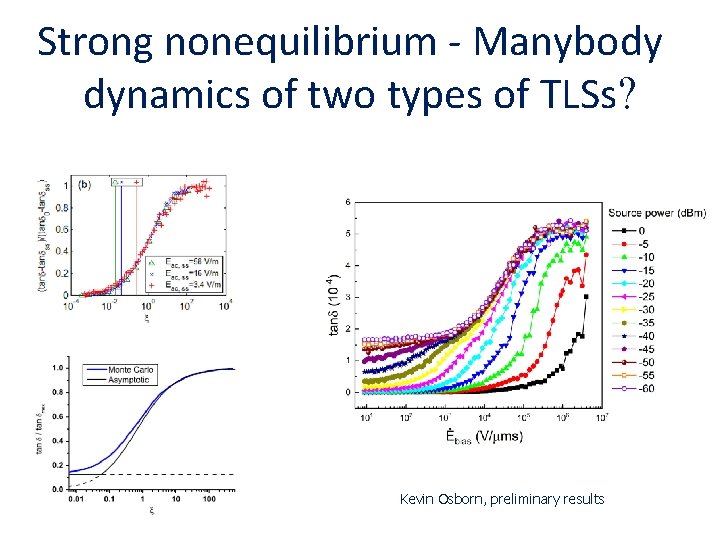
Strong nonequilibrium - Manybody dynamics of two types of TLSs? Kevin Osborn, preliminary results
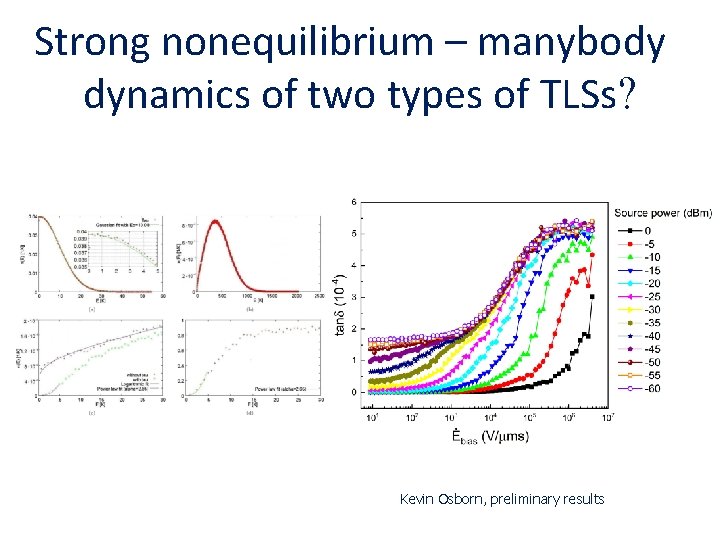
Strong nonequilibrium – manybody dynamics of two types of TLSs? Kevin Osborn, preliminary results
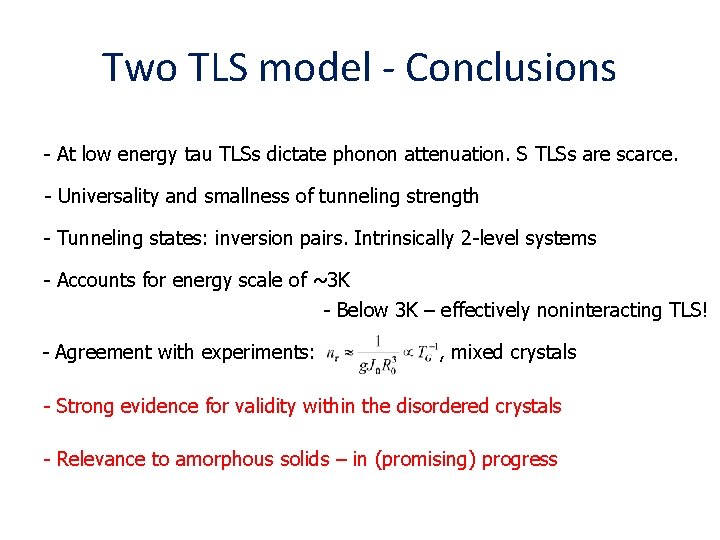
Two TLS model - Conclusions - At low energy tau TLSs dictate phonon attenuation. S TLSs are scarce. - Universality and smallness of tunneling strength - Tunneling states: inversion pairs. Intrinsically 2 -level systems - Accounts for energy scale of ~3 K - Below 3 K – effectively noninteracting TLS! - Agreement with experiments: , mixed crystals - Strong evidence for validity within the disordered crystals - Relevance to amorphous solids – in (promising) progress
Open questions, future directions • Decoupling of TLSs by periodic bias also for qubits • Beyond the STM - Applicability of Two-TLS model to amorphous solids • Quantum many body dynamics, nonequilibrium
Thanks Philip Stamp (UBC) Alejandro Gaita-Arino (Valencia) Danny Barash (BGU) Idan Gabdank (BGU, Stanford) Alex Churkin (BGU) Alex Burin (Tulane) Peter Nalbach (Hamburg) Shlomi Matityahu (BGU) Alexander Shnirman (KIT) Gerd Schon (KIT) Jurgen Lisenfeld (KIT) Hartmut Schmidt (KIT) Alexander Bilmes (KIT) Georg Weiss (KIT) Alexey Ustinov (KIT) Naftali Kirsh (Hebrew U) Elisha Svetitsky (Hebrew U) Nadav Katz (Hebrew U)
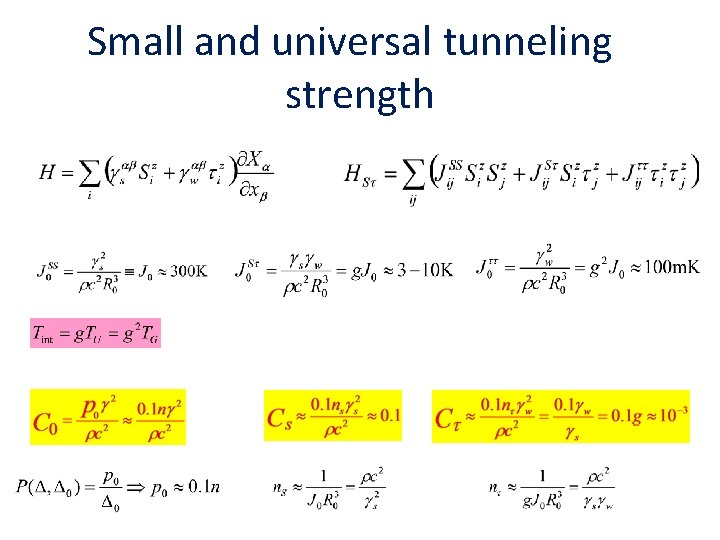
Small and universal tunneling strength
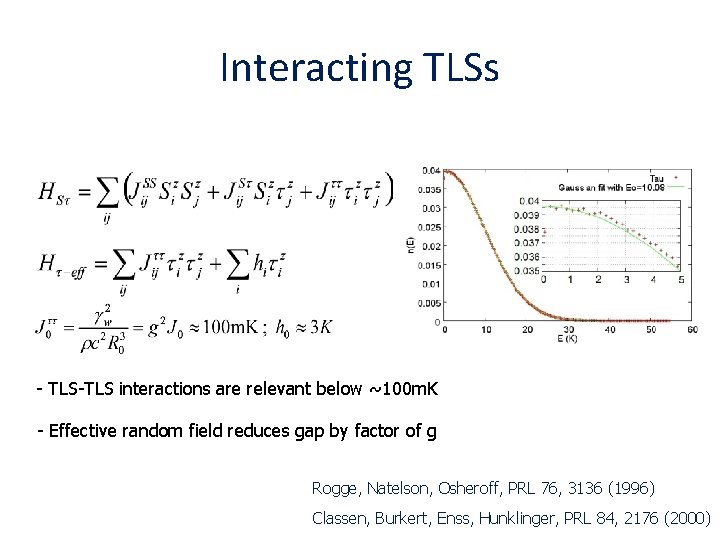
Interacting TLSs - TLS-TLS interactions are relevant below ~100 m. K - Effective random field reduces gap by factor of g Rogge, Natelson, Osheroff, PRL 76, 3136 (1996) Classen, Burkert, Enss, Hunklinger, PRL 84, 2176 (2000)