
Study of the Number of Constituent Quark Scaling
Study of the Number of Constituent Quark Scaling of v 2 at High p. T Na Li (for the STAR Collaboration) Institute of Particle Physics, Wuhan, China Brookhaven National Laboratory, Upton, USA Outline: Ø Introduction Ø STAR Detector and Dataset Ø v 2 and Number of Constituent Quark (NCQ) scaling Ø Summary
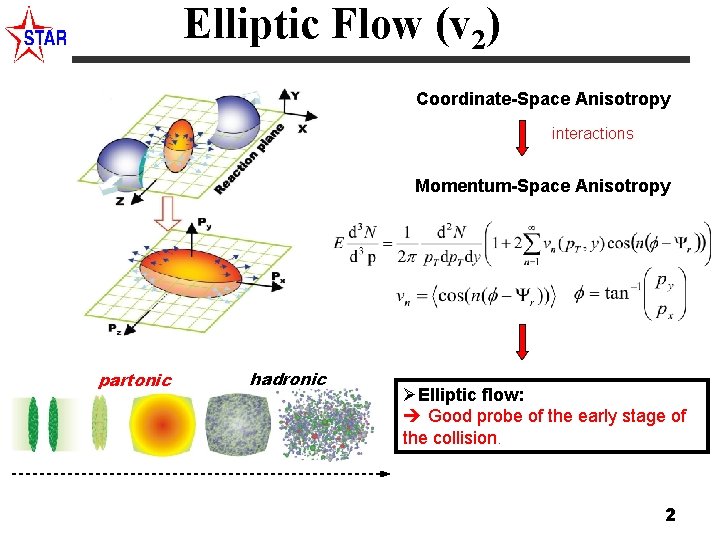
Elliptic Flow (v 2) Coordinate-Space Anisotropy interactions Momentum-Space Anisotropy partonic hadronic ØElliptic flow: è Good probe of the early stage of the collision. 2
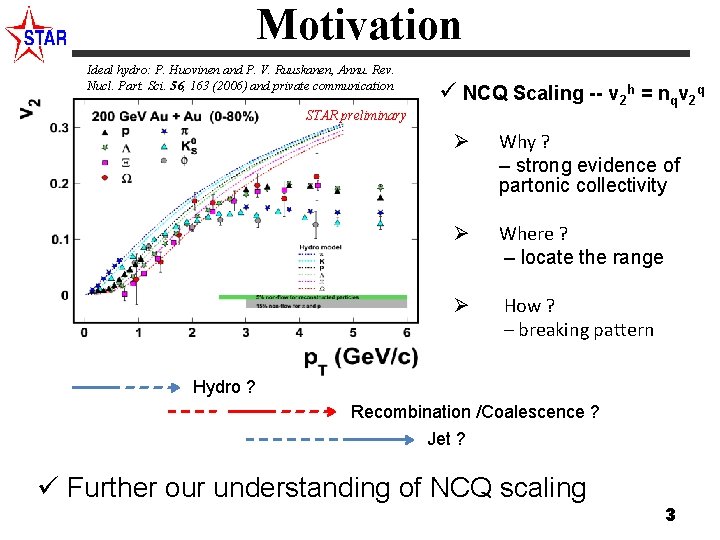
Motivation Ideal hydro: P. Huovinen and P. V. Ruuskanen, Annu. Rev. Nucl. Part. Sci. 56, 163 (2006) and private communication STAR preliminary ü NCQ Scaling -- v 2 h = nqv 2 q Ø Why ? – strong evidence of partonic collectivity Ø Where ? – locate the range Ø How ? – breaking pattern Hydro ? Recombination /Coalescence ? Jet ? ü Further our understanding of NCQ scaling 3
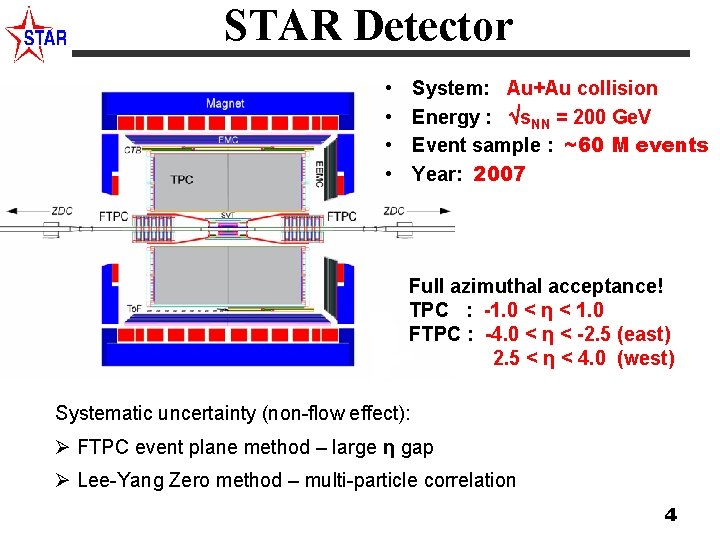
STAR Detector Dataset and Cuts • • System: Au+Au collision Energy : s. NN = 200 Ge. V Event sample : ~60 M events Year: 2007 Full azimuthal acceptance! TPC : -1. 0 < η < 1. 0 FTPC : -4. 0 < η < -2. 5 (east) 2. 5 < η < 4. 0 (west) Systematic uncertainty (non-flow effect): Ø FTPC event plane method – large η gap Ø Lee-Yang Zero method – multi-particle correlation 4
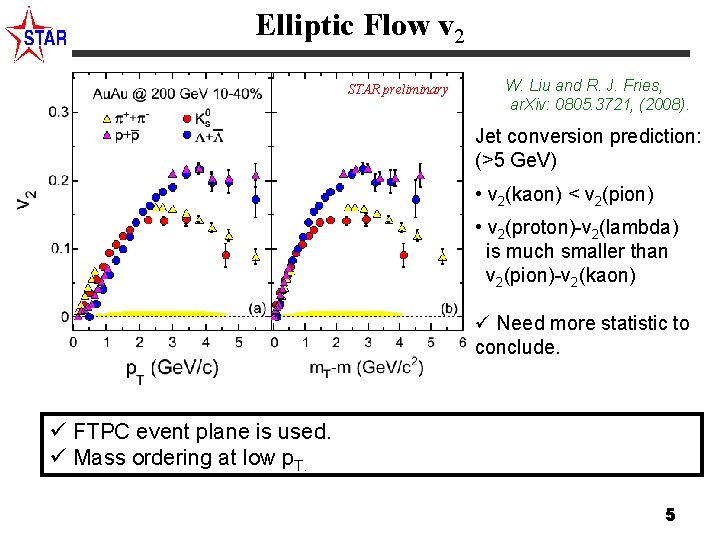
Elliptic Flow v 2 STAR preliminary W. Liu and R. J. Fries, ar. Xiv: 0805. 3721, (2008). Jet conversion prediction: (>5 Ge. V) • v 2(kaon) < v 2(pion) • v 2(proton)-v 2(lambda) is much smaller than v 2(pion)-v 2(kaon) ü Need more statistic to conclude. ü FTPC event plane is used. ü Mass ordering at low p. T. 5

Number of Constituent Quark Scaling STAR preliminary ü Pion v 2/nq starts to deviate from NCQ scaling at 1 Ge. V for (m. T - m)/nq. ü A larger pion v 2/nq than other v 2/nq at large p. T /nq. 6
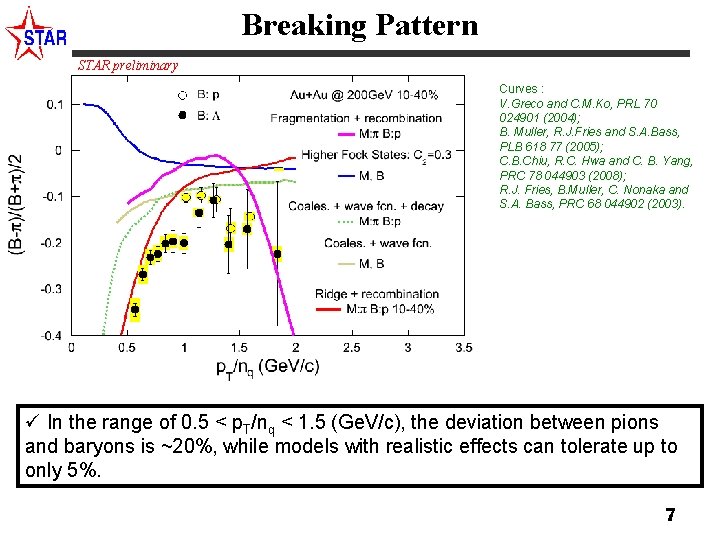
Breaking Pattern STAR preliminary Curves : V. Greco and C. M. Ko, PRL 70 024901 (2004); B. Muller, R. J. Fries and S. A. Bass, PLB 618 77 (2005); C. B. Chiu, R. C. Hwa and C. B. Yang, PRC 78 044903 (2008); R. J. Fries, B. Muller, C. Nonaka and S. A. Bass, PRC 68 044902 (2003). ü In the range of 0. 5 < p. T/nq < 1. 5 (Ge. V/c), the deviation between pions and baryons is ~20%, while models with realistic effects can tolerate up to only 5%. 7

Summary ü At p. T /nq > 1 Ge. V, data show clear discrepancies with naive NCQ scaling: • Pions deviate from NCQ scaling by 20% (while models can tolerate only 5%). • Fragmentation may kick in and be more dominant. Outlook ü STAR Run 10: full TOF coverage v Measure v 2 for charged pion / kaon / (anti)proton at intermediate p. T --- Test jet conversion prediction. --- Improve the signal/background ratio of reconstructed particles. 8
BACK UP 9

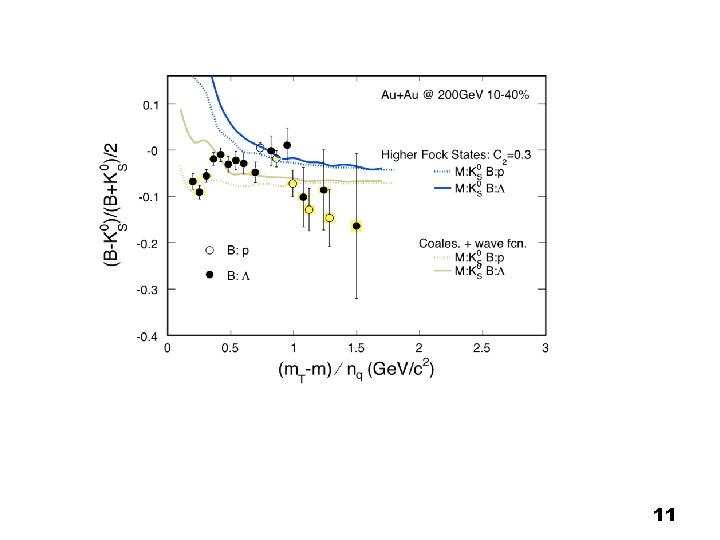
Breaking Pattern (I) STAR preliminary Curves : V. Greco and C. M. Ko, PRL 70 024901 (2004); B. Muller, R. J. Fries and S. A. Bass, PLB 618 77 (2005) ü The large deviation at low p. T in plot made with p. T/nq is due to mass splitting, which can be reduced by plotting with (m. T-m)/nq ü Models with realistic effects can well describe the difference between kaons and baryons 10
11
- Slides: 11