
Study of the level of total electron content



- Slides: 12
Study of the level of total electron content disturbance in the middle-latitude and Arctic regions by GPS data Natalia P. Perevalova (1), Ilya K. Edemskiy (1), Olga V. Timofeeva (1, 2), Darya D. Katashevtseva (1, 2), Anna S. Polyakova (1) Institute of Solar-Terrestrial Physics, SB RAS (2) Irkutsk State University Bolshie Koty, Russia
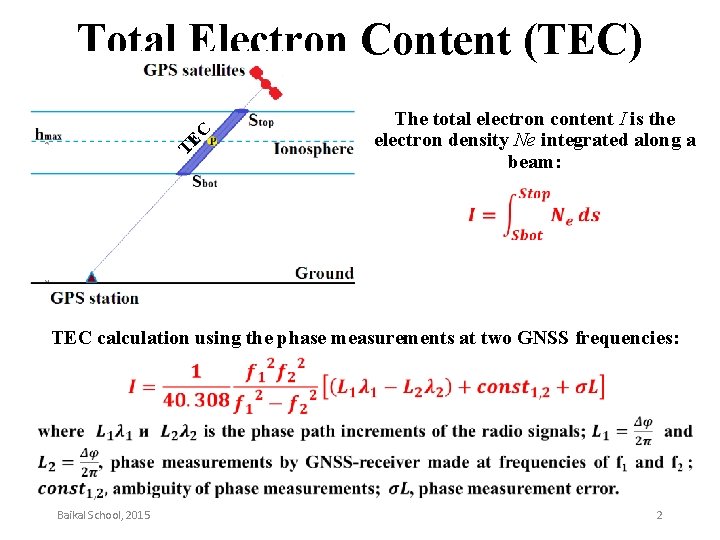
TE C Total Electron Content (TEC) The total electron content I is the electron density Ne integrated along a beam: TEC calculation using the phase measurements at two GNSS frequencies: Baikal School, 2015 2
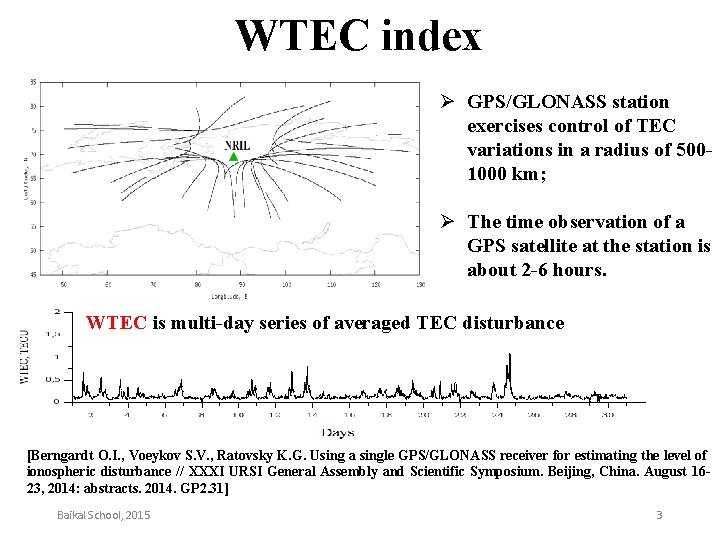
WTEC index Ø GPS/GLONASS station exercises control of TEC variations in a radius of 5001000 km; Ø The time observation of a GPS satellite at the station is about 2 -6 hours. WTEC is multi-day series of averaged TEC disturbance [Berngardt O. I. , Voeykov S. V. , Ratovsky K. G. Using a single GPS/GLONASS receiver for estimating the level of ionospheric disturbance // XXXI URSI General Assembly and Scientific Symposium. Beijing, China. August 1623, 2014: abstracts. 2014. GP 2. 31] Baikal School, 2015 3
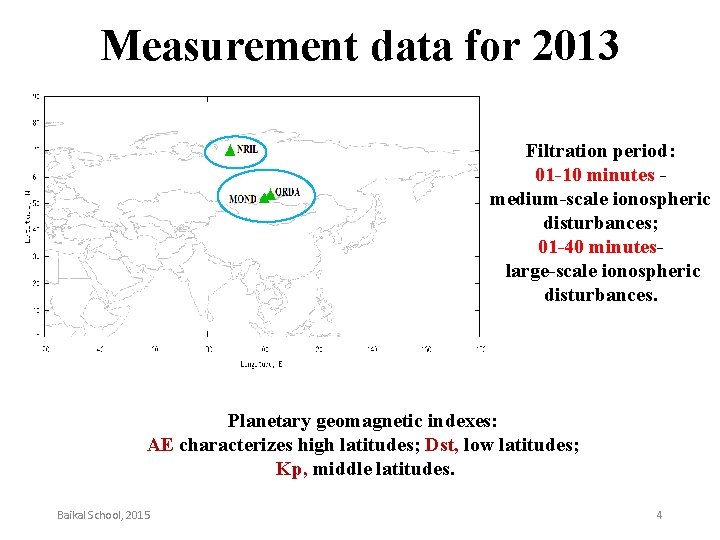
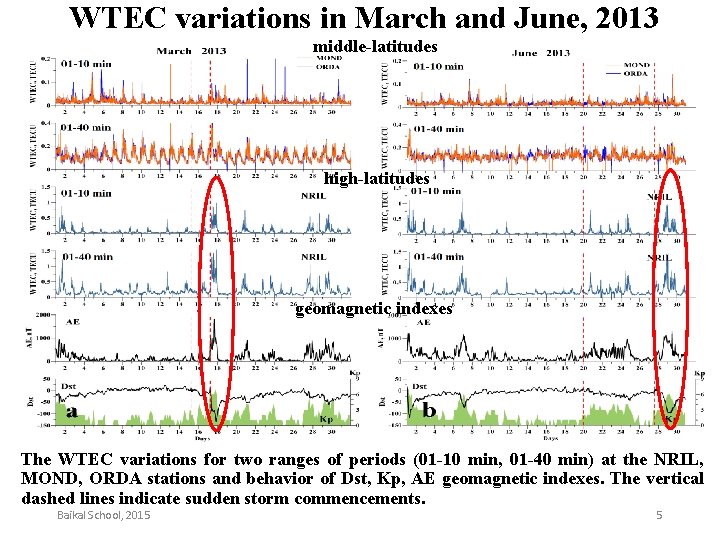
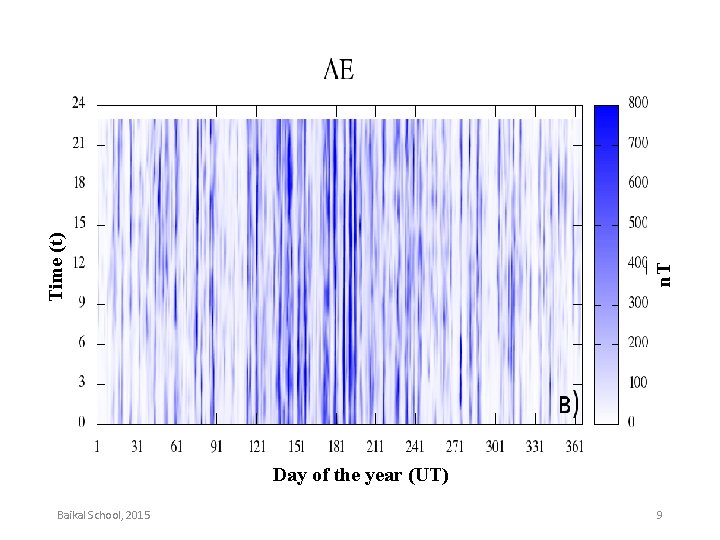
Measurement data for 2013 Filtration period: 01 -10 minutes medium-scale ionospheric disturbances; 01 -40 minuteslarge-scale ionospheric disturbances. Planetary geomagnetic indexes: AE characterizes high latitudes; Dst, low latitudes; Kp, middle latitudes. Baikal School, 2015 4
WTEC variations in March and June, 2013 middle-latitudes high-latitudes geomagnetic indexes The WTEC variations for two ranges of periods (01 -10 min, 01 -40 min) at the NRIL, MOND, ORDA stations and behavior of Dst, Kp, AE geomagnetic indexes. The vertical dashed lines indicate sudden storm commencements. Baikal School, 2015 5
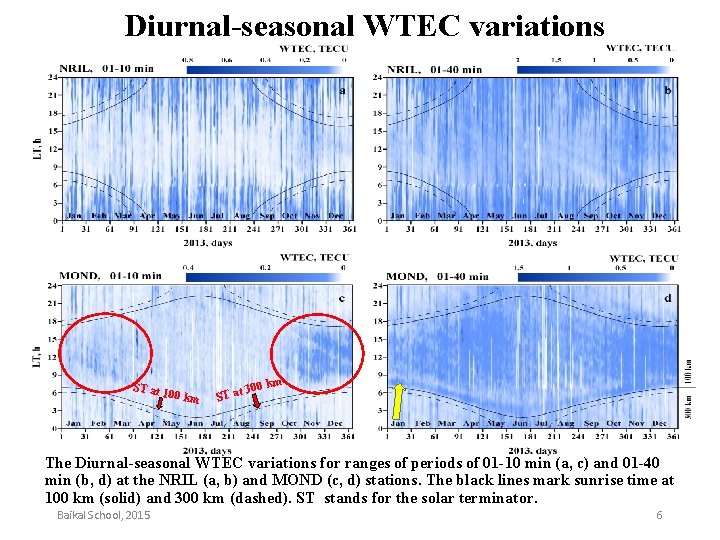
Diurnal-seasonal WTEC variations ST at 1 00 km t 30 ST a 0 km The Diurnal-seasonal WTEC variations for ranges of periods of 01 -10 min (a, c) and 01 -40 min (b, d) at the NRIL (a, b) and MOND (c, d) stations. The black lines mark sunrise time at 100 km (solid) and 300 km (dashed). ST stands for the solar terminator. Baikal School, 2015 6
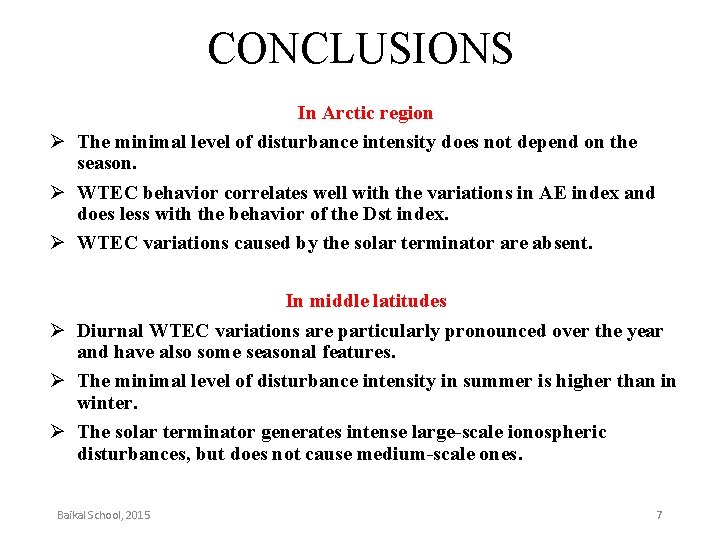
CONCLUSIONS In Arctic region Ø The minimal level of disturbance intensity does not depend on the season. Ø WTEC behavior correlates well with the variations in AE index and does less with the behavior of the Dst index. Ø WTEC variations caused by the solar terminator are absent. In middle latitudes Ø Diurnal WTEC variations are particularly pronounced over the year and have also some seasonal features. Ø The minimal level of disturbance intensity in summer is higher than in winter. Ø The solar terminator generates intense large-scale ionospheric disturbances, but does not cause medium-scale ones. Baikal School, 2015 7
THANK YOU FOR YOUR ATTENTION! Baikal School, 2015 8
n. T Time (t) Day of the year (UT) Baikal School, 2015 9
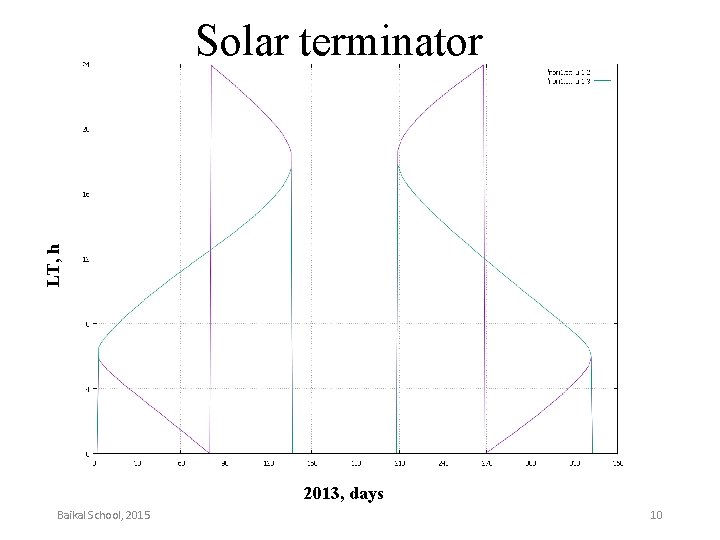
LT, h Solar terminator 2013, days Baikal School, 2015 10
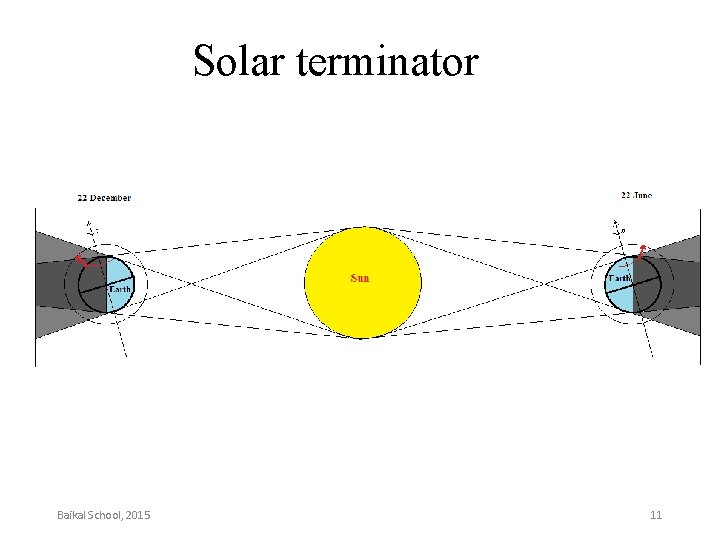
Solar terminator Baikal School, 2015 11