
Study of the Interstellar Medium and Cosmic Rays
- Slides: 1
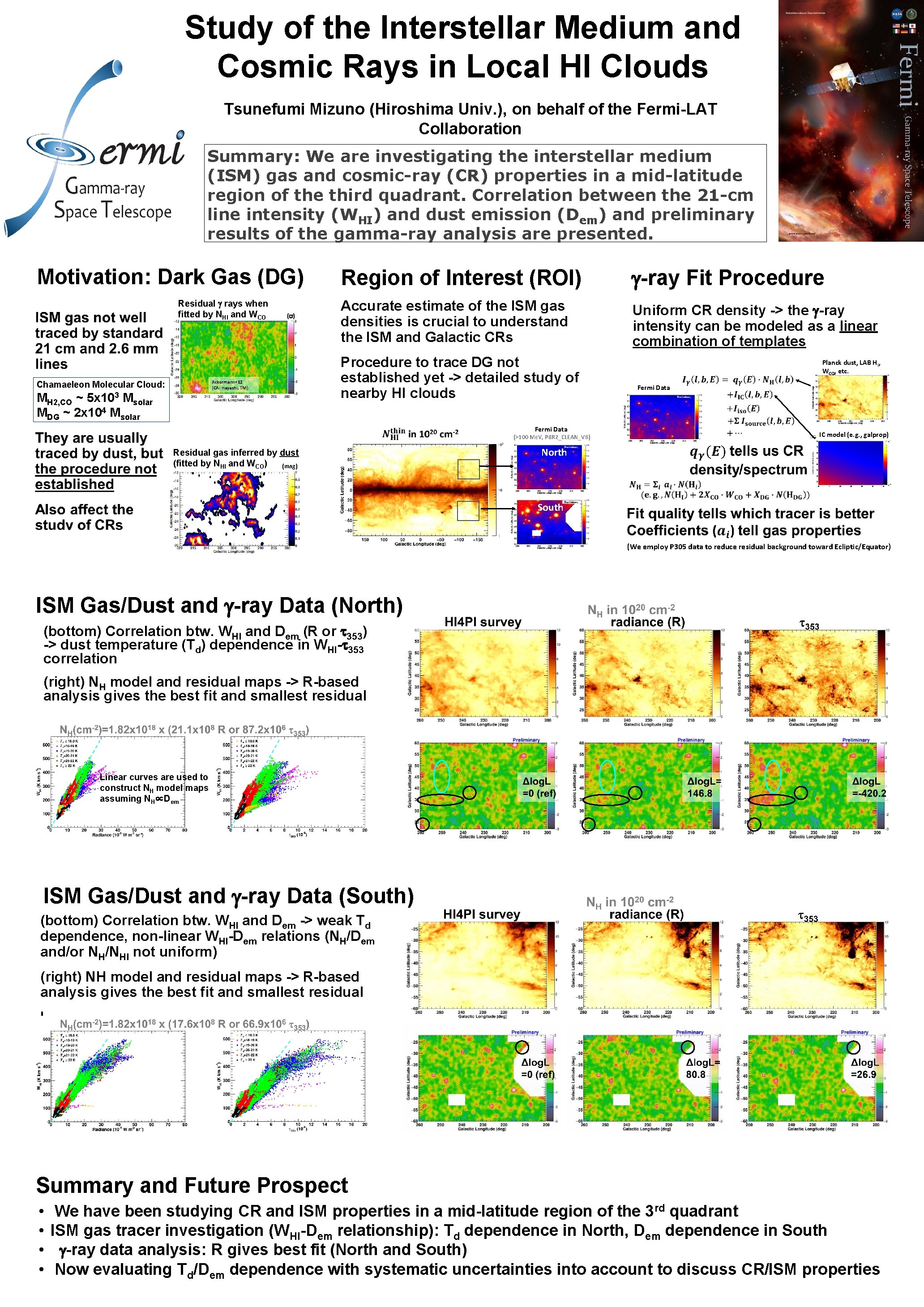
Study of the Interstellar Medium and Cosmic Rays in Local HI Clouds Tsunefumi Mizuno (Hiroshima Univ. ), on behalf of the Fermi-LAT Collaboration Summary: We are investigating the interstellar medium (ISM) gas and cosmic-ray (CR) properties in a mid-latitude region of the third quadrant. Correlation between the 21 -cm line intensity (WHI) and dust emission (Dem) and preliminary results of the gamma-ray analysis are presented. Motivation: Dark Gas (DG) Residual g rays when fitted by NHI and WCO (s) Ackermann+12 (CA: Hayashi, TM) Chamaeleon Molecular Cloud: MH 2, CO ~ 5 x 10³ Msolar MDG ~ 2 x 10⁴ Msolar Region of Interest (ROI) g-ray Fit Procedure Accurate estimate of the ISM gas densities is crucial to understand the ISM and Galactic CRs Uniform CR density -> the g-ray intensity can be modeled as a linear combination of templates Procedure to trace DG not established yet -> detailed study of nearby HI clouds Residual gas inferred by dust (fitted by NHI and WCO) (mag) Fermi Data (>100 Me. V, P 8 R 2_CLEAN_V 6) North South Planck dust, LAB HI, WCO, etc. IC model (e. g. , galprop) (We employ P 305 data to reduce residual background toward Ecliptic/Equator) ISM Gas/Dust and g-ray Data (North) (bottom) Correlation btw. WHI and Dem (R or t 353) -> dust temperature (Td) dependence in WHI-t 353 correlation (right) NH model and residual maps -> R-based analysis gives the best fit and smallest residual Linear curves are used to construct NH model maps assuming NH∝Dem ISM Gas/Dust and g-ray Data (South) (bottom) Correlation btw. WHI and Dem -> weak Td dependence, non-linear WHI-Dem relations (NH/Dem and/or NH/NHI not uniform) (right) NH model and residual maps -> R-based analysis gives the best fit and smallest residual l Summary and Future Prospect • • We have been studying CR and ISM properties in a mid-latitude region of the 3 rd quadrant ISM gas tracer investigation (WHI-Dem relationship): Td dependence in North, Dem dependence in South g-ray data analysis: R gives best fit (North and South) Now evaluating Td/Dem dependence with systematic uncertainties into account to discuss CR/ISM properties