
Study of secondary electron emission and thermoelectric current
- Slides: 5
Study of secondary electron emission and thermoelectric current effects with Li A. Yu. Pigarov, S. I. Krasheninnikov, V. Soukhanovskii, C. H. Skinner, R. Maingi, S. Gerhardt NSTX Research Forum, December 2009
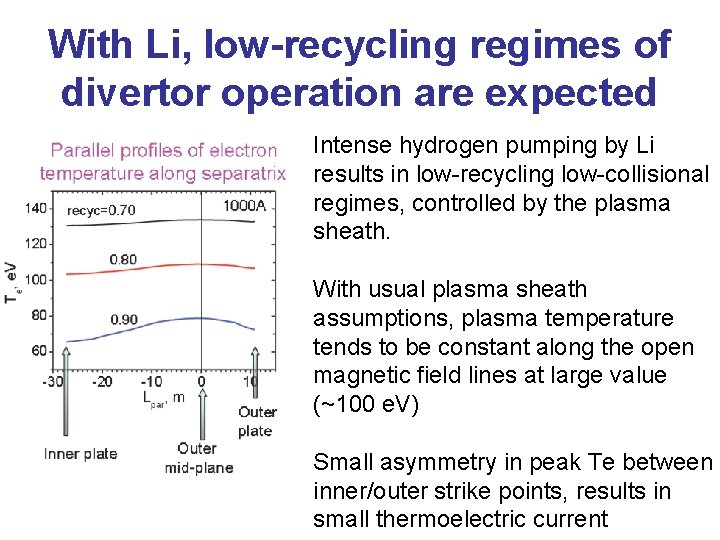
With Li, low-recycling regimes of divertor operation are expected Intense hydrogen pumping by Li results in low-recycling low-collisional regimes, controlled by the plasma sheath. With usual plasma sheath assumptions, plasma temperature tends to be constant along the open magnetic field lines at large value (~100 e. V) Small asymmetry in peak Te between inner/outer strike points, results in small thermoelectric current
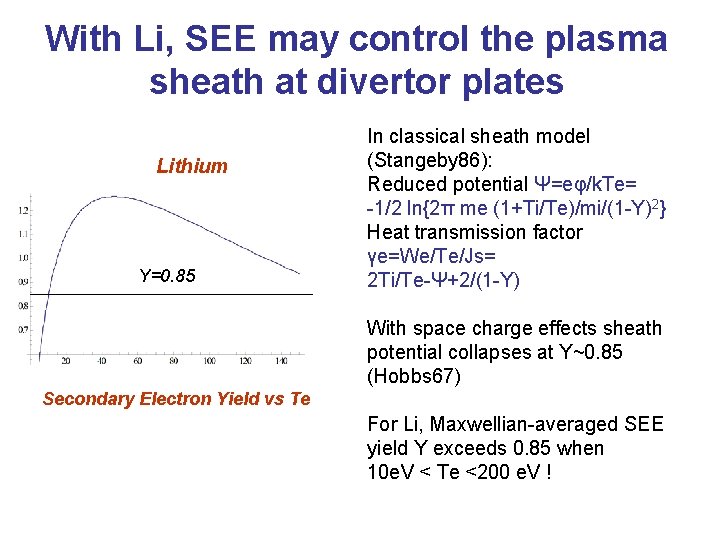
With Li, SEE may control the plasma sheath at divertor plates Lithium Y=0. 85 In classical sheath model (Stangeby 86): Reduced potential Ψ=eφ/k. Te= -1/2 ln{2π me (1+Ti/Te)/mi/(1 -Y)2} Heat transmission factor γe=We/Te/Js= 2 Ti/Te-Ψ+2/(1 -Y) With space charge effects sheath potential collapses at Y~0. 85 (Hobbs 67) Secondary Electron Yield vs Te For Li, Maxwellian-averaged SEE yield Y exceeds 0. 85 when 10 e. V < Te <200 e. V !
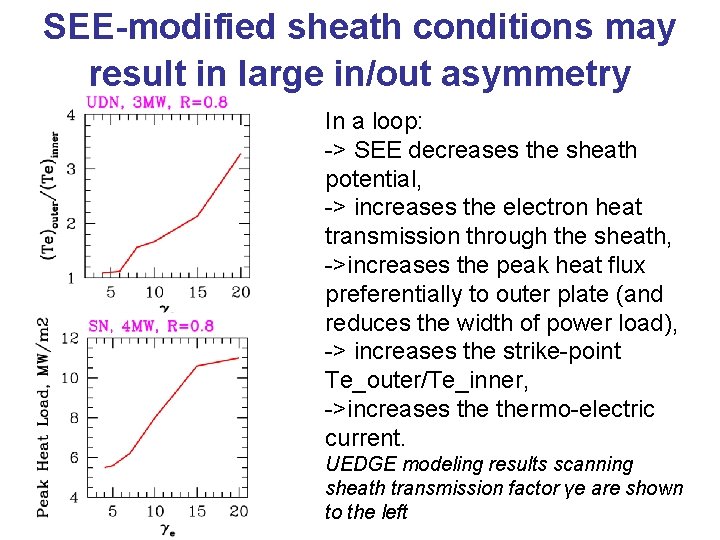
SEE-modified sheath conditions may result in large in/out asymmetry In a loop: -> SEE decreases the sheath potential, -> increases the electron heat transmission through the sheath, ->increases the peak heat flux preferentially to outer plate (and reduces the width of power load), -> increases the strike-point Te_outer/Te_inner, ->increases thermo-electric current. UEDGE modeling results scanning sheath transmission factor γe are shown to the left
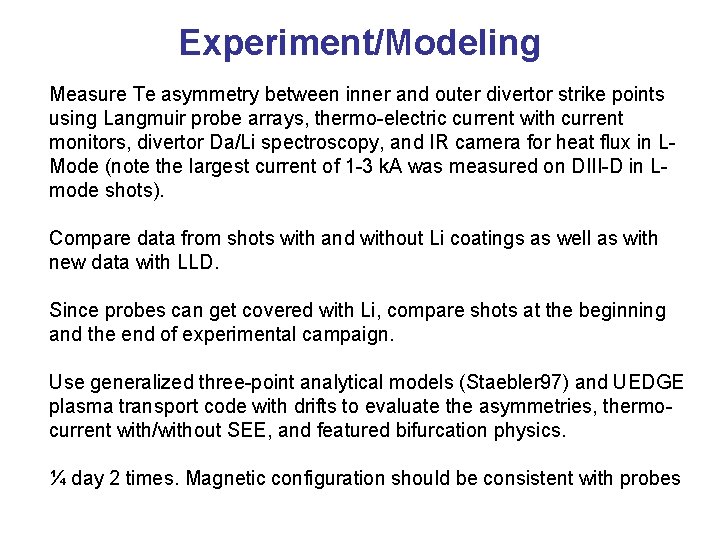
Experiment/Modeling Measure Te asymmetry between inner and outer divertor strike points using Langmuir probe arrays, thermo-electric current with current monitors, divertor Da/Li spectroscopy, and IR camera for heat flux in LMode (note the largest current of 1 -3 k. A was measured on DIII-D in Lmode shots). Compare data from shots with and without Li coatings as well as with new data with LLD. Since probes can get covered with Li, compare shots at the beginning and the end of experimental campaign. Use generalized three-point analytical models (Staebler 97) and UEDGE plasma transport code with drifts to evaluate the asymmetries, thermocurrent with/without SEE, and featured bifurcation physics. ¼ day 2 times. Magnetic configuration should be consistent with probes