
STUDY OF PHENYLACETYLENE BY CAVITY RINGDOWN SPECTROSCOPY GARY
STUDY OF PHENYLACETYLENE BY CAVITY RING-DOWN SPECTROSCOPY GARY V. LOPEZ and PHILIP M. JOHNSON Department of Chemistry, Stony Brook University TREVOR SEARS* and CHIH-HSUAN CHANG+ Department of Chemistry, Brookhaven National Laboratory * also Department of Chemistry, Stony Brook University + currently at JILA, Colorado 6/21/2011 66 th ISMS The Ohio State University TD-10
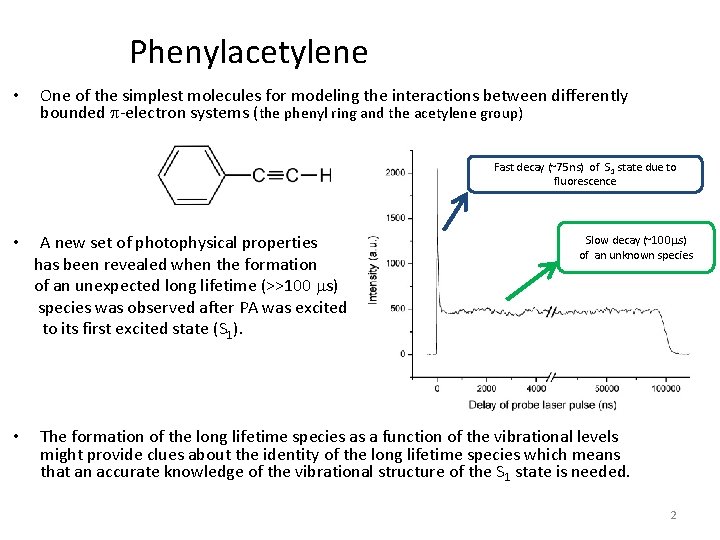
Phenylacetylene • One of the simplest molecules for modeling the interactions between differently bounded p-electron systems (the phenyl ring and the acetylene group) Fast decay (~75 ns) of S 1 state due to fluorescence • • A new set of photophysical properties has been revealed when the formation of an unexpected long lifetime (>>100 ms) species was observed after PA was excited to its first excited state (S 1). Slow decay (~100 ms) of an unknown species The formation of the long lifetime species as a function of the vibrational levels might provide clues about the identity of the long lifetime species which means that an accurate knowledge of the vibrational structure of the S 1 state is needed. 2
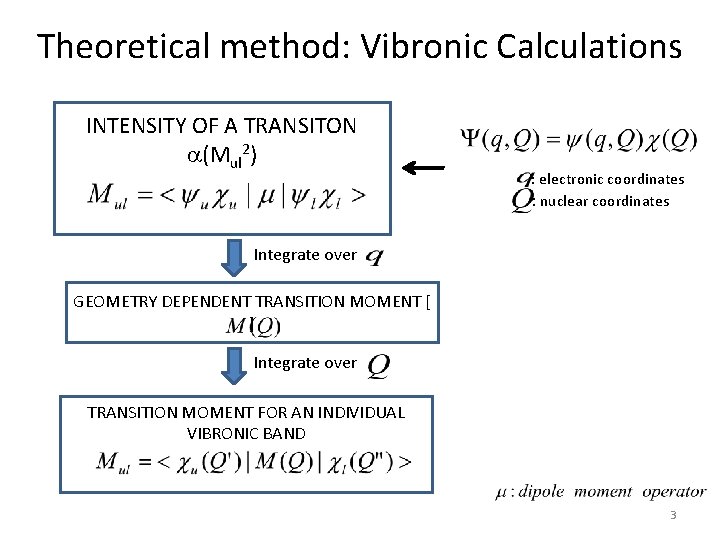
Theoretical method: Vibronic Calculations INTENSITY OF A TRANSITON a(Mul 2) : electronic coordinates : nuclear coordinates Integrate over GEOMETRY DEPENDENT TRANSITION MOMENT [ ] Integrate over TRANSITION MOMENT FOR AN INDIVIDUAL VIBRONIC BAND 3
![Theoretical method: Vibronic Calculations (Cnt’d) GEOMETRY DEPENDENT TRANSITION MOMENT [ ] Expanding the Taylor’s](http://slidetodoc.com/presentation_image/d69fdcda75bc998ee4c72f83acb2265c/image-4.jpg "Theoretical method: Vibronic Calculations (Cnt’d) GEOMETRY DEPENDENT TRANSITION MOMENT [ ] Expanding the Taylor’s")
Theoretical method: Vibronic Calculations (Cnt’d) GEOMETRY DEPENDENT TRANSITION MOMENT [ ] Expanding the Taylor’s series in the normal coord. For a C 2 v symmetry, the Taylor ‘s series can be terminated after the second derivative [a] 1 ST AND 2 ND ORDER TRANSITION MOMENTS THE INTEGRALS CAN BE CONVERTED TO SUMS OF FRANCK-CONDON FACTORS (PC Programs are available) 4 [a] Johnson P. , Xu H. and Sears T. , J. Chem. Phys. 125, 164330, 2006
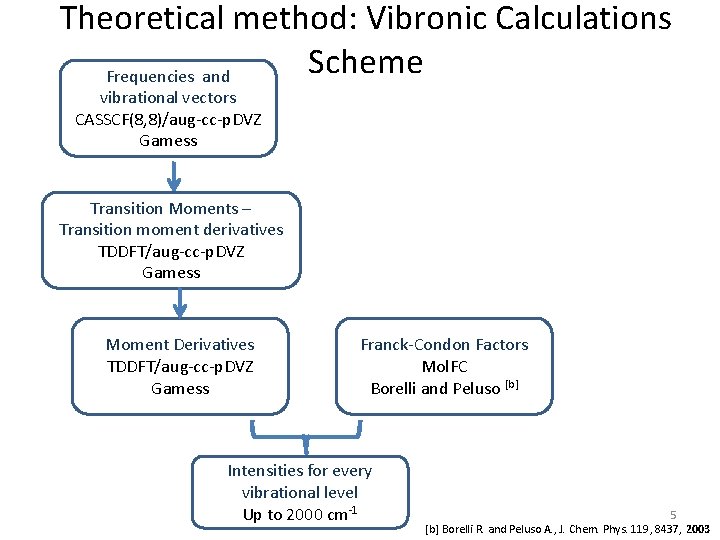
Theoretical method: Vibronic Calculations Scheme Frequencies and vibrational vectors CASSCF(8, 8)/aug-cc-p. DVZ Gamess Transition Moments – Transition moment derivatives TDDFT/aug-cc-p. DVZ Gamess Moment Derivatives TDDFT/aug-cc-p. DVZ Gamess Franck-Condon Factors Mol. FC Borelli and Peluso [b] Intensities for every vibrational level Up to 2000 cm-1 5 [b] Borelli R. and Peluso A. , J. Chem. Phys. 119, 8437, 2003
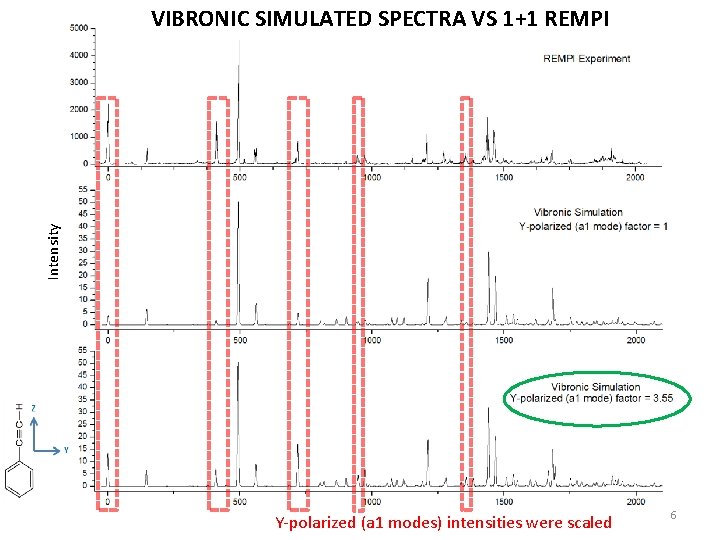
Intensity VIBRONIC SIMULATED SPECTRA VS 1+1 REMPI Y-polarized (a 1 modes) intensities were scaled 6

Cavity-Ring Down Spectroscopy (CRDS) CRDS measures the rate of decay of light intensity in a stable optical cavity Not affected by the laser intensity DET LASER R L R DET LASER ABSORBER 7
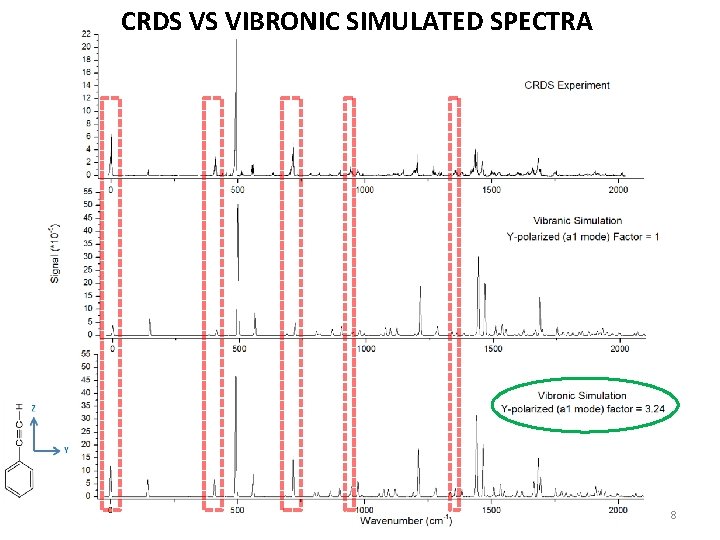
CRDS VS VIBRONIC SIMULATED SPECTRA 8
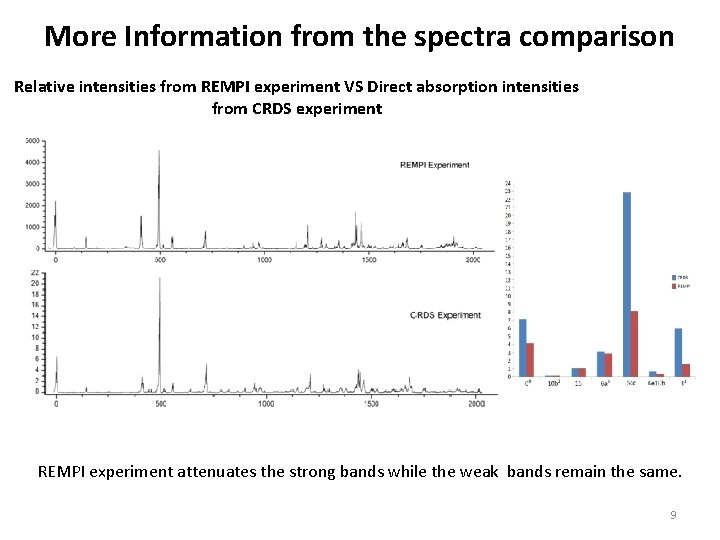
More Information from the spectra comparison Relative intensities from REMPI experiment VS Direct absorption intensities from CRDS experiment REMPI experiment attenuates the strong bands while the weak bands remain the same. 9
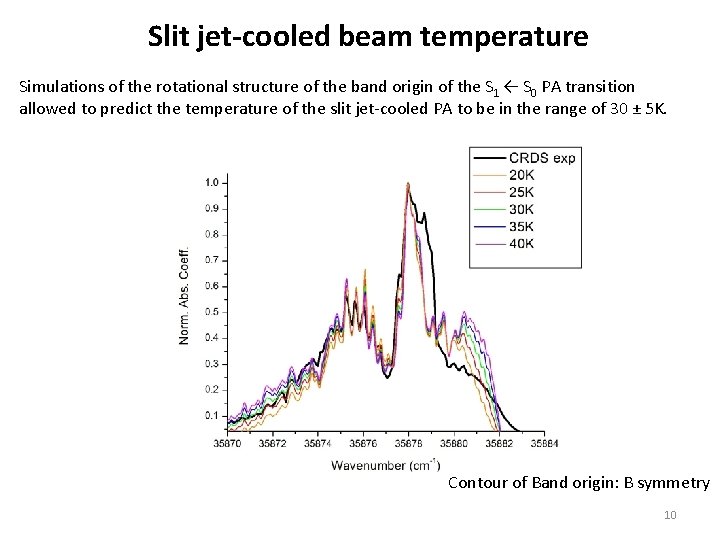
Slit jet-cooled beam temperature Simulations of the rotational structure of the band origin of the S 1 ← S 0 PA transition allowed to predict the temperature of the slit jet-cooled PA to be in the range of 30 ± 5 K. Contour of Band origin: B symmetry 10
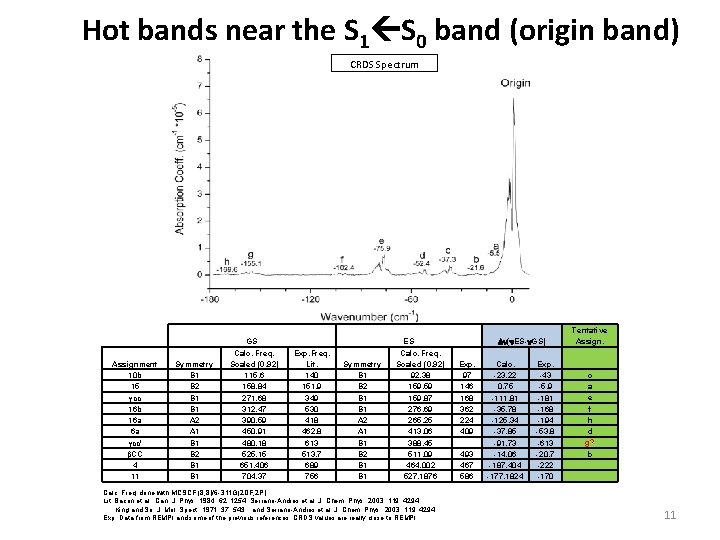
Hot bands near the S 1 S 0 band (origin band) CRDS Spectrum Assignment 10 b 15 gcc 16 b 16 a 6 a gcc' b. CC 4 11 Symmetry B 1 B 2 B 1 A 2 A 1 B 2 B 1 GS Calc. Freq. Scaled (0. 92) 115. 6 158. 84 271. 68 312. 47 390. 59 450. 91 480. 18 525. 15 651. 406 704. 37 Exp. Freq. Lit. 140 151. 9 349 530 418 462. 8 613 513. 7 689 756 Symmetry B 1 B 2 B 1 A 2 A 1 B 2 B 1 ES Calc. Freq. Scaled (0. 92) 92. 38 159. 59 159. 87 276. 69 265. 25 413. 06 388. 45 511. 09 464. 002 527. 1876 Calc. Freq. done with MCSCF (8, 8)/6 -311 G(2 DF, 2 P). Lit: Bacon et al. , Can. J. Phys. 1984, 62, 1254; Serrano-Andres et al, J. Chem. Phys. 2003, 119, 4294; King and So, J. Mol. Spect. 1971, 37, 543. , and Serrano-Andres et al, J. Chem. Phys. 2003, 119, 4294 Exp. Data from REMPI and some of the previous references. CRDS values are really close to REMPI Dn(n. ES-n. GS) Exp. 97 146 168 362 224 409 493 467 586 Calc. -23. 22 0. 75 -111. 81 -35. 78 -125. 34 -37. 85 -91. 73 -14. 06 -187. 404 -177. 1824 Exp. -43 -5. 9 -181 -168 -194 -53. 8 -613 -20. 7 -222 -170 Tentative Assign. c a e f h d g? b 11
Conclusions • Vibronic activity occurs in forbidden and allowed transitions (mix of electronic effects from states of the same symmetry) • Strong bands are attenuated in the REMPI spectrum while the weak bands (a 1 modes) remained the same when compared to CRD spectra. • The comparison of the vibronic simulated spectrum to the CRD and REMPI spectra were satisfactory for most part when the a 1 modes were scaled up by a factor of 3. 24 and 3. 55, respectively. • The use of scaling factors gives evidence of some possible theoretical artifacts that may be related to the need for having the best possible normal mode displacement vectors in the transition moment calculation. • The temperature of the slit jet-cooled PA was found to be in the range of 30 ± 5 K allowing us to assign many hot bands located near the band origin of the this transition. 12
Acknowledgments Dr. Trevor Sears (Stony Brook University / BNL) Dr. Philip Johnson (Stony Brook University) Dr. Chih-hsuan Chang (BNL) Dr. Gregory Hall (BNL) Dr. Alexey Teslja (Fairleigh Dickinson University) Funding: DOE. 06/21/10 65 th MSS 13

14
- Slides: 14