
Study of Magnetic Helicity and Its Relationship with
![Φ [1020 Mx] d. H/dt [1040 Mx 2 hr-1] 1. 2. Time Profile of](https://slidetodoc.com/presentation_image_h2/d8174b11081bd16462fa49aed676b758/image-3.jpg "Φ [1020 Mx] d. H/dt [1040 Mx 2 hr-1] 1. 2. Time Profile of")
![<Φ> [1020 Mx] 1. 4. |< d. H/dt >| vs. < Φ > |](https://slidetodoc.com/presentation_image_h2/d8174b11081bd16462fa49aed676b758/image-5.jpg "<Φ> [1020 Mx] 1. 4. |< d. H/dt >| vs. < Φ > |")
- Slides: 16
Study of Magnetic Helicity and Its Relationship with Solar Activities: Flares, CMEs, and Solar Cycle 23 Sung-Hong Park Space Weather Research Laboratory New Jersey Institute of Technology
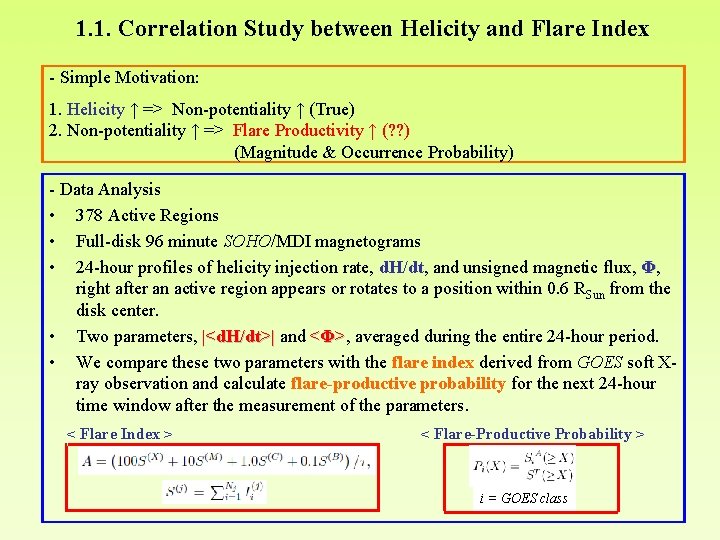
1. 1. Correlation Study between Helicity and Flare Index - Simple Motivation: 1. Helicity ↑ => Non-potentiality ↑ (True) 2. Non-potentiality ↑ => Flare Productivity ↑ (? ? ) (Magnitude & Occurrence Probability) - Data Analysis • 378 Active Regions • Full-disk 96 minute SOHO/MDI magnetograms • 24 -hour profiles of helicity injection rate, d. H/dt and unsigned magnetic flux, Φ, right after an active region appears or rotates to a position within 0. 6 RSun from the disk center. • Two parameters, |<d. H/dt>| and <Φ>, averaged during the entire 24 -hour period. • We compare these two parameters with the flare index derived from GOES soft Xray observation and calculate flare-productive probability for the next 24 -hour time window after the measurement of the parameters. < Flare Index > < Flare-Productive Probability > i = GOES class
Φ [1020 Mx] d. H/dt [1040 Mx 2 hr-1] 1. 2. Time Profile of d. H/dt and Φ Fidx > 10 1 < Fidx < 10 ~46 Fidx < 1 ~25 ~540 ~10 ~470 ~250 Time [ hours ]
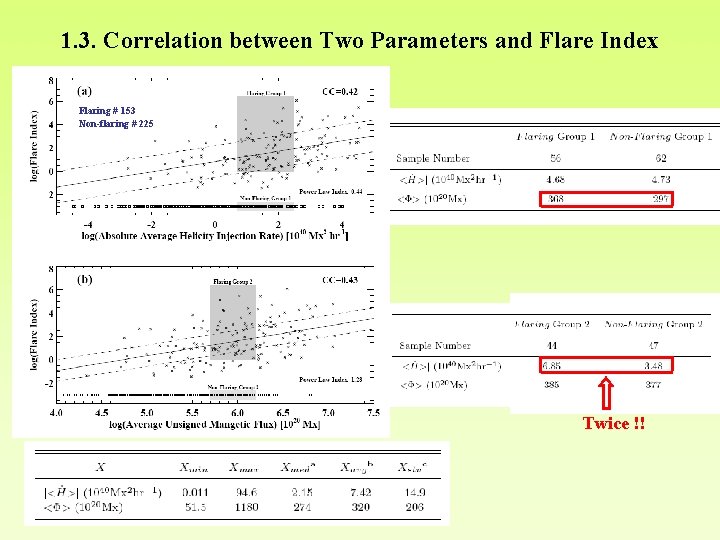
1. 3. Correlation between Two Parameters and Flare Index Flaring # 153 Non-flaring # 225 Twice !!
<Φ> [1020 Mx] 1. 4. |< d. H/dt >| vs. < Φ > | < d. H/dt > | [1040 Mx 2 hr-1]
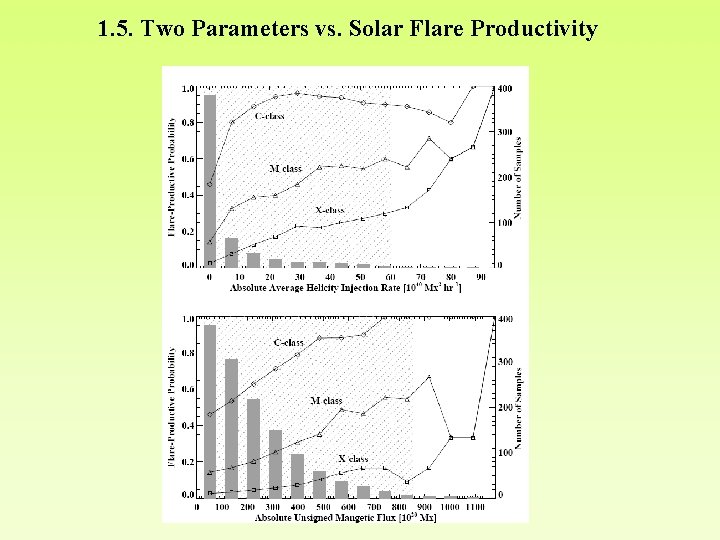
1. 5. Two Parameters vs. Solar Flare Productivity
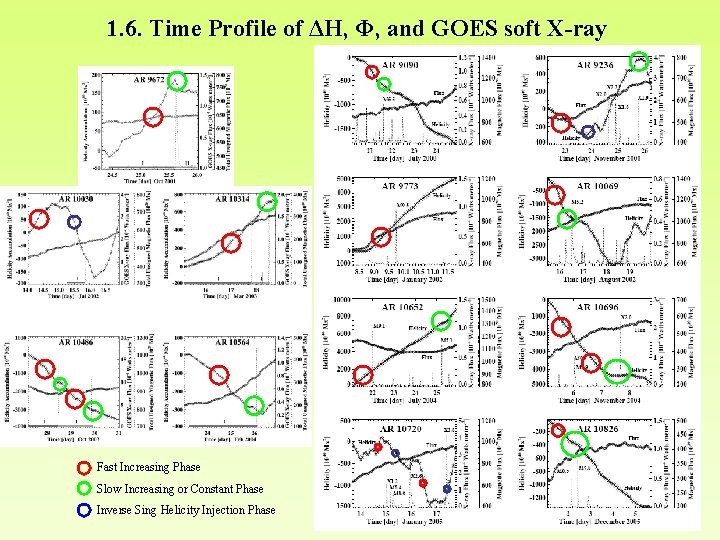
1. 6. Time Profile of ΔH, Φ, and GOES soft X-ray Fast Increasing Phase Slow Increasing or Constant Phase Inverse Sing Helicity Injection Phase
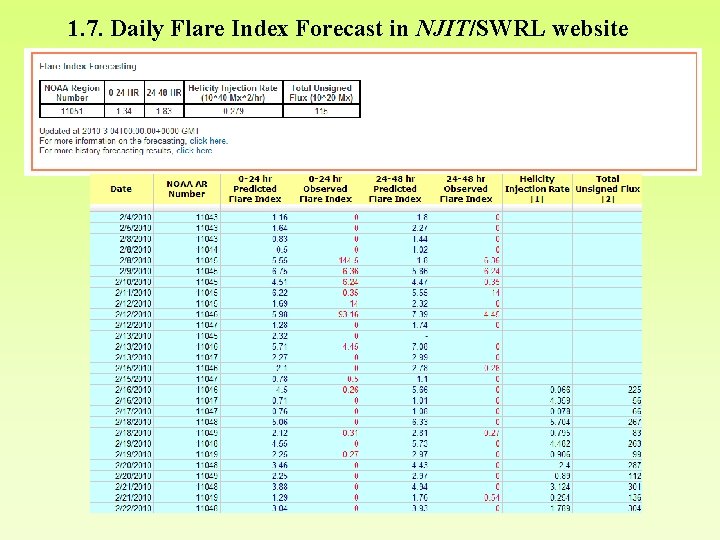
1. 7. Daily Flare Index Forecast in NJIT/SWRL website
1. 8. Summary • Helicity physically considers both structure and evolution of magnetic fields while other previous forecasting studies are based on snap-shot morphology only. • For 91 AR samples having similarly large magnetic flux, the flaring AR group has the average helicity injection rate about twice greater than that of the non-flaring AR group. • The flare-productive probability of the helicity parameter for C-class flares shows a well defined cut-off between flare-productive and flarequiet ARs. • Helicity accumulates significantly and consistently over 1 -1. 5 days in major flare producing ARs so that a warning sign of flares can be given by the presence of a phase of monotonically increasing helicity. Some of major flares occurred when the helicity injection became slow (sometimes almost zero) or the opposite sign of helicity started to be injected after the significant helicity accumulation phase.
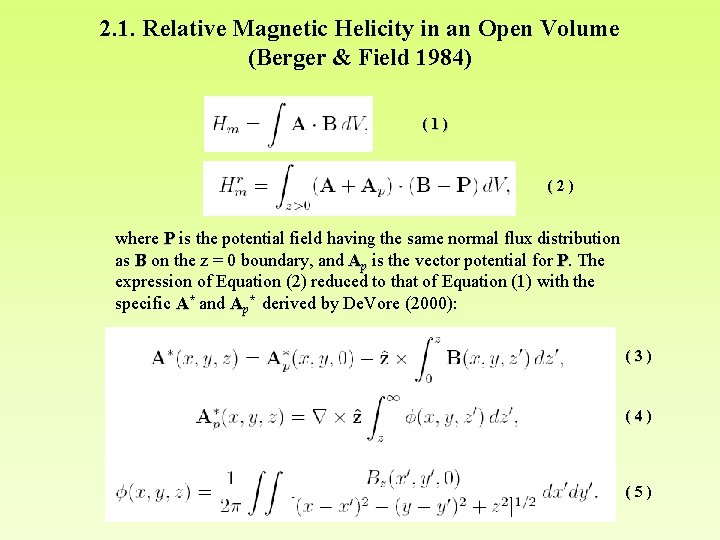
2. 1. Relative Magnetic Helicity in an Open Volume (Berger & Field 1984) (1) (2) where P is the potential field having the same normal flux distribution as B on the z = 0 boundary, and Ap is the vector potential for P. The expression of Equation (2) reduced to that of Equation (1) with the specific A* and Ap* derived by De. Vore (2000): (3) (4) (5)
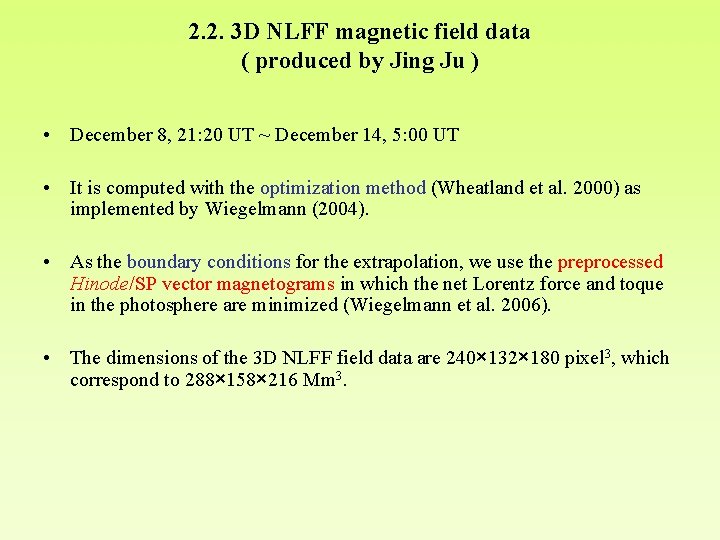
2. 2. 3 D NLFF magnetic field data ( produced by Jing Ju ) • December 8, 21: 20 UT ~ December 14, 5: 00 UT • It is computed with the optimization method (Wheatland et al. 2000) as implemented by Wiegelmann (2004). • As the boundary conditions for the extrapolation, we use the preprocessed Hinode/SP vector magnetograms in which the net Lorentz force and toque in the photosphere are minimized (Wiegelmann et al. 2006). • The dimensions of the 3 D NLFF field data are 240× 132× 180 pixel 3, which correspond to 288× 158× 216 Mm 3.
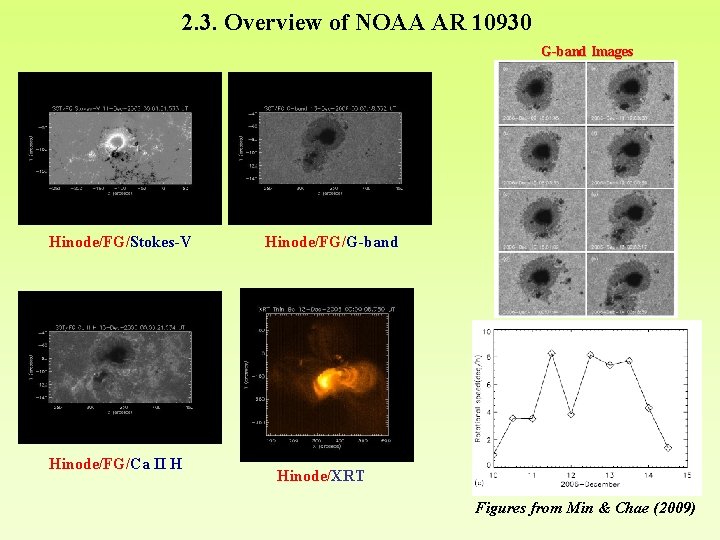
2. 3. Overview of NOAA AR 10930 G-band Images Hinode/FG/Stokes-V Hinode/FG/Ca II H Hinode/FG/G-band Hinode/XRT Figures from Min & Chae (2009)
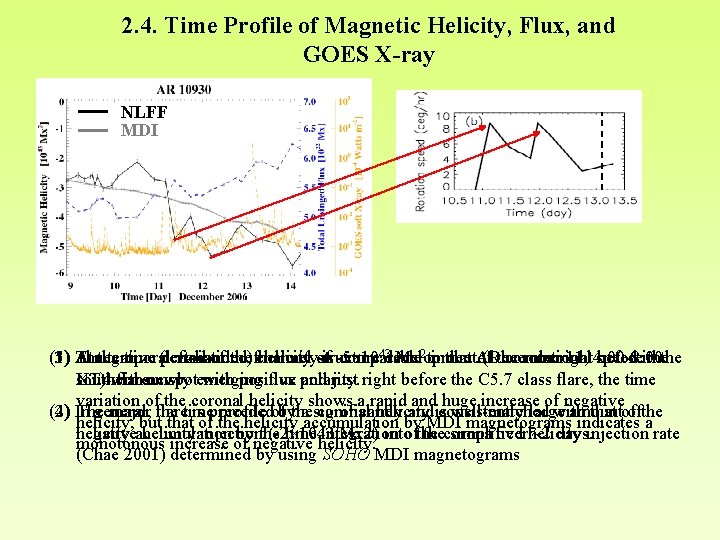
2. 4. Time Profile of Magnetic Helicity, Flux, and GOES X-ray NLFF MDI 43 (1) At (3) (5) The A negative the temporal time (left-handed) period variation of theofchannel helicityof structure is -5× 10 comparable development Mx 2 to in that the AR of (December the corona rotational right 11, 4: 00 -8: 00 speed beforeinthe X 3. 4 with southern UT) flare. sunspot newly emerging with positive flux polarity. and just right before the C 5. 7 class flare, the time variation of the coronal helicity shows a rapid and huge increase of negative (2) In (4) The general, major flare the time is preceded profile ofbythe a significantly coronal helicity and isconsistently well-matched large with amount that ofofthe helicity, but that of the helicity accumulation by MDI magnetograms indicates a negativeaccumulation helicity injection by the (-2× 1043 time integration Mx 2) intoofthe thecorona simplified overhelicity ~2 days. injection rate monotonous increase of negative helicity. (Chae 2001) determined by using SOHO MDI magnetograms
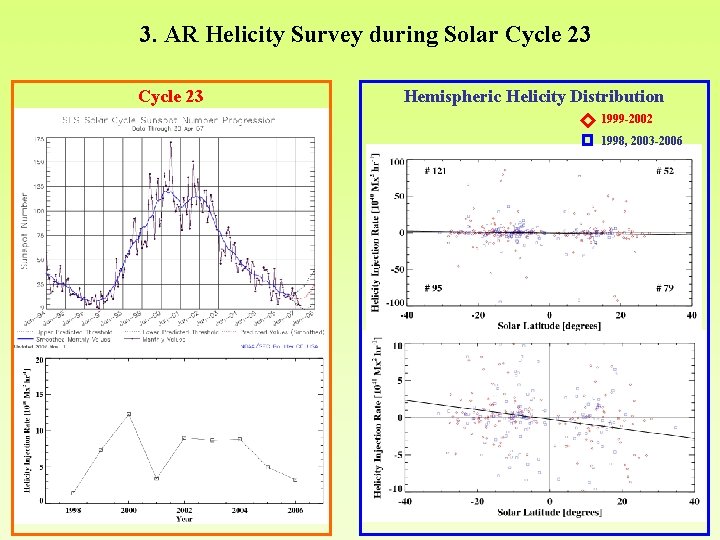
3. AR Helicity Survey during Solar Cycle 23 Hemispheric Helicity Distribution 1999 -2002 1998, 2003 -2006
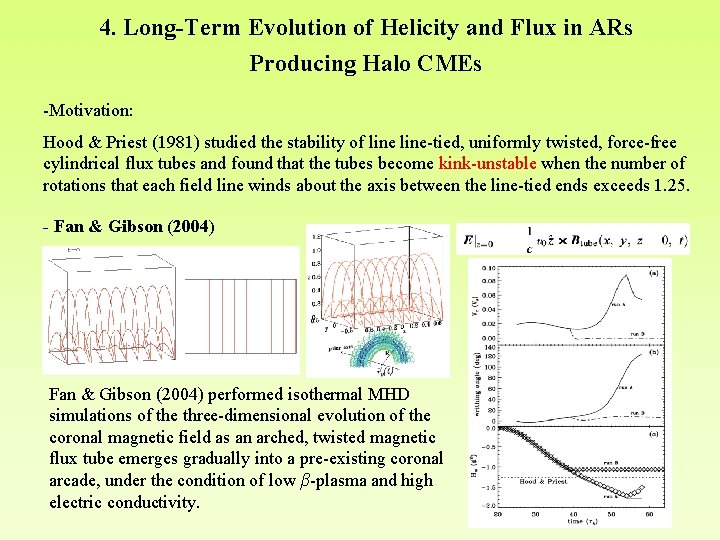
4. Long-Term Evolution of Helicity and Flux in ARs Producing Halo CMEs -Motivation: Hood & Priest (1981) studied the stability of line-tied, uniformly twisted, force-free cylindrical flux tubes and found that the tubes become kink-unstable when the number of rotations that each field line winds about the axis between the line-tied ends exceeds 1. 25. - Fan & Gibson (2004) performed isothermal MHD simulations of the three-dimensional evolution of the coronal magnetic field as an arched, twisted magnetic flux tube emerges gradually into a pre-existing coronal arcade, under the condition of low β-plasma and high electric conductivity.
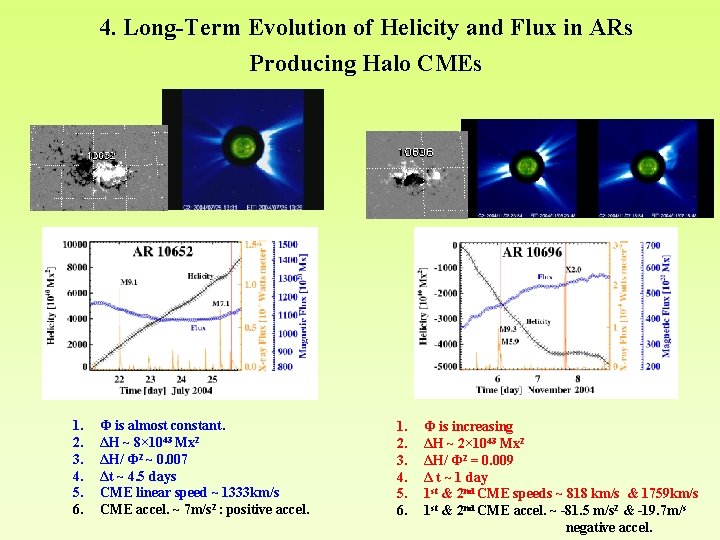
4. Long-Term Evolution of Helicity and Flux in ARs Producing Halo CMEs 1. 2. 3. 4. 5. 6. Φ is almost constant. ΔH ~ 8× 1043 Mx 2 ΔH/ Φ 2 ~ 0. 007 Δt ~ 4. 5 days CME linear speed ~ 1333 km/s CME accel. ~ 7 m/s 2 : positive accel. 1. 2. 3. 4. 5. 6. Φ is increasing ΔH ~ 2× 1043 Mx 2 ΔH/ Φ 2 = 0. 009 Δ t ~ 1 day 1 st & 2 nd CME speeds ~ 818 km/s & 1759 km/s 1 st & 2 nd CME accel. ~ -81. 5 m/s 2 & -19. 7 m/s negative accel.