
STUDY OF HARMONIC CURRENTS INTRODUCED BY THREEPHASE PWMCONVERTERS
STUDY OF HARMONIC CURRENTS INTRODUCED BY THREE-PHASE PWM-CONVERTERS CONNECTED TO THE GRID Philippe Delarue *, Patrick Bartholomeus *, Frank Minne **, Emmanuel De Jaeger ** presented by: Bruno FRANCOIS * CNRT CIRED 2003
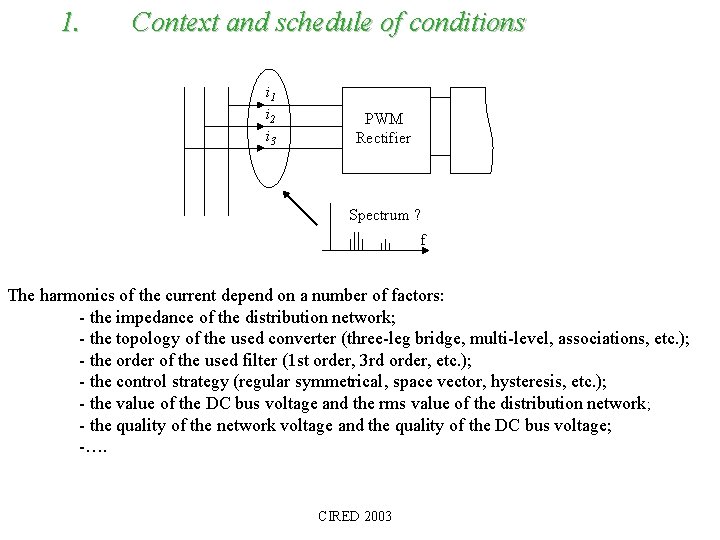
1. Context and schedule of conditions i 1 i 2 i 3 PWM Rectifier Spectrum ? f The harmonics of the current depend on a number of factors: - the impedance of the distribution network; - the topology of the used converter (three-leg bridge, multi-level, associations, etc. ); - the order of the used filter (1 st order, 3 rd order, etc. ); - the control strategy (regular symmetrical, space vector, hysteresis, etc. ); - the value of the DC bus voltage and the rms value of the distribution network; - the quality of the network voltage and the quality of the DC bus voltage; -…. CIRED 2003
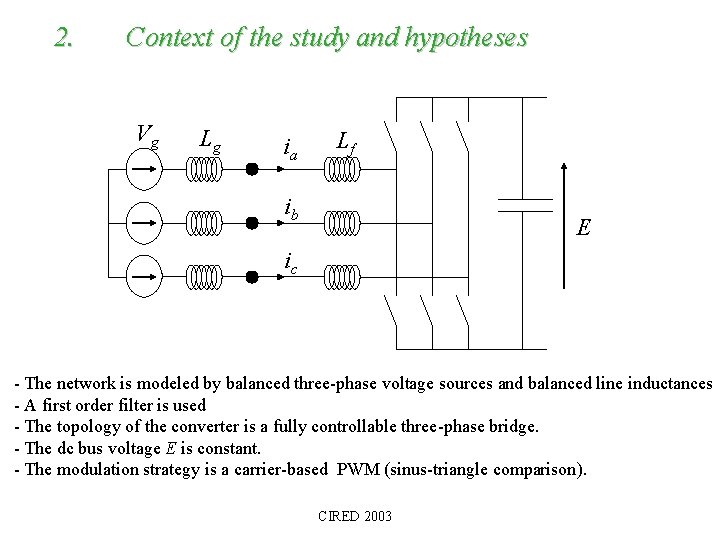
2. Context of the study and hypotheses Vg Lg ia Lf ib E ic - The network is modeled by balanced three-phase voltage sources and balanced line inductances - A first order filter is used - The topology of the converter is a fully controllable three-phase bridge. - The dc bus voltage E is constant. - The modulation strategy is a carrier-based PWM (sinus-triangle comparison). CIRED 2003

3. The three phase PWM rectifier Voltage regulation coefficient: r vb vgb vc vgc Lg Lf 1/f 1 0 va vga varef= r sin 2. p. f. t v’a v’b v’c -1 E/2 v’a : Modulated voltage 1/fc E/2 0 0 E E/2 va 1 = v’a 1 = r (E/2) sin wt -E/2 ia 2 E/3 0 -2 E/3 va Spectrum of va m=fc/f > 15 Vg, E, r Spectrum of ia CIRED 2003 f mf 2 mf 3 mf

4. Voltage and current harmonics vp vg Vhmax/(2 E/p) Lg 1 Lf i 0. 8 v f 0. 6 k=Lr/Lf 0. 4 0. 2 1/fc 1 r (m± 2)f 0 0 (2 m± 1)f r 0 02 0. 4 0. 6 0. 8 1 Ihmax(Lr+Lf)mw /(2 E/p ) -1 0. 4 1/f Generalized frequency spectrum (2 m ± 1) f (m ± 2) f (m± 2)f 0. 2 (2 m± 1)f 0 f mf=fc 2 mf=2 fc CIRED 2003 r 0 02 0. 4 0. 6 0. 8 1
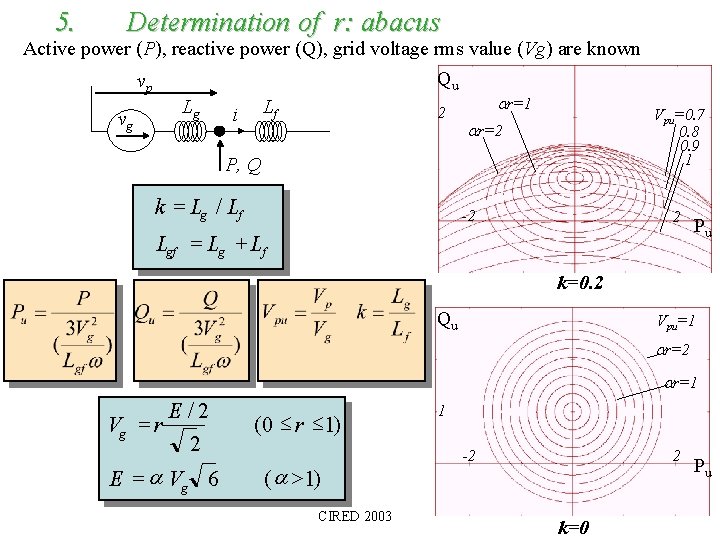
5. Determination of r: abacus Active power (P), reactive power (Q), grid voltage rms value (Vg) are known Qu vp Lg vg Lf i 2 ar=1 Vpu=0. 7 0. 8 0. 9 1 ar=2 P, Q k = Lg / Lf -2 2 Lgf = Lg + Lf Pu k=0. 2 Qu Vpu=1 ar=2 ar=1 Vg = r E/2 2 E = a Vg 6 (0 £ r £ 1) ( a > 1) CIRED 2003 1 -2 2 k=0 Pu
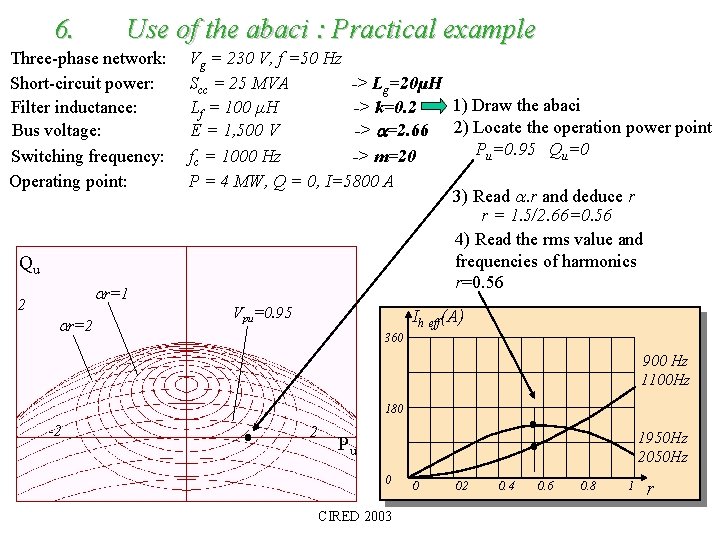
6. Use of the abaci : Practical example Three-phase network: Short-circuit power: Filter inductance: Bus voltage: Switching frequency: Operating point: Qu ar=1 2 ar=2 Vg = 230 V, f =50 Hz Scc = 25 MVA -> Lg=20µH 1) Draw the abaci Lf = 100 μH -> k=0. 2 E = 1, 500 V -> a=2. 66 2) Locate the operation power point Pu=0. 95 Qu=0 fc = 1000 Hz -> m=20 P = 4 MW, Q = 0, I=5800 A 3) Read a. r and deduce r r = 1. 5/2. 66=0. 56 4) Read the rms value and frequencies of harmonics r=0. 56 Vpu=0. 95 Ih eff(A) 360 900 Hz 1100 Hz 180 -2 2 1950 Hz 2050 Hz Pu 0 CIRED 2003 0 02 0. 4 0. 6 0. 8 1 r
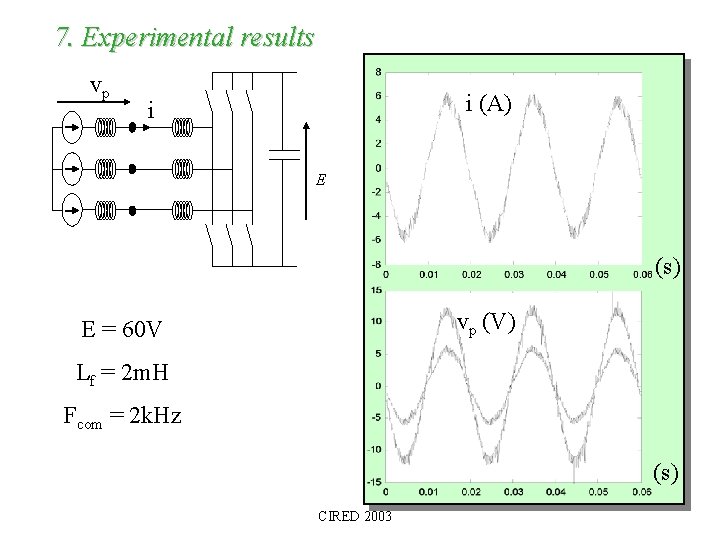
7. Experimental results vp i (A) i E (s) vp (V) E = 60 V Lf = 2 m. H Fcom = 2 k. Hz (s) CIRED 2003
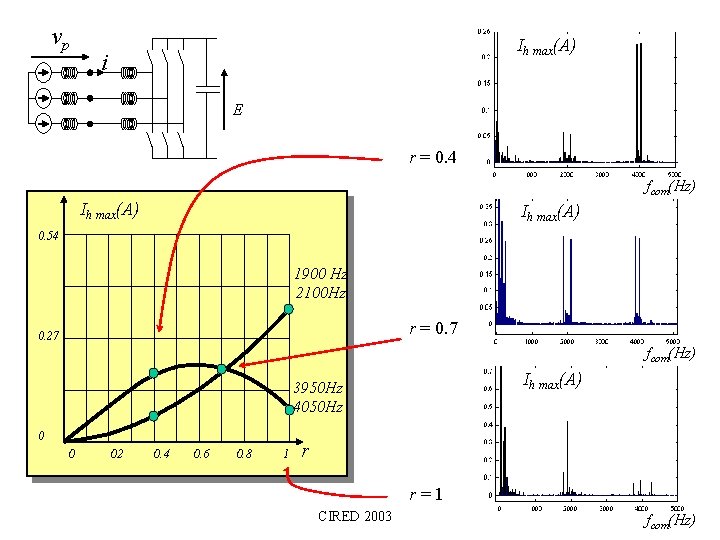
vp Ih max(A) i E r = 0. 4 fcom(Hz) Ih max(A) 0. 54 1900 Hz 2100 Hz r = 0. 7 0. 27 fcom(Hz) Ih max(A) 3950 Hz 4050 Hz 0 0 02 0. 4 0. 6 0. 8 1 r r=1 CIRED 2003 fcom(Hz)
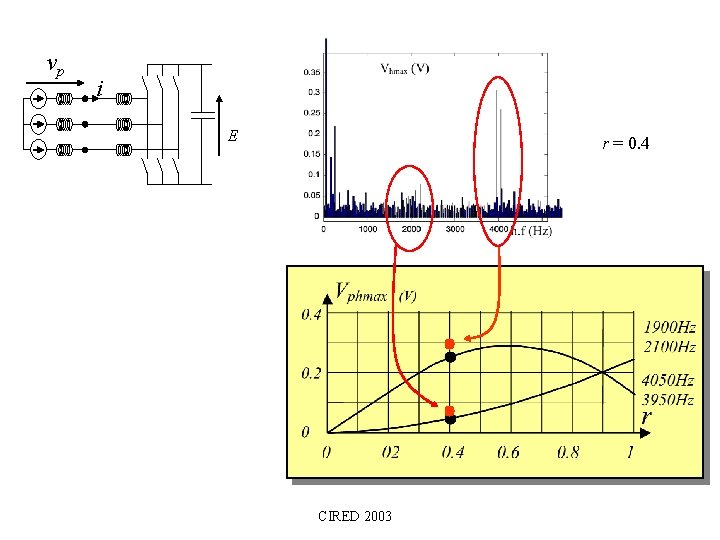
vp i E r = 0. 4 CIRED 2003
Conclusions - Prediction of current and oltage harmonics generated by PWM rectifiers - Requirements: converter parameters, grid parameters - Design of two abacis for practical use Futur perspectives - Extension to other modulation techniques - Extension to other converter topologies (multilevel…) -. . . CIRED 2003
- Slides: 11