
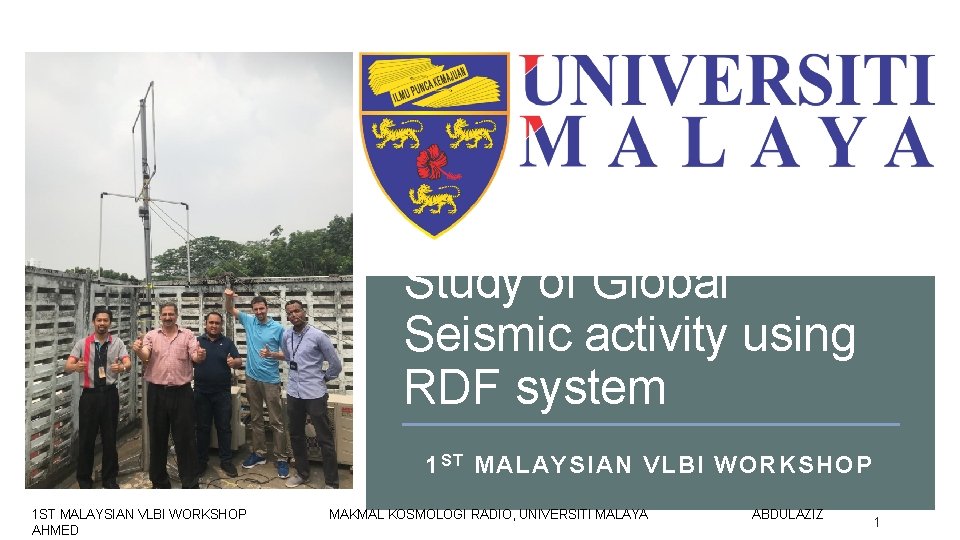
Study of Global Seismic activity using RDF system
Study of Global Seismic activity using RDF system 1 S T MALAYSIAN VLBI WORKSHOP 1 ST MALAYSIAN VLBI WORKSHOP AHMED MAKMAL KOSMOLOGI RADIO, UNIVERSITI MALAYA ABDULAZIZ 1
Outline 1. Introduction and Brief History of RDF 2. Current RDF projects 3. Relationship between Solar activity and Earthquakes 4. RDF in Malaysia 5. Relationship between Solar Burst and Earthquakes 6. Near future plans 1 ST MALAYSIAN VLBI WORKSHOP ABDULAZIZ AHMED MAKMAL KOSMOLOGI RADIO, UNIVERSITI MALAYA 2
1. Introduction Ø The Radio Emissions Project deals with the study of solar activity and terrestrial geomagnetic activity related to global seismic activity. Ø The heart of the project is represented by a series of computerized radio receivers, active 24 hours a day, which allow the monitoring of the earth's geomagnetic fund and natural radio emissions at a frequency between 0. 0013 and 96000 Hz (SELF-LF band) and with a resolution between 0. 8 m. Hz (milli. Hz) and 1 Hz. Ø This station is able to provide spectrometric and spectrographic measurements of natural radio emissions captured through a series of special antennas (self-built), specifically designed for this type of research. The Radio Emissions Project is the first independent scientific research project in the world engaged in research on the prediction of potentially destructive earthquakes capable of generating tsunamis. 1 ST MALAYSIAN VLBI WORKSHOP ABDULAZIZ AHMED MAKMAL KOSMOLOGI RADIO, UNIVERSITI MALAYA 3
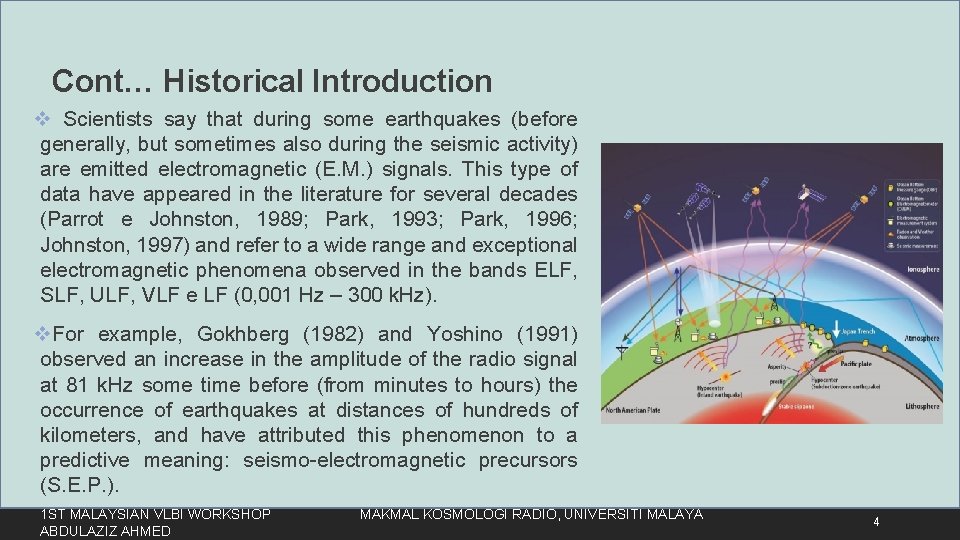
Cont… Historical Introduction v Scientists say that during some earthquakes (before generally, but sometimes also during the seismic activity) are emitted electromagnetic (E. M. ) signals. This type of data have appeared in the literature for several decades (Parrot e Johnston, 1989; Park, 1993; Park, 1996; Johnston, 1997) and refer to a wide range and exceptional electromagnetic phenomena observed in the bands ELF, SLF, ULF, VLF e LF (0, 001 Hz – 300 k. Hz). v. For example, Gokhberg (1982) and Yoshino (1991) observed an increase in the amplitude of the radio signal at 81 k. Hz some time before (from minutes to hours) the occurrence of earthquakes at distances of hundreds of kilometers, and have attributed this phenomenon to a predictive meaning: seismo-electromagnetic precursors (S. E. P. ). 1 ST MALAYSIAN VLBI WORKSHOP ABDULAZIZ AHMED MAKMAL KOSMOLOGI RADIO, UNIVERSITI MALAYA 4
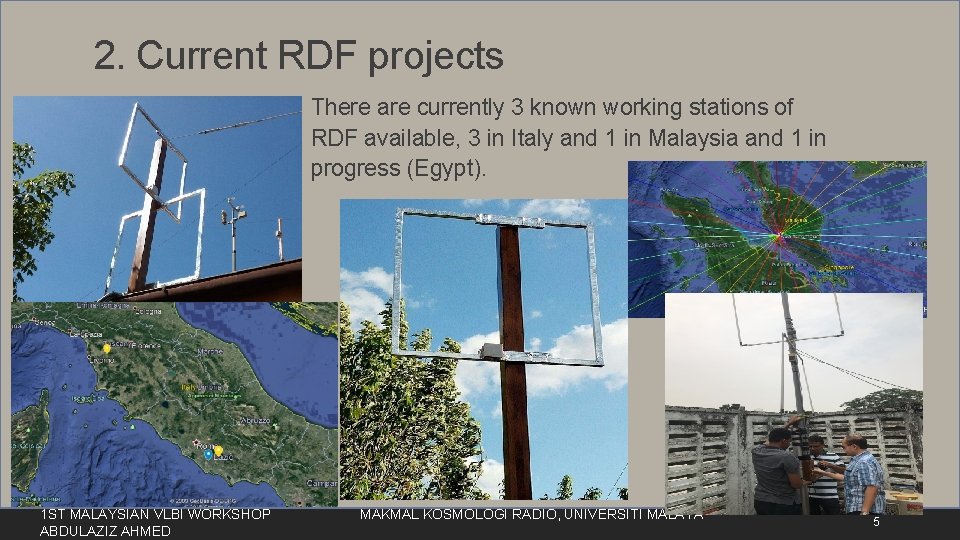
2. Current RDF projects There are currently 3 known working stations of RDF available, 3 in Italy and 1 in Malaysia and 1 in progress (Egypt). 1 ST MALAYSIAN VLBI WORKSHOP ABDULAZIZ AHMED MAKMAL KOSMOLOGI RADIO, UNIVERSITI MALAYA 5
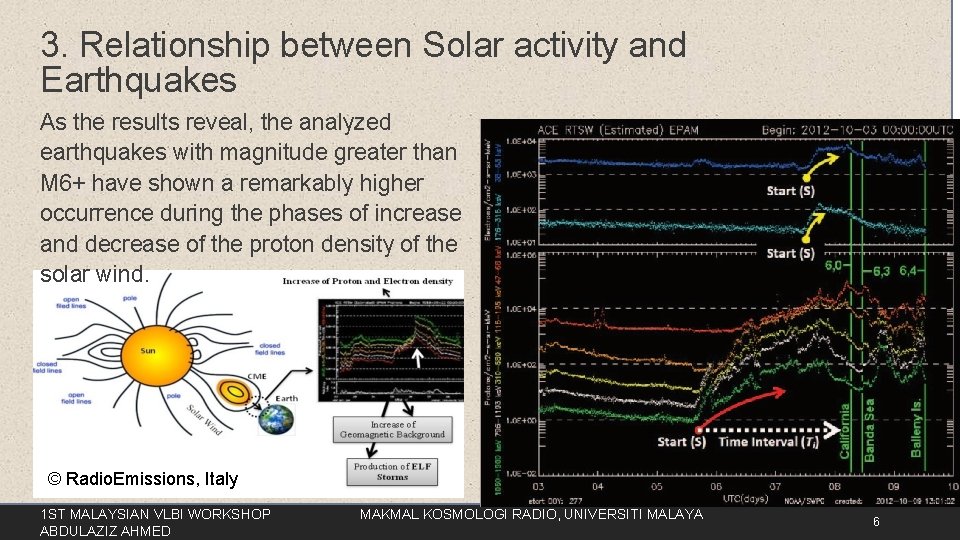
3. Relationship between Solar activity and Earthquakes As the results reveal, the analyzed earthquakes with magnitude greater than M 6+ have shown a remarkably higher occurrence during the phases of increase and decrease of the proton density of the solar wind. © Radio. Emissions, Italy 1 ST MALAYSIAN VLBI WORKSHOP ABDULAZIZ AHMED MAKMAL KOSMOLOGI RADIO, UNIVERSITI MALAYA 6
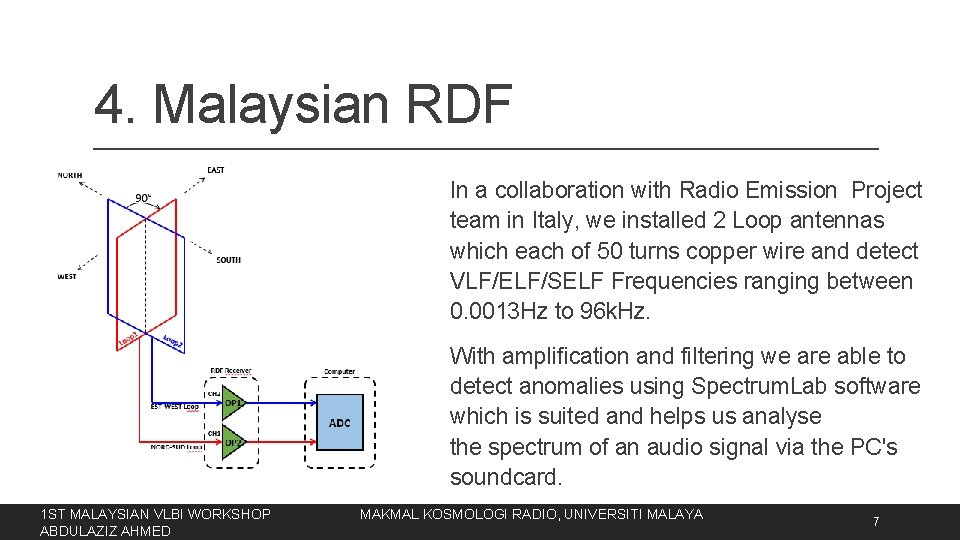
4. Malaysian RDF In a collaboration with Radio Emission Project team in Italy, we installed 2 Loop antennas which each of 50 turns copper wire and detect VLF/ELF/SELF Frequencies ranging between 0. 0013 Hz to 96 k. Hz. With amplification and filtering we are able to detect anomalies using Spectrum. Lab software which is suited and helps us analyse the spectrum of an audio signal via the PC's soundcard. 1 ST MALAYSIAN VLBI WORKSHOP ABDULAZIZ AHMED MAKMAL KOSMOLOGI RADIO, UNIVERSITI MALAYA 7
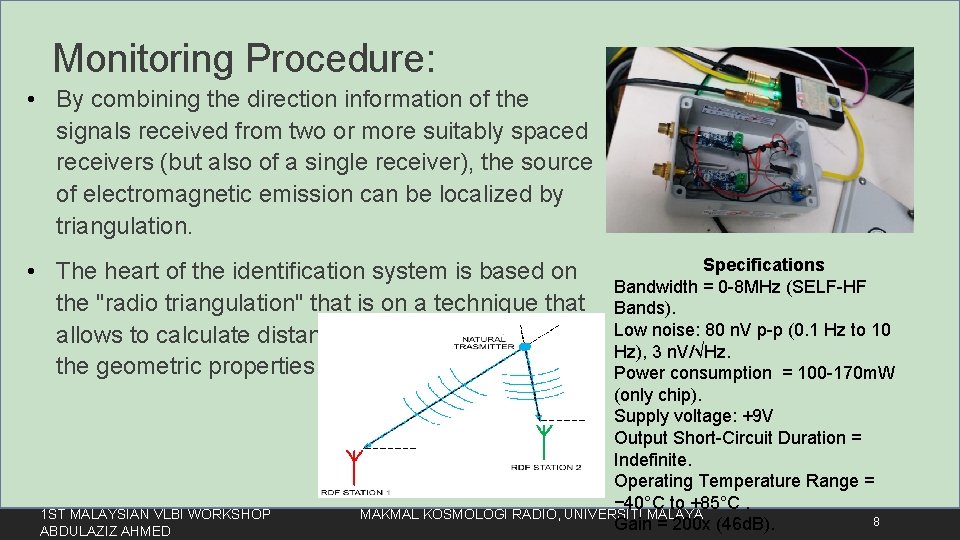
Monitoring Procedure: • By combining the direction information of the signals received from two or more suitably spaced receivers (but also of a single receiver), the source of electromagnetic emission can be localized by triangulation. Specifications Bandwidth = 0 -8 MHz (SELF-HF Bands). Low noise: 80 n. V p-p (0. 1 Hz to 10 Hz), 3 n. V/√Hz. Power consumption = 100 -170 m. W (only chip). Supply voltage: +9 V Output Short-Circuit Duration = Indefinite. Operating Temperature Range = − 40°C to +85°C. MAKMAL KOSMOLOGI RADIO, UNIVERSITI MALAYA 8 Gain = 200 x (46 d. B). • The heart of the identification system is based on the "radio triangulation" that is on a technique that allows to calculate distances between points using the geometric properties of the triangles. 1 ST MALAYSIAN VLBI WORKSHOP ABDULAZIZ AHMED
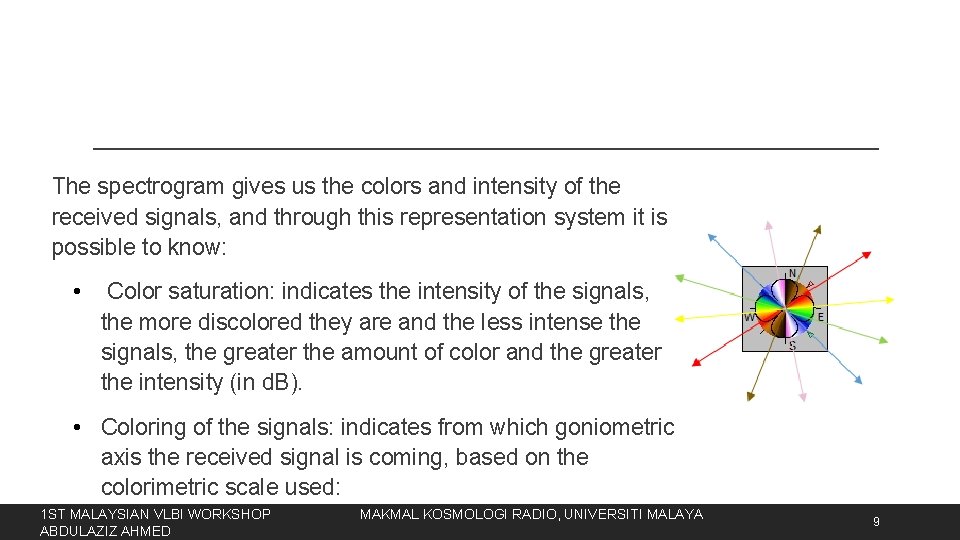
The spectrogram gives us the colors and intensity of the received signals, and through this representation system it is possible to know: • Color saturation: indicates the intensity of the signals, the more discolored they are and the less intense the signals, the greater the amount of color and the greater the intensity (in d. B). • Coloring of the signals: indicates from which goniometric axis the received signal is coming, based on the colorimetric scale used: 1 ST MALAYSIAN VLBI WORKSHOP ABDULAZIZ AHMED MAKMAL KOSMOLOGI RADIO, UNIVERSITI MALAYA 9
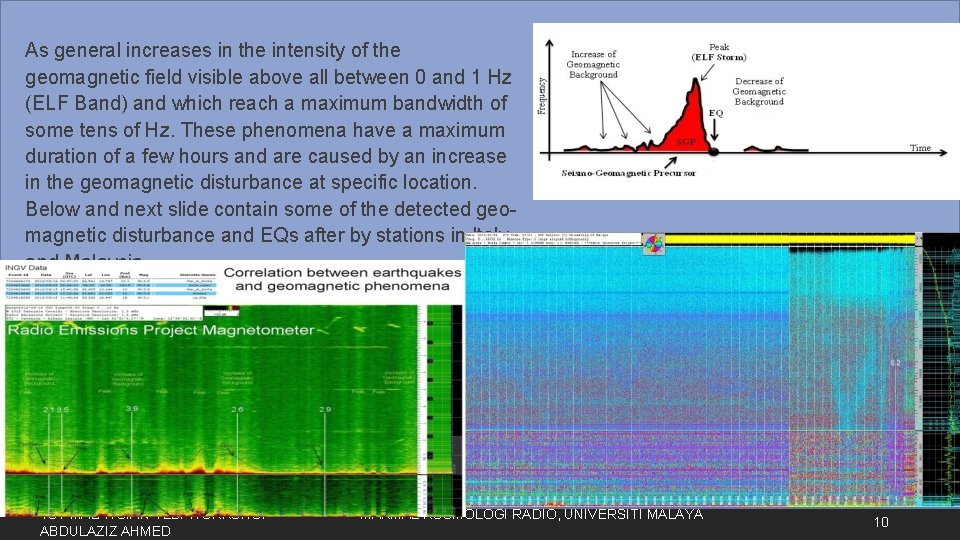
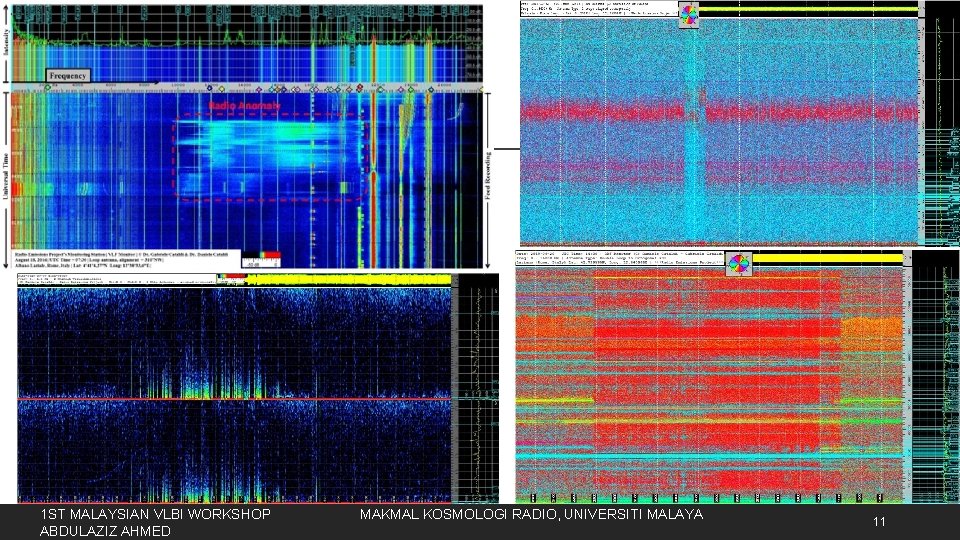
As general increases in the intensity of the geomagnetic field visible above all between 0 and 1 Hz (ELF Band) and which reach a maximum bandwidth of some tens of Hz. These phenomena have a maximum duration of a few hours and are caused by an increase in the geomagnetic disturbance at specific location. Below and next slide contain some of the detected geomagnetic disturbance and EQs after by stations in Italy and Malaysia. 1 ST MALAYSIAN VLBI WORKSHOP ABDULAZIZ AHMED MAKMAL KOSMOLOGI RADIO, UNIVERSITI MALAYA 10
1 ST MALAYSIAN VLBI WORKSHOP ABDULAZIZ AHMED MAKMAL KOSMOLOGI RADIO, UNIVERSITI MALAYA 11
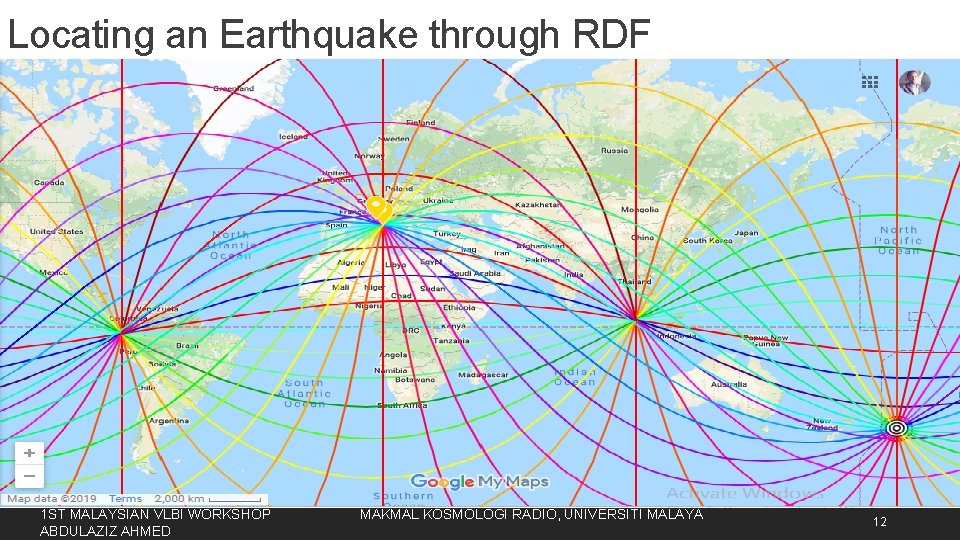
Locating an Earthquake through RDF 1 ST MALAYSIAN VLBI WORKSHOP ABDULAZIZ AHMED MAKMAL KOSMOLOGI RADIO, UNIVERSITI MALAYA 12
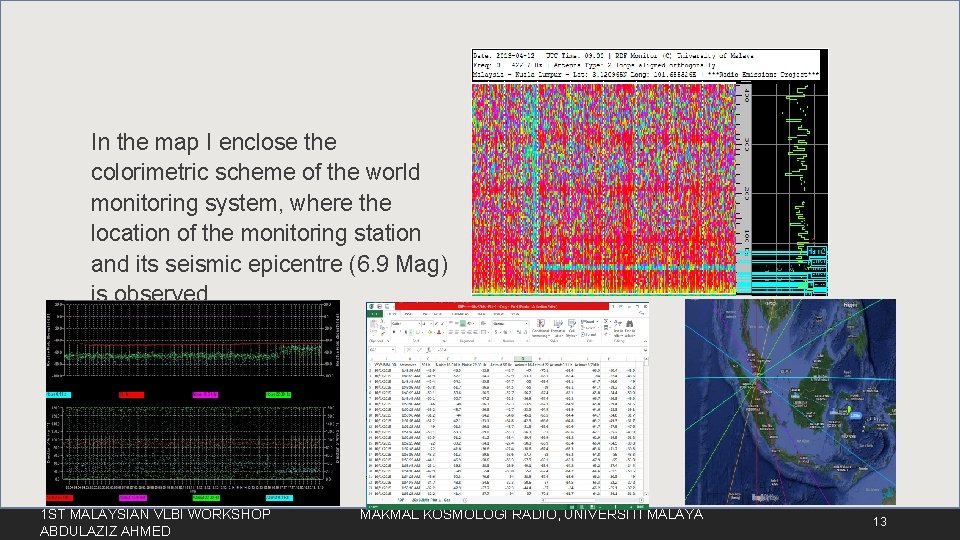
In the map I enclose the colorimetric scheme of the world monitoring system, where the location of the monitoring station and its seismic epicentre (6. 9 Mag) is observed, 1 ST MALAYSIAN VLBI WORKSHOP ABDULAZIZ AHMED MAKMAL KOSMOLOGI RADIO, UNIVERSITI MALAYA 13
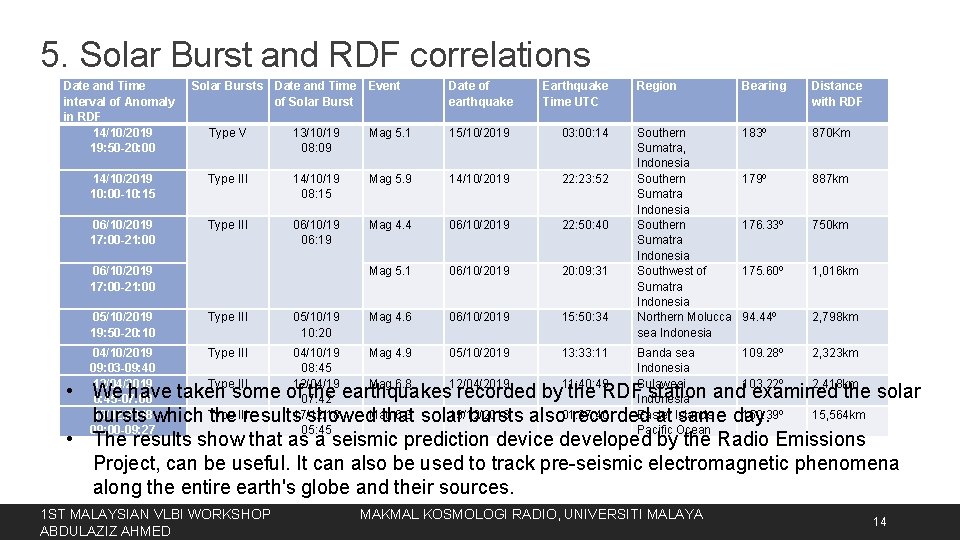
5. Solar Burst and RDF correlations Date and Time interval of Anomaly in RDF 14/10/2019 19: 50 -20: 00 Solar Bursts Date and Time Event of Solar Burst Date of earthquake Earthquake Time UTC Type V 13/10/19 08: 09 Mag 5. 1 15/10/2019 03: 00: 14 14/10/2019 10: 00 -10: 15 Type III 14/10/19 08: 15 Mag 5. 9 14/10/2019 22: 23: 52 06/10/2019 17: 00 -21: 00 Type III 06/10/19 06: 19 Mag 4. 4 06/10/2019 22: 50: 40 Mag 5. 1 06/10/2019 20: 09: 31 06/10/2019 17: 00 -21: 00 05/10/2019 19: 50 -20: 10 Type III 05/10/19 10: 20 Mag 4. 6 06/10/2019 15: 50: 34 04/10/2019 09: 03 -09: 40 12/04/2019 6: 45 -07: 00 18/12/2018 09: 00 -09: 27 Type III 04/10/19 08: 45 12/04/19 07: 42 17/12/18 05: 45 Mag 4. 9 05/10/2019 13: 33: 11 Region Bearing Distance with RDF Southern Sumatra, Indonesia Southern Sumatra Indonesia Southwest of Sumatra Indonesia Northern Molucca sea Indonesia 183⁰ 870 Km 179⁰ 887 km 176. 33⁰ 750 km 175. 60⁰ 1, 016 km 94. 44⁰ 2, 798 km Banda sea Indonesia Sulawesi Indonesia Easter Islands Pacific Ocean 109. 28⁰ 2, 323 km Type III Mag 6. 8 12/04/2019 2, 418 km • We have taken some of the earthquakes recorded by 11: 40: 49 the RDF station and 103. 22⁰ examined the solar 6. 3 solar 19/12/2018 150. 39⁰ 15, 564 km bursts which Type the IIIresults showed. Mag that bursts also 01: 37: 40 recorded at same day. • The results show that as a seismic prediction device developed by the Radio Emissions Project, can be useful. It can also be used to track pre-seismic electromagnetic phenomena along the entire earth's globe and their sources. 1 ST MALAYSIAN VLBI WORKSHOP ABDULAZIZ AHMED MAKMAL KOSMOLOGI RADIO, UNIVERSITI MALAYA 14
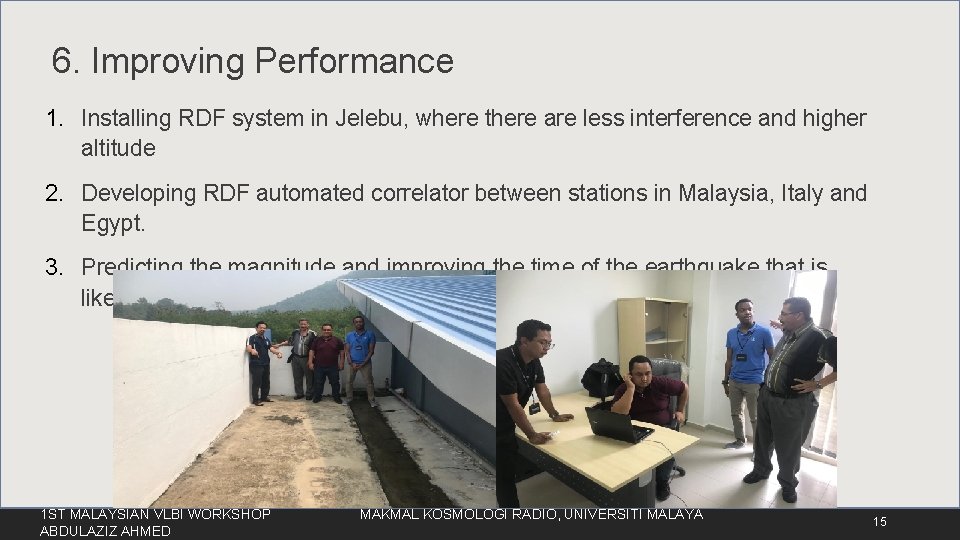
6. Improving Performance 1. Installing RDF system in Jelebu, where there are less interference and higher altitude 2. Developing RDF automated correlator between stations in Malaysia, Italy and Egypt. 3. Predicting the magnitude and improving the time of the earthquake that is likely to happen. 1 ST MALAYSIAN VLBI WORKSHOP ABDULAZIZ AHMED MAKMAL KOSMOLOGI RADIO, UNIVERSITI MALAYA 15

1 ST MALAYSIAN VLBI WORKSHOP ABDULAZIZ AHMED MAKMAL KOSMOLOGI RADIO, UNIVERSITI MALAYA 16
- Slides: 16