
Study of Floating Fill Impact on Interconnect Capacitance


- Slides: 21
Study of Floating Fill Impact on Interconnect Capacitance Andrew B. Kahng Kambiz Samadi Puneet Sharma CSE and ECE Departments University of California, San Diego
Outline • Introduction • Foundations • Study of Capacitance Impact of Fill – Proposed Guidelines • Validation of Guidelines • Conclusions
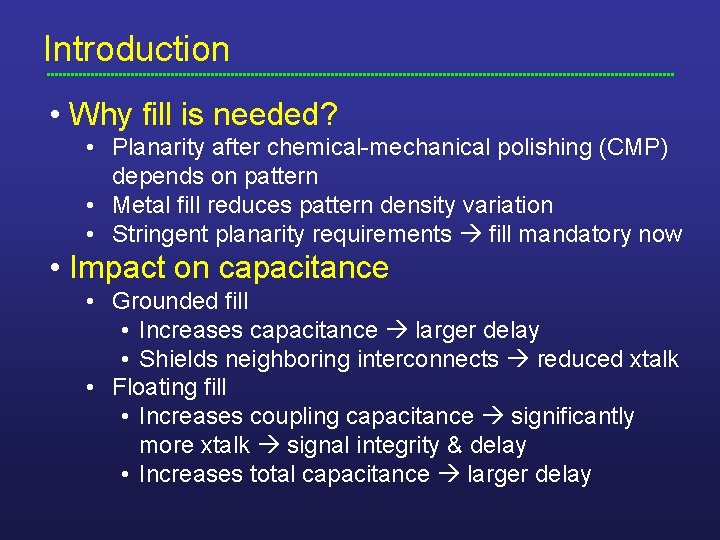
Introduction • Why fill is needed? • Planarity after chemical-mechanical polishing (CMP) depends on pattern • Metal fill reduces pattern density variation • Stringent planarity requirements fill mandatory now • Impact on capacitance • Grounded fill • Increases capacitance larger delay • Shields neighboring interconnects reduced xtalk • Floating fill • Increases coupling capacitance significantly more xtalk signal integrity & delay • Increases total capacitance larger delay
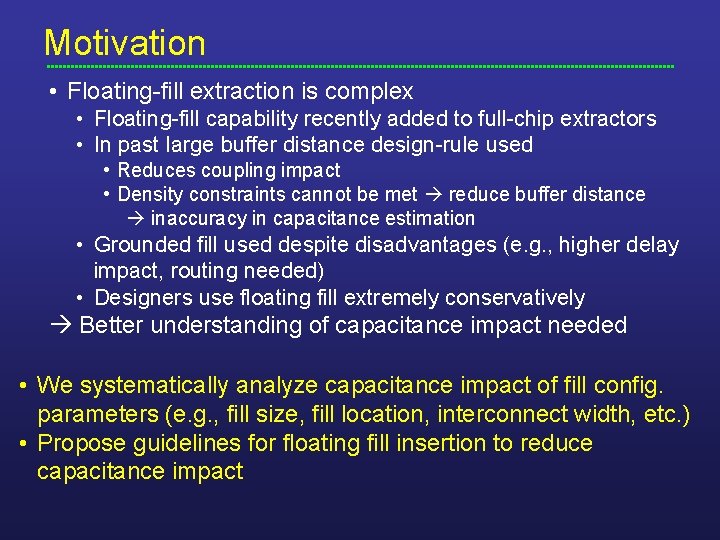
Motivation • Floating-fill extraction is complex • Floating-fill capability recently added to full-chip extractors • In past large buffer distance design-rule used • Reduces coupling impact • Density constraints cannot be met reduce buffer distance inaccuracy in capacitance estimation • Grounded fill used despite disadvantages (e. g. , higher delay impact, routing needed) • Designers use floating fill extremely conservatively Better understanding of capacitance impact needed • We systematically analyze capacitance impact of fill config. parameters (e. g. , fill size, fill location, interconnect width, etc. ) • Propose guidelines for floating fill insertion to reduce capacitance impact
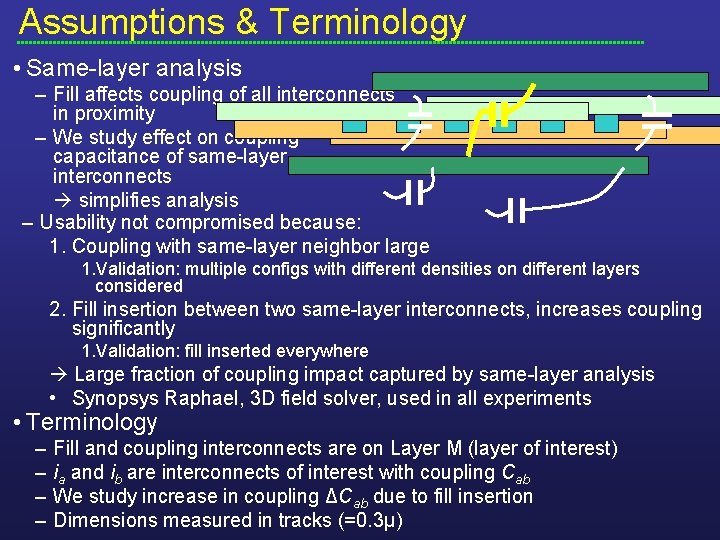
Assumptions & Terminology • Same-layer analysis – Fill affects coupling of all interconnects in proximity – We study effect on coupling capacitance of same-layer interconnects simplifies analysis – Usability not compromised because: 1. Coupling with same-layer neighbor large 1. Validation: multiple configs with different densities on different layers considered 2. Fill insertion between two same-layer interconnects, increases coupling significantly 1. Validation: fill inserted everywhere Large fraction of coupling impact captured by same-layer analysis • Synopsys Raphael, 3 D field solver, used in all experiments • Terminology – – Fill and coupling interconnects are on Layer M (layer of interest) ia and ib are interconnects of interest with coupling Cab We study increase in coupling ΔCab due to fill insertion Dimensions measured in tracks (=0. 3µ)
Outline • Introduction • Foundations • Study of Capacitance Impact of Fill – Proposed Guidelines • Validation of Guidelines • Conclusions
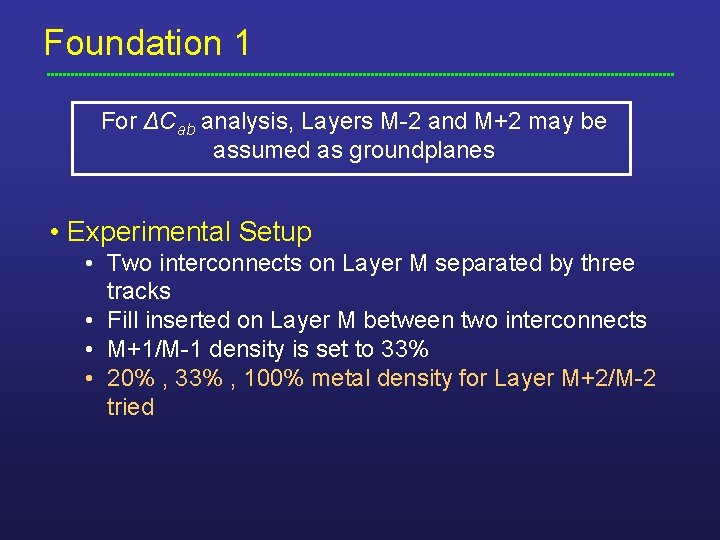
Foundation 1 For ΔCab analysis, Layers M-2 and M+2 may be assumed as groundplanes • Experimental Setup • Two interconnects on Layer M separated by three tracks • Fill inserted on Layer M between two interconnects • M+1/M-1 density is set to 33% • 20% , 33% , 100% metal density for Layer M+2/M-2 tried
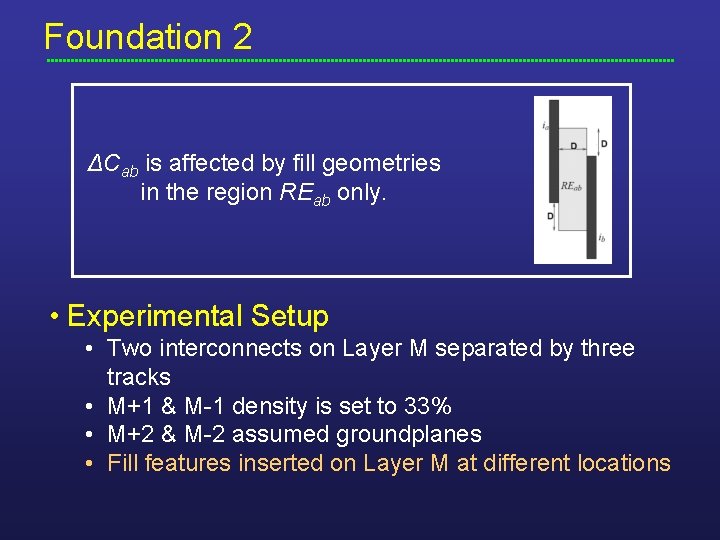
Foundation 2 ΔCab is affected by fill geometries in the region REab only. • Experimental Setup • Two interconnects on Layer M separated by three tracks • M+1 & M-1 density is set to 33% • M+2 & M-2 assumed groundplanes • Fill features inserted on Layer M at different locations
Outline • Introduction • Foundations • Study of Capacitance Impact of Fill – Proposed Guidelines • Validation of Guidelines • Conclusions
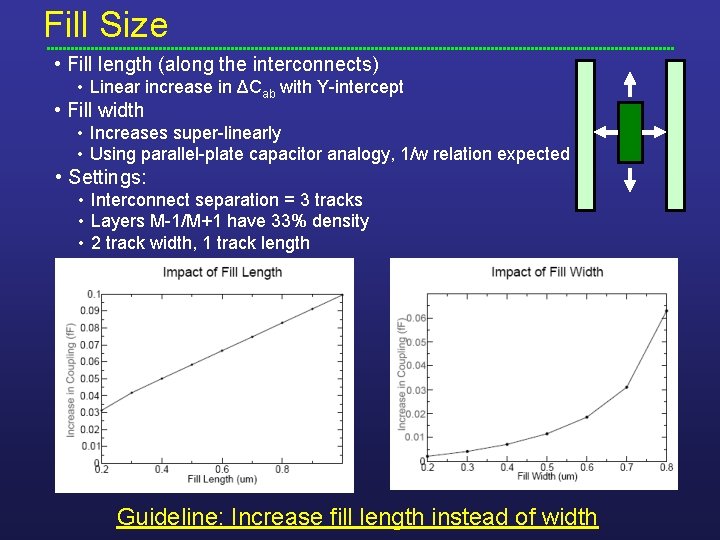
Fill Size • Fill length (along the interconnects) • Linear increase in ΔCab with Y-intercept • Fill width • Increases super-linearly • Using parallel-plate capacitor analogy, 1/w relation expected • Settings: • Interconnect separation = 3 tracks • Layers M-1/M+1 have 33% density • 2 track width, 1 track length Guideline: Increase fill length instead of width
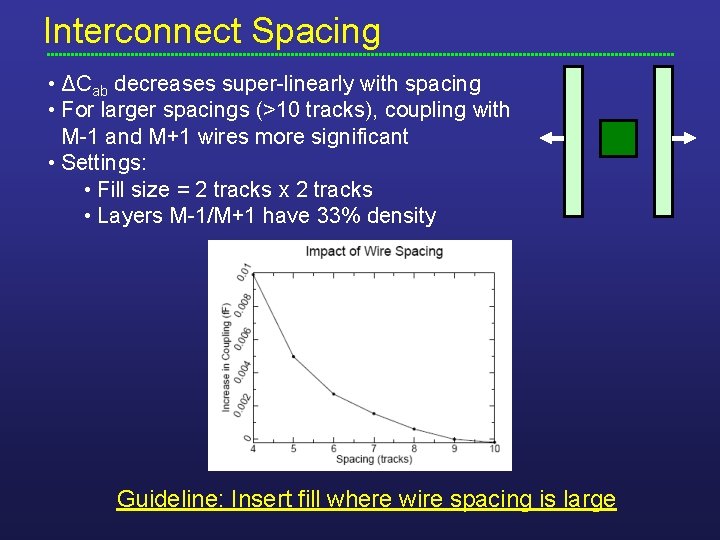
Interconnect Spacing • ΔCab decreases super-linearly with spacing • For larger spacings (>10 tracks), coupling with M-1 and M+1 wires more significant • Settings: • Fill size = 2 tracks x 2 tracks • Layers M-1/M+1 have 33% density Guideline: Insert fill where wire spacing is large
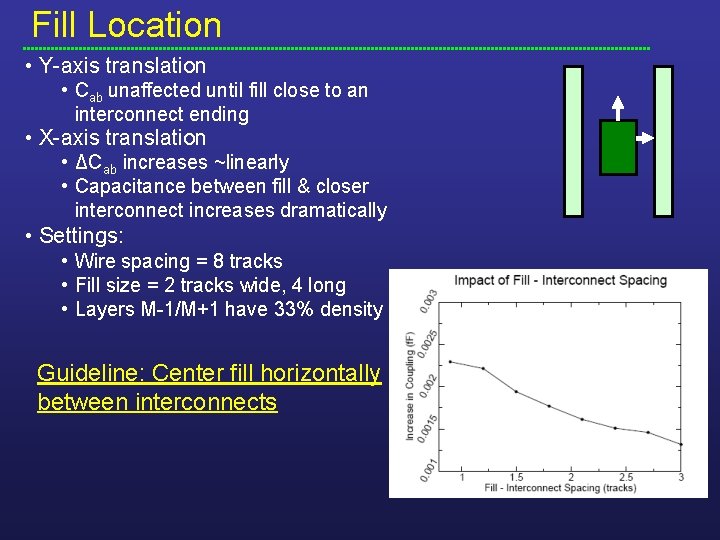
Fill Location • Y-axis translation • Cab unaffected until fill close to an interconnect ending • X-axis translation • ΔCab increases ~linearly • Capacitance between fill & closer interconnect increases dramatically • Settings: • Wire spacing = 8 tracks • Fill size = 2 tracks wide, 4 long • Layers M-1/M+1 have 33% density Guideline: Center fill horizontally between interconnects
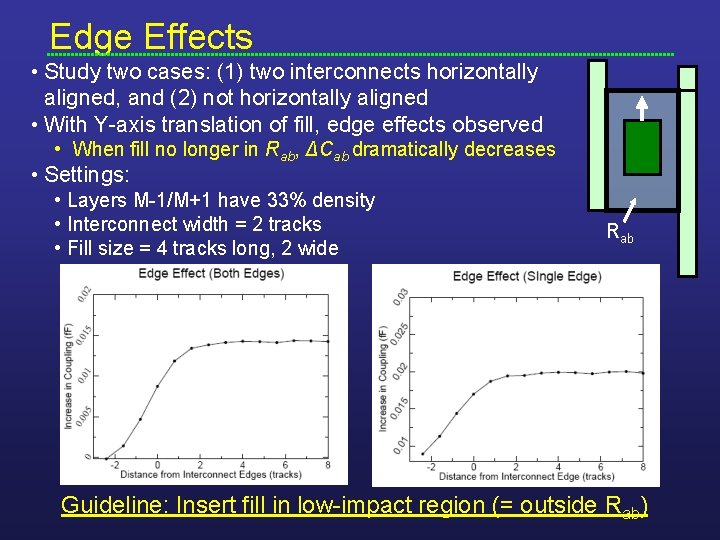
Edge Effects • Study two cases: (1) two interconnects horizontally aligned, and (2) not horizontally aligned • With Y-axis translation of fill, edge effects observed • When fill no longer in Rab, ΔCab dramatically decreases • Settings: • Layers M-1/M+1 have 33% density • Interconnect width = 2 tracks • Fill size = 4 tracks long, 2 wide Rab Guideline: Insert fill in low-impact region (= outside Rab)
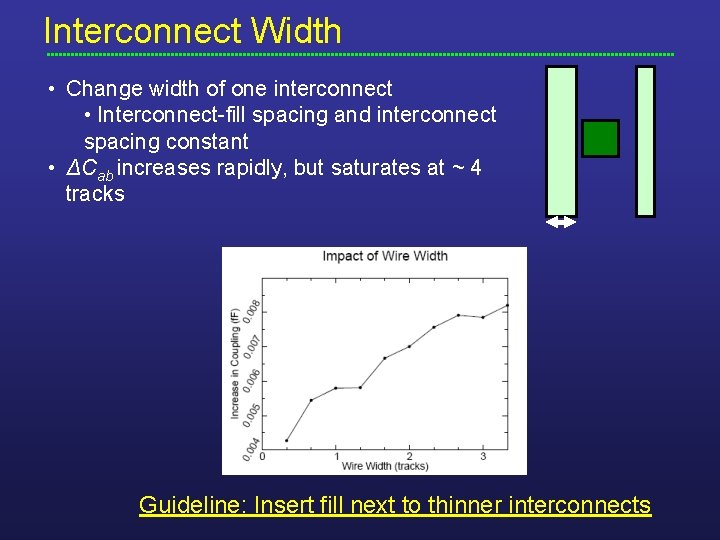
Interconnect Width • Change width of one interconnect • Interconnect-fill spacing and interconnect spacing constant • ΔCab increases rapidly, but saturates at ~ 4 tracks Guideline: Insert fill next to thinner interconnects
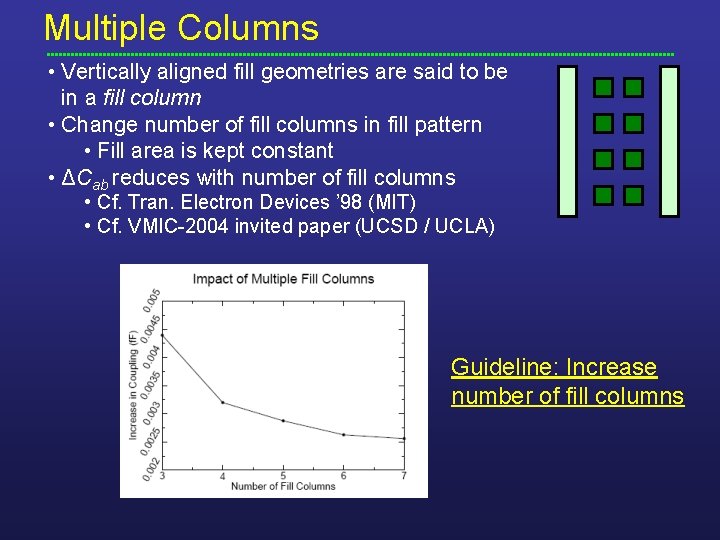
Multiple Columns • Vertically aligned fill geometries are said to be in a fill column • Change number of fill columns in fill pattern • Fill area is kept constant • ΔCab reduces with number of fill columns • Cf. Tran. Electron Devices ’ 98 (MIT) • Cf. VMIC-2004 invited paper (UCSD / UCLA) Guideline: Increase number of fill columns
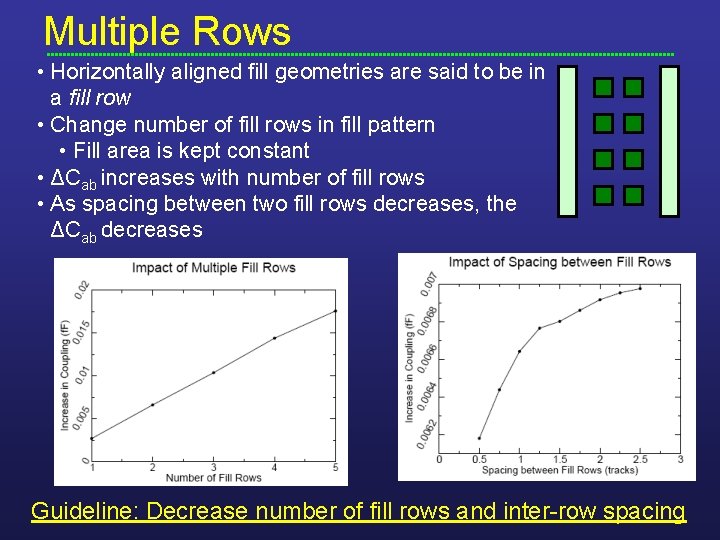
Multiple Rows • Horizontally aligned fill geometries are said to be in a fill row • Change number of fill rows in fill pattern • Fill area is kept constant • ΔCab increases with number of fill rows • As spacing between two fill rows decreases, the ΔCab decreases Guideline: Decrease number of fill rows and inter-row spacing
Outline • Introduction • Background & Terminology • Study of Capacitance Impact of Fill – Proposed Guidelines • Validation of Guidelines • Conclusions
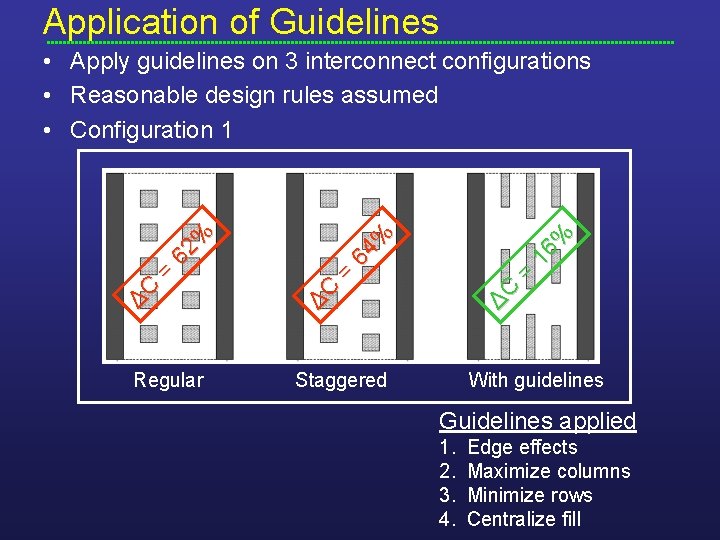
Application of Guidelines Regular 16 % ΔC = 64 % = ΔC ΔC = 62 % • Apply guidelines on 3 interconnect configurations • Reasonable design rules assumed • Configuration 1 Staggered With guidelines Guidelines applied 1. 2. 3. 4. Edge effects Maximize columns Minimize rows Centralize fill
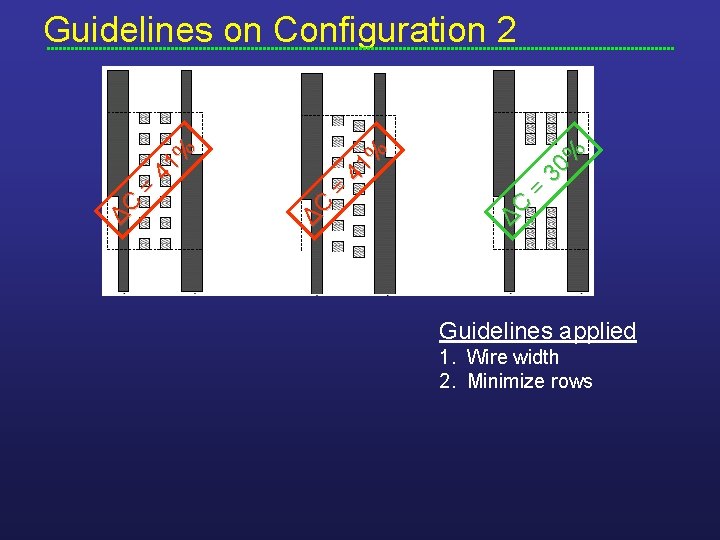
30 % ΔC = 41 % = ΔC ΔC = 41 % Guidelines on Configuration 2 Guidelines applied 1. Wire width 2. Minimize rows
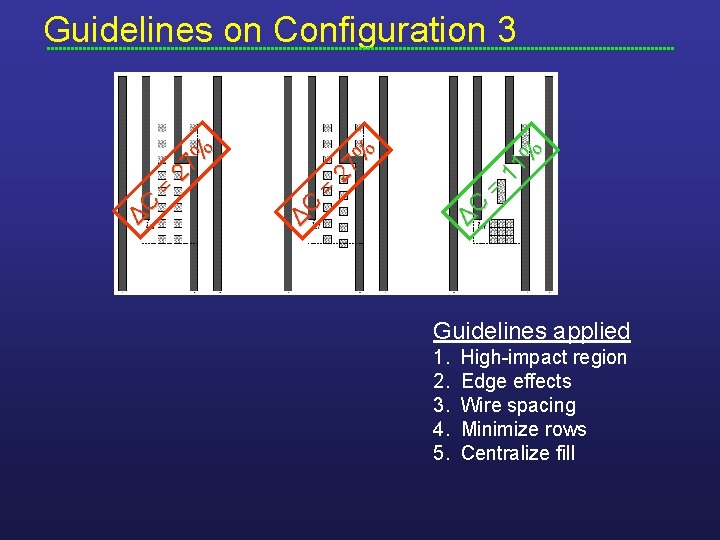
11 % 27 % Δ C = = ΔC ΔC = 27 % Guidelines on Configuration 3 Guidelines applied 1. 2. 3. 4. 5. High-impact region Edge effects Wire spacing Minimize rows Centralize fill
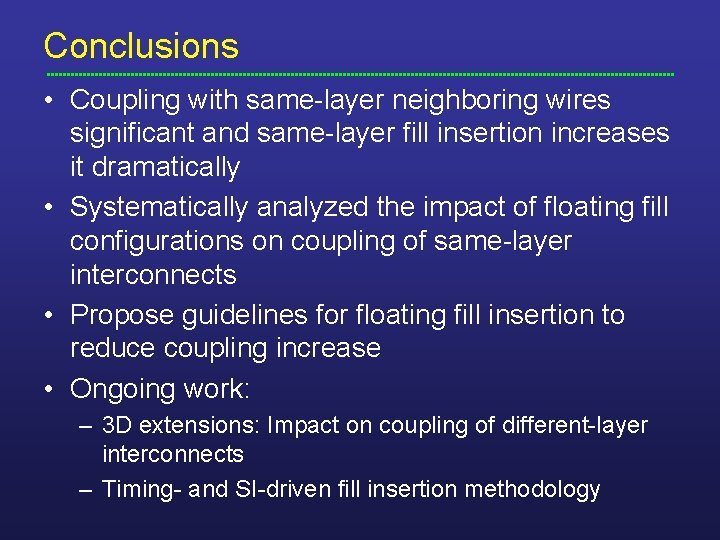
Conclusions • Coupling with same-layer neighboring wires significant and same-layer fill insertion increases it dramatically • Systematically analyzed the impact of floating fill configurations on coupling of same-layer interconnects • Propose guidelines for floating fill insertion to reduce coupling increase • Ongoing work: – 3 D extensions: Impact on coupling of different-layer interconnects – Timing- and SI-driven fill insertion methodology