
Study of Cherenkov detectors for high momentum charged

- Slides: 29
Study of Cherenkov detectors for high momentum charged particle identification in ALICE experiment at LHC Guy Paic Instituto de Ciencias Nucleares UNAM For the VHMPID group
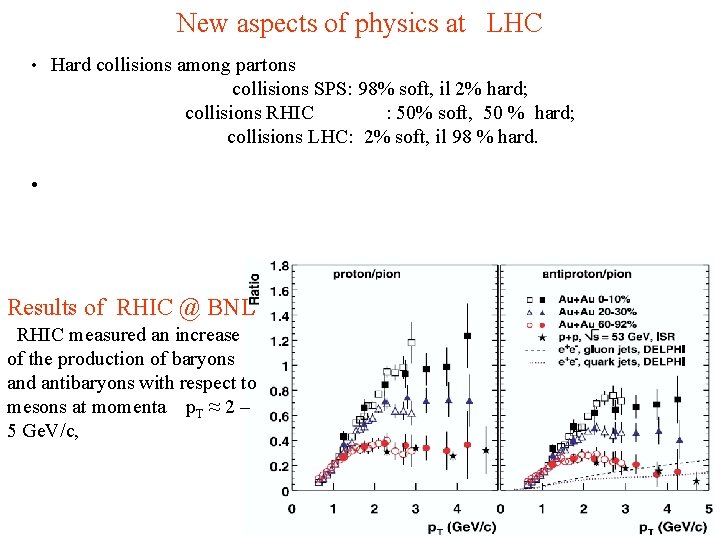
New aspects of physics at LHC • Hard collisions among partons collisions SPS: 98% soft, il 2% hard; collisions RHIC : 50% soft, 50 % hard; collisions LHC: 2% soft, il 98 % hard. • Results of RHIC @ BNL RHIC measured an increase of the production of baryons and antibaryons with respect to mesons at momenta p. T ≈ 2 – 5 Ge. V/c,
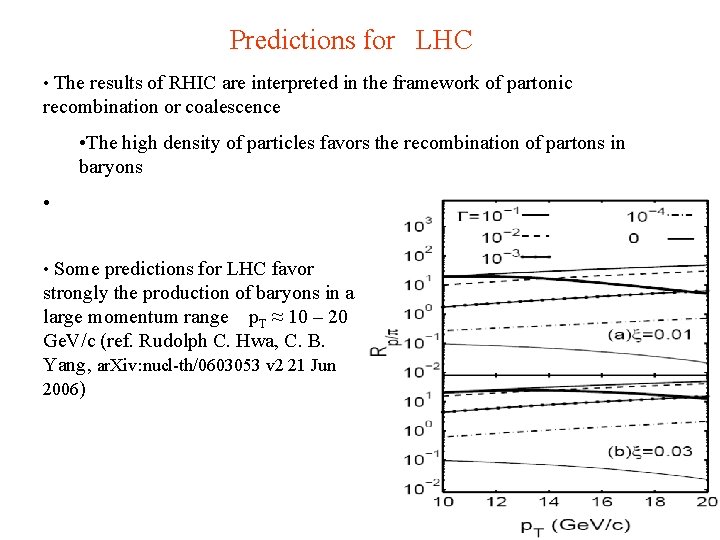
Predictions for LHC • The results of RHIC are interpreted in the framework of partonic recombination or coalescence • The high density of particles favors the recombination of partons in baryons • • Some predictions for LHC favor strongly the production of baryons in a large momentum range p. T ≈ 10 – 20 Ge. V/c (ref. Rudolph C. Hwa, C. B. Yang, ar. Xiv: nucl-th/0603053 v 2 21 Jun 2006)
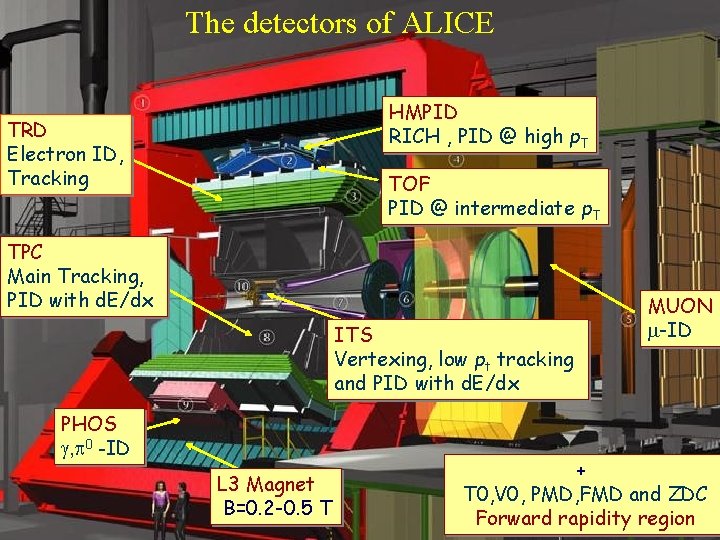
The detectors of ALICE TRD Electron ID, Tracking pioni HMPID RICH , PID @ high p. T TOF PID @ intermediate p. T TPC Main Tracking, PID with d. E/dx ITS Vertexing, low pt tracking and PID with d. E/dx PHOS g, p 0 -ID pioni L 3 Magnet B=0. 2 -0. 5 T MUON m-ID + T 0, V 0, PMD, FMD and ZDC Forward rapidity region
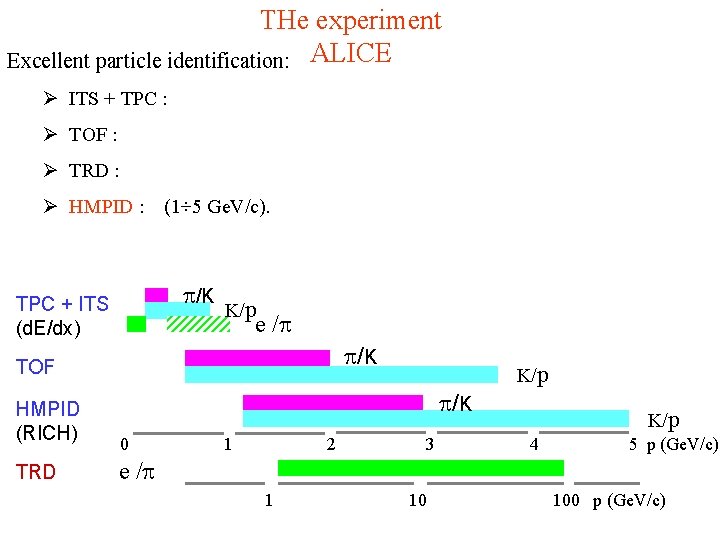
THe experiment Excellent particle identification: ALICE Ø ITS + TPC : Ø TOF : Ø TRD : Ø HMPID : (1÷ 5 Ge. V/c). p/K TPC + ITS (d. E/dx) K/p e /p p/K TOF HMPID (RICH) TRD K/p p/K 0 1 2 3 K/p 4 5 p (Ge. V/c) e /p 1 10 100 p (Ge. V/c)
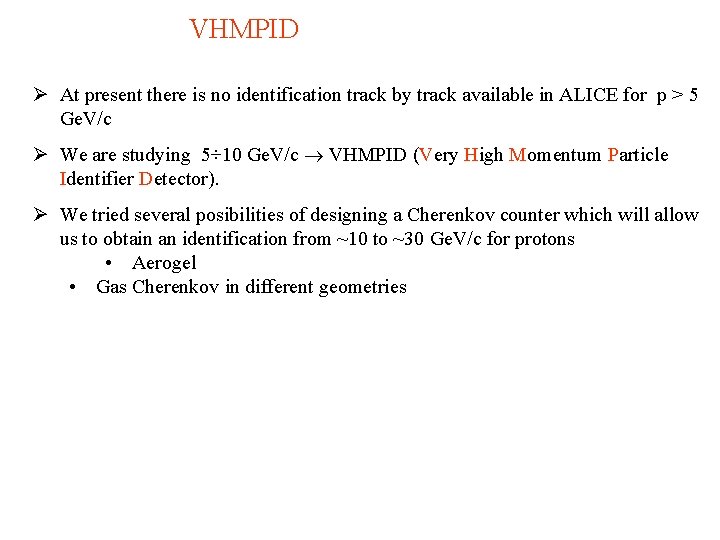
VHMPID Ø At present there is no identification track by track available in ALICE for p > 5 Ge. V/c Ø We are studying 5÷ 10 Ge. V/c VHMPID (Very High Momentum Particle Identifier Detector). Ø We tried several posibilities of designing a Cherenkov counter which will allow us to obtain an identification from ~10 to ~30 Ge. V/c for protons • Aerogel • Gas Cherenkov in different geometries
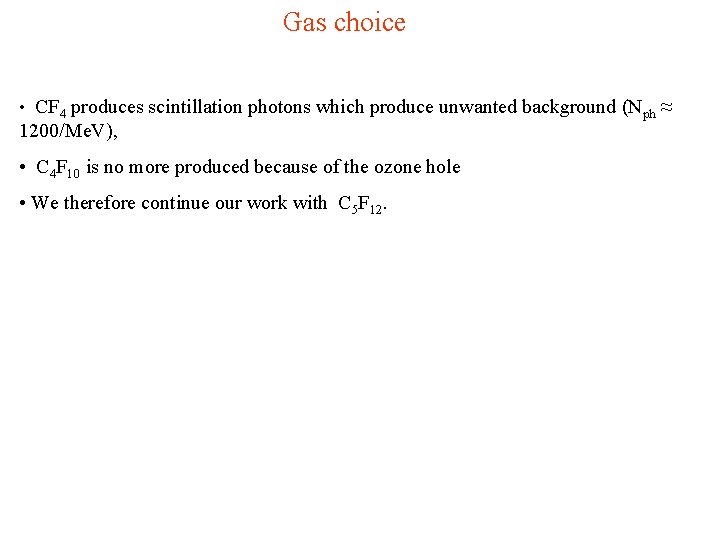
Gas choice • CF 4 produces scintillation photons which produce unwanted background (Nph ≈ 1200/Me. V), • C 4 F 10 is no more produced because of the ozone hole • We therefore continue our work with C 5 F 12.
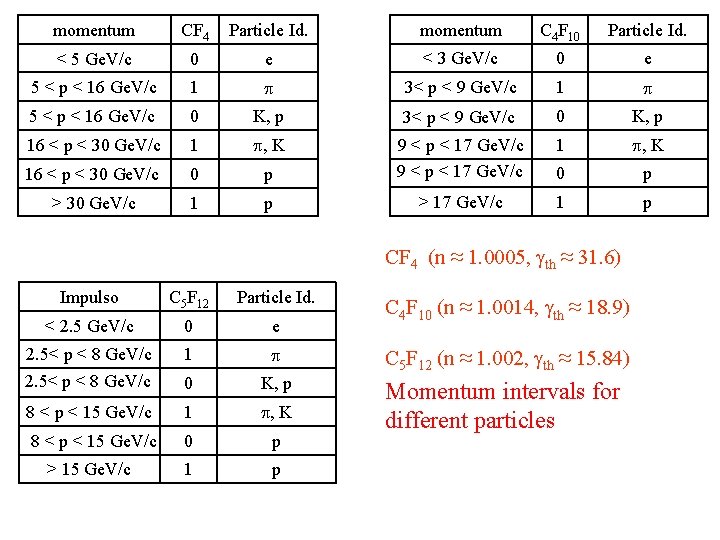
momentum CF 4 Particle Id. momentum C 4 F 10 Particle Id. < 5 Ge. V/c 0 e < 3 Ge. V/c 0 e 5 < p < 16 Ge. V/c 1 p 3< p < 9 Ge. V/c 1 p 5 < p < 16 Ge. V/c 0 K, p 3< p < 9 Ge. V/c 0 K, p 16 < p < 30 Ge. V/c 1 p, K 16 < p < 30 Ge. V/c 0 p 9 < p < 17 Ge. V/c 0 p > 30 Ge. V/c 1 p > 17 Ge. V/c 1 p CF 4 (n ≈ 1. 0005, gth ≈ 31. 6) Impulso C 5 F 12 Particle Id. < 2. 5 Ge. V/c 0 e 2. 5< p < 8 Ge. V/c 1 p C 5 F 12 (n ≈ 1. 002, gth ≈ 15. 84) 0 K, p 8 < p < 15 Ge. V/c 1 p, K 8 < p < 15 Ge. V/c 0 p Momentum intervals for different particles > 15 Ge. V/c 1 p C 4 F 10 (n ≈ 1. 0014, gth ≈ 18. 9)
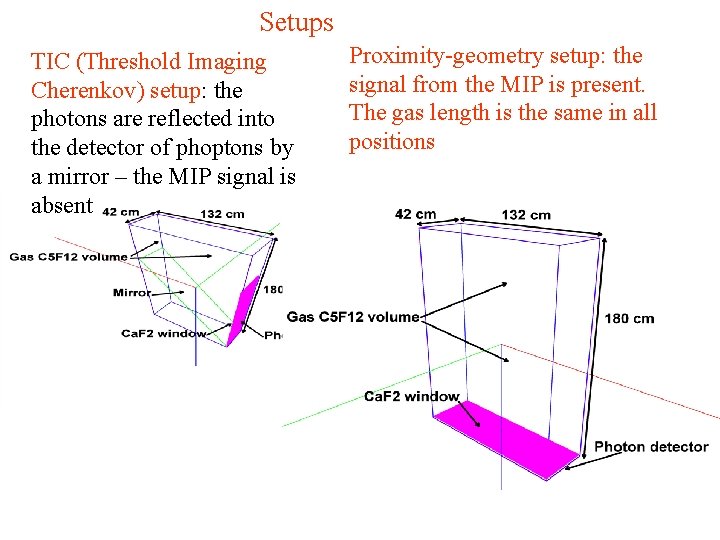
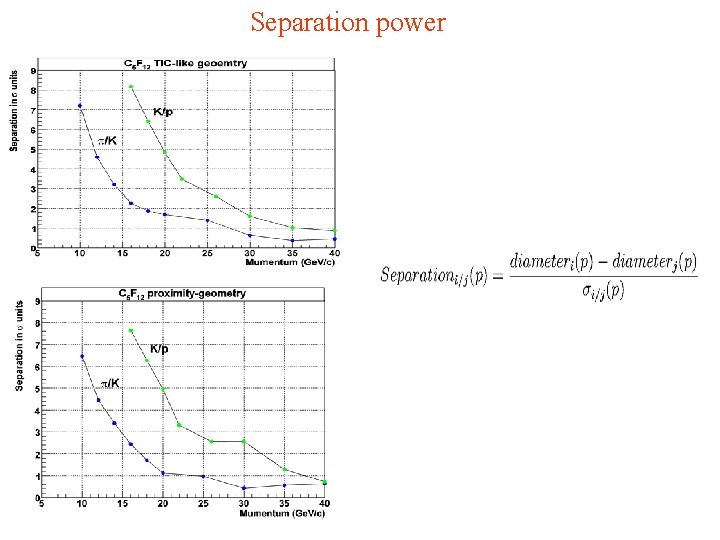
Setups TIC (Threshold Imaging Cherenkov) setup: the photons are reflected into the detector of phoptons by a mirror – the MIP signal is absent Proximity-geometry setup: the signal from the MIP is present. The gas length is the same in all positions
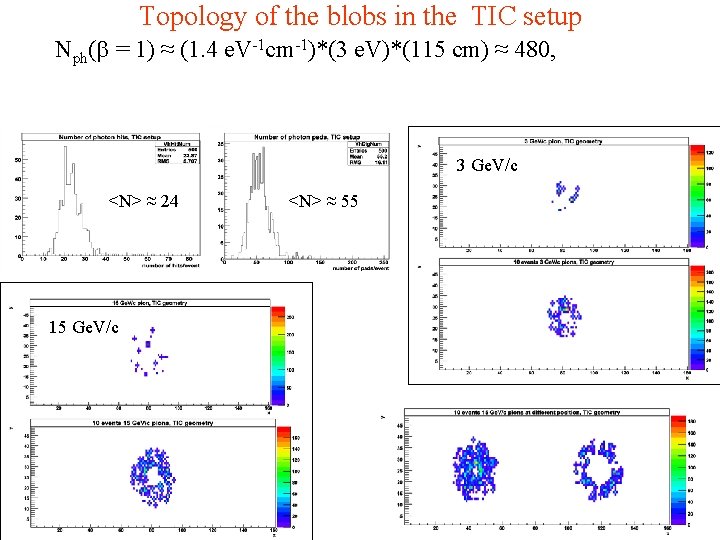
Topology of the blobs in the TIC setup Nph(b = 1) ≈ (1. 4 e. V-1 cm-1)*(3 e. V)*(115 cm) ≈ 480, 3 Ge. V/c <N> ≈ 24 15 Ge. V/c <N> ≈ 55
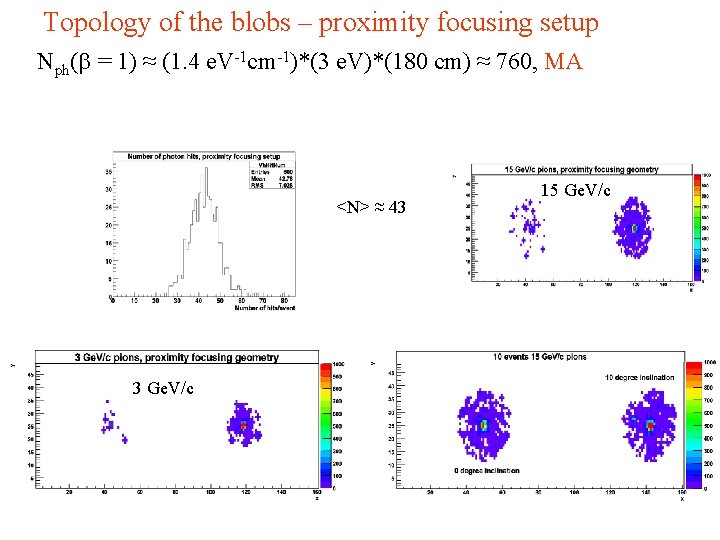
Topology of the blobs – proximity focusing setup Nph(b = 1) ≈ (1. 4 e. V-1 cm-1)*(3 e. V)*(180 cm) ≈ 760, MA <N> ≈ 43 3 Ge. V/c 15 Ge. V/c
Diameter of the photon blob A special algorithm was developed to determine the photon blob We consider that the radius R is given by the circle which contains of the pads registered.
Separation power
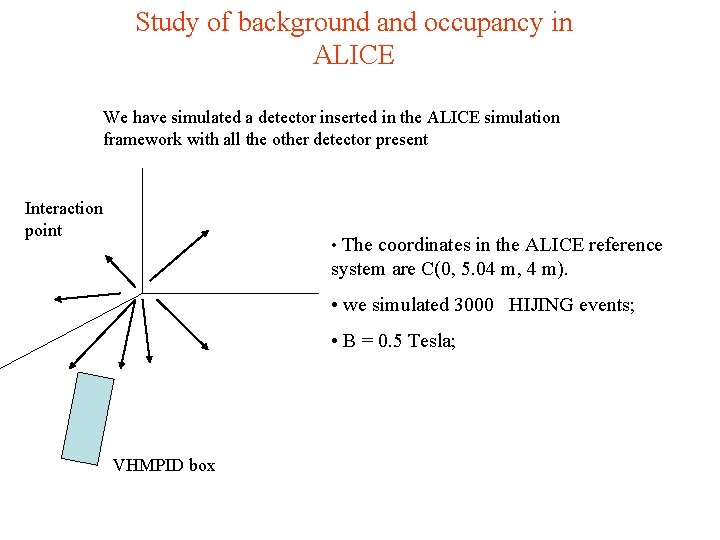
Study of background and occupancy in ALICE We have simulated a detector inserted in the ALICE simulation framework with all the other detector present Interaction point • The coordinates in the ALICE reference system are C(0, 5. 04 m, 4 m). • we simulated 3000 HIJING events; • B = 0. 5 Tesla; VHMPID box
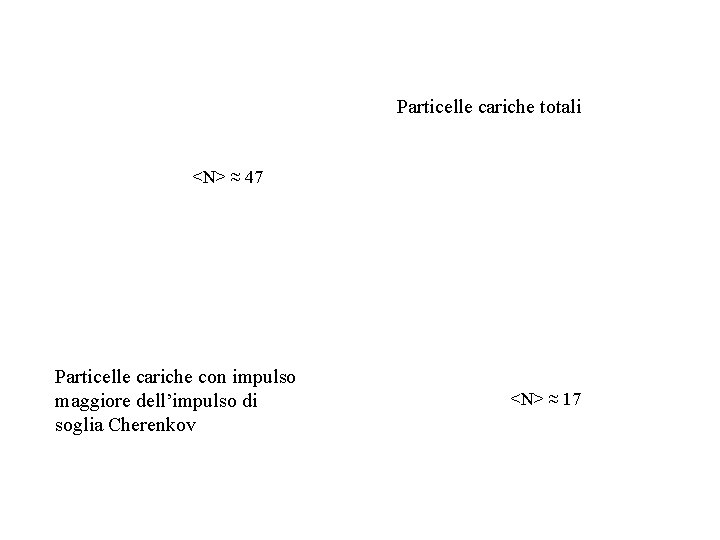
Particelle cariche totali <N> ≈ 47 Particelle cariche con impulso maggiore dell’impulso di soglia Cherenkov <N> ≈ 17
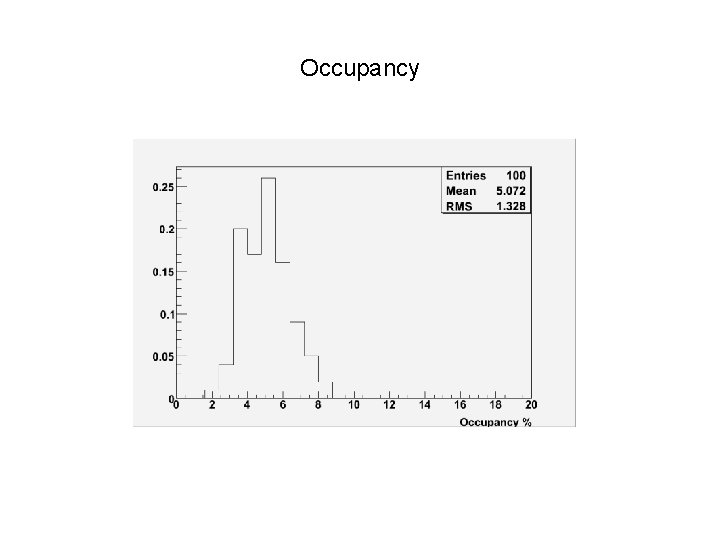
Occupancy ≈ 5. 8 %
Conclusions I We abandon the TIC geometry 1. It is difficult to build large size detectors in this geometry 2. The form of the blob depends from the point of imapact 3. the absence of the MIP signal in conditions of large background as in Pb. Pb collisions at LHC is making the tracking difficult
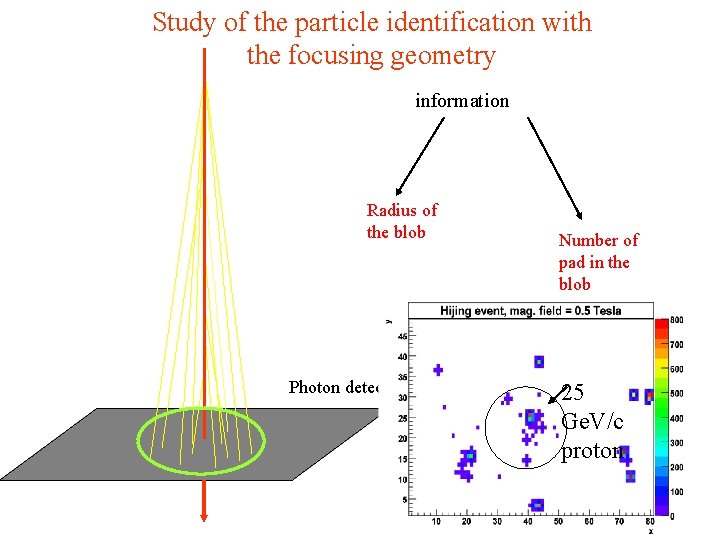
Study of the particle identification with the focusing geometry information Radius of the blob Photon detector Number of pad in the blob 25 Ge. V/c proton
ID for a single particle
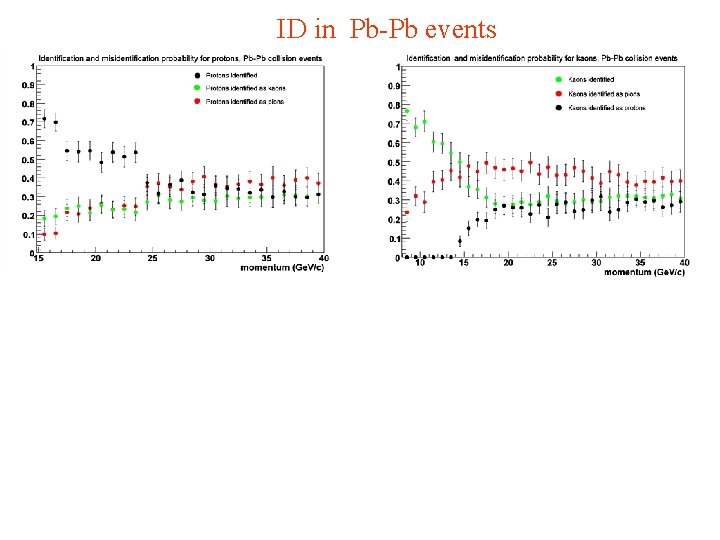
ID in Pb-Pb events
Conclusion II • The proximity focusing design is very sensitive to background and therefore difficult to identify without substantial misidentification
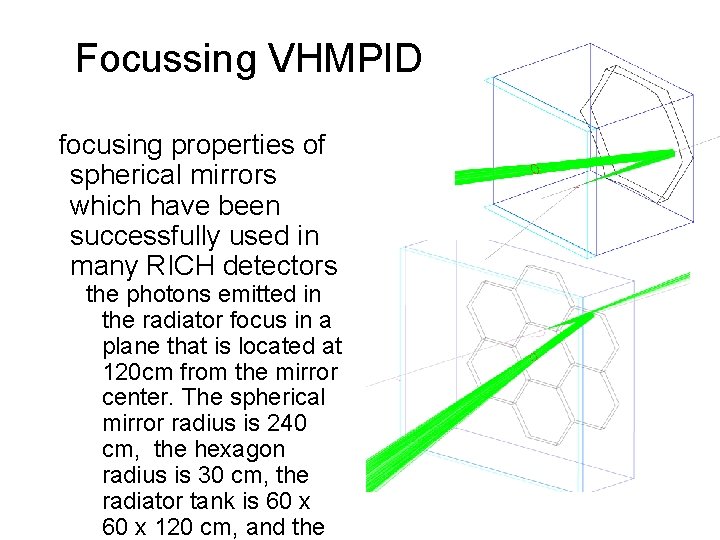
Focussing VHMPID focusing properties of spherical mirrors which have been successfully used in many RICH detectors the photons emitted in the radiator focus in a plane that is located at 120 cm from the mirror center. The spherical mirror radius is 240 cm, the hexagon radius is 30 cm, the radiator tank is 60 x 120 cm, and the
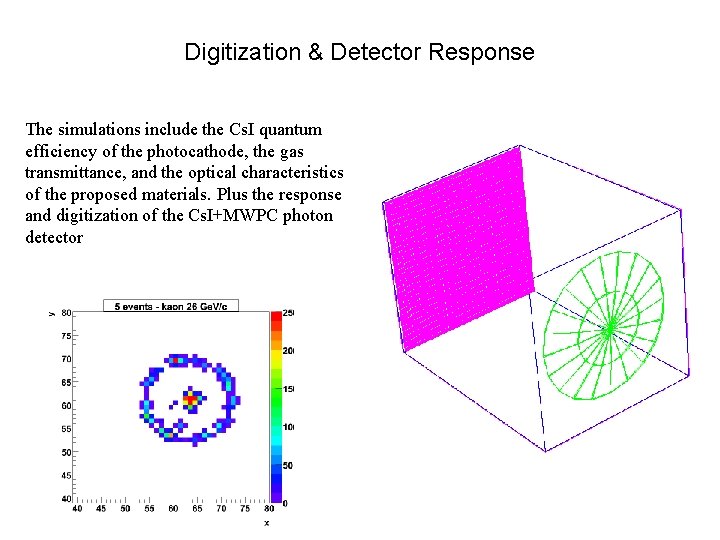
Digitization & Detector Response The simulations include the Cs. I quantum efficiency of the photocathode, the gas transmittance, and the optical characteristics of the proposed materials. Plus the response and digitization of the Cs. I+MWPC photon detector
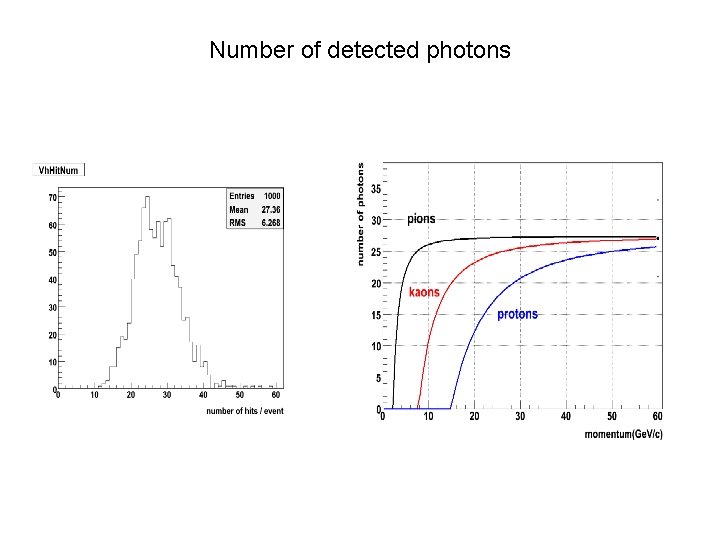
Number of detected photons
Occupancy
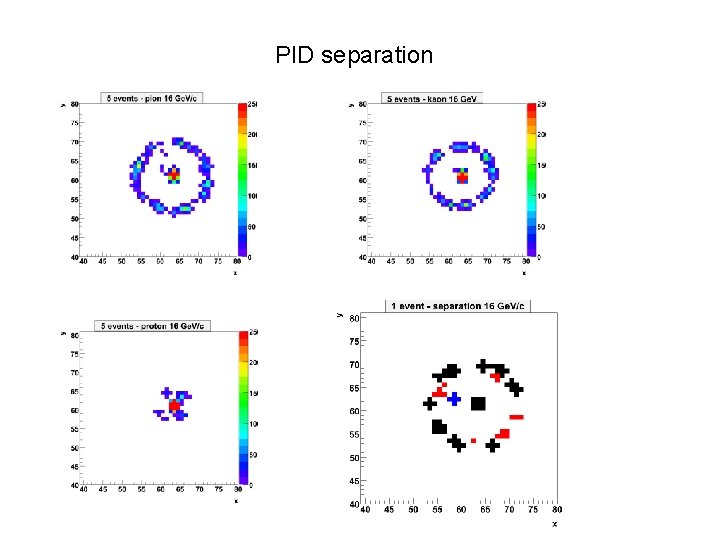
PID separation
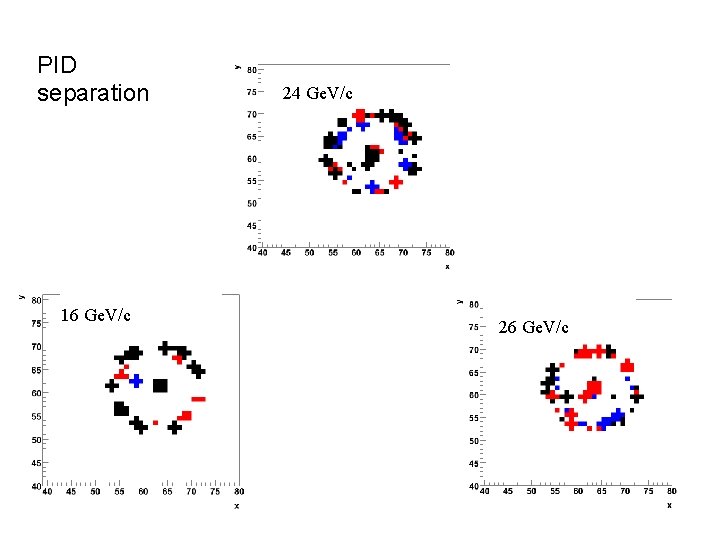
PID separation 16 Ge. V/c 24 Ge. V/c 26 Ge. V/c
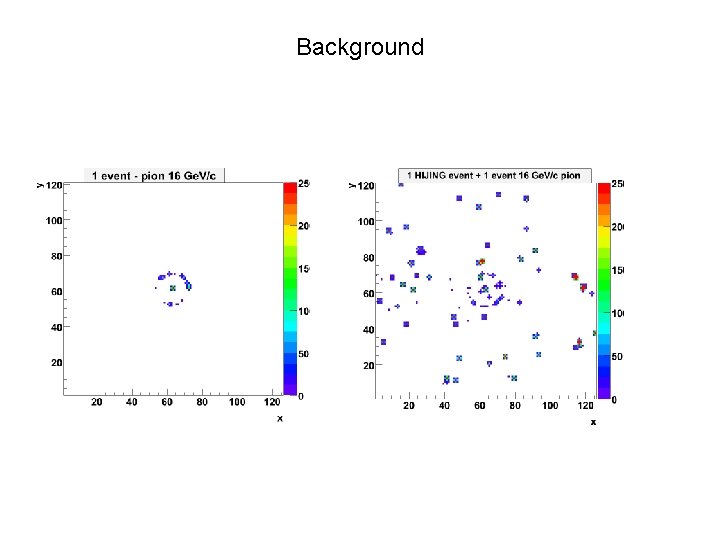
Background
Conclusions III • The focusing geometry offers a real possibility to identify the protons in a large momentum range • We are working on deatiled pattern recognition for this setup • We are working on the phton detector design and tests using gas electron multipliers (GEM)