
Study of a Cherenkov based TOF PET module
Study of a Cherenkov based TOF -PET module Samo Korpar, Rok Dolenec, Peter Križan, Rok Pestotnik, Aleš Stanovnik J. Stefan Institute, Ljubljana, University of Ljubljana and University of Maribor VCI 2013, February 11 -15, 2013 February 14, 2013 Study of a Cherenkov TOFPET module Peter Križan, Ljubljana
Contents Detection of annihilation gammas in a Cherenkov radiator for TOF-PET MCP-PMT Experimental setup Back-to-back timing resolution Reconstruction, data and MC Conclusions and summary February 14, 2013 Study of a Cherenkov TOFPET module Peter Križan, Ljubljana
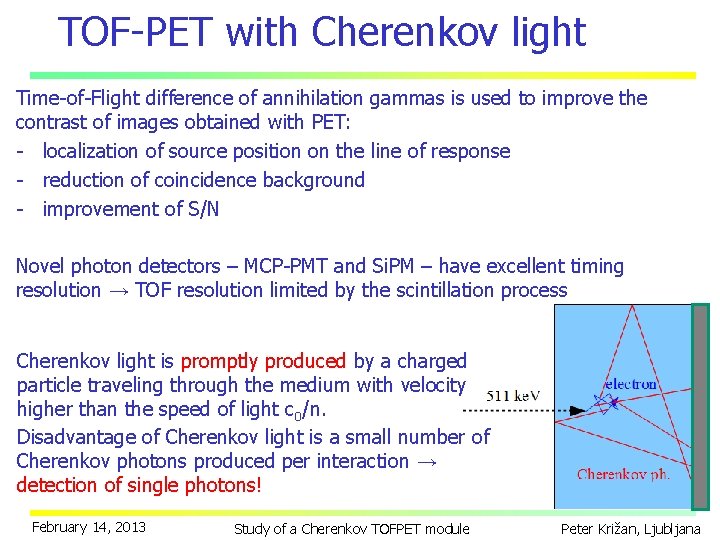
TOF-PET with Cherenkov light Time-of-Flight difference of annihilation gammas is used to improve the contrast of images obtained with PET: - localization of source position on the line of response - reduction of coincidence background - improvement of S/N Novel photon detectors – MCP-PMT and Si. PM – have excellent timing resolution → TOF resolution limited by the scintillation process Cherenkov light is promptly produced by a charged particle traveling through the medium with velocity higher than the speed of light c 0/n. Disadvantage of Cherenkov light is a small number of Cherenkov photons produced per interaction → detection of single photons! February 14, 2013 Study of a Cherenkov TOFPET module Peter Križan, Ljubljana
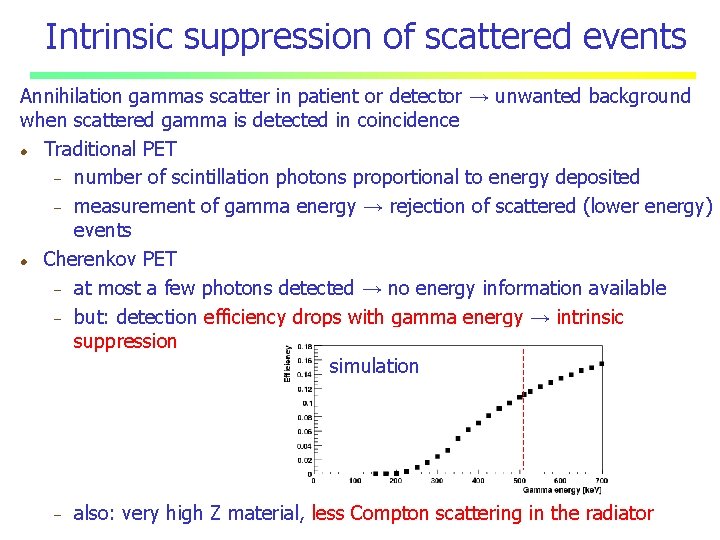
Intrinsic suppression of scattered events Annihilation gammas scatter in patient or detector → unwanted background when scattered gamma is detected in coincidence Traditional PET number of scintillation photons proportional to energy deposited measurement of gamma energy → rejection of scattered (lower energy) events Cherenkov PET at most a few photons detected → no energy information available but: detection efficiency drops with gamma energy → intrinsic suppression simulation also: very high Z material, less Compton scattering in the radiator February 14, 2013 Study of a Cherenkov TOFPET module Peter Križan, Ljubljana

Cherenkov radiator for gamma detection Requirements for the Cherenkov radiator for annihilation gammas: • High gamma stopping power • High fraction of gamma interactions via photoeffect → electrons with maximal kinetic energy → more Cherenkov photons • High enough refractive index (needs to be optimized) • High transmission for visible and near UV Cherenkov photons • Studied: Pb. F 2 and Pb. WO 4 N. B. Pb. WO 4 is also a scintillator. February 14, 2013 Study of a Cherenkov TOFPET module Peter Križan, Ljubljana
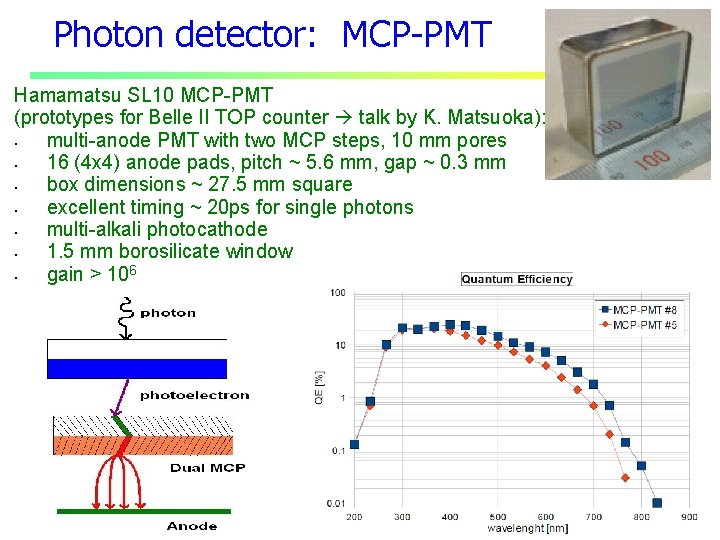
Photon detector: MCP-PMT Hamamatsu SL 10 MCP-PMT (prototypes for Belle II TOP counter talk by K. Matsuoka): • multi-anode PMT with two MCP steps, 10 mm pores • 16 (4 x 4) anode pads, pitch ~ 5. 6 mm, gap ~ 0. 3 mm • box dimensions ~ 27. 5 mm square • excellent timing ~ 20 ps for single photons • multi-alkali photocathode • 1. 5 mm borosilicate window • gain > 106 February 14, 2013 Study of a Cherenkov TOFPET module Peter Križan, Ljubljana
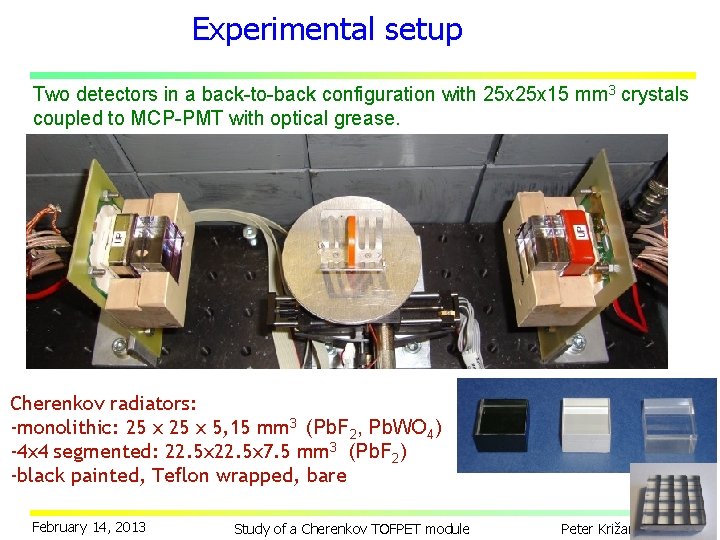
Experimental setup Two detectors in a back-to-back configuration with 25 x 15 mm 3 crystals coupled to MCP-PMT with optical grease. Cherenkov radiators: -monolithic: 25 x 5, 15 mm 3 (Pb. F 2, Pb. WO 4) -4 x 4 segmented: 22. 5 x 7. 5 mm 3 (Pb. F 2) -black painted, Teflon wrapped, bare February 14, 2013 Study of a Cherenkov TOFPET module Peter Križan, Ljubljana
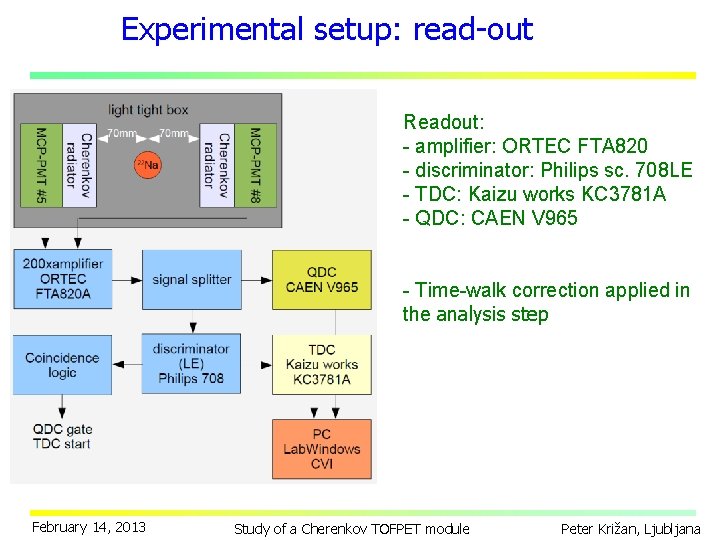
Experimental setup: read-out Readout: - amplifier: ORTEC FTA 820 - discriminator: Philips sc. 708 LE - TDC: Kaizu works KC 3781 A - QDC: CAEN V 965 - Time-walk correction applied in the analysis step February 14, 2013 Study of a Cherenkov TOFPET module Peter Križan, Ljubljana
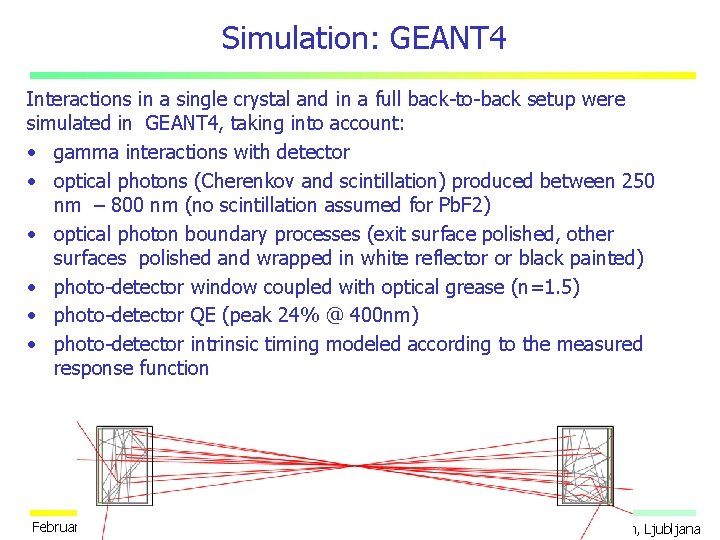
Simulation: GEANT 4 Interactions in a single crystal and in a full back-to-back setup were simulated in GEANT 4, taking into account: • gamma interactions with detector • optical photons (Cherenkov and scintillation) produced between 250 nm – 800 nm (no scintillation assumed for Pb. F 2) • optical photon boundary processes (exit surface polished, other surfaces polished and wrapped in white reflector or black painted) • photo-detector window coupled with optical grease (n=1. 5) • photo-detector QE (peak 24% @ 400 nm) • photo-detector intrinsic timing modeled according to the measured response function February 14, 2013 Study of a Cherenkov TOFPET module Peter Križan, Ljubljana
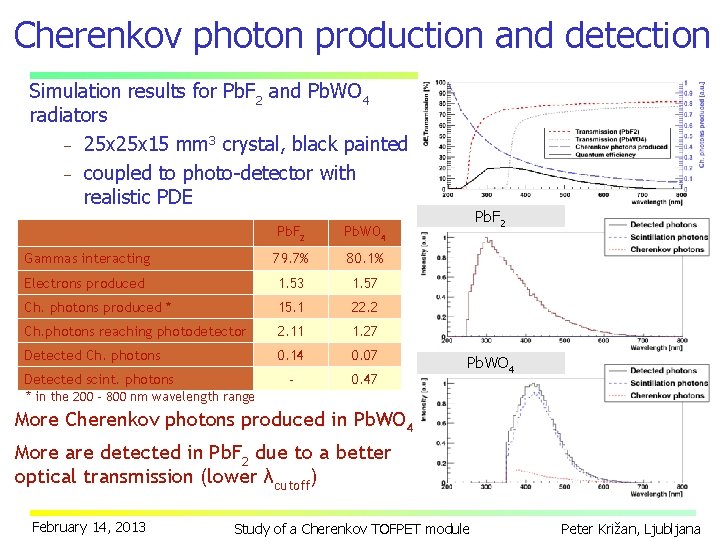
Cherenkov photon production and detection Simulation results for Pb. F 2 and Pb. WO 4 radiators 25 х25 х15 mm 3 crystal, black painted coupled to photo-detector with realistic PDE Pb. F 2 Pb. WO 4 Gammas interacting 79. 7% 80. 1% Electrons produced 1. 53 1. 57 Ch. photons produced * 15. 1 22. 2 Ch. photons reaching photodetector 2. 11 1. 27 Detected Ch. photons 0. 14 0. 07 - 0. 47 Detected scint. photons Pb. F 2 Pb. WO 4 * in the 200 - 800 nm wavelength range More Cherenkov photons produced in Pb. WO 4 More are detected in Pb. F 2 due to a better optical transmission (lower λcutoff) February 14, 2013 Study of a Cherenkov TOFPET module Peter Križan, Ljubljana
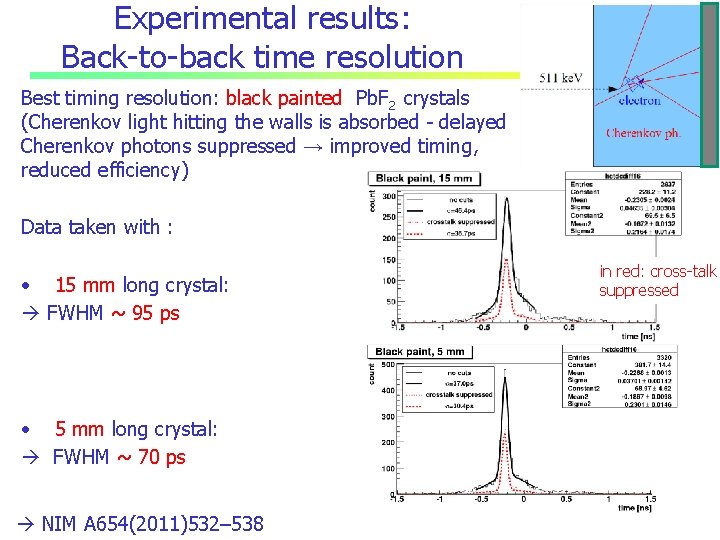
Experimental results: Back-to-back time resolution Best timing resolution: black painted Pb. F 2 crystals (Cherenkov light hitting the walls is absorbed - delayed Cherenkov photons suppressed → improved timing, reduced efficiency) Data taken with : • 15 mm long crystal: FWHM ~ 95 ps in red: cross-talk suppressed • 5 mm long crystal: FWHM ~ 70 ps February NIM A 654(2011)532– 538 14, 2013 Study of a Cherenkov TOFPET module Peter Križan, Ljubljana
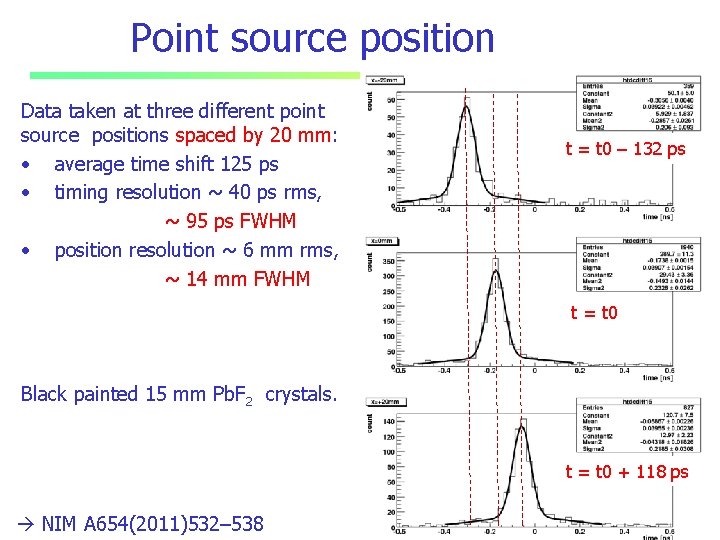
Point source position Data taken at three different point source positions spaced by 20 mm: • average time shift 125 ps • timing resolution ~ 40 ps rms, ~ 95 ps FWHM • position resolution ~ 6 mm rms, ~ 14 mm FWHM t = t 0 – 132 ps t = t 0 Black painted 15 mm Pb. F 2 crystals. t = t 0 + 118 ps February NIM A 654(2011)532– 538 14, 2013 Study of a Cherenkov TOFPET module Peter Križan, Ljubljana
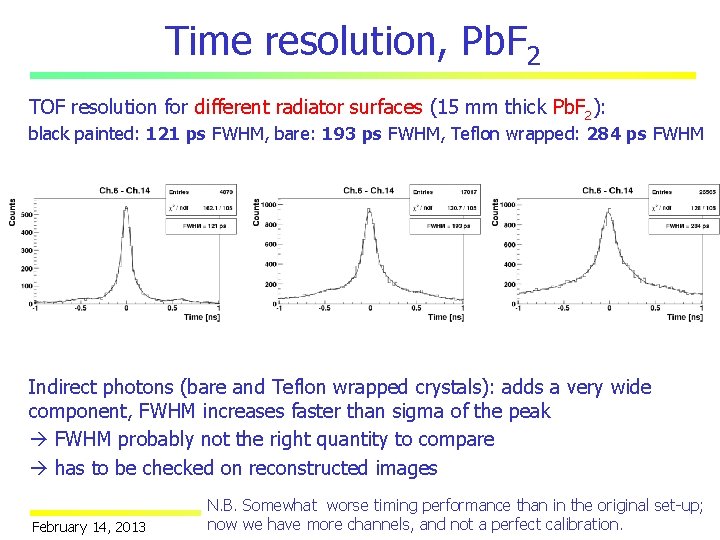
Time resolution, Pb. F 2 TOF resolution for different radiator surfaces (15 mm thick Pb. F 2): black painted: 121 ps FWHM, bare: 193 ps FWHM, Teflon wrapped: 284 ps FWHM Indirect photons (bare and Teflon wrapped crystals): adds a very wide component, FWHM increases faster than sigma of the peak FWHM probably not the right quantity to compare has to be checked on reconstructed images February 14, 2013 N. B. Somewhat worse timing performance than in the original set-up; now. Study we have more channels, not a perfect calibration. of a Cherenkov TOFPETand module Peter Križan, Ljubljana
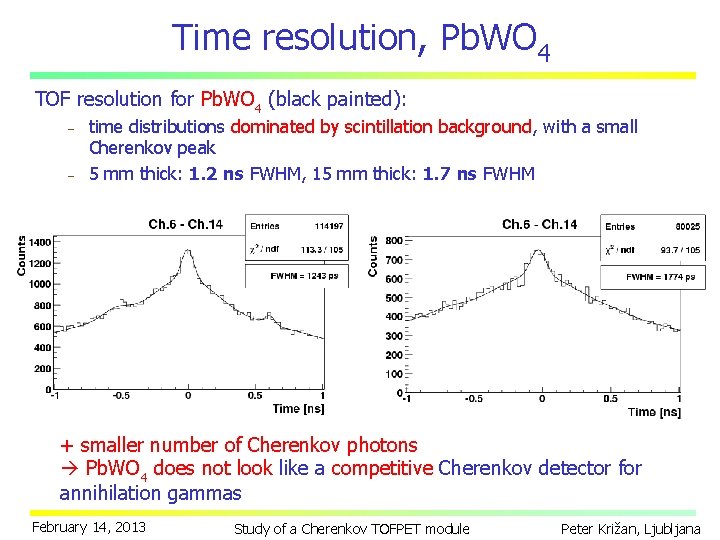
Time resolution, Pb. WO 4 TOF resolution for Pb. WO 4 (black painted): time distributions dominated by scintillation background, with a small Cherenkov peak 5 mm thick: 1. 2 ns FWHM, 15 mm thick: 1. 7 ns FWHM + smaller number of Cherenkov photons Pb. WO 4 does not look like a competitive Cherenkov detector for annihilation gammas February 14, 2013 Study of a Cherenkov TOFPET module Peter Križan, Ljubljana
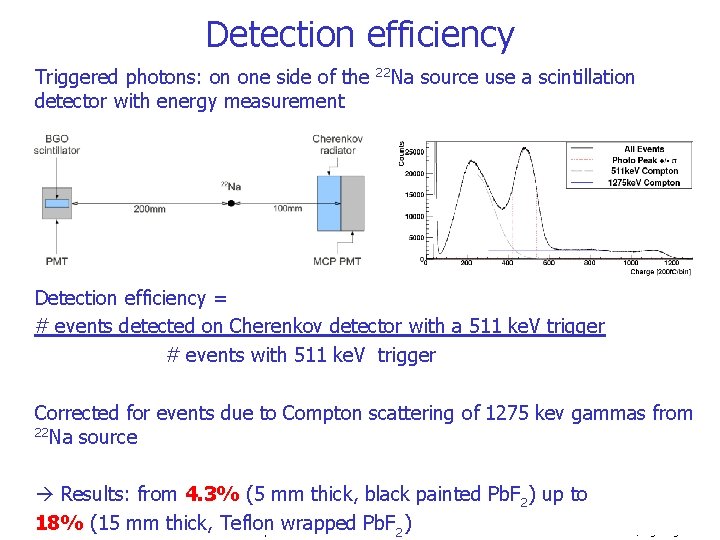
Detection efficiency Triggered photons: on one side of the detector with energy measurement 22 Na source use a scintillation Detection efficiency = # events detected on Cherenkov detector with a 511 ke. V trigger # events with 511 ke. V trigger Corrected for events due to Compton scattering of 1275 kev gammas from 22 Na source Results: from 4. 3% (5 mm thick, black painted Pb. F 2) up to 15/24 18% (15 mm thick, Teflon ) module February 14, 2013 Study ofwrapped a Cherenkov. Pb. F TOFPET Peter Križan, Ljubljana 2
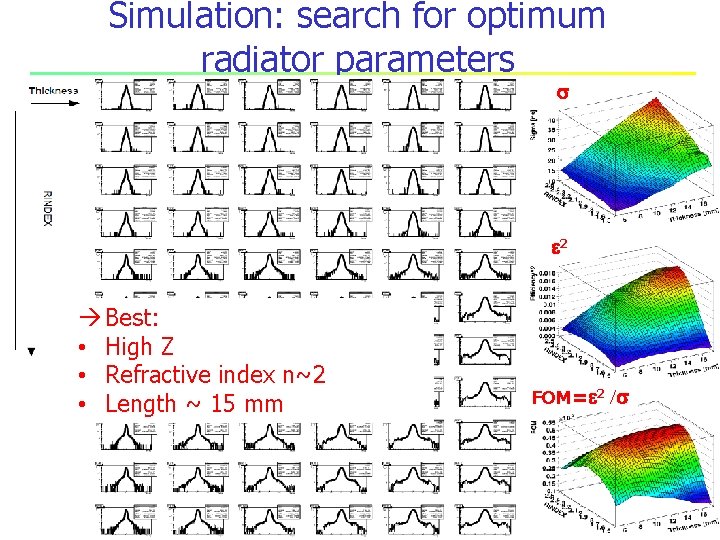
Simulation: search for optimum radiator parameters s e 2 Best: • High Z • Refractive index n~2 • Length ~ 15 mm February 14, 2013 Study of a Cherenkov TOFPET module FOM=e 2 /s Peter Križan, Ljubljana
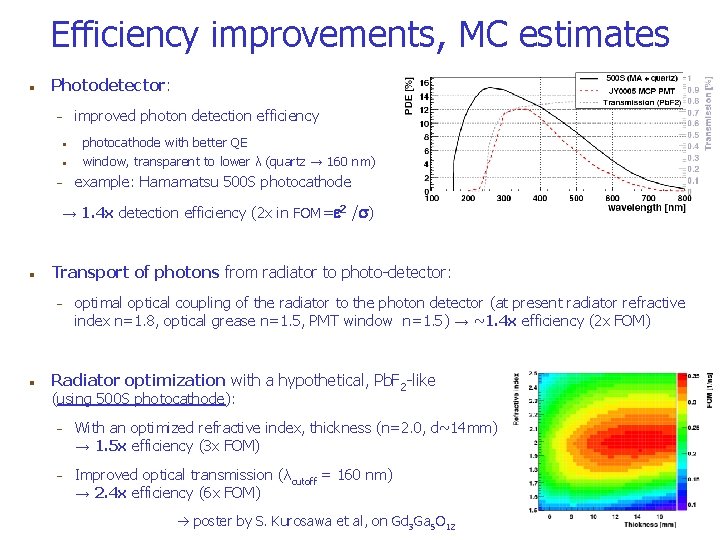
Efficiency improvements, MC estimates Photodetector: improved photon detection efficiency photocathode with better QE window, transparent to lower λ (quartz → 160 nm) example: Hamamatsu 500 S photocathode → 1. 4 x detection efficiency (2 x in FOM=e 2 /s) Transport of photons from radiator to photo-detector: optimal optical coupling of the radiator to the photon detector (at present radiator refractive index n=1. 8, optical grease n=1. 5, PMT window n=1. 5) → ~1. 4 x efficiency (2 x FOM) Radiator optimization with a hypothetical, Pb. F 2 -like (using 500 S photocathode): With an optimized refractive index, thickness (n=2. 0, d~14 mm) → 1. 5 x efficiency (3 x FOM) Improved optical transmission (λcutoff = 160 nm) → 2. 4 x efficiency (6 x FOM) February 14, 2013 poster by S. Kurosawa et al, on Gd 3 Ga 5 O 12 Study of a Cherenkov TOFPET module Peter Križan, Ljubljana
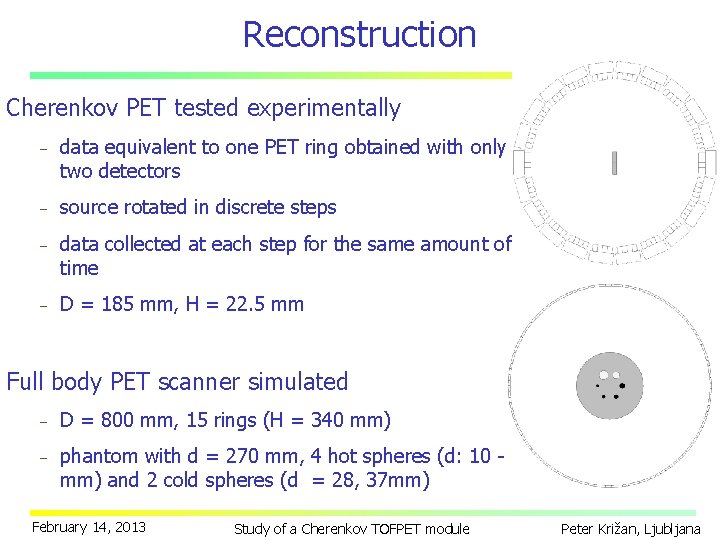
Reconstruction Cherenkov PET tested experimentally data equivalent to one PET ring obtained with only two detectors source rotated in discrete steps data collected at each step for the same amount of time D = 185 mm, H = 22. 5 mm Full body PET scanner simulated D = 800 mm, 15 rings (H = 340 mm) phantom with d = 270 mm, 4 hot spheres (d: 10 - 22 mm) and 2 cold spheres (d = 28, 37 mm) February 14, 2013 Study of a Cherenkov TOFPET module Peter Križan, Ljubljana
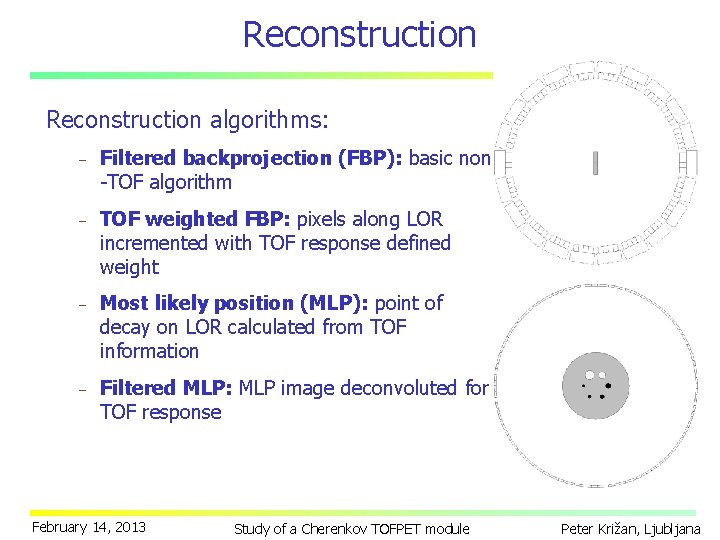
Reconstruction algorithms: Filtered backprojection (FBP): basic non -TOF algorithm TOF weighted FBP: pixels along LOR incremented with TOF response defined weight Most likely position (MLP): point of decay on LOR calculated from TOF information Filtered MLP: MLP image deconvoluted for TOF response February 14, 2013 Study of a Cherenkov TOFPET module Peter Križan, Ljubljana
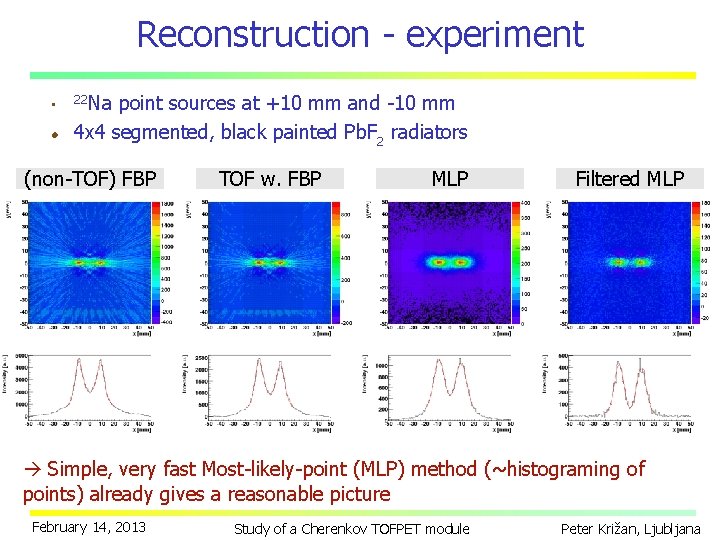
Reconstruction - experiment Na point sources at +10 mm and -10 mm 4 x 4 segmented, black painted Pb. F 2 radiators 22 (non-TOF) FBP TOF w. FBP MLP Filtered MLP Simple, very fast Most-likely-point (MLP) method (~histograming of points) already gives a reasonable picture February 14, 2013 Study of a Cherenkov TOFPET module Peter Križan, Ljubljana
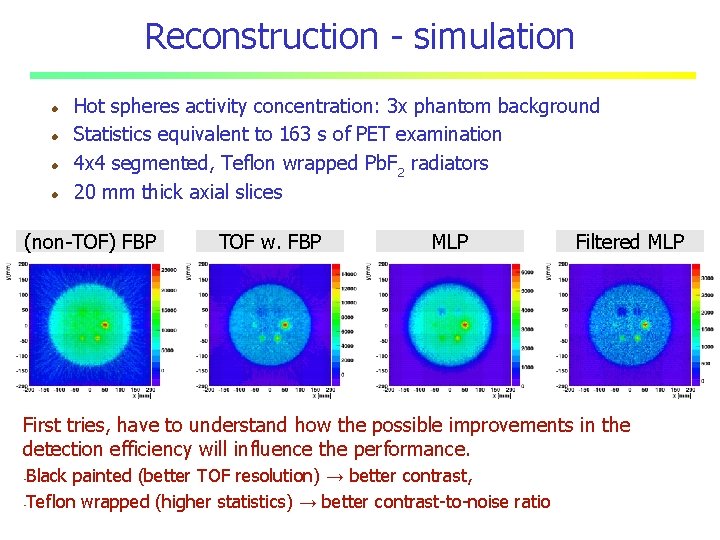
Reconstruction - simulation Hot spheres activity concentration: 3 x phantom background Statistics equivalent to 163 s of PET examination 4 x 4 segmented, Teflon wrapped Pb. F 2 radiators 20 mm thick axial slices (non-TOF) FBP TOF w. FBP MLP Filtered MLP First tries, have to understand how the possible improvements in the detection efficiency will influence the performance. Black painted (better TOF resolution) → better contrast, • Teflon wrapped (higher statistics) → better contrast-to-noise ratio • February 14, 2013 Study of a Cherenkov TOFPET module Peter Križan, Ljubljana
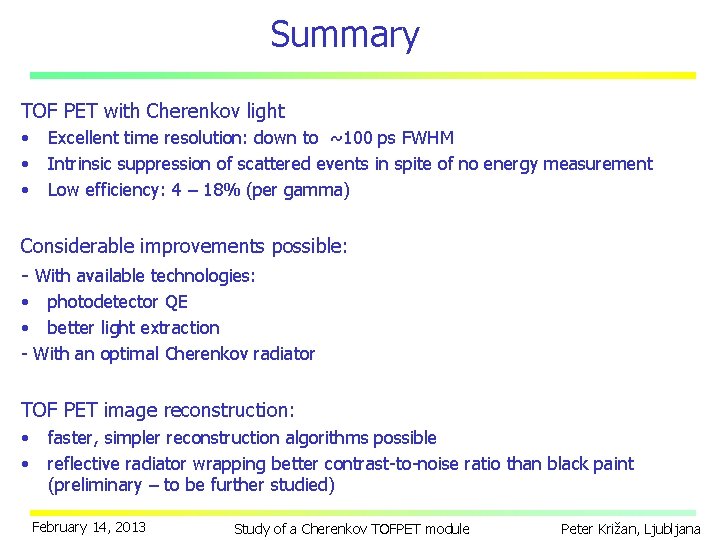
Summary TOF PET with Cherenkov light • • • Excellent time resolution: down to ~100 ps FWHM Intrinsic suppression of scattered events in spite of no energy measurement Low efficiency: 4 – 18% (per gamma) Considerable improvements possible: - With available technologies: • photodetector QE • better light extraction - With an optimal Cherenkov radiator TOF PET image reconstruction: • • faster, simpler reconstruction algorithms possible reflective radiator wrapping better contrast-to-noise ratio than black paint (preliminary – to be further studied) February 14, 2013 Study of a Cherenkov TOFPET module Peter Križan, Ljubljana
Conclusions TOF PET with Cherenkov light • Promissing method • Challenge: improve efficiency, several options quite promissing • Fast and simple reconstruction possible – potentially interesting already with the present layout With possible improvements in efficiency, Cherenkov TOF PET could become competitive (and potentially complementary because of fast reconstruction) with the traditional scintillator TOF PET February 14, 2013 Study of a Cherenkov TOFPET module Peter Križan, Ljubljana
Back-up slides February 14, 2013 Study of a Cherenkov TOFPET module Peter Križan, Ljubljana
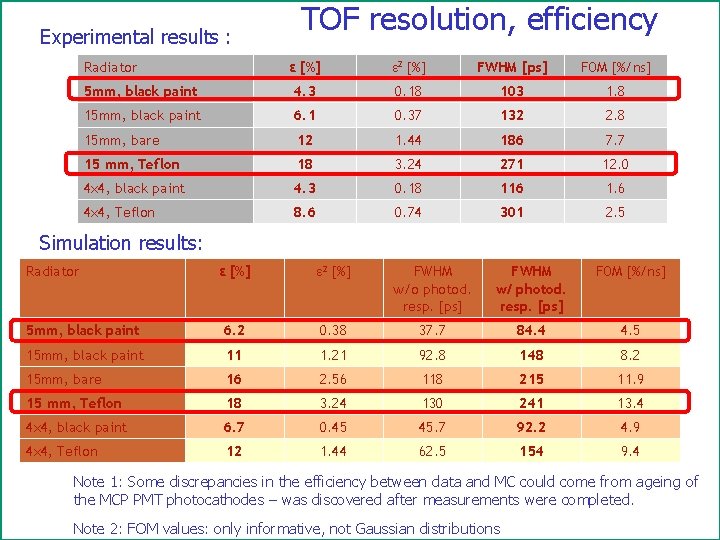
Experimental results : TOF resolution, efficiency ε [%] ε 2 [%] FWHM [ps] FOM [%/ns] 5 mm, black paint 4. 3 0. 18 103 1. 8 15 mm, black paint 6. 1 0. 37 132 2. 8 15 mm, bare 12 1. 44 186 7. 7 15 mm, Teflon 18 3. 24 271 12. 0 4 x 4, black paint 4. 3 0. 18 116 1. 6 4 x 4, Teflon 8. 6 0. 74 301 2. 5 Radiator Simulation results: ε [%] ε 2 [%] FWHM w/o photod. resp. [ps] FWHM w/ photod. resp. [ps] FOM [%/ns] 5 mm, black paint 6. 2 0. 38 37. 7 84. 4 4. 5 15 mm, black paint 11 1. 21 92. 8 148 8. 2 15 mm, bare 16 2. 56 118 215 11. 9 15 mm, Teflon 18 3. 24 130 241 13. 4 4 x 4, black paint 6. 7 0. 45 45. 7 92. 2 4. 9 4 x 4, Teflon 12 1. 44 62. 5 154 9. 4 Radiator Note 1: Some discrepancies in the efficiency between data and MC could come from ageing of the MCP PMT photocathodes – was discovered after measurements were completed. February 14, 2: 2013 of a Cherenkov TOFPETdistributions module Note FOM values: only. Study informative, not Gaussian Peter Križan, Ljubljana
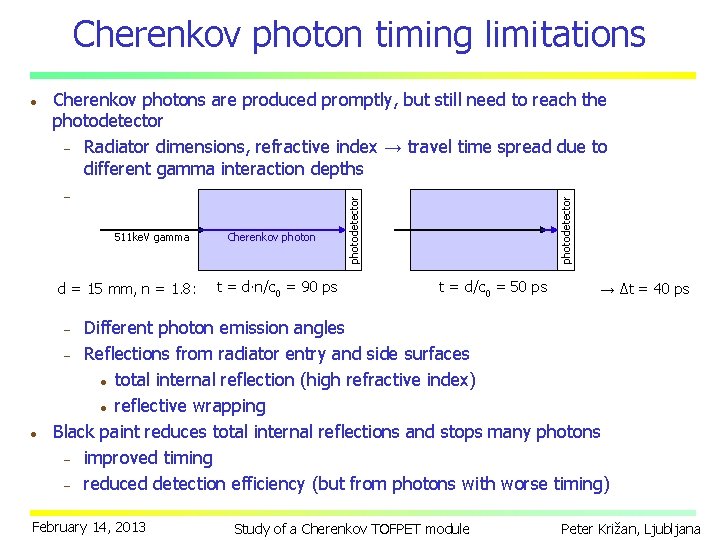
Cherenkov photon timing limitations Cherenkov photons are produced promptly, but still need to reach the photodetector Radiator dimensions, refractive index → travel time spread due to different gamma interaction depths 511 ke. V gamma d = 15 mm, n = 1. 8: Cherenkov photon t = d∙n/c 0 = 90 ps photodetector t = d/c 0 = 50 ps → ∆t = 40 ps Different photon emission angles Reflections from radiator entry and side surfaces total internal reflection (high refractive index) reflective wrapping Black paint reduces total internal reflections and stops many photons improved timing reduced detection efficiency (but from photons with worse timing) February 14, 2013 Study of a Cherenkov TOFPET module Peter Križan, Ljubljana
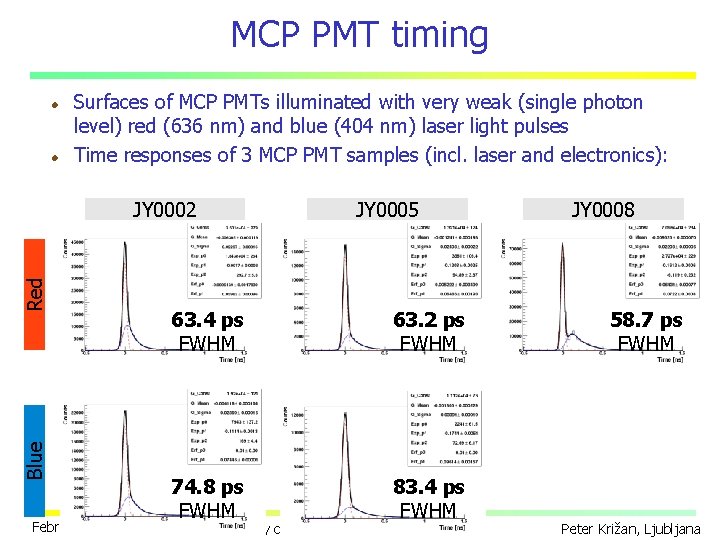
MCP PMT timing Surfaces of MCP PMTs illuminated with very weak (single photon level) red (636 nm) and blue (404 nm) laser light pulses Time responses of 3 MCP PMT samples (incl. laser and electronics): Blue Red JY 0002 February 14, 2013 JY 0005 63. 4 ps FWHM 63. 2 ps FWHM 74. 8 ps FWHM 83. 4 ps FWHM Study of a Cherenkov TOFPET module JY 0008 58. 7 ps FWHM Peter Križan, Ljubljana
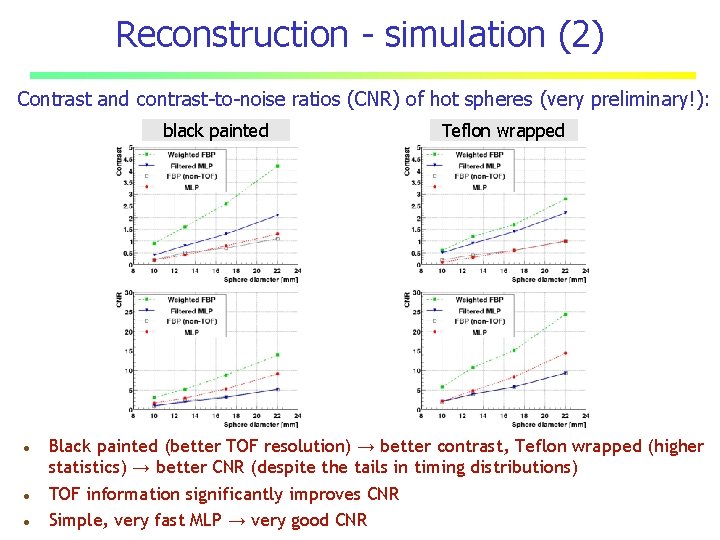
Reconstruction - simulation (2) Contrast and contrast-to-noise ratios (CNR) of hot spheres (very preliminary!): black painted Teflon wrapped Black painted (better TOF resolution) → better contrast, Teflon wrapped (higher statistics) → better CNR (despite the tails in timing distributions) TOF information significantly improves CNR Simple, very good CNR February 14, very 2013 fast MLP → Study of a Cherenkov TOFPET module Peter Križan, Ljubljana
- Slides: 28