
Study No 5 Yahweh Shalom Okanagan May 18
- Slides: 17
Study No. 5 Yahweh Shalom Okanagan, May 18, 2013 1
The work of Peace q All of Paul’s epistles begin with a reference to peace (except Hebrews) Rom. 1: 7; 1 Cor. 1: 3; 2 Cor. 1: 2; Gal. 1: 3; Eph. 1: 2; Phil. 1: 2; Col. 1: 2; 1 Thess. 1: 1; 2 Thess. 1: 2; 1 Tim. 1: 2; 2 Tim. 1: 2; Titus 1: 4; Philem. 1: 3. q Yahweh is described as a “God of Peace”: Rom. 15: 33; 16: 20; Phil. 4: 9; 1 Thess. 5: 23; 2 Thess. 3: 16 (Lord); Heb. 13: 20; (2 Cor. 13: 11) – i. e. God works to achieve peace. q Possible to claim Peace, yet it is absent: Jer. 6: 14; 8: 11; Ezek. 13: 10. Only achieved by spiritual mindedness, Rom. 8: 6. 2
The work of Peace q “seek peace”: 1 Pet. 3: 11; q q Psa. 34: 14 “live in peace”: 2 Cor. 3: 11 “Have peace with one another”: Mark 9: 50; 1 Thess. 5: 13 “Follow peace with all men”: Heb. 13: 14; 2 Tim. 2: 22 “let the peace of God rule in your hearts”: Col. 3: 15 q Isaiah 32: 17: Peace follows Righteousness, one is the consequence of the other. q James 3: 18: ESV – “A harvest of righteousness is sown in peace of them that make peace” In order to reap righteousness peace must be at the heart of its pursuit 3
PEACE q Hebrew = shalom (H 7965) Peace, complete, restore – especially in covenant relationship q Greek = eire ne (G 1515) Peace, set at one again, harmony, exemption from rage. Peace No longer estranged full restoration. 4
Yahweh Shalom q Judges 6: 24 – God’s promise of WHAT He intends to achieve – “He who shall be Peace”. q Isaiah 9: 6 – God informs us WHO will achieve this – “A child is born. . . the Prince of Peace” q Isaiah 53: 5 – God reveals HOW He will achieve peace – “the chastisement of our peace was upon him”. 5
The Book of Judges q Book of Judges – one of Israel’s darkest periods in OT history q There is a recurring cycle of SIN, SUFFERING, SUPPLICATION, SALVATION – a cycle occurring six times – the number of flesh. q Judges 6: 1 – “children of Israel did evil in the sight of Yahweh” q A period when “everyman did that which was right in his own eyes” (Judges 17: 6) q A few faithful individuals, loyal to Yahweh: Othniel; Ehud; Deborah/Barak; Gideon; Jephthah; Samson. 6
Judges 6 q Verse 11: Gideon – “the hewer down” q Verse 12 – “thou mighty man of valour”. q Hebrew “Gibbor” (1368) – powerful, “by implication “warrior, translated “champion” (1 Sam. 17: 51). q Reference to near kinsman, Ruth 2: 1: Boaz, a mighty man. q Reference to Jesus, Isaiah 9: 7 – The might God (El Gibbor). 7
Yahweh Shalom q God’s purpose of securing PEACE to be achieved in two stages q FIRST, through the individual who will achieve the victory v Gideon is a representative man – “Judgment must begin at the house of God” (1 Peter 4: 17) q SECOND, the final victory over the enemy of God – the Midianites 8
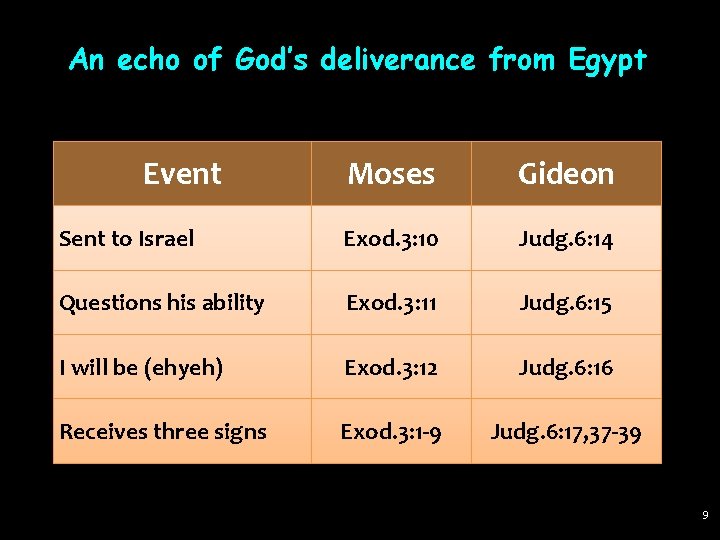
An echo of God’s deliverance from Egypt Event Moses Gideon Sent to Israel Exod. 3: 10 Judg. 6: 14 Questions his ability Exod. 3: 11 Judg. 6: 15 I will be (ehyeh) Exod. 3: 12 Judg. 6: 16 Receives three signs Exod. 3: 1 -9 Judg. 6: 17, 37 -39 9
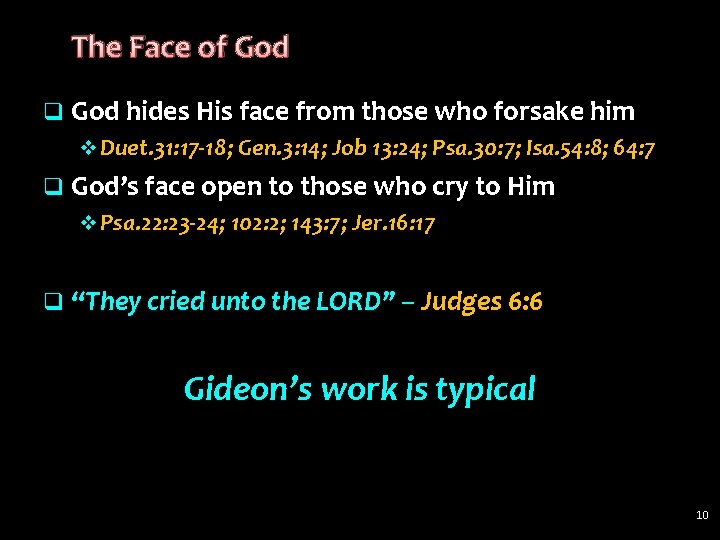
The Face of God q God hides His face from those who forsake him v Duet. 31: 17 -18; Gen. 3: 14; Job 13: 24; Psa. 30: 7; Isa. 54: 8; 64: 7 q God’s face open to those who cry to Him v Psa. 22: 23 -24; 102: 2; 143: 7; Jer. 16: 17 q “They cried unto the LORD” – Judges 6: 6 Gideon’s work is typical 10
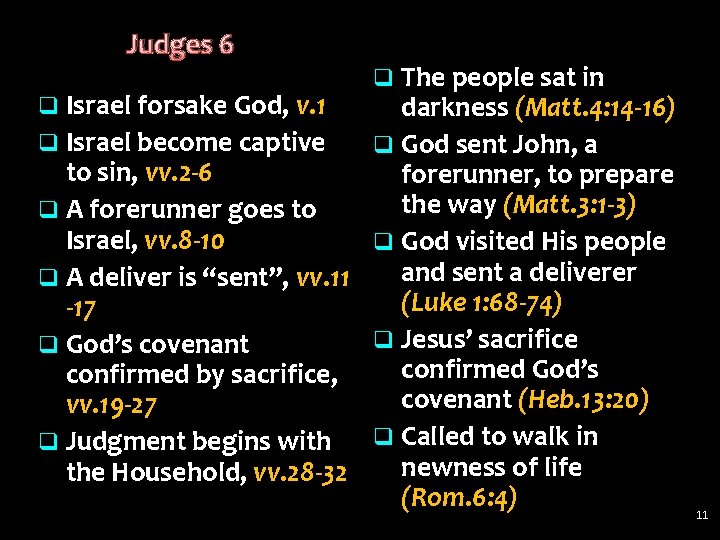
Judges 6 q Israel forsake God, v. 1 q The people sat in darkness (Matt. 4: 14 -16) q Israel become captive q God sent John, a to sin, vv. 2 -6 forerunner, to prepare the way (Matt. 3: 1 -3) q A forerunner goes to Israel, vv. 8 -10 q God visited His people and sent a deliverer q A deliver is “sent”, vv. 11 (Luke 1: 68 -74) -17 q Jesus’ sacrifice q God’s covenant confirmed God’s confirmed by sacrifice, covenant (Heb. 13: 20) vv. 19 -27 q Called to walk in q Judgment begins with newness of life the Household, vv. 28 -32 (Rom. 6: 4) 11
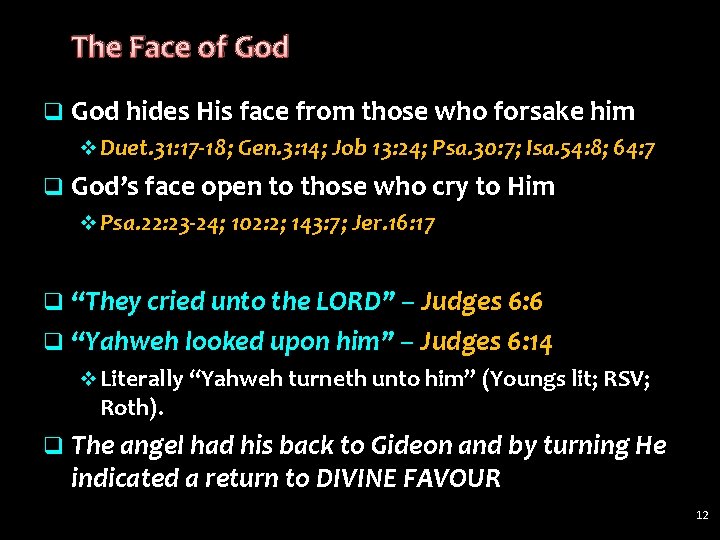
The Face of God q God hides His face from those who forsake him v Duet. 31: 17 -18; Gen. 3: 14; Job 13: 24; Psa. 30: 7; Isa. 54: 8; 64: 7 q God’s face open to those who cry to Him v Psa. 22: 23 -24; 102: 2; 143: 7; Jer. 16: 17 q “They cried unto the LORD” – Judges 6: 6 q “Yahweh looked upon him” – Judges 6: 14 v Literally “Yahweh turneth unto him” (Youngs lit; RSV; Roth). q The angel had his back to Gideon and by turning He indicated a return to DIVINE FAVOUR 12
Numbers 6 Yahweh bless thee and keep thee (verse 24) Yahweh make His face to shine upon thee (verse 25) Yahweh be gracious unto thee (verse 25) Yahweh lift up His countenance upon thee and give thee peace (verse 26) Judges 6: 12 Judges 6: 14 Judges 6: 17 Judges 6: 23 13
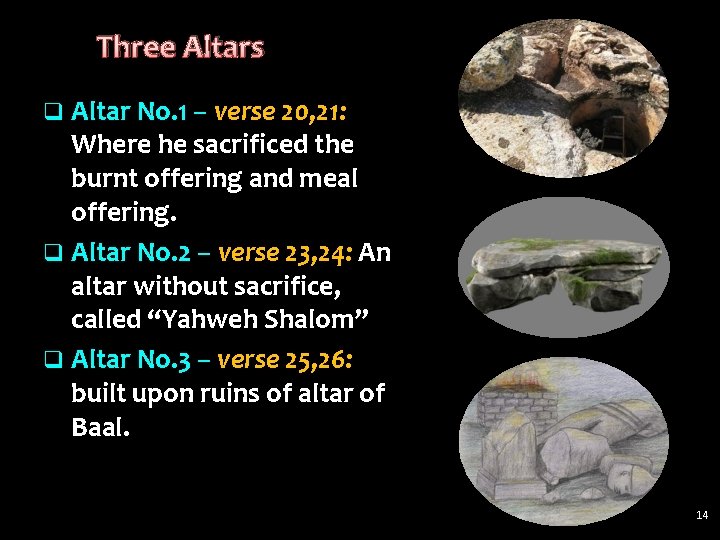
Three Altars q Altar No. 1 – verse 20, 21: Where he sacrificed the burnt offering and meal offering. q Altar No. 2 – verse 23, 24: An altar without sacrifice, called “Yahweh Shalom” q Altar No. 3 – verse 25, 26: built upon ruins of altar of Baal. 14
Altar No. 1 q Gideon provides a PRESENT Judges 6: 17, 18. A large quantity in difficult times (verse 19) q Whatever purpose was intended the kid is accepted as a burnt offering (verse 20 -21) Two different rocks described!! q 1 st Rock (v. 20) = selah (5553) denotes a lofty isolated rock. Can signify a rock split off. This is same word used in Numbers 20: 8 – speak to the rock. q 2 nd Rock (v. 21) = tsur (6697) denotes cliff or boulder. This is same word used in Exod. 17: 6 – smite the rock. q That “rock was Christ” (1 Cor. 10: 4) – Christ in his Sacrificial role and Mediator’s role. The kid is not the principle offering q “Present”: Heb. (4503) ‘minchah’ – reference to “meal offering” – CONSECRATION based upon “sincerity and truth” (1 Cor. 5: 8). q The kid for a burnt offering indicates HOW our consecration is made, through TOTAL DEDICATION 15
Altar No. 3 q Signifies the SECOND stage in overthrowing the enemy of God – verse 25 -26. Cast down the altar of Baal which dominated Israel. q Midian had re-established a grip over Israel (6: 1) q The sin of Balaam had returned (Num. 22: 4, 7; 31: 18) q There is a “way of peace”: Luke 1: 79; Rom. 3: 17. But not everyone walks in it – Isa. 48: 22; 57: 21; Rom. 3: 16 -17. Such walk in crooked paths”, Isa. 59: 8. q Israel presently in this position – Jer. 16: 5; Isa. 54: 8; Ezek. 38: 29 16
Altar No. 2 q The sacrificial altar is now followed by a memorial altar – Yahweh Shalom – “He who will be Peace”. q Sacrifice of Jesus brought PEACE – John 14: 27; Eph. 2: 13 -15 – the work of Jesus brought reconciliation between the Creator and His creation – 2 Cor. 4: 6 (face of Jesus). q Paul comments in Phil. 4: 7 – the peace of God passes all understanding (see also Eph. 3: 19 the love of Christ passes knowledge). q Isaiah 53: 4 -5 “the chastisement of our peace” q God in the pursuit of peace with His creation was willing to sacrifice His son. Rom. 4: 25 -5: 1; Col. 1: 20 17