
Study material by Prof Debasri Banerjee for Online
Study material by Prof. Debasri Banerjee for Online Platform of B. Ed Sem 2 Course-III (1. 2. 3)Unit 3 Social Constructivist Learning. Concept of Vygotsky.
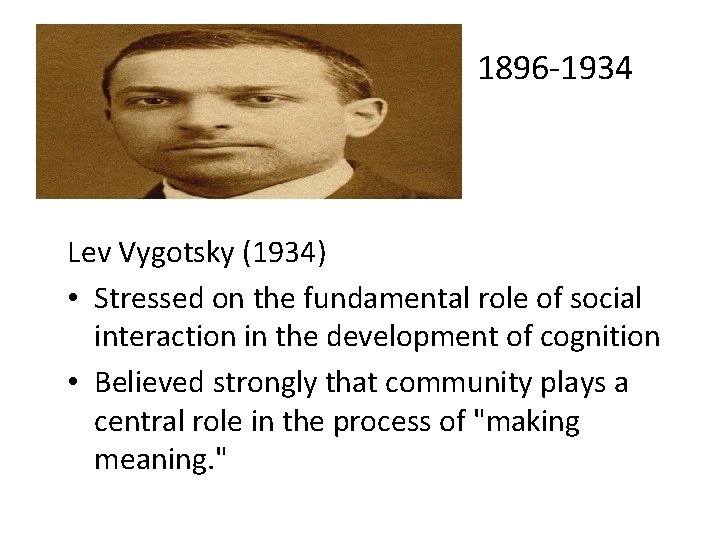
1896 -1934 Lev Vygotsky (1934) • Stressed on the fundamental role of social interaction in the development of cognition • Believed strongly that community plays a central role in the process of "making meaning. "
Sociocultural approach to cognitive development • No single principle can account for development. • Individual development cannot be understood without reference to the social and cultural context within which it is embedded. • Higher mental processes in the individual have their origin in social processes.
• Vygotsky assumes cognitive development varies across cultures • Cognitive development stems from social interactions from guided learning within the zone of proximal development as children and their partner's co-construct knowledge
• Environment in which children grow up will influence how they think and what they think about. • Thought and language are initially separate systems from the beginning of life, merging at around three years of age, producing verbal thought (inner speech). For Vygotsky, cognitive development results from an internalization of language.
Adults are an important source of cognitive development. Adults transmit their culture's tools of intellectual adaptation that children internalize.
More Knowledgeable Other • The more knowledgeable other (MKO) refers to someone who has a better understanding or a higher ability level than the learner, with respect to a particular task, process, or concept. • Although the implication is that the MKO is a teacher or an older adult, this is not necessarily the case. Many times, a child's peers or an adult's children may be the individuals with more knowledge or experience.
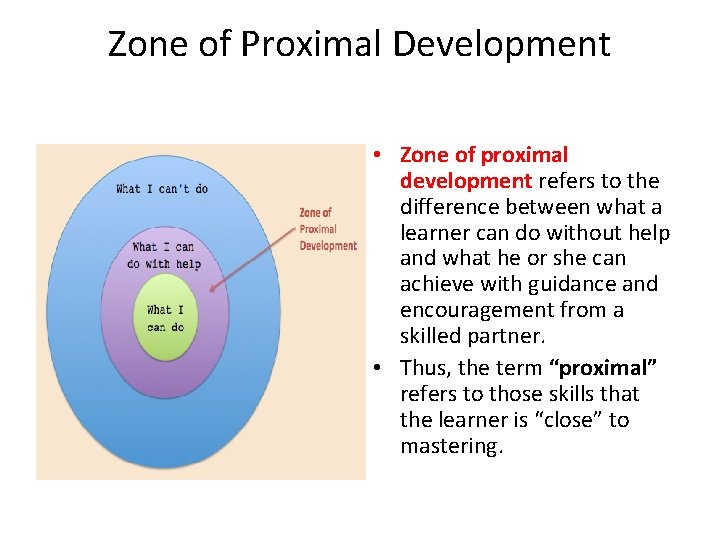
Zone of Proximal Development • Zone of proximal development refers to the difference between what a learner can do without help and what he or she can achieve with guidance and encouragement from a skilled partner. • Thus, the term “proximal” refers to those skills that the learner is “close” to mastering.
Scaffolding consists of the activities provided by the educator, or more competent peer, to support the student as he or she is led through the zone of proximal development. • Support is tapered off (i. e. withdrawn) as it becomes unnecessary. The student will then be able to complete the task again on his own
‘Elementary mental functions' o Attention o Sensation o Perception o Memory
• Through interaction within the sociocultural environment, these are developed into more sophisticated and effective mental processes/strategies -'higher mental functions. '
Important learning by the child occurs through social interaction with a skillful tutor. The tutor may model behaviors and/or provide verbal instructions for the child. Vygotsky refers to this as cooperative or collaborative dialogue. The child seeks to understand the actions or instructions provided by the tutor (often the parent or teacher) then internalizes the information, using it to guide or regulate their own performance
• Vygotsky refers to tools of intellectual adaptation - these allow children to use the basic mental functions more effectively/adaptively, and these are culturally determined (e. g. , memory mnemonics, mind maps). • Cognitive functions, even those carried out alone, are affected by the beliefs, values, and tools of intellectual adaptation of the culture in which a person develops and therefore socio-culturally determined. The tools of intellectual adaptation, therefore, vary from culture to culture
• Vygotsky and language development: 1. Preintellectual speech- elementary processes crying, cooing, babbling, bodily movements that gradually develop into speech and behaviour. 2. Social speech/naïve psychology which is external communication used to talk to others, labelling objects etc (typical from the age of two); 3. Private speech /egocentric speech (typical from the age of three) speech in which children talk, whether anyone is listening or not; 4. Silent inner speech -finally private speech goes underground, diminishing in audibility as it takes on a self-regulating function and is transformed into silent inner speech (typical from the age of seven).
Key points in Vygotsky’s theory • Social interactions are critical; knowledge is co-constructed between two or more people. • Self-regulation is developed through internalization (developing an internal representation) of actions and mental operations that occur in social interactions. • Human development occurs through the cultural transmission of tools (language, symbols). • Language is the most critical tool. Language develops from social speech, to private speech, to covert (inner) speech. • The zone of proximal development (ZPD) is the difference between what children can do on their own and what they can do with assistance from others. Interactions with adults and peers in the ZPD promote cognitive development. • Source: (Meece, 2002 cited by Schunk, 2012)
Classroom Applications • A contemporary educational application of Vygotsky's theories is "reciprocal teaching, " used to improve students' ability to learn from text. In this method, teachers and students collaborate in learning and practicing four key skills: summarizing, questioning, clarifying, and predicting. The teacher's role in the process is reduced over time.
• Also, Vygotsky is relevant to instructional concepts such as "scaffolding" and "apprenticeship, " in which a teacher or more advanced peer helps to structure or arrange a task so that a novice can work on it successfully.
• Vygotsky's theories also feed into the current interest in collaborative learning, suggesting that group members should have different levels of ability so more advanced peers can help less advanced members operate within their ZPD.
You may get support from • https: //www. instructionaldesign. org/theories/socialdevelopment/ • https: //www. simplypsychology. org/Zone-of-Proximal. Development. html • David L, "Social Development Theory (Vygotsky), " in Learning Theories, July 23, 2014, https: //www. learningtheories. com/vygotskys-social-learning-theory. html. • https: //www. learning-theories. com/vygotskys-sociallearning-theory. html • https: //youtu. be/UWmdne 1 s. JXw • Elliot, S. N, Kratochwill, T. R. , Cook, J. L. , Travers, J. F. (2000). Educational Psychology: Effective Teaching, Effective Learning. Mc Graw Hill
- Slides: 19