
STUDY GUIDE LOCOMOTOR SYSTEM MODULE FIRSTYEARMBBS 1 st
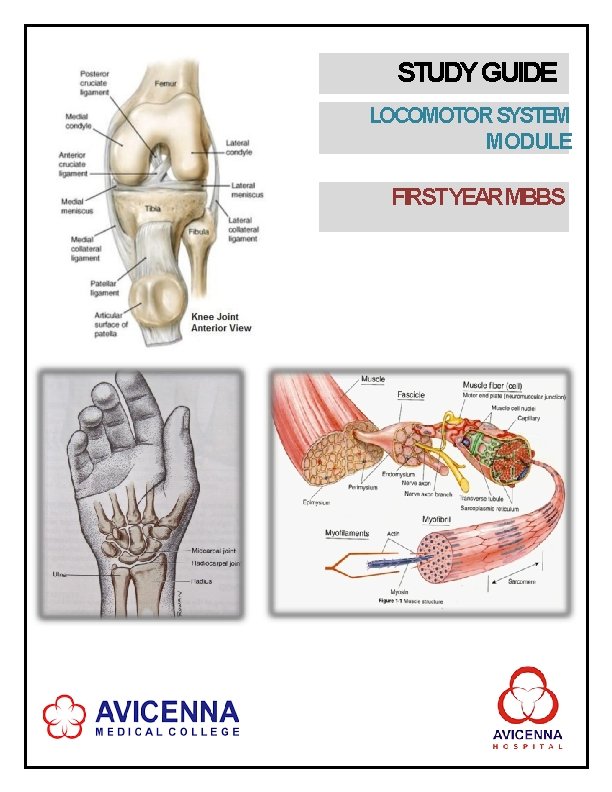
STUDY GUIDE LOCOMOTOR SYSTEM MODULE FIRSTYEARMBBS
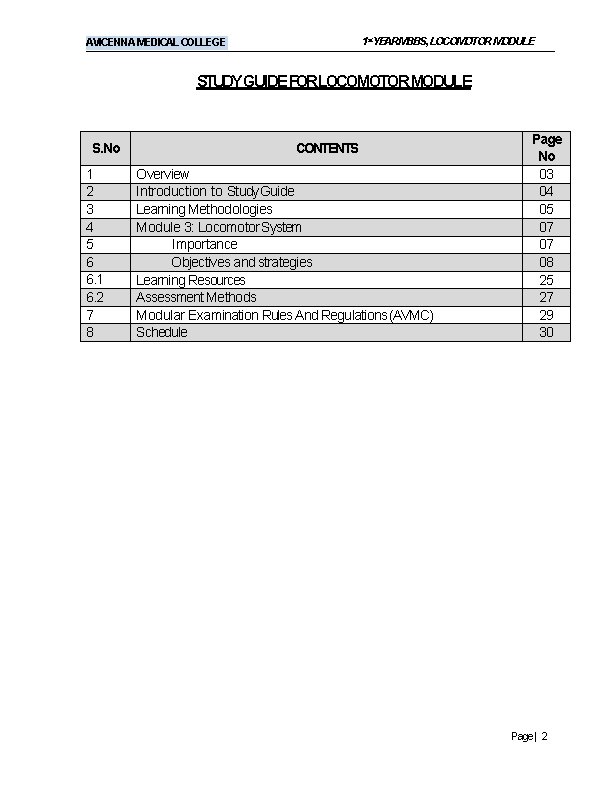
1 st. YEARMBBS, LOCOMOTOR MODULE AVICENNA MEDICAL COLLEGE STUDYGUIDE FORLOCOMOTOR MODULE S. No 1 2 3 4 5 6 6. 1 6. 2 7 8 CONTENTS Overview Introduction to Study Guide Learning Methodologies Module 3: Locomotor System Importance Objectives and strategies Learning Resources Assessment Methods Modular Examination Rules And Regulations (AVMC) Schedule Page No 03 04 05 07 07 08 25 27 29 30 Page | 2
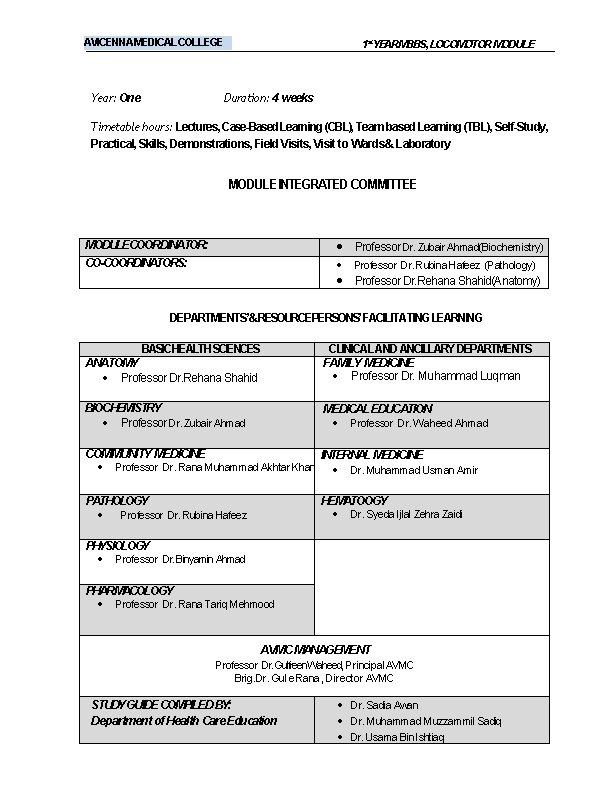
AVICENNA MEDICAL COLLEGE Year: One 1 st. YEARMBBS, LOCOMOTOR MODULE Duration: 4 weeks Timetable hours: Lectures, Case-Based Learning (CBL), Team based Learning (TBL), Self-Study, Practical, Skills, Demonstrations, Field Visits, Visit to Wards& Laboratory MODULE INTEGRATED COMMITTEE MODULECOORDINATOR: Professor Dr. Zubair Ahmad(Biochemistry) CO-COORDINATORS: Professor Dr. Rubina Hafeez (Pathology) Professor Dr. Rehana Shahid(Anatomy) DEPARTMENTS’& RESOURCEPERSONS’FACILITATINGLEARNING BASICHEALTH SCIENCES ANATOMY Professor Dr. Rehana Shahid CLINICAL AND ANCILLARY DEPARTMENTS FAMILY MEDICINE Professor Dr. Muhammad Luqman BIOCHEMISTRY Professor Dr. Zubair Ahmad MEDICAL EDUCATION Professor Dr. Waheed Ahmad COMMUNITY MEDICINE INTERNAL MEDICINE Professor Dr. Rana Muhammad Akhtar Khan Dr. Muhammad Usman Amir PATHOLOGY Professor Dr. Rubina Hafeez HEMATOOGY Dr. Syeda Ijlal Zehra Zaidi PHYSIOLOGY Professor Dr. Binyamin Ahmad PHARMACOLOGY Professor Dr. Rana Tariq Mehmood AVMC MANAGEMENT Professor Dr. Gulfreen Waheed, Principal AVMC Brig. Dr. Gul e Rana , Director AVMC STUDYGUIDE COMPILED BY: Department of Health Care Education Dr. Sadia Awan Dr. Muhammad Muzzammil Sadiq Page | 3 Dr. Usama Bin Ishtiaq
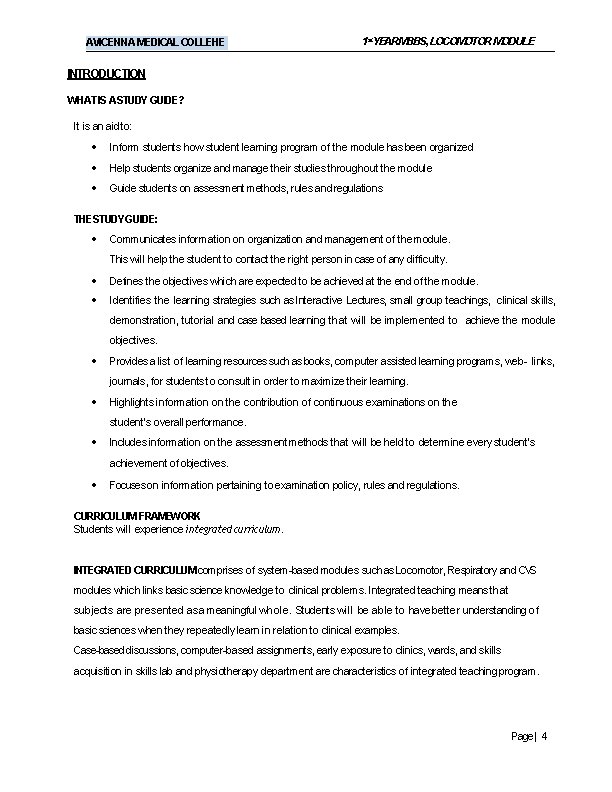
AVICENNA MEDICAL COLLEHE 1 st. YEARMBBS, LOCOMOTOR MODULE INTRODUCTION WHAT IS A STUDY GUIDE? It is an aid to: Inform students how student learning program of the module has been organized Help students organize and manage their studies throughout the module Guide students on assessment methods, rules and regulations THESTUDY GUIDE: Communicates information on organization and management of the module. This will help the student to contact the right person in case of any difficulty. Defines the objectives which are expected to be achieved at the end of the module. Identifies the learning strategies such as Interactive Lectures, small group teachings, clinical skills, demonstration, tutorial and case based learning that will be implemented to achieve the module objectives. Provides a list of learning resources such as books, computer assisted learning programs, web- links, journals, for students to consult in order to maximize their learning. Highlights information on the contribution of continuous examinations on the student’s overall performance. Includes information on the assessment methods that will be held to determine every student’s achievement of objectives. Focuses on information pertaining to examination policy, rules and regulations. CURRICULUM FRAMEWORK Students will experience integrated curriculum. INTEGRATED CURRICULUM comprises of system-based modules such as Locomotor, Respiratory and CVS modules which links basic science knowledge to clinical problems. Integrated teaching means that subjects are presented as a meaningful whole. Students will be able to have better understanding of basic sciences when they repeatedly learn in relation to clinical examples. Case-based discussions, computer-based assignments, early exposure to clinics, wards, and skills acquisition in skills lab and physiotherapy department are characteristics of integrated teaching program. Page | 4
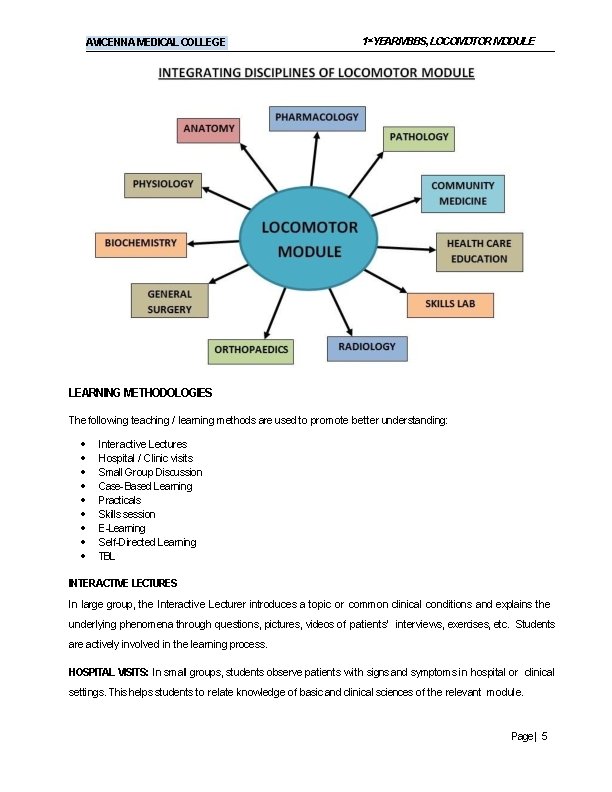
AVICENNA MEDICAL COLLEGE 1 st. YEARMBBS, LOCOMOTOR MODULE LEARNING METHODOLOGIES The following teaching / learning methods are used to promote better understanding: Interactive Lectures Hospital / Clinic visits Small Group Discussion Case- Based Learning Practicals Skills session E-Learning Self-Directed Learning TBL INTERACTIVE LECTURES In large group, the Interactive Lecturer introduces a topic or common clinical conditions and explains the underlying phenomena through questions, pictures, videos of patients’ interviews, exercises, etc. Students are actively involved in the learning process. HOSPITAL VISITS: In small groups, students observe patients with signs and symptoms in hospital or clinical settings. This helps students to relate knowledge of basic and clinical sciences of the relevant module. Page | 5
AVICENNA MEDICAL COLLEGE 1 st. YEARMBBS, LOCOMOTOR MODULE SMALL GROUP DISCUSSION (SGD): This format helps students to clarify concepts acquire skills or attitudes. Sessions are structured with the help of specific exercises such as patient case, interviews or discussion topics. Students exchange opinions and apply knowledge gained from Interactive Lectures, tutorials and self study. The facilitator role is to ask probing questions, summarize, or rephrase to help clarify concepts. CASE- BASED LEARNING: A small group discussion format where learning is focused around a series of questions based on a clinical scenario. Students’ discuss and answer the questions applying relevant knowledge gained in clinical and basic health sciences during the module. PRACTICAL: Basic science practicals related to anatomy, biochemistry, pathology, pharmacology and physiology are scheduled for student learning. SKILLS SESSION: Skills relevant to respective module are observed and practiced where applicable in skills laboratory or Department of Physiotherapy. SELFDIRECTED LEARNING: Students’ assume responsibilities of their own learning through individual study, sharing and discussing with peers, seeking information from Learning Resource Center, teachers and resource persons within and outside the college. Students can utilize the time within the college scheduled hours of self-study. TEAM BASED LEARNING: Team-based learning (TBL) is a structured form of small-group learning that emphasizes student preparation out of class and application of knowledge in class. Students are organized strategically into diverse teams of 5 -7 students that work together throughout the class. Before each session/class, students prepare by reading prior to class. In class students are given different tasks or test where they work asteam. Page | 6
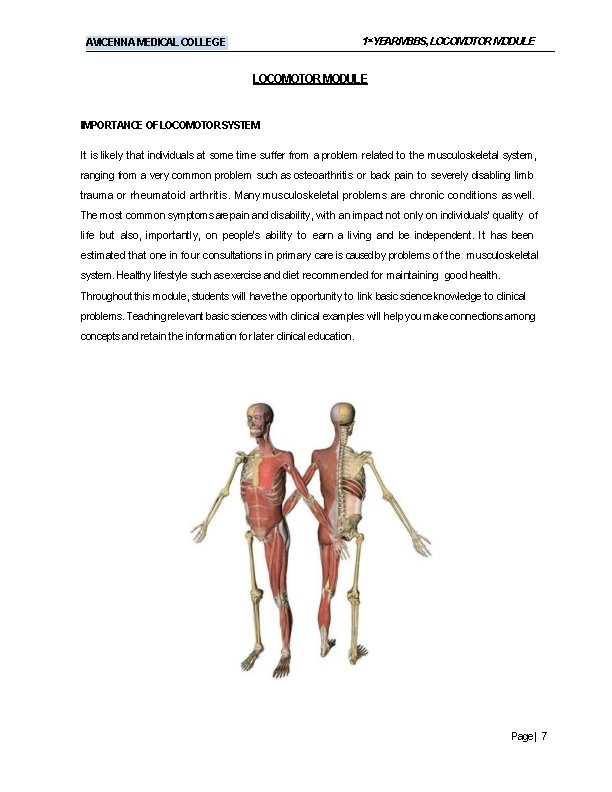
1 st. YEARMBBS, LOCOMOTOR MODULE AVICENNA MEDICAL COLLEGE LOCOMOTOR MODULE IMPORTANCE OFLOCOMOTOR SYSTEM It is likely that individuals at some time suffer from a problem related to the musculoskeletal system, ranging from a very common problem such as osteoarthritis or back pain to severely disabling limb trauma or rheumatoid arthritis. Many musculoskeletal problems are chronic conditions as well. The most common symptoms are pain and disability, with an impact not only on individuals’ quality of life but also, importantly, on people’s ability to earn a living and be independent. It has been estimated that one in four consultations in primary care is caused by problems of the musculoskeletal system. Healthy lifestyle such as exercise and diet recommended for maintaining good health. Throughout this module, students will have the opportunity to link basic science knowledge to clinical problems. Teaching relevant basic sciences with clinical examples will help you make connections among concepts and retain the information for later clinical education. Page | 7
1 st. YEARMBBS, LOCOMOTOR MODULE AVICENNAMEDICALCOLLEGE TOPICS, OBJECTIVESANDSTRATEGIES By the end of the module students will be able to: ANATOMY TOPICS & OBJECTIVES LEARNING STRATEGY (1) Introduction to the Musculoskeletal system: Discuss the division and functions of skeletal system Enumerate the parts of axial and appendicular skeleton Define pectoral and pelvic girdle Describe the division and curvature of vertebral column Discuss the types and number of vertebrae found in adults (2) Clavicle Osteology Muscle Attachment: Identify the features of bone like borders, surfaces and land marks used for side determination Discuss the attachments of muscles (3) Histology of Cartilage: Enumerate the general properties of cartilage Discuss the different types of cartilage, their properties and locations Describe the process of growth of cartilage (4) Sternoclavicular and Acromioclavicular Joints: Classify types of joint Describe the structure of joints List the muscles acting on the joint Explain the movements at the joint Explain clinical aspects of the joint Interactive Lectures/Small Group Discussion/ Demonstration (5) Scapula Osteology & Attachment: Identify the bone Identify the sites of bone Identify the bony landmarks of bone like borders, surfaces and land mark used for side determination Discuss the attachment of muscles on scapula Page | 8
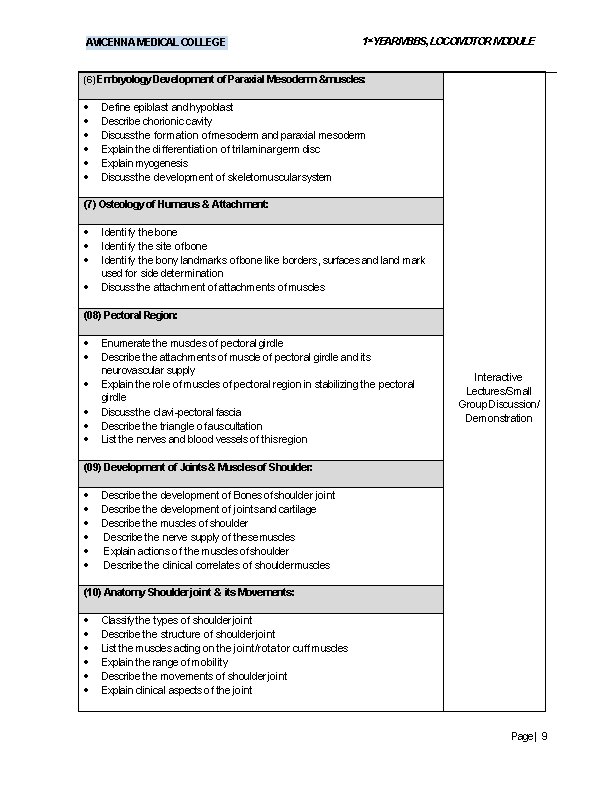
AVICENNA MEDICAL COLLEGE 1 st. YEARMBBS, LOCOMOTOR MODULE (6) Embryology Development of Paraxial Mesoderm &muscles: Define epiblast and hypoblast Describe chorionic cavity Discuss the formation of mesoderm and paraxial mesoderm Explain the differentiation of trilaminar germ disc Explain myogenesis Discuss the development of skeletomuscular system (7) Osteology of Humerus & Attachment: Identify the bone Identify the site of bone Identify the bony landmarks of bone like borders, surfaces and land mark used for side determination Discuss the attachment of attachments of muscles (08) Pectoral Region: Enumerate the muscles of pectoral girdle Describe the attachments of muscle of pectoral girdle and its neurovascular supply Explain the role of muscles of pectoral region in stabilizing the pectoral girdle Discuss the clavi-pectoral fascia Describe the triangle of auscultation List the nerves and blood vessels of this region Interactive Lectures/Small Group Discussion/ Demonstration (09) Development of Joints & Muscles of Shoulder: Describe the development of Bones of shoulder joint Describe the development of joints and cartilage Describe the muscles of shoulder Describe the nerve supply of these muscles Explain actions of the muscles of shoulder Describe the clinical correlates of shoulder muscles (10) Anatomy Shoulder joint & its Movements: Classify the types of shoulder joint Describe the structure of shoulder joint List the muscles acting on the joint/rotator cuff muscles Explain the range of mobility Describe the movements of shoulder joint Explain clinical aspects of the joint Page | 9
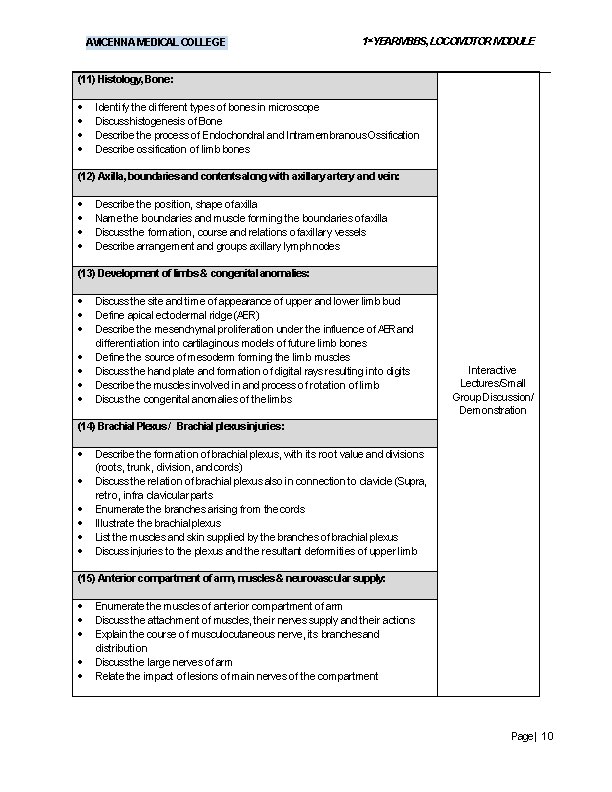
AVICENNA MEDICAL COLLEGE 1 st. YEARMBBS, LOCOMOTOR MODULE (11) Histology, Bone : Identify the different types of bones in microscope Discuss histogenesis of Bone Describe the process of Endochondral and Intramembranous Ossification Describe ossification of limb bones (12) Axilla, boundaries and contents along with axillary artery and vein: Describe the position, shape of axilla Name the boundaries and muscle forming the boundaries of axilla Discuss the formation, course and relations of axillary vessels Describe arrangement and groups axillary lymph nodes (13) Development of limbs & congenital anomalies: Discuss the site and time of appearance of upper and lower limb bud Define apical ectodermal ridge (AER) Describe the mesenchymal proliferation under the influence of AERand differentiation into cartilaginous models of future limb bones Define the source of mesoderm forming the limb muscles Discuss the hand plate and formation of digital rays resulting into digits Describe the muscles involved in and process of rotation of limb Discus the congenital anomalies of the limbs Interactive Lectures/Small Group Discussion/ Demonstration (14) Brachial Plexus / Brachial plexus injuries : Describe the formation of brachial plexus, with its root value and divisions (roots, trunk, division, and cords) Discuss the relation of brachial plexus also in connection to clavicle (Supra, retro, infra clavicular parts Enumerate the branches arising from the cords Illustrate the brachial plexus List the muscles and skin supplied by the branches of brachial plexus Discuss injuries to the plexus and the resultant deformities of upper limb (15) Anterior compartment of arm, muscles & neurovascular supply: Enumerate the muscles of anterior compartment of arm Discuss the attachment of muscles, their nerves supply and their actions Explain the course of musculocutaneous nerve, its branchesand distribution Discuss the large nerves of arm Relate the impact of lesions of main nerves of the compartment Page | 10
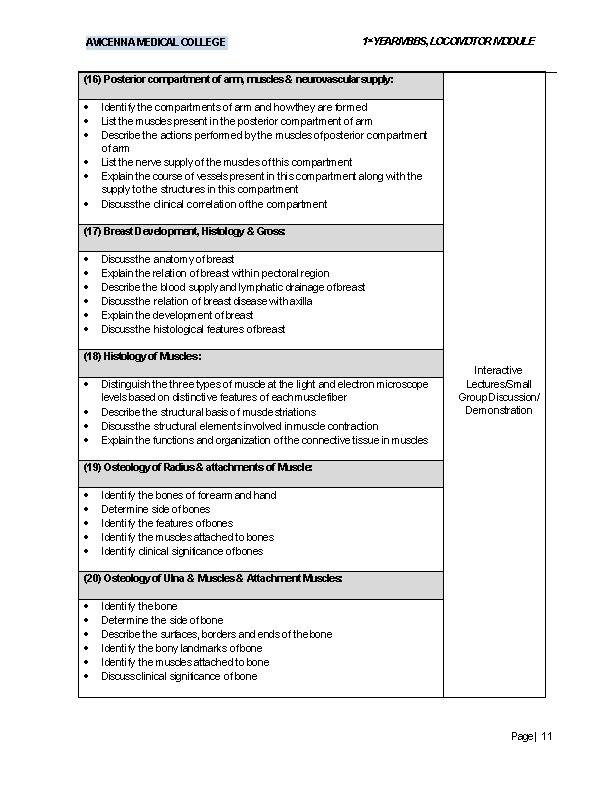
AVICENNA MEDICAL COLLEGE 1 st. YEARMBBS, LOCOMOTOR MODULE (16) Posterior compartment of arm, muscles & neurovascularsupply: Identify the compartments of arm and how they are formed List the muscles present in the posterior compartment of arm Describe the actions performed by the muscles of posterior compartment of arm List the nerve supply of the muscles of this compartment Explain the course of vessels present in this compartment along with the supply to the structures in this compartment Discuss the clinical correlation of the compartment (17) Breast Development, Histology & Gross: Discuss the anatomy of breast Explain the relation of breast within pectoral region Describe the blood supply and lymphatic drainage of breast Discuss the relation of breast disease with axilla Explain the development of breast Discuss the histological features of breast (18) Histology of Muscles : Distinguish the three types of muscle at the light and electron microscope levels based on distinctive features of each musclefiber Describe the structural basis of muscle striations Discuss the structural elements involved in muscle contraction Explain the functions and organization of the connective tissue in muscles Interactive Lectures/Small Group Discussion/ Demonstration (19) Osteology of Radius & attachments of Muscle: Identify the bones of forearm and hand Determine side of bones Identify the features of bones Identify the muscles attached to bones Identify clinical significance of bones (20) Osteology of Ulna & Muscles & Attachment Muscles: Identify the bone Determine the side of bone Describe the surfaces, borders and ends of the bone Identify the bony landmarks of bone Identify the muscles attached to bone Discuss clinical significance of bone Page | 11
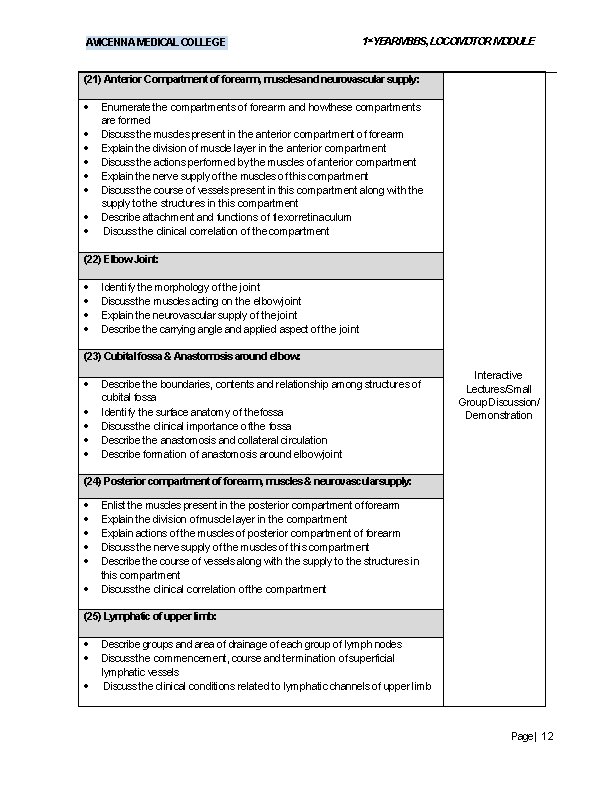
AVICENNA MEDICAL COLLEGE 1 st. YEARMBBS, LOCOMOTOR MODULE (21) Anterior Compartment of forearm, muscles and neurovascular supply: Enumerate the compartments of forearm and how these compartments are formed Discuss the muscles present in the anterior compartment of forearm Explain the division of muscle layer in the anterior compartment Discuss the actions performed by the muscles of anterior compartment Explain the nerve supply of the muscles of this compartment Discuss the course of vessels present in this compartment along with the supply to the structures in this compartment Describe attachment and functions of flexor retinaculum Discuss the clinical correlation of the compartment (22) Elbow Joint: Identify the morphology of the joint Discuss the muscles acting on the elbow joint Explain the neurovascular supply of the joint Describe the carrying angle and applied aspect of the joint (23) Cubital fossa & Anastomosis around elbow: Describe the boundaries, contents and relationship among structures of cubital fossa Identify the surface anatomy of the fossa Discuss the clinical importance of the fossa Describe the anastomosis and collateral circulation Describe formation of anastomosis around elbow joint Interactive Lectures/Small Group Discussion/ Demonstration (24) Posterior compartment of forearm, muscles & neurovascularsupply: Enlist the muscles present in the posterior compartment of forearm Explain the division of muscle layer in the compartment Explain actions of the muscles of posterior compartment of forearm Discuss the nerve supply of the muscles of this compartment Describe the course of vessels along with the supply to the structures in this compartment Discuss the clinical correlation of the compartment (25) Lymphatic of upper limb: Describe groups and area of drainage of each group of lymph nodes Discuss the commencement, course and termination of superficial lymphatic vessels Discuss the clinical conditions related to lymphatic channels of upper limb Page | 12
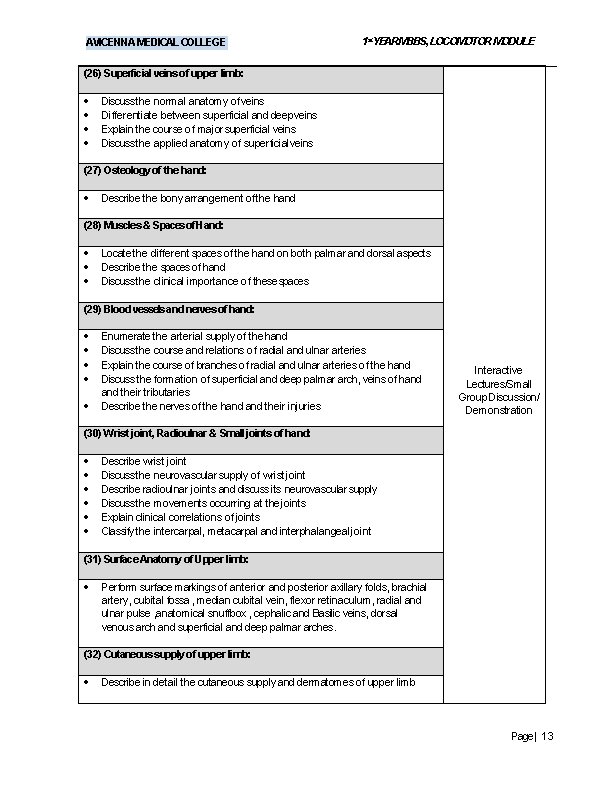
AVICENNA MEDICAL COLLEGE 1 st. YEARMBBS, LOCOMOTOR MODULE (26) Superficial veins of upper limb: Discuss the normal anatomy of veins Differentiate between superficial and deep veins Explain the course of major superficial veins Discuss the applied anatomy of superficial veins (27) Osteology of the hand: Describe the bony arrangement of the hand (28) Muscles & Spaces of Hand: Locate the different spaces of the hand on both palmar and dorsal aspects Describe the spaces of hand Discuss the clinical importance of thesespaces (29) Blood vessels and nerves of hand: Enumerate the arterial supply of the hand Discuss the course and relations of radial and ulnar arteries Explain the course of branches of radial and ulnar arteries of the hand Discuss the formation of superficial and deep palmar arch, veins of hand their tributaries Describe the nerves of the hand their injuries Interactive Lectures/Small Group Discussion/ Demonstration (30) Wrist joint, Radioulnar & Small joints of hand: Describe wrist joint Discuss the neurovascular supply of wrist joint Describe radioulnar joints and discuss its neurovascular supply Discuss the movements occurring at the joints Explain clinical correlations of joints Classify the intercarpal, metacarpal and interphalangeal joint (31) Surface Anatomy of Upper limb: Perform surface markings of anterior and posterior axillary folds, brachial artery, cubital fossa , median cubital vein, flexor retinaculum, radial and ulnar pulse , anatomical snuffbox , cephalic and Basilic veins, dorsal venous arch and superficial and deep palmar arches. (32) Cutaneous supply of upper limb: Describe in detail the cutaneous supply and dermatomes of upper limb Page | 13
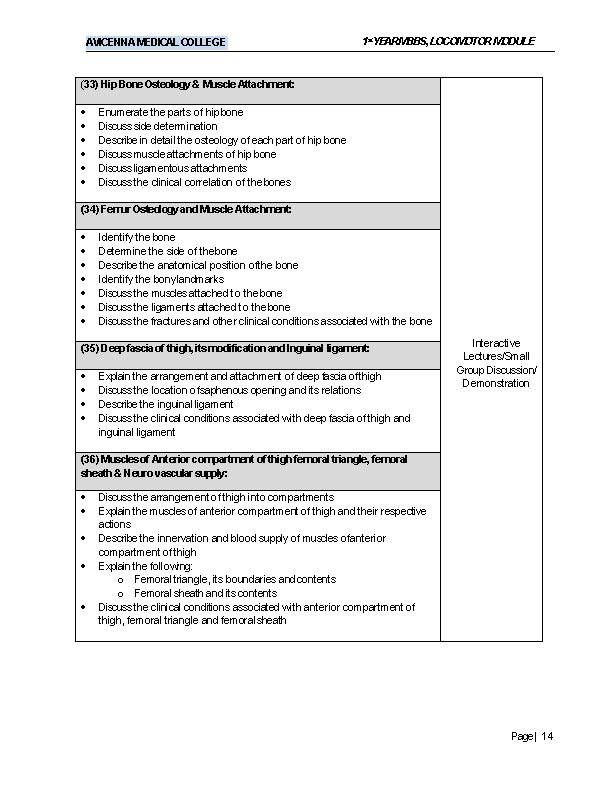
AVICENNA MEDICAL COLLEGE 1 st. YEARMBBS, LOCOMOTOR MODULE (33) Hip Bone Osteology & Muscle Attachment: Enumerate the parts of hip bone Discuss side determination Describe in detail the osteology of each part of hip bone Discuss muscle attachments of hip bone Discuss ligamentous attachments Discuss the clinical correlation of the bones (34) Femur Osteology and Muscle Attachment: Identify the bone Determine the side of the bone Describe the anatomical position of the bone Identify the bony landmarks Discuss the muscles attached to the bone Discuss the ligaments attached to the bone Discuss the fractures and other clinical conditions associated with the bone (35) Deep fascia of thigh, its modification and Inguinal ligament: Explain the arrangement and attachment of deep fascia of thigh Discuss the location of saphenous opening and its relations Describe the inguinal ligament Discuss the clinical conditions associated with deep fascia of thigh and inguinal ligament Interactive Lectures/Small Group Discussion/ Demonstration (36) Muscles of Anterior compartment of thigh femoral triangle, femoral sheath & Neuro vascular supply: Discuss the arrangement of thigh into compartments Explain the muscles of anterior compartment of thigh and their respective actions Describe the innervation and blood supply of muscles of anterior compartment of thigh Explain the following: o Femoral triangle, its boundaries and contents o Femoral sheath and its contents Discuss the clinical conditions associated with anterior compartment of thigh, femoral triangle and femoral sheath Page | 14
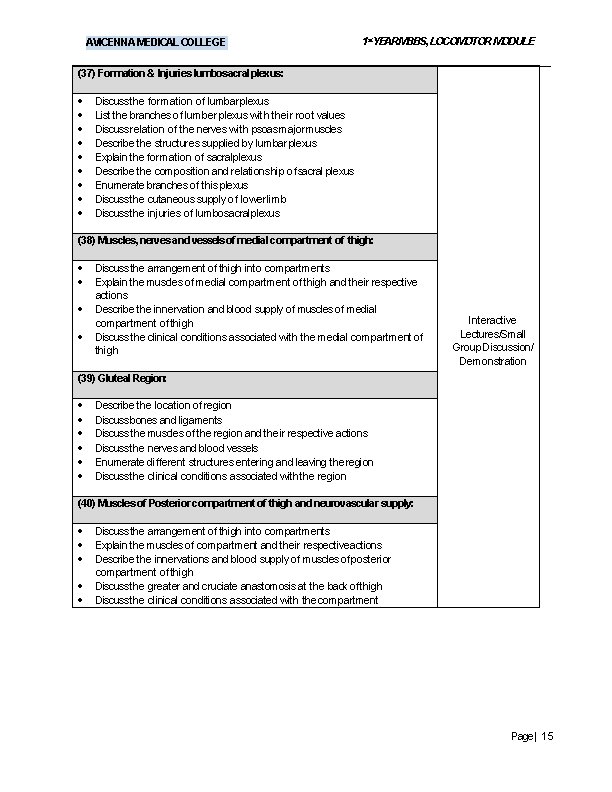
AVICENNA MEDICAL COLLEGE 1 st. YEARMBBS, LOCOMOTOR MODULE (37) Formation & Injuries lumbosacral plexus: Discuss the formation of lumbar plexus List the branches of lumber plexus with their root values Discuss relation of the nerves with psoas major muscles Describe the structures supplied by lumbar plexus Explain the formation of sacralplexus Describe the composition and relationship of sacral plexus Enumerate branches of this plexus Discuss the cutaneous supply of lower limb Discuss the injuries of lumbosacral plexus (38) Muscles, nerves and vessels of medial compartment of thigh: Discuss the arrangement of thigh into compartments Explain the muscles of medial compartment of thigh and their respective actions Describe the innervation and blood supply of muscles of medial compartment of thigh Discuss the clinical conditions associated with the medial compartment of thigh Interactive Lectures/Small Group Discussion/ Demonstration (39) Gluteal Region: Describe the location of region Discuss bones and ligaments Discuss the muscles of the region and their respective actions Discuss the nerves and blood vessels Enumerate different structures entering and leaving the region Discuss the clinical conditions associated with the region (40) Muscles of Posterior compartment of thigh and neurovascular supply: Discuss the arrangement of thigh into compartments Explain the muscles of compartment and their respectiveactions Describe the innervations and blood supply of muscles of posterior compartment of thigh Discuss the greater and cruciate anastomosis at the back of thigh Discuss the clinical conditions associated with the compartment Page | 15
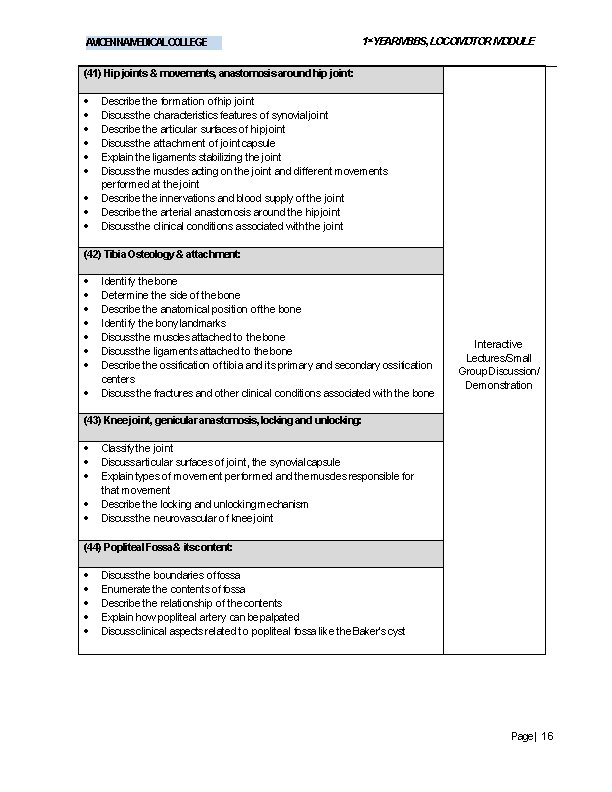
AVICENNAMEDICALCOLLEGE 1 st. YEARMBBS, LOCOMOTOR MODULE (41) Hip joints & movements, anastomosis around hip joint: Describe the formation of hip joint Discuss the characteristics features of synovial joint Describe the articular surfaces of hip joint Discuss the attachment of joint capsule Explain the ligaments stabilizing the joint Discuss the muscles acting on the joint and different movements performed at the joint Describe the innervations and blood supply of the joint Describe the arterial anastomosis around the hip joint Discuss the clinical conditions associated with the joint (42) Tibia Osteology & attachment: Identify the bone Determine the side of the bone Describe the anatomical position of the bone Identify the bony landmarks Discuss the muscles attached to the bone Discuss the ligaments attached to the bone Describe the ossification of tibia and its primary and secondary ossification centers Discuss the fractures and other clinical conditions associated with the bone Interactive Lectures/Small Group Discussion/ Demonstration (43) Knee joint, genicular anastomosis, locking and unlocking: Classify the joint Discuss articular surfaces of joint, the synovial capsule Explain types of movement performed and the muscles responsible for that movement Describe the locking and unlocking mechanism Discuss the neurovascular of knee joint (44) Popliteal Fossa & itscontent: Discuss the boundaries of fossa Enumerate the contents of fossa Describe the relationship of the contents Explain how popliteal artery can be palpated Discuss clinical aspects related to popliteal fossa like the Baker’s cyst Page | 16
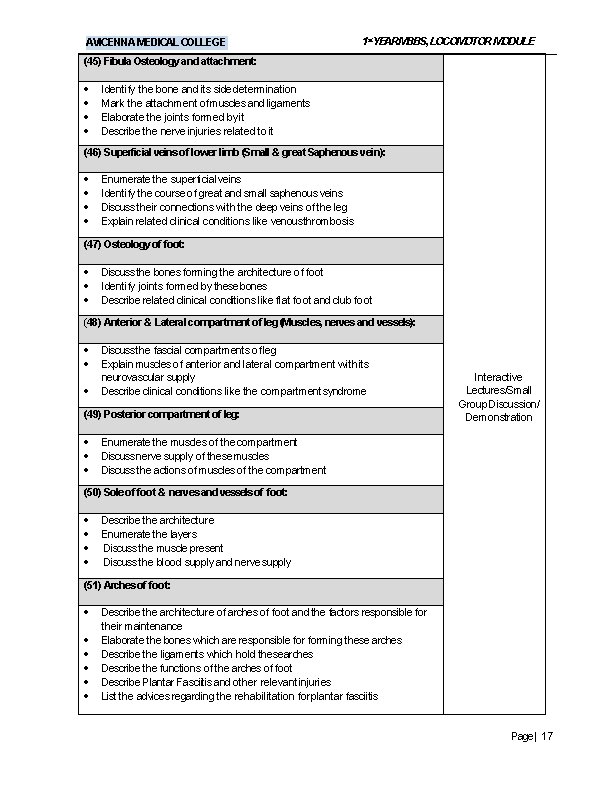
AVICENNA MEDICAL COLLEGE 1 st. YEARMBBS, LOCOMOTOR MODULE (45) Fibula Osteology and attachment: Identify the bone and its side determination Mark the attachment of muscles and ligaments Elaborate the joints formed by it Describe the nerve injuries related to it (46) Superficial veins of lower limb (Small & great Saphenous vein): Enumerate the superficial veins Identify the course of great and small saphenous veins Discuss their connections with the deep veins of the leg Explain related clinical conditions like venous thrombosis (47) Osteology of foot: Discuss the bones forming the architecture of foot Identify joints formed by these bones Describe related clinical conditions like flat foot and club foot (48) Anterior & Lateral compartment of leg (Muscles, nerves and vessels): Discuss the fascial compartments of leg Explain muscles of anterior and lateral compartment with its neurovascular supply Describe clinical conditions like the compartment syndrome (49) Posterior compartment of leg: Interactive Lectures/Small Group Discussion/ Demonstration Enumerate the muscles of the compartment Discuss nerve supply of these muscles Discuss the actions of muscles of the compartment (50) Sole of foot & nerves and vessels of foot: Describe the architecture Enumerate the layers Discuss the muscle present Discuss the blood supply and nerve supply (51) Arches of foot: Describe the architecture of arches of foot and the factors responsible for their maintenance Elaborate the bones which are responsible forming these arches Describe the ligaments which hold these arches Describe the functions of the arches of foot Describe Plantar Fasciitis and other relevant injuries List the advices regarding the rehabilitation for plantar fasciitis Page | 17
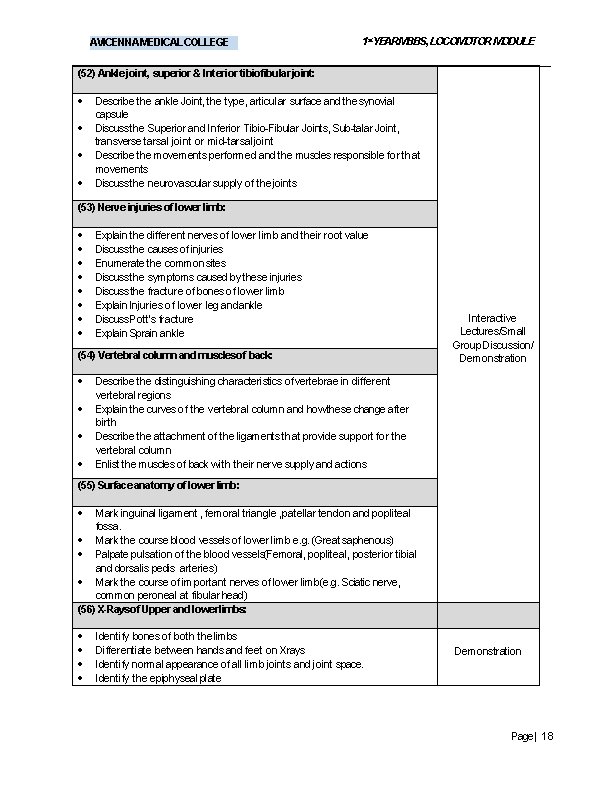
AVICENNA MEDICAL COLLEGE 1 st. YEARMBBS, LOCOMOTOR MODULE (52) Ankle joint, superior & Interior tibiofibular joint: Describe the ankle Joint, the type, articular surface and the synovial capsule Discuss the Superior and Inferior Tibio-Fibular Joints, Sub-talar Joint, transverse tarsal joint or mid-tarsal joint Describe the movements performed and the muscles responsible for that movements Discuss the neurovascular supply of the joints (53) Nerve injuries of lower limb: Explain the different nerves of lower limb and their root value Discuss the causes of injuries Enumerate the common sites Discuss the symptoms caused by these injuries Discuss the fracture of bones of lower limb Explain Injuries of lower leg andankle Discuss Pott’s fracture Explain Sprain ankle (54) Vertebral column and muscles of back: Interactive Lectures/Small Group Discussion/ Demonstration Describe the distinguishing characteristics of vertebrae in different vertebral regions Explain the curves of the vertebral column and how these change after birth Describe the attachment of the ligaments that provide support for the vertebral column Enlist the muscles of back with their nerve supply and actions (55) Surface anatomy of lower limb: Mark inguinal ligament , femoral triangle , patellar tendon and popliteal fossa. Mark the course blood vessels of lower limb e. g. (Great saphenous) Palpate pulsation of the blood vessels(Femoral, popliteal, posterior tibial and dorsalis pedis arteries) Mark the course of important nerves of lower limb(e. g. Sciatic nerve, common peroneal at fibular head) (56) X-Rays of Upper and lower limbs: Identify bones of both the limbs Differentiate between hands and feet on Xrays Identify normal appearance of all limb joints and joint space. Identify the epiphyseal plate Demonstration Page | 18
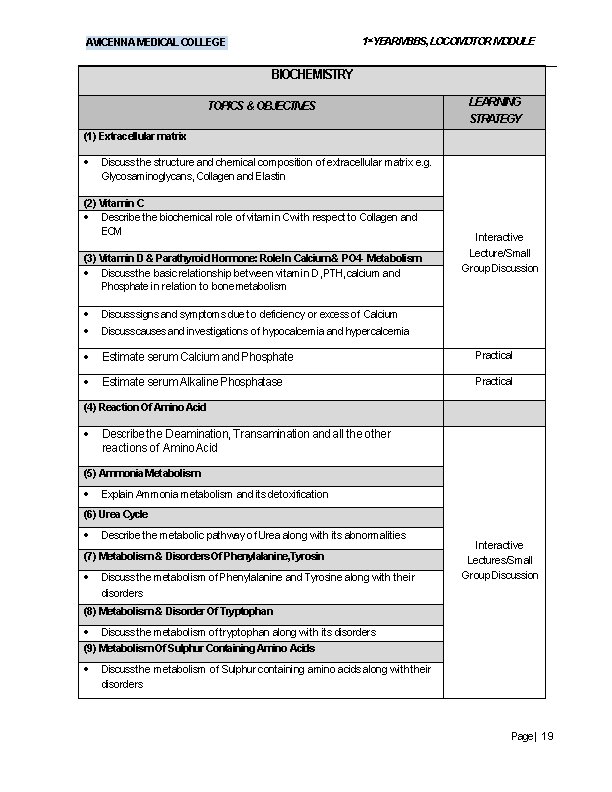
1 st. YEARMBBS, LOCOMOTOR MODULE AVICENNA MEDICAL COLLEGE BIOCHEMISTRY TOPICS & OBJECTIVES LEARNING STRATEGY (1) Extracellular matrix Discuss the structure and chemical composition of extracellular matrix e. g. Glycosaminoglycans, Collagen and Elastin (2) Vitamin C Describe the biochemical role of vitamin Cwith respect to Collagen and ECM (3) Vitamin D & Parathyroid Hormone: Role In Calcium & PO 4 - Metabolism Discuss the basic relationship between vitamin D, PTH, calcium and Phosphate in relation to bone metabolism Interactive Lecture/Small Group Discussion Discuss signs and symptoms due to deficiency or excess of Calcium Discuss causes and investigations of hypocalcemia and hypercalcemia Estimate serum Calcium and Phosphate Practical Estimate serum Alkaline Phosphatase Practical (4) Reaction Of Amino Acid Describe the Deamination, Transamination and all the other reactions of Amino Acid (5) Ammonia Metabolism Explain Ammonia metabolism and its detoxification (6) Urea Cycle Describe the metabolic pathway of Urea along with its abnormalities (7) Metabolism & Disorders Of Phenylalanine, Tyrosin Discuss the metabolism of Phenylalanine and Tyrosine along with their disorders Interactive Lectures/Small Group Discussion (8) Metabolism & Disorder Of Tryptophan Discuss the metabolism of tryptophan along with its disorders (9) Metabolism Of Sulphur Containing Amino Acids Discuss the metabolism of Sulphur containing amino acids along with their disorders Page | 19
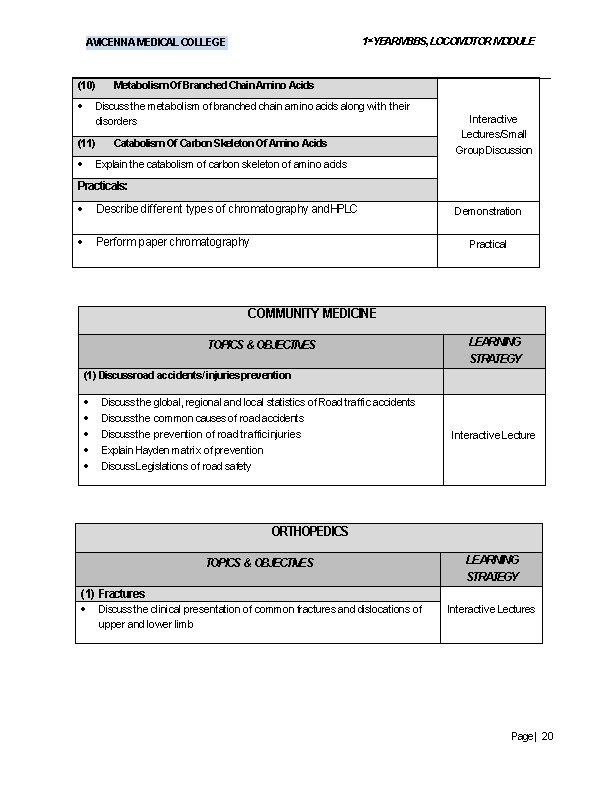
1 st. YEARMBBS, LOCOMOTOR MODULE AVICENNA MEDICAL COLLEGE (10) Metabolism Of Branched Chain Amino Acids Discuss the metabolism of branched chain amino acids along with their disorders (11) Catabolism Of Carbon Skeleton Of Amino Acids Interactive Lectures/Small Group Discussion Explain the catabolism of carbon skeleton of amino acids Practicals: Describe different types of chromatography and HPLC Perform paper chromatography Demonstration Practical COMMUNITY MEDICINE TOPICS & OBJECTIVES LEARNING STRATEGY (1) Discuss road accidents/ injuries prevention Discuss the global, regional and local statistics of Road traffic accidents Discuss the common causes of road accidents Discuss the prevention of road traffic injuries Explain Hayden matrix of prevention Discuss Legislations of road safety Interactive Lecture ORTHOPEDICS TOPICS & OBJECTIVES (1) Fractures Discuss the clinical presentation of common fractures and dislocations of LEARNING STRATEGY Interactive Lectures upper and lower limb Page | 20
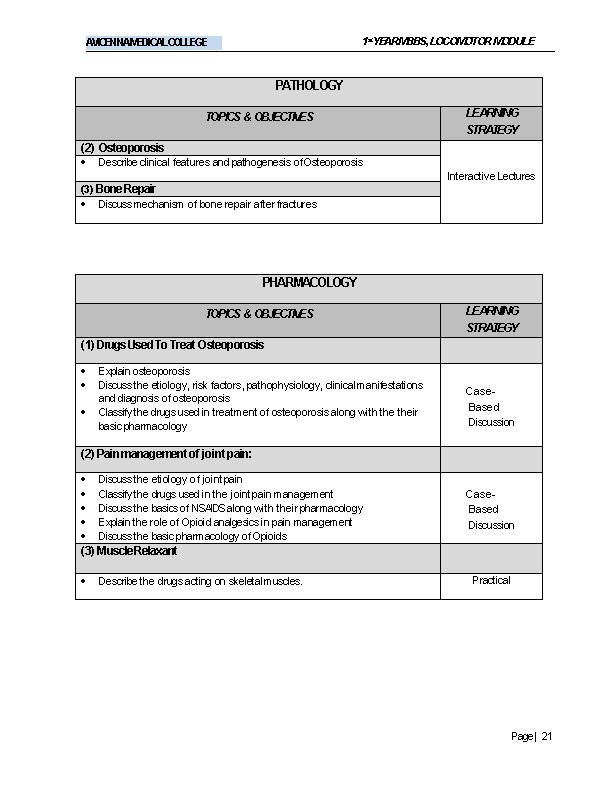
1 st. YEARMBBS, LOCOMOTOR MODULE AVICENNAMEDICALCOLLEGE PATHOLOGY TOPICS & OBJECTIVES LEARNING STRATEGY (2) Osteoporosis Describe clinical features and pathogenesis of Osteoporosis (3) Bone Repair Discuss mechanism of bone repair after fractures Interactive Lectures PHARMACOLOGY TOPICS & OBJECTIVES LEARNING STRATEGY (1) Drugs Used To Treat Osteoporosis Explain osteoporosis Discuss the etiology, risk factors, pathophysiology, clinical manifestations and diagnosis of osteoporosis Classify the drugs used in treatment of osteoporosis along with their basic pharmacology Case. Based Discussion (2) Pain management of joint pain: Discuss the etiology of joint pain Classify the drugs used in the joint pain management Discuss the basics of NSAIDS along with their pharmacology Explain the role of Opioid analgesics in pain management Discuss the basic pharmacology of Opioids (3) Muscle. Relaxant Describe the drugs acting on skeletal muscles. Case. Based Discussion Practical Page | 21
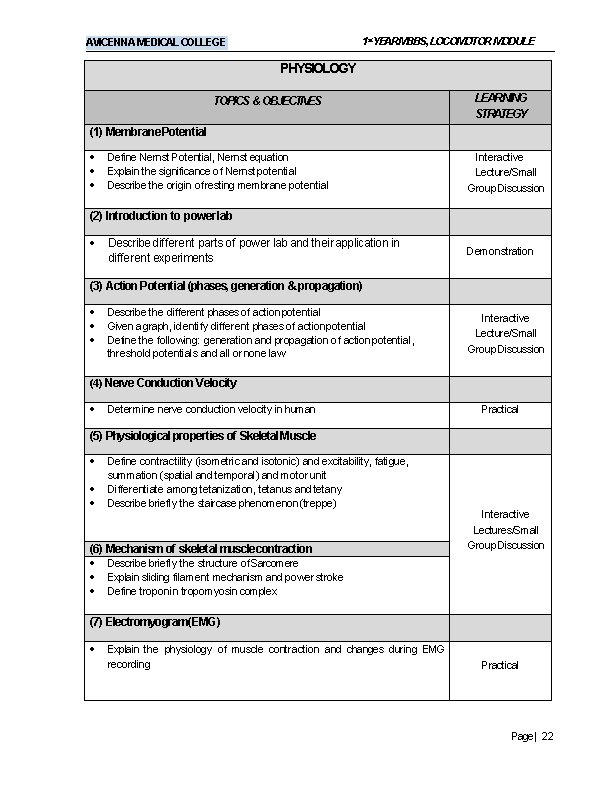
1 st. YEARMBBS, LOCOMOTOR MODULE AVICENNA MEDICAL COLLEGE PHYSIOLOGY TOPICS & OBJECTIVES LEARNING STRATEGY (1) Membrane Potential Define Nernst Potential, Nernst equation Explain the significance of Nernst potential Describe the origin of resting membrane potential Interactive Lecture/Small Group Discussion (2) Introduction to power lab Describe different parts of power lab and their application in different experiments Demonstration (3) Action Potential (phases, generation & propagation) Describe the different phases of action potential Given a graph, identify different phases of action potential Define the following: generation and propagation of action potential, threshold potentials and all or none law Interactive Lecture/Small Group Discussion (4) Nerve Conduction Velocity Determine nerve conduction velocity in human Practical (5) Physiological properties of Skeletal Muscle Define contractility (isometric and isotonic) and excitability, fatigue, summation (spatial and temporal) and motor unit Differentiate among tetanization, tetanus and tetany Describe briefly the staircase phenomenon (treppe) (6) Mechanism of skeletal musclecontraction Describe briefly the structure of Sarcomere Explain sliding filament mechanism and power stroke Define troponin tropomyosin complex Interactive Lectures/Small Group Discussion (7) Electromyogram(EMG) Explain the physiology of muscle contraction and changes during EMG recording Practical Page | 22
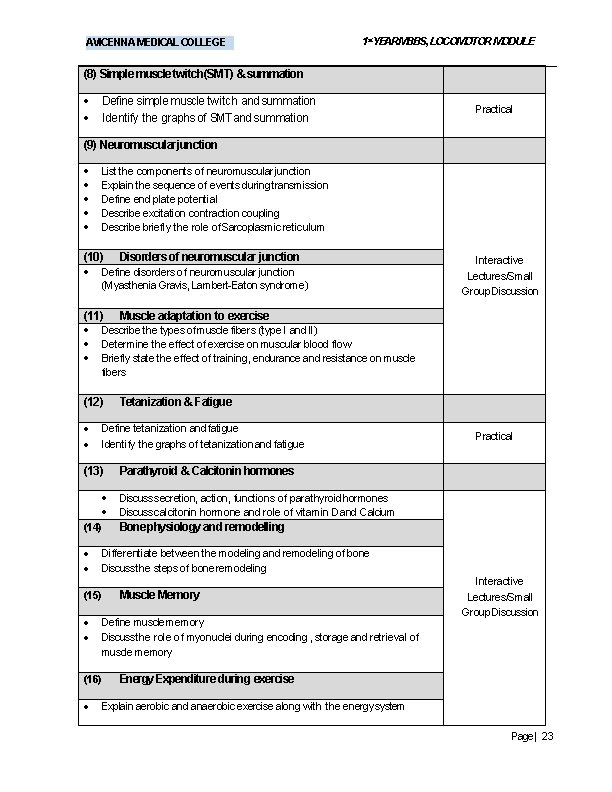
AVICENNA MEDICAL COLLEGE 1 st. YEARMBBS, LOCOMOTOR MODULE (8) Simple muscle twitch(SMT) & summation Define simple muscle twitch and summation Identify the graphs of SMT and summation Practical (9) Neuromuscularjunction List the components of neuromuscular junction Explain the sequence of events during transmission Define end plate potential Describe excitation contraction coupling Describe briefly the role of Sarcoplasmic reticulum (10) Disorders of neuromuscular junction Define disorders of neuromuscular junction (Myasthenia Gravis, Lambert-Eaton syndrome) Interactive Lectures/Small Group Discussion (11) Muscle adaptation to exercise Describe the types of muscle fibers (type I and II) Determine the effect of exercise on muscular blood flow Briefly state the effect of training, endurance and resistance on muscle fibers (12) Tetanization & Fatigue Define tetanization and fatigue Identify the graphs of tetanization and fatigue (13) Parathyroid & Calcitonin hormones (14) Discuss secretion, action, functions of parathyroid hormones Discuss calcitonin hormone and role of vitamin D and Calcium Muscle Memory Define muscle memory Discuss the role of myonuclei during encoding , storage and retrieval of muscle memory (16) Bone physiology and remodelling Differentiate between the modeling and remodeling of bone Discuss the steps of bone remodeling (15) Practical Interactive Lectures/Small Group Discussion Energy Expenditure during exercise Explain aerobic and anaerobic exercise along with the energysystem Page | 23
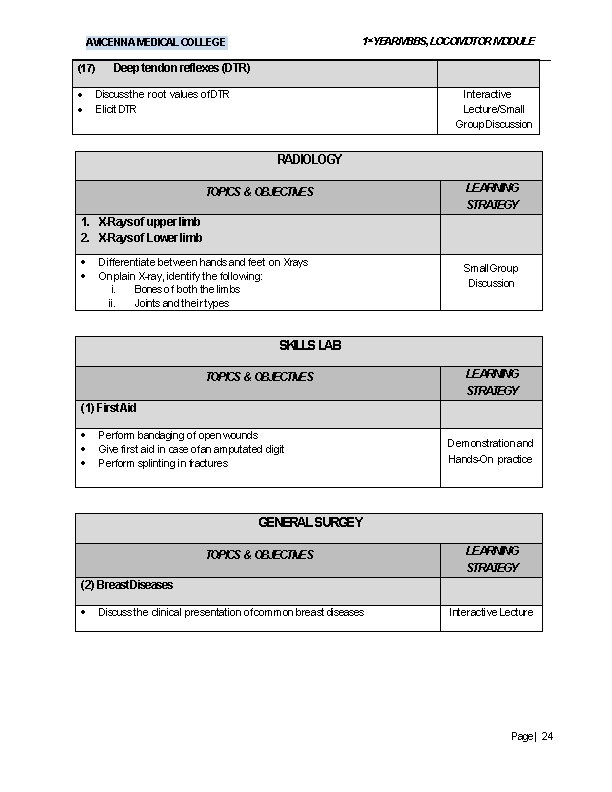
1 st. YEARMBBS, LOCOMOTOR MODULE AVICENNA MEDICAL COLLEGE (17) Deep tendon reflexes (DTR) Discuss the root values of DTR Elicit DTR Interactive Lecture/Small Group Discussion RADIOLOGY TOPICS & OBJECTIVES LEARNING STRATEGY 1. X-Rays of upper limb 2. X-Rays of Lower limb Differentiate between hands and feet on Xrays On plain X-ray, identify the following: i. Bones of both the limbs ii. Joints and their types Small Group Discussion SKILLS LAB TOPICS & OBJECTIVES LEARNING STRATEGY (1) First. Aid Perform bandaging of open wounds Give first aid in case of an amputated digit Perform splinting in fractures Demonstration and Hands-On practice GENERAL SURGEY TOPICS & OBJECTIVES LEARNING STRATEGY (2) Breast. Diseases Discuss the clinical presentation of common breast diseases Interactive Lecture Page | 24
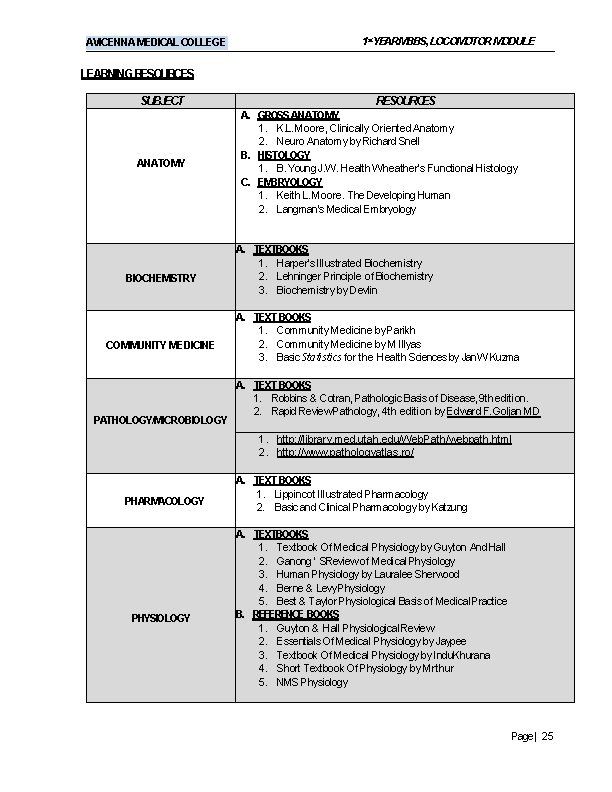
AVICENNA MEDICAL COLLEGE 1 st. YEARMBBS, LOCOMOTOR MODULE LEARNING RESOURCES SUBJECT ANATOMY BIOCHEMISTRY COMMUNITY MEDICINE PATHOLOGY/MICROBIOLOGY RESOURCES A. GROSS ANATOMY 1. K. L. Moore, Clinically Oriented Anatomy 2. Neuro Anatomy by Richard Snell B. HISTOLOGY 1. B. Young J. W. Health Wheather’s Functional Histology C. EMBRYOLOGY 1. Keith L. Moore. The Developing Human 2. Langman’s Medical Embryology A. TEXTBOOKS 1. Harper’s Illustrated Biochemistry 2. Lehninger Principle of Biochemistry 3. Biochemistry by Devlin A. TEXT BOOKS 1. Community Medicine by Parikh 2. Community Medicine by M Illyas 3. Basic Statistics for the Health Sciences by Jan W Kuzma A. TEXT BOOKS 1. Robbins & Cotran, Pathologic Basis of Disease, 9 th edition. 2. Rapid Review Pathology, 4 th edition by Edward F. Goljan MD 1. http: //library. med. utah. edu/Web. Path/webpath. html 2. http: //www. pathologyatlas. ro/ PHARMACOLOGY PHYSIOLOGY A. TEXT BOOKS 1. Lippincot Illustrated Pharmacology 2. Basic and Clinical Pharmacology by Katzung A. TEXTBOOKS 1. Textbook Of Medical Physiology by Guyton And Hall 2. Ganong ‘ SReview of Medical Physiology 3. Human Physiology by Lauralee Sherwood 4. Berne & Levy Physiology 5. Best & Taylor Physiological Basis of Medical Practice B. REFERENCE BOOKS 1. Guyton & Hall Physiological Review 2. Essentials Of Medical Physiology by Jaypee 3. Textbook Of Medical Physiology by Indu. Khurana 4. Short Textbook Of Physiology by Mrthur 5. NMS Physiology Page | 25
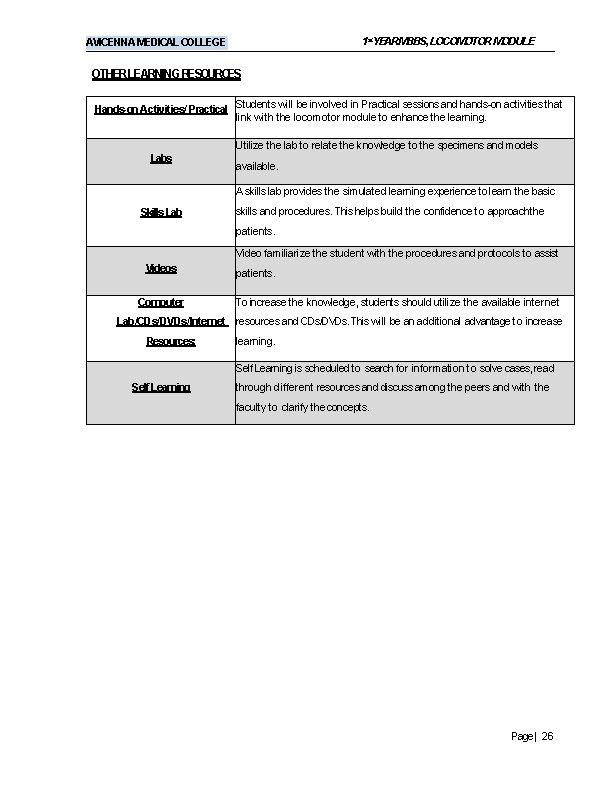
1 st. YEARMBBS, LOCOMOTOR MODULE AVICENNA MEDICAL COLLEGE OTHERLEARNING RESOURCES Hands-on Activities/ Practical Students will be involved in Practical sessions and hands-on activities that link with the locomotor module to enhance the learning. Utilize the lab to relate the knowledge to the specimens and models Labs available. A skills lab provides the simulated learning experience to learn the basic Skills Lab skills and procedures. This helps build the confidence to approachthe patients. Video familiarize the student with the procedures and protocols to assist Videos Computer patients. To increase the knowledge, students should utilize the available internet Lab/CDs/DVDs/Internet resources and CDs/DVDs. This will be an additional advantage to increase Resources: learning. Self Learning is scheduled to search for information to solve cases, read Self Learning through different resources and discuss among the peers and with the faculty to clarify the concepts. Page | 26
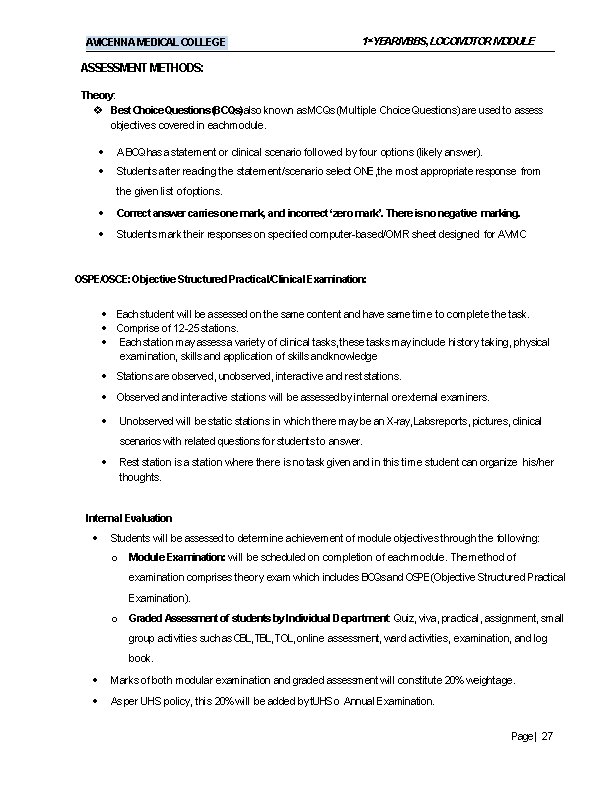
AVICENNA MEDICAL COLLEGE 1 st. YEARMBBS, LOCOMOTOR MODULE ASSESSMENT METHODS: Theory: Best Choice Questions (BCQs) also known as MCQs (Multiple Choice Questions) are used to assess objectives covered in each module. A BCQhas a statement or clinical scenario followed by four options (likely answer). Students after reading the statement/scenario select ONE, the most appropriate response from the given list of options. Correct answer carries one mark, and incorrect ‘zero mark’. There is no negative marking. Students mark their responses on specified computer-based/OMR sheet designed for AVMC OSPE/OSCE: Objective Structured Practical/Clinical Examination: Each student will be assessed on the same content and have same time to complete the task. Comprise of 12 -25 stations. Each station may assess a variety of clinical tasks, these tasks may include history taking, physical examination, skills and application of skills and knowledge Stations are observed, unobserved, interactive and rest stations. Observed and interactive stations will be assessed by internal or external examiners. Unobserved will be static stations in which there may be an X-ray, Labs reports, pictures, clinical scenarios with related questions for students to answer. Rest station is a station where there is no task given and in this time student can organize his/her thoughts. Internal Evaluation Students will be assessed to determine achievement of module objectives through the following: o Module Examination: will be scheduled on completion of each module. The method of examination comprises theory exam which includes BCQsand OSPE(Objective Structured Practical Examination). o Graded Assessment of students by Individual Department: Quiz, viva, practical, assignment, small group activities such as CBL, TOL, online assessment, ward activities, examination, and log book. Marks of both modular examination and graded assessment will constitute 20% weightage. As per UHS policy, this 20% will be added by t. UHS o Annual Examination. Page | 27
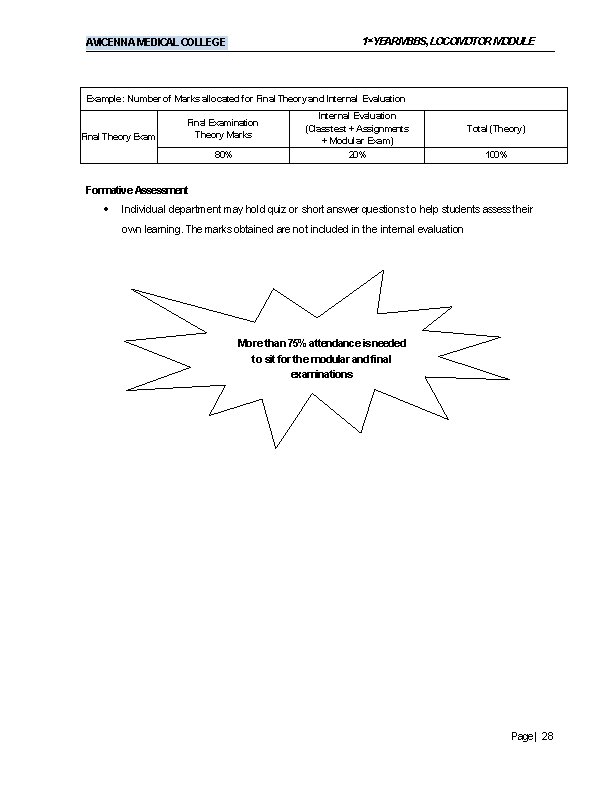
1 st. YEARMBBS, LOCOMOTOR MODULE AVICENNA MEDICAL COLLEGE Example : Number of Marks allocated for Final Theory and Internal Evaluation Final Theory Exam Final Examination Theory Marks 80% Internal Evaluation (Class test + Assignments + Modular Exam) 20% Total (Theory) 100% Formative Assessment Individual department may hold quiz or short answer questions to help students assess their own learning. The marks obtained are not included in the internal evaluation More than 75% attendance is needed to sit for the modular and final examinations Page | 28
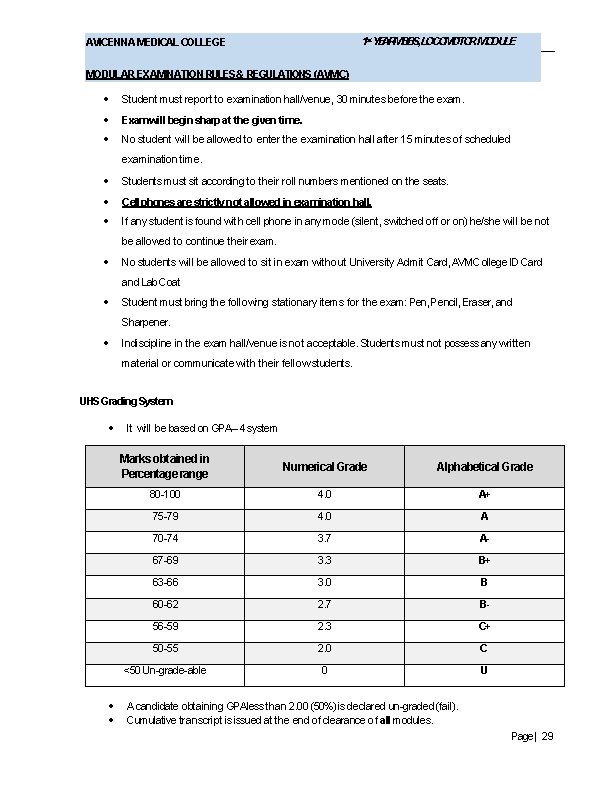
1 st. YEARMBBS, LOCOMOTORMODULE AVICENNA MEDICAL COLLEGE MODULAR EXAMINATION RULES& REGULATIONS (AVMC) Student must report to examination hall/venue, 30 minutes before the exam. Exam will begin sharp at the given time. No student will be allowed to enter the examination hall after 15 minutes of scheduled examination time. Students must sit according to their roll numbers mentioned on the seats. Cell phones are strictly not allowed in examination hall. If any student is found with cell phone in any mode (silent, switched off or on) he/she will be not be allowed to continue their exam. No students will be allowed to sit in exam without University Admit Card, AVMC ollege ID Card and Lab Coat Student must bring the following stationary items for the exam: Pen, Pencil, Eraser, and Sharpener. Indiscipline in the exam hall/venue is not acceptable. Students must not possess any written material or communicate with their fellow students. UHS Grading System It will be based on GPA– 4 system Marks obtained in Percentage range Numerical Grade Alphabetical Grade 80 -100 4. 0 A+ 75 -79 4. 0 A 70 -74 3. 7 A- 67 -69 3. 3 B+ 63 -66 3. 0 B 60 -62 2. 7 B- 56 -59 2. 3 C+ 50 -55 2. 0 C <50 Un-grade-able 0 U A candidate obtaining GPAless than 2. 00 (50%) is declared un-graded (fail). Cumulative transcript is issued at the end of clearance of all modules. Page | 29
- Slides: 29