
Study Designs in Health Research An Overview Lecture

- Slides: 41
Study Designs in Health Research: An Overview Lecture outline by Professor Ahmed Mandil KSU College of Medicine Pictures and graphs added by Dr Amna R Siddiqui
Headlines Ø Ø Ø Health research Classification of study designs Qualitative methods Quantitative methods Choice of study design
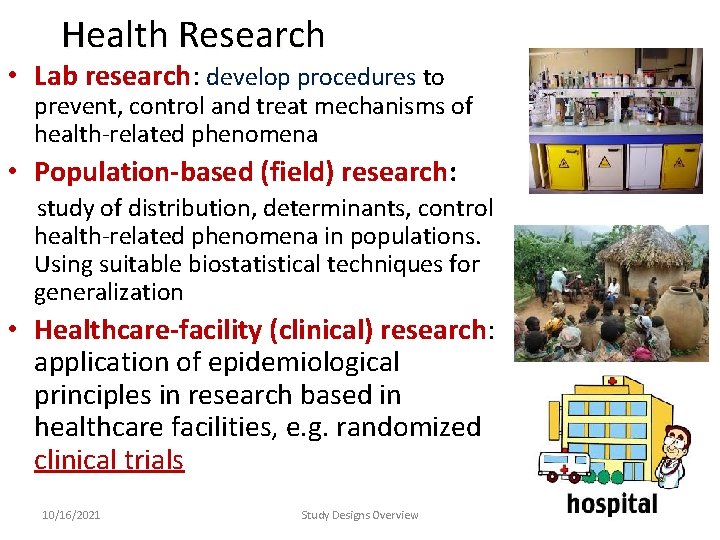
Health Research • Lab research: develop procedures to prevent, control and treat mechanisms of health-related phenomena • Population-based (field) research: study of distribution, determinants, control health-related phenomena in populations. Using suitable biostatistical techniques for generalization • Healthcare-facility (clinical) research: application of epidemiological principles in research based in healthcare facilities, e. g. randomized clinical trials 10/16/2021 Study Designs Overview 3
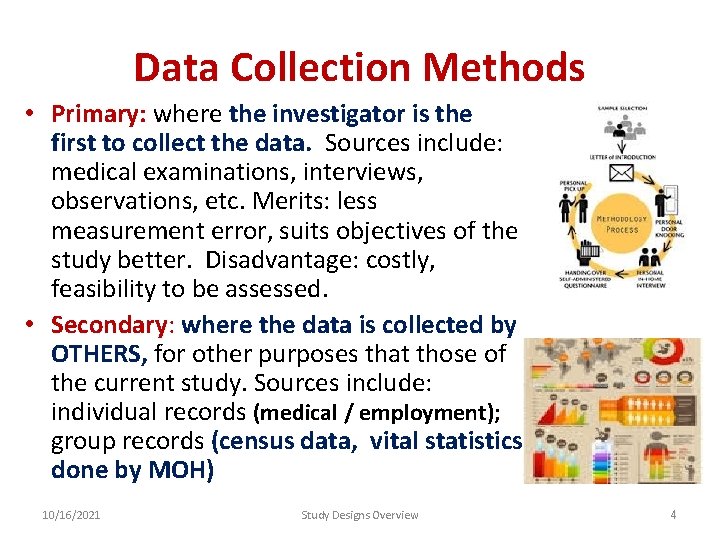
Data Collection Methods • Primary: where the investigator is the first to collect the data. Sources include: medical examinations, interviews, observations, etc. Merits: less measurement error, suits objectives of the study better. Disadvantage: costly, feasibility to be assessed. • Secondary: where the data is collected by OTHERS, for other purposes that those of the current study. Sources include: individual records (medical / employment); group records (census data, vital statistics done by MOH) 10/16/2021 Study Designs Overview 4
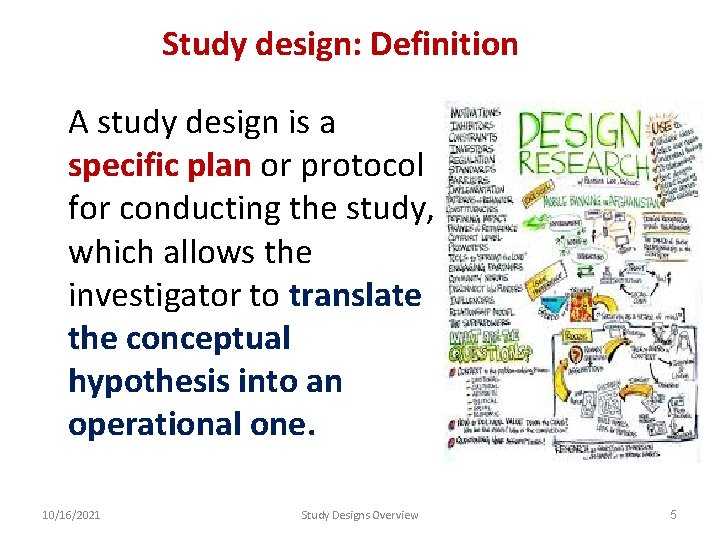
Study design: Definition A study design is a specific plan or protocol for conducting the study, which allows the investigator to translate the conceptual hypothesis into an operational one. 10/16/2021 Study Designs Overview 5
Study Designs: Types • Qualitative • Quantitative –Experimental –Observational 10/16/2021 Study Designs Overview 6
Qualitative Designs
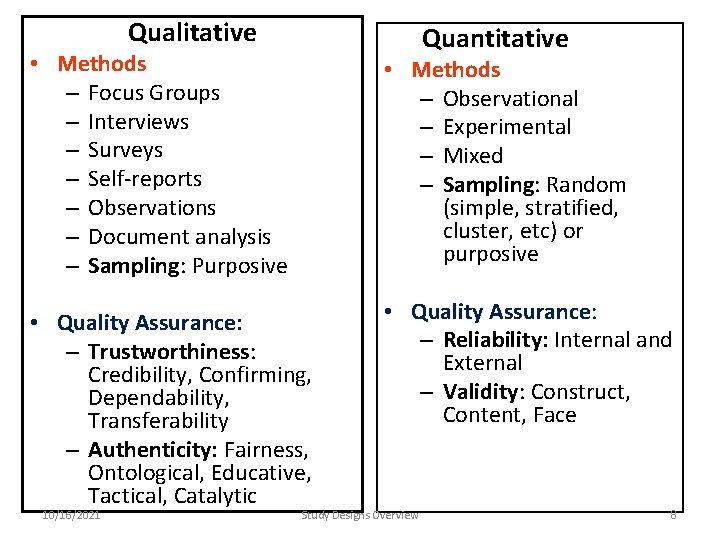
Qualitative Quantitative • Methods – Focus Groups – Interviews – Surveys – Self-reports – Observations – Document analysis – Sampling: Purposive • Methods – Observational – Experimental – Mixed – Sampling: Random (simple, stratified, cluster, etc) or purposive • Quality Assurance: – Trustworthiness: Credibility, Confirming, Dependability, Transferability – Authenticity: Fairness, Ontological, Educative, Tactical, Catalytic • Quality Assurance: – Reliability: Internal and External – Validity: Construct, Content, Face 10/16/2021 Study Designs Overview 8
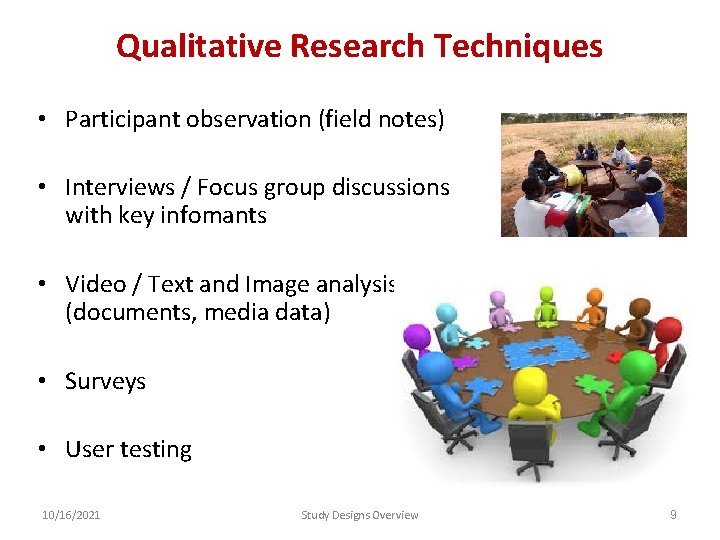
Qualitative Research Techniques • Participant observation (field notes) • Interviews / Focus group discussions with key infomants • Video / Text and Image analysis (documents, media data) • Surveys • User testing 10/16/2021 Study Designs Overview 9
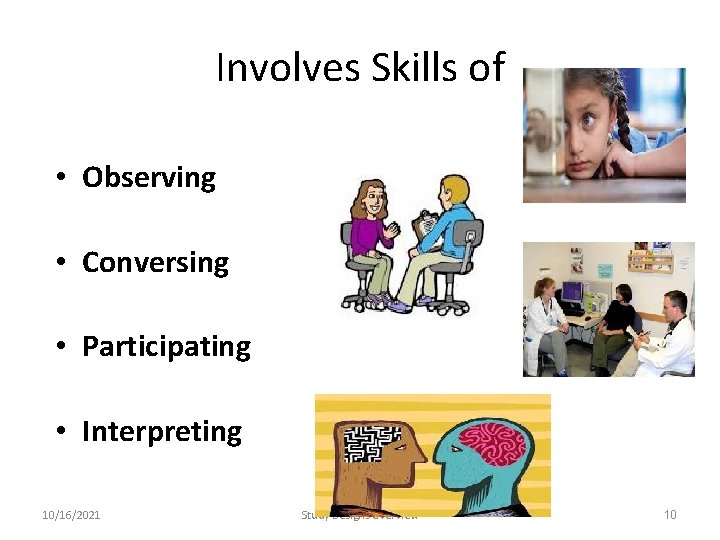
Involves Skills of • Observing • Conversing • Participating • Interpreting 10/16/2021 Study Designs Overview 10
Rigor in Qualitative Research • • 10/16/2021 Dependability Credibility Transferability Confirmability Study Designs Overview 11
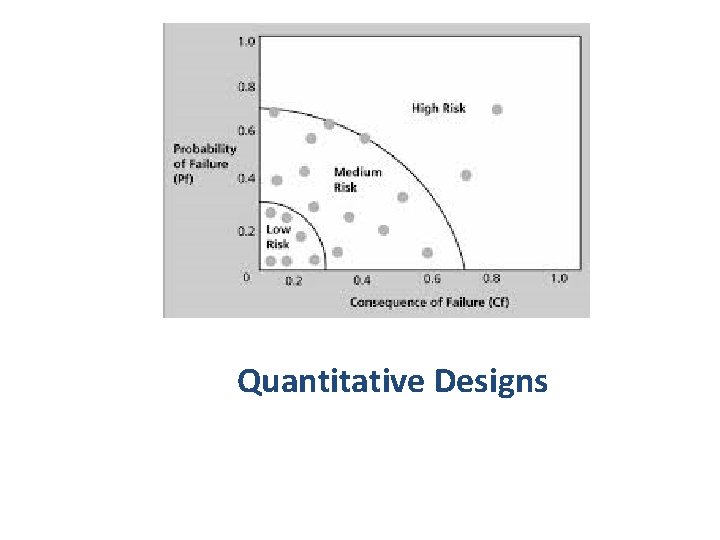
Quantitative Designs
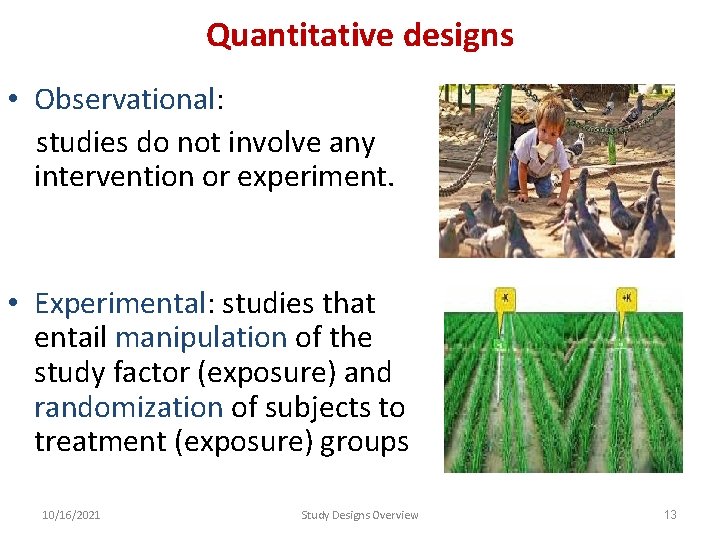
Quantitative designs • Observational: studies do not involve any intervention or experiment. • Experimental: studies that entail manipulation of the study factor (exposure) and randomization of subjects to treatment (exposure) groups 10/16/2021 Study Designs Overview 13
Observational Designs
Observation Methods • Selected Units: individuals, groups • Study Populations: cross-sectional, longitudinal • Data collection timing: prospectively, retrospectively, combination • Data collection types: primary, secondary 10/16/2021 Study Designs Overview 15
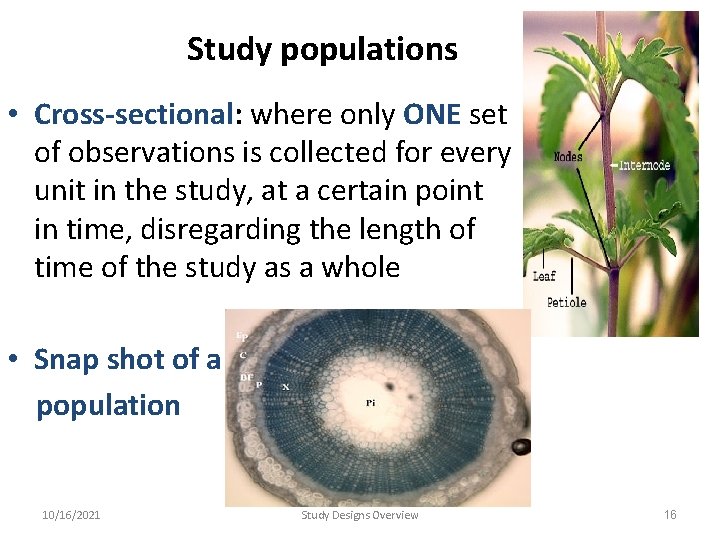
Study populations • Cross-sectional: where only ONE set of observations is collected for every unit in the study, at a certain point in time, disregarding the length of time of the study as a whole • Snap shot of a population 10/16/2021 Study Designs Overview 16
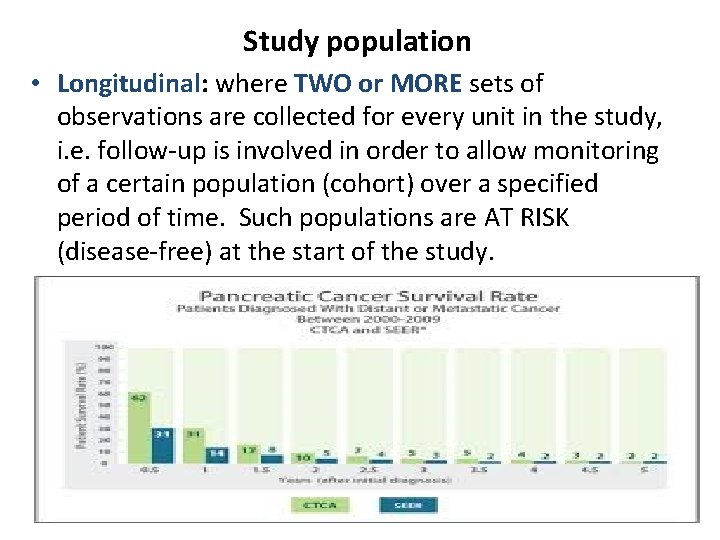
Study population • Longitudinal: where TWO or MORE sets of observations are collected for every unit in the study, i. e. follow-up is involved in order to allow monitoring of a certain population (cohort) over a specified period of time. Such populations are AT RISK (disease-free) at the start of the study. 10/16/2021 Study Designs Overview 17
Observational Designs: Classification • Exploratory: used when the state of knowledge about the phenomenon is poor: small scale; of limited duration. • Descriptive: used to formulate a certain hypothesis: small / large scale. Examples: casestudies / series; cross-sectional studies • Analytical: used to test hypotheses: small / large scale. Examples: case-control, cross-sectional, cohort. 10/16/2021 Study Designs Overview 18
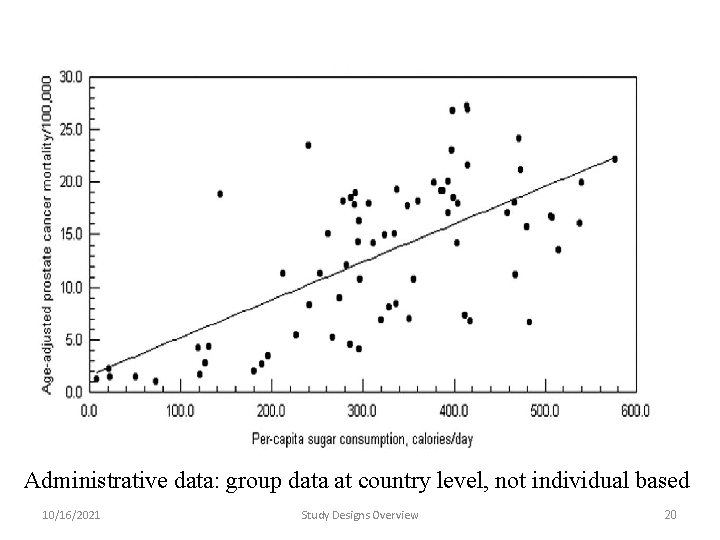
Ecological studies (I) • E. g. hardness of water, are correlated with health data collected on individuals say CHD rates. • Conceptually, the ecological component is an issue of data analysis; not study design. • What is missing: relationship between exposure and outcome at the individual level (incomplete design) • Could be hypothesis generating analyses/design 10/16/2021 Study Designs Overview 19
Administrative data: group data at country level, not individual based 10/16/2021 Study Designs Overview 20
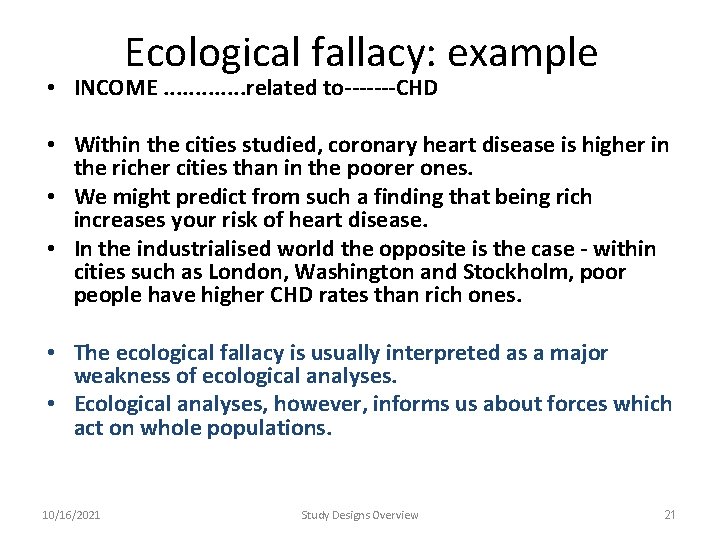
Ecological fallacy: example • INCOME. . . related to-------CHD • Within the cities studied, coronary heart disease is higher in the richer cities than in the poorer ones. • We might predict from such a finding that being rich increases your risk of heart disease. • In the industrialised world the opposite is the case - within cities such as London, Washington and Stockholm, poor people have higher CHD rates than rich ones. • The ecological fallacy is usually interpreted as a major weakness of ecological analyses. • Ecological analyses, however, informs us about forces which act on whole populations. 10/16/2021 Study Designs Overview 21
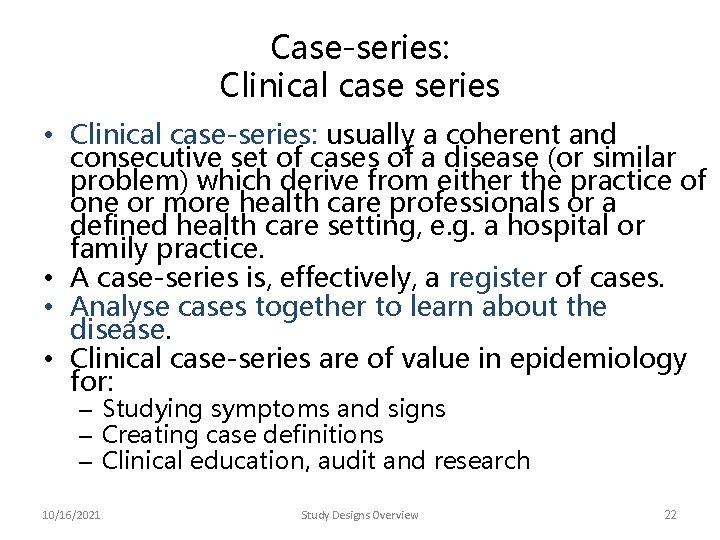
Case-series: Clinical case series • Clinical case-series: usually a coherent and consecutive set of cases of a disease (or similar problem) which derive from either the practice of one or more health care professionals or a defined health care setting, e. g. a hospital or family practice. • A case-series is, effectively, a register of cases. • Analyse cases together to learn about the disease. • Clinical case-series are of value in epidemiology for: – Studying symptoms and signs – Creating case definitions – Clinical education, audit and research 10/16/2021 Study Designs Overview 22
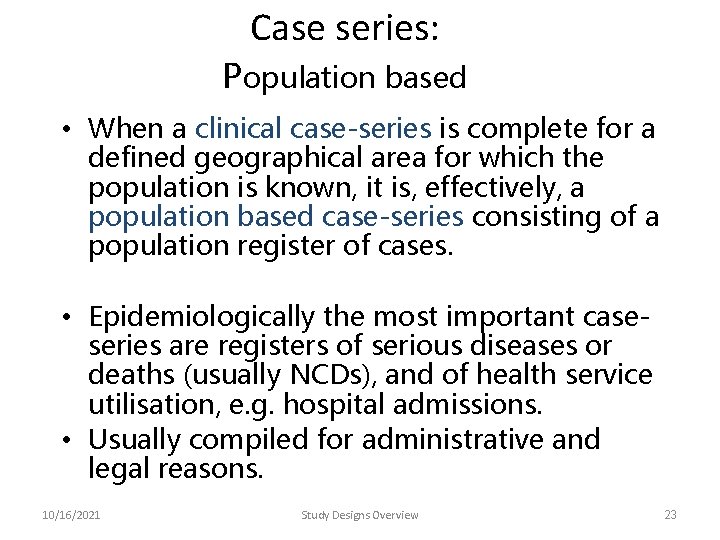
Case series: Population based • When a clinical case-series is complete for a defined geographical area for which the population is known, it is, effectively, a population based case-series consisting of a population register of cases. • Epidemiologically the most important caseseries are registers of serious diseases or deaths (usually NCDs), and of health service utilisation, e. g. hospital admissions. • Usually compiled for administrative and legal reasons. 10/16/2021 Study Designs Overview 23
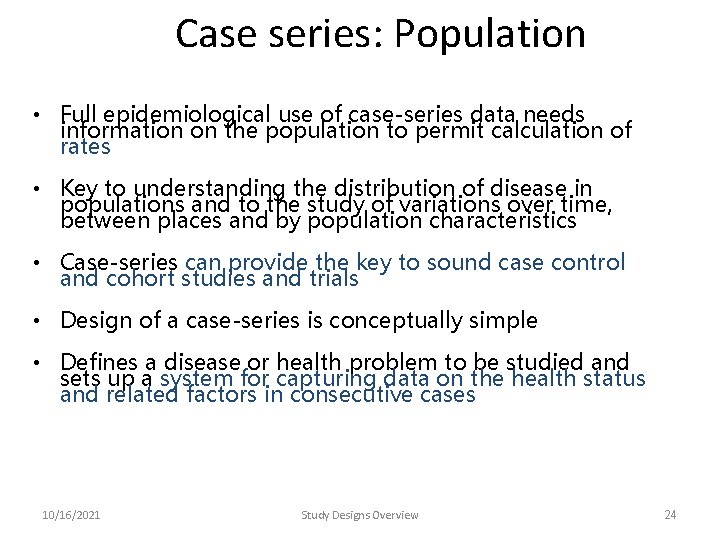
Case series: Population • Full epidemiological use of case-series data needs information on the population to permit calculation of rates • Key to understanding the distribution of disease in populations and to the study of variations over time, between places and by population characteristics • Case-series can provide the key to sound case control and cohort studies and trials • Design of a case-series is conceptually simple • Defines a disease or health problem to be studied and sets up a system for capturing data on the health status and related factors in consecutive cases 10/16/2021 Study Designs Overview 24
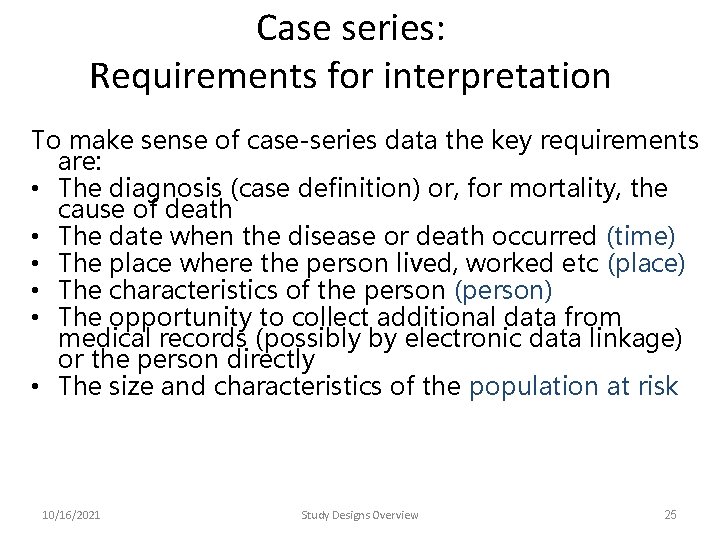
Case series: Requirements for interpretation To make sense of case-series data the key requirements are: • The diagnosis (case definition) or, for mortality, the cause of death • The date when the disease or death occurred (time) • The place where the person lived, worked etc (place) • The characteristics of the person (person) • The opportunity to collect additional data from medical records (possibly by electronic data linkage) or the person directly • The size and characteristics of the population at risk 10/16/2021 Study Designs Overview 25
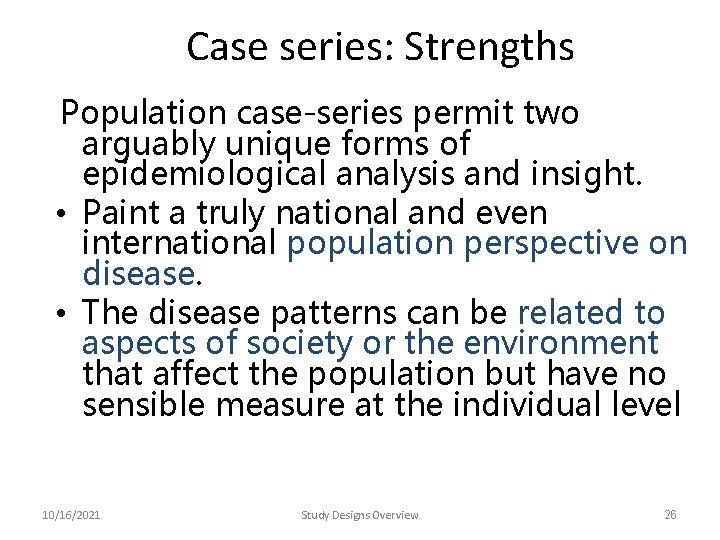
Case series: Strengths Population case-series permit two arguably unique forms of epidemiological analysis and insight. • Paint a truly national and even international population perspective on disease. • The disease patterns can be related to aspects of society or the environment that affect the population but have no sensible measure at the individual level 10/16/2021 Study Designs Overview 26
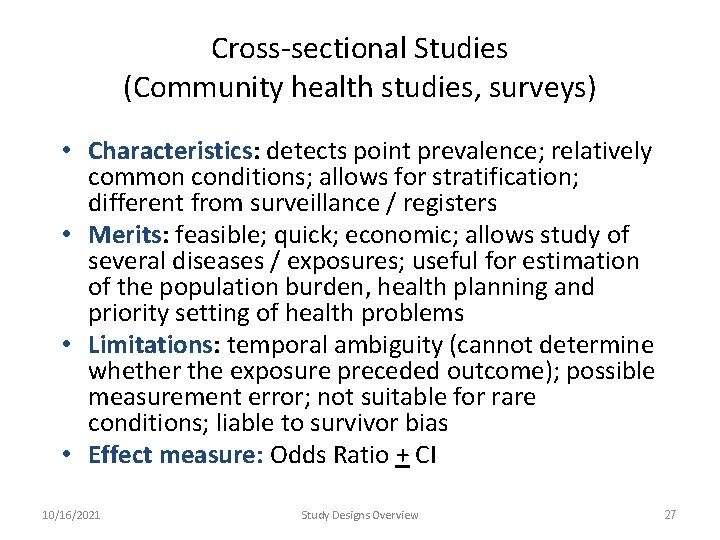
Cross-sectional Studies (Community health studies, surveys) • Characteristics: detects point prevalence; relatively common conditions; allows for stratification; different from surveillance / registers • Merits: feasible; quick; economic; allows study of several diseases / exposures; useful for estimation of the population burden, health planning and priority setting of health problems • Limitations: temporal ambiguity (cannot determine whether the exposure preceded outcome); possible measurement error; not suitable for rare conditions; liable to survivor bias • Effect measure: Odds Ratio + CI 10/16/2021 Study Designs Overview 27
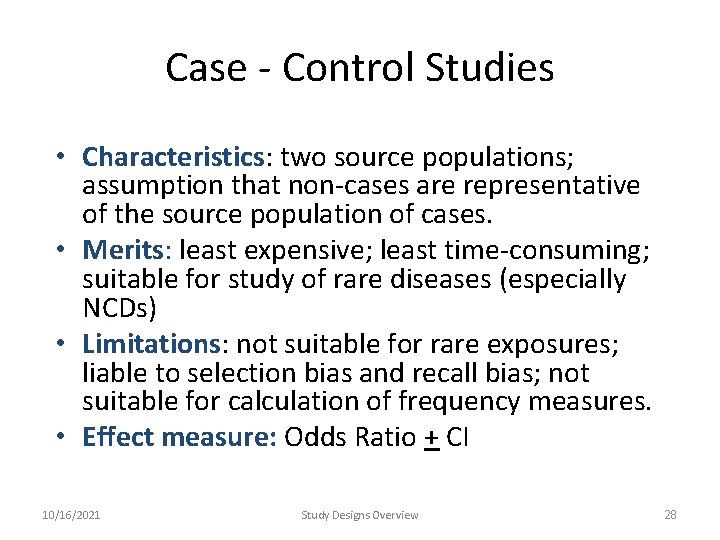
Case - Control Studies • Characteristics: two source populations; assumption that non-cases are representative of the source population of cases. • Merits: least expensive; least time-consuming; suitable for study of rare diseases (especially NCDs) • Limitations: not suitable for rare exposures; liable to selection bias and recall bias; not suitable for calculation of frequency measures. • Effect measure: Odds Ratio + CI 10/16/2021 Study Designs Overview 28
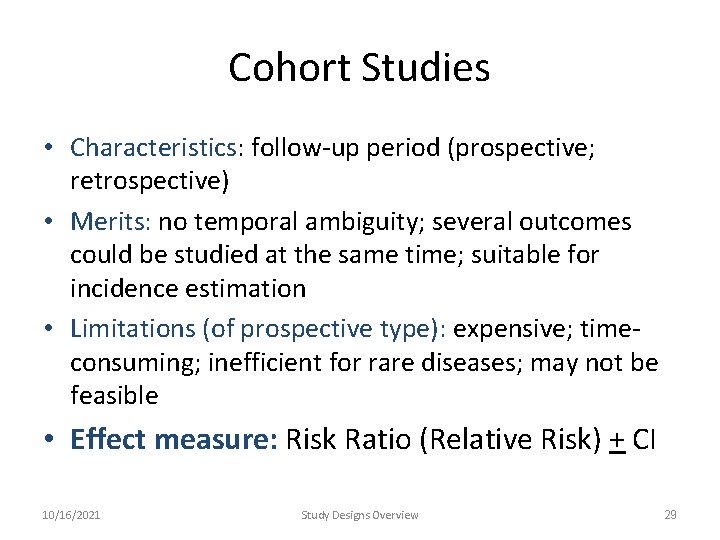
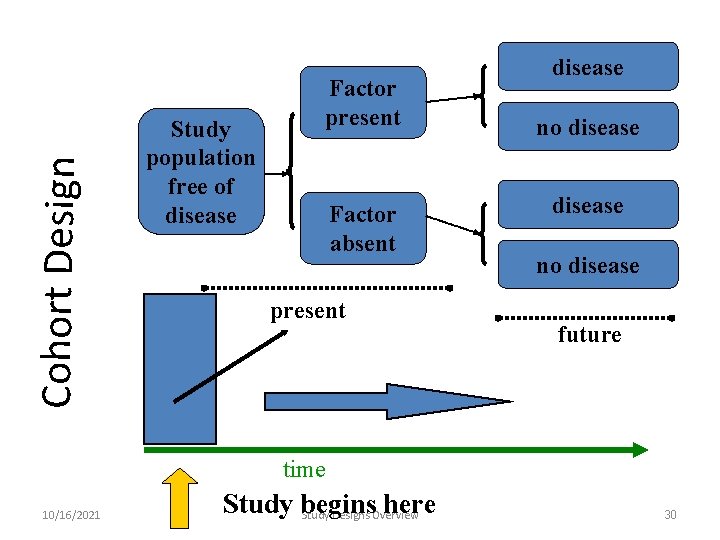
Cohort Studies • Characteristics: follow-up period (prospective; retrospective) • Merits: no temporal ambiguity; several outcomes could be studied at the same time; suitable for incidence estimation • Limitations (of prospective type): expensive; timeconsuming; inefficient for rare diseases; may not be feasible • Effect measure: Risk Ratio (Relative Risk) + CI 10/16/2021 Study Designs Overview 29
Cohort Design Study population free of disease Factor present Factor absent present disease no disease future time 10/16/2021 Study begins here Study Designs Overview 30
Experimental Designs
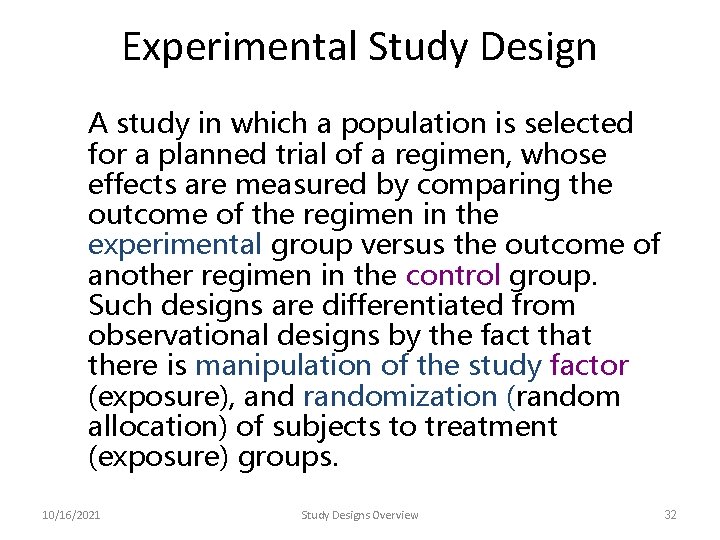
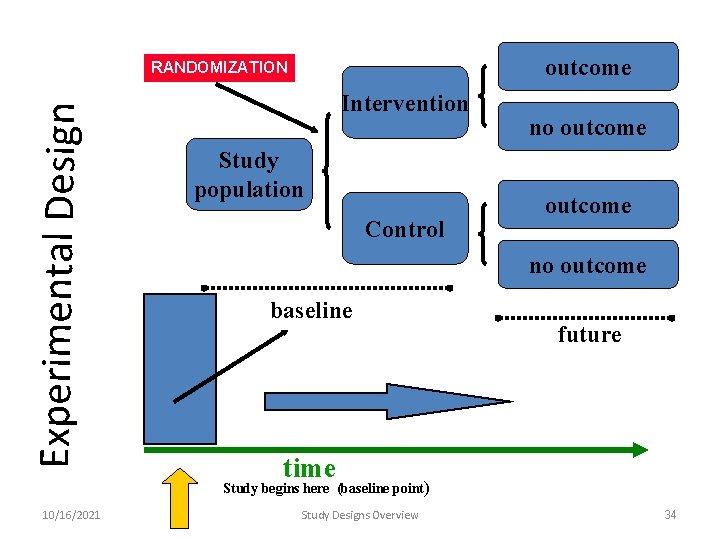
Experimental Study Design A study in which a population is selected for a planned trial of a regimen, whose effects are measured by comparing the outcome of the regimen in the experimental group versus the outcome of another regimen in the control group. Such designs are differentiated from observational designs by the fact that there is manipulation of the study factor (exposure), and randomization (random allocation) of subjects to treatment (exposure) groups. 10/16/2021 Study Designs Overview 32
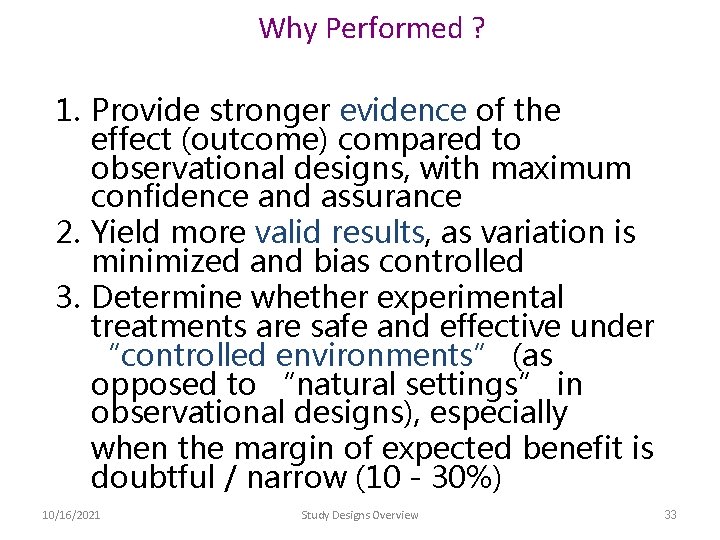
Why Performed ? 1. Provide stronger evidence of the effect (outcome) compared to observational designs, with maximum confidence and assurance 2. Yield more valid results, as variation is minimized and bias controlled 3. Determine whether experimental treatments are safe and effective under “controlled environments” (as opposed to “natural settings” in observational designs), especially when the margin of expected benefit is doubtful / narrow (10 - 30%) 10/16/2021 Study Designs Overview 33
outcome Experimental Design RANDOMIZATION Intervention Study population Control no outcome baseline future time Study begins here (baseline point) 10/16/2021 Study Designs Overview 34
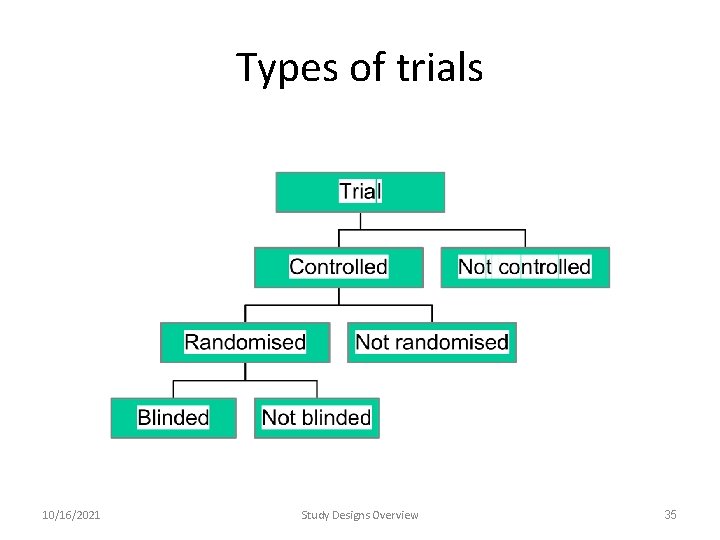
Types of trials 10/16/2021 Study Designs Overview 35
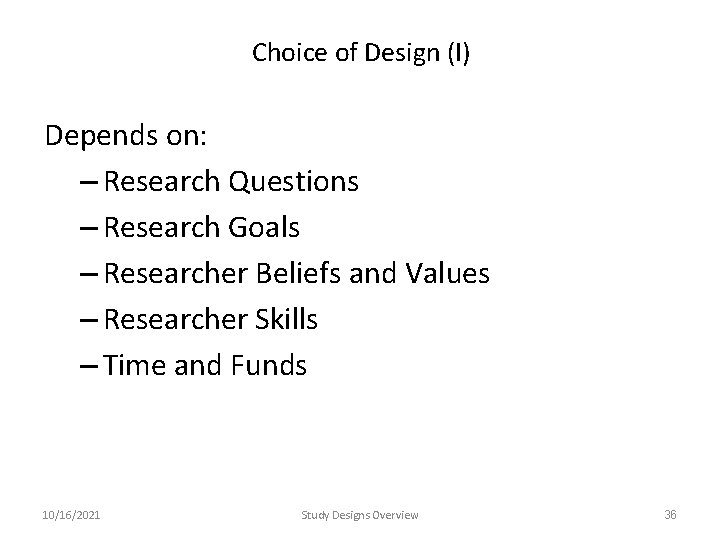
Choice of Design (I) Depends on: – Research Questions – Research Goals – Researcher Beliefs and Values – Researcher Skills – Time and Funds 10/16/2021 Study Designs Overview 36
Choice of design (II) It is also related to: • Status of existent knowledge • Occurrence of disease • Duration of latent period • Nature and availability of information • Available resources 10/16/2021 Study Designs Overview 37
Conclusion • Qualitative designs are complementary to quantitative designs, are important in study of social determinants of health problems • Quantitative designs have a common goal to understand the frequency and causes of health-related phenomena • Seeking causes starts by describing associations between exposures (causes) and outcomes 10/16/2021 Study Designs Overview 38
Headlines Ø Ø Ø Health research Classification of designs Qualitative methods Quantitative methods Choice of design
References 1. Porta M. A dictionary of epidemiology. 5 th edition. Oxford, New York: Oxford University Press, 2008. 2. Rothman J, Greenland S. Modern epidemiology. Second edition. Lippincott - Raven Publishers, 1998. 3. Bhopal R. Study design. University of Edinburgh. 4. NLM. An introduction to Clinical trials. U. S. National Library of Medicine, 2004 5. Songer T. Study designs in epidemiological research. In: South Asian Cardiovascular Research Methodology Workshop. Aga-Khan and Pittsburgh universities. 10/16/2021 Study Designs Overview 40
Thanks for your kind attention and listening