
Study design Objectives To know the different types
Study design
Objectives: • To know the different types and varieties of designs that are commonly used in medical researches. • To know the characteristics, advantages and limitations of each type in order to know how to choose a proper design that helps conduct a strong, efficient and valid study that is neat of errors and bias.
Types of studies A study is an organized, systematic, scientific search for the truth in the community. Study design: Is the main structure of the study that determine it’s approach, plan, and steps of conduction and implementation to reach the inference.
We design a study according to: • Objective(s) od the study • Nature of the research question • Our resources • The inference we aim or expect to reach
We have two main types of epidemiologic studies: 1. Descriptive II. Analytic
I. Descriptive studies Characterize the occurrence of disease in terms of: person-place-time, or host-agent-environment, characterizes exposure and susceptibility state. It enables us to develop (formulate) hypotheses about the disease pattern and also to identify the high risk population.
1. Case report: describes clinical observations, interesting or unusual variation of a disease. Advantages: - Easy, simple, quick, inexpensive. - Calls attention to unexpected findings. Disadvantages: cannot be generalized (single case and not population based).
2. Case series: Refers to a group of similar cases which may enable us to discern a clinical pattern to identify characteristics common to the cases. Advantages: - Easy, simple, quick, and inexpensive. - Recognition of a new disease or beginning of an epidemic. Disadvantages: - Cannot be generalized (small sample size). - Estimation of risk cannot be done (because of lack of a control group).
3. Cross-sectional: (prevalence study, photograph, snap shot, …. ) describe or identify health problems in the entire population (or a sample of the population) at a point in time or over a short period of time. Advantages: - Inexpensive & not time consuming. - Measures the prevalence. - Can study many variables at the same time.
Disadvantages: - Risk cannot be measured. - Chicken-egg dilemma; because the exposure & disease are assessed at the same time. - Selecting survival (usually in fatal disease). - Bias: memory, recall, interviewer, loss of accuracy of temporal relationship.
4. Ecologic (Correlation) studies Measures that represent characteristics of entire population are used to describe disease and to postulate causal association. Strengths: Cheap, quick and simple (generally make use of secondary data). Limitations: • Can not link exposure-disease relationship at the individual level • Uses average exposure levels rather than actual levels of exposure • Inability to control for confounding factors
5. Biometry 6. Hospital-records study 7. Meta analysis (Generally descriptive studies are used only to suggest hypotheses & not to test them. )
II-Analytic-studies: go beyond simply describing the distribution of occurrence of diseases & attempt to analyze the reasons for them (testing etiological hypotheses). So hypotheses derived from descriptive studies may be tested by analytic studies. Factor & disease can be the dependent or independent variable according to the approach of the study. It is of 2 types:
A- Observational: In which we just observe (then analyze) what is going on without interference - Case control studies - Cohort studies
1. Case-control: in which subjects are selected on basis of presence or absence of disease. Advantages: - Easy, quick, inexpensive & can support (but not prove) casual hypotheses. - Useful in rare diseases but not rare exposures. - Odds ratio can be estimated from it. Disadvantages: - Cannot measure incidence or RR. - Bias: selection, memory, and recall
. - Problems of control group: * No. should be 1 -4 times. * Matching (particular & conceptual problem). * Randomization (problem of specific control). * Types of control group. Nested case control study: A case control study inside the cohort prospective to decrease time, money & efforts, it will identify the risk factors & eliminate re-call bias.
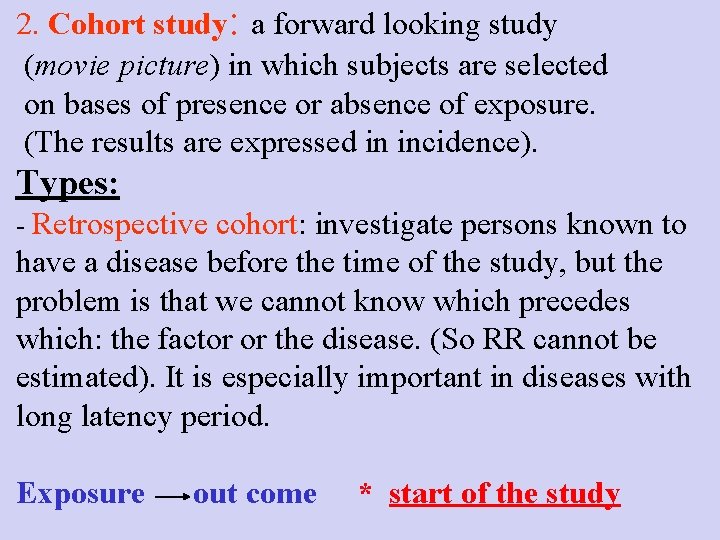
2. Cohort study: a forward looking study (movie picture) in which subjects are selected on bases of presence or absence of exposure. (The results are expressed in incidence). Types: - Retrospective cohort: investigate persons known to have a disease before the time of the study, but the problem is that we cannot know which precedes which: the factor or the disease. (So RR cannot be estimated). It is especially important in diseases with long latency period. Exposure out come * start of the study
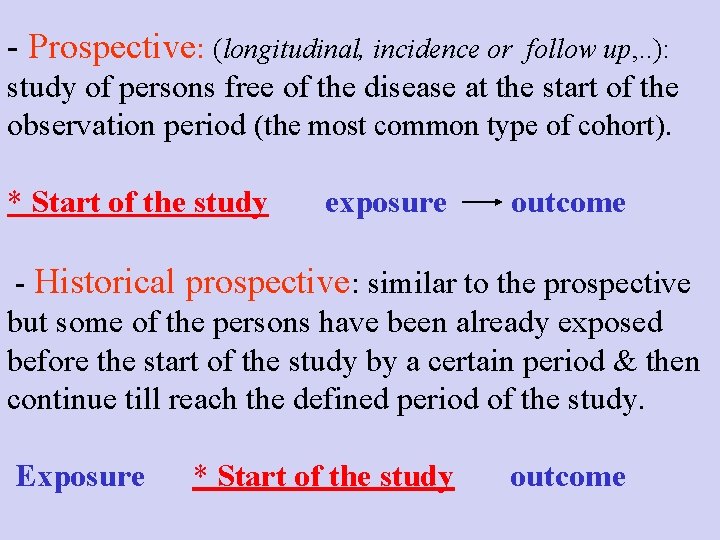
- Prospective: (longitudinal, incidence or follow up, . . ): study of persons free of the disease at the start of the observation period (the most common type of cohort). * Start of the study exposure outcome - Historical prospective: similar to the prospective but some of the persons have been already exposed before the start of the study by a certain period & then continue till reach the defined period of the study. Exposure * Start of the study outcome
Advantages: - Test hypotheses of casual relationship & give directly RR. - Temporal sequence between exposure & disease can be more clearly established. - Confirm causes, and magnitude of risk can be quantified more clearly because it gives us incidence rates. - Particularly suited for assessing the effects of rare exposures.
Disadvantages: - Time, efforts & money consuming. - Problems of non-response or drop out (attrition). - Not feasible for disease of low incidence because non or very few persons in the sample may actually manifest the disease.
B- Interventional: (randomized trial) A high quality type of cohort studies in which the investigator himself allocates the exposure, means we don’t only observe but do interfere in the form of a new element which could be a new drug, surgical procedure, vaccine, test, or new method of diagnosis. So it has the potential to provide a degree of assurance about the validity of a result that is not possible with any observational design option.
Types: Therapeutic trial: - Two different drugs or procedures. - Drug & placebo - Single drug (before & after Rx). Preventive trial: - Individuals (as in polio vaccine). - Entire pop. (community trial) an in floride fortification of water.
Types • • Randomized controlled trials (clinical trials) Cluster randomized controlled trials Field trials Community trials
Unique problems: - Ethical: we must be sure that it is not harmful, never the less we must inform them about the aim of the study & the possible complications, get their acceptance & decide when to stop & when to proceed, there must be sufficient doubt about the agent to be tested to allow withholding it from half the subjects & at the same time there must be sufficient belief in the agents potential justify exposing the remaining half. - Feasibility: should be considered before a believe gets spread. - Cost.
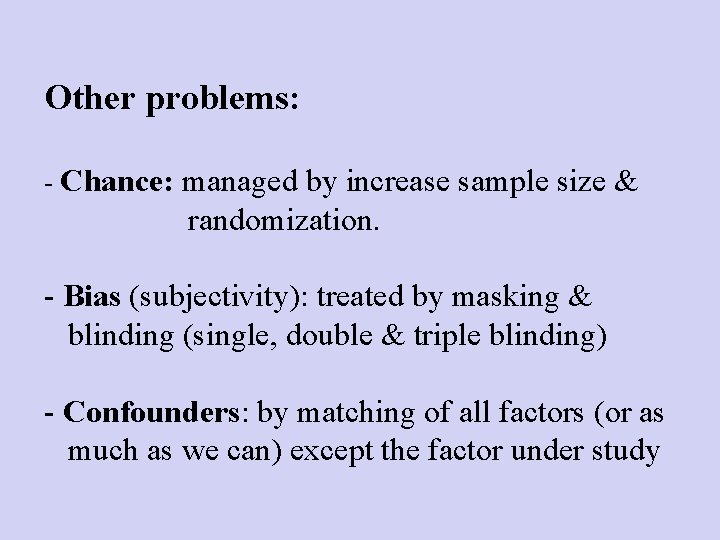
Other problems: - Chance: managed by increase sample size & randomization. - Bias (subjectivity): treated by masking & blinding (single, double & triple blinding) - Confounders: by matching of all factors (or as much as we can) except the factor under study
- Slides: 25