
Study Design Analytical Interventional Studies Analytical Interventional Studies

- Slides: 24
Study Design Analytical Interventional Studies
Analytical Interventional Studies The purpose of an analytic study in epidemiology is to identify and quantify the relationship between an exposure and a health outcome.
Analytical Interventional Studies Interventional studies are those in which the research subjects are assigned by the investigator to a treatment or other intervention, and their outcomes are measured. Observational studies are those in which individuals are observed and their outcomes are measured by the investigators.
Analytical Interventional Studies • There are two major types of intervention studies: • Controlled clinical trials in which individual subjects are assigned to one or another of the competing interventions, or • Community interventions, in which an intervention is assigned to an entire group.
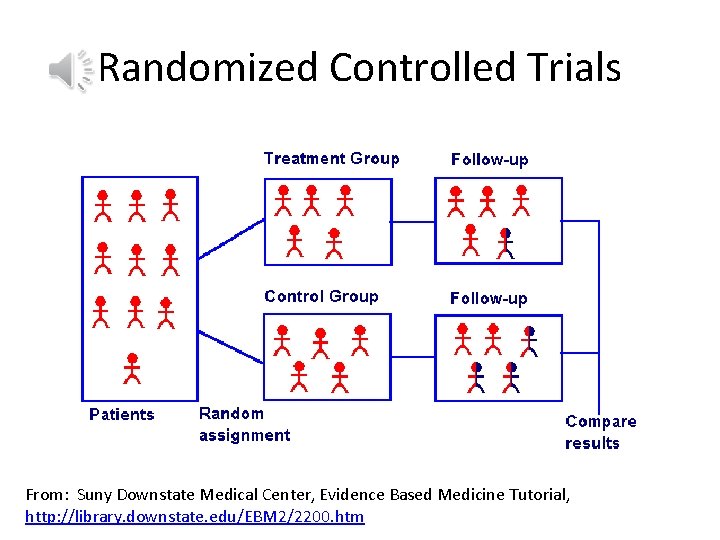
Randomized Controlled Trials • Randomized controlled trials are carefully planned projects that study the effect of a therapy on real patients. They include methodologies that reduce the potential for bias and that allow for comparison between intervention groups and control groups (no intervention).
Randomized Controlled Trials • Participants are randomly assigned into an experimental group or a control group. As the study is conducted, the only expected difference between the control and experimental groups in a randomized controlled trial (RCT) is the outcome variable being studied.
Randomized Controlled Trials From: Suny Downstate Medical Center, Evidence Based Medicine Tutorial, http: //library. downstate. edu/EBM 2/2200. htm
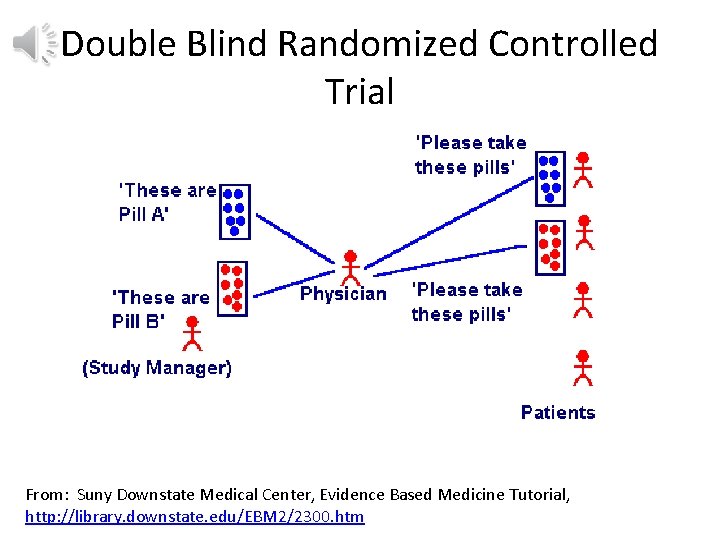
Double Blind Randomized Controlled Trial • A double blind study is one in which neither the patient nor the physician knows whether the patient is receiving the treatment of interest or the control treatment.
Double Blind Randomized Controlled Trial From: Suny Downstate Medical Center, Evidence Based Medicine Tutorial, http: //library. downstate. edu/EBM 2/2300. htm
Placebo Controlled Study • Placebo-controlled studies are a way of testing a medical therapy in which, in addition to a group of subjects that receives the treatment to be evaluated, a separate control group receives a sham "placebo" treatment which is specifically designed to have no real effect.
Placebo Controlled Study • Placebos are most commonly used in blinded trials, where subjects do not know whether they are receiving real or placebo treatment. Often, there is also a further "natural history" group that does not receive any treatment at all.
Crossover Design • A controlled trial where each study participant has both therapies, e. g, is randomised to treatment A first, at the crossover point they then start treatment B. Only relevant if the outcome is reversible with time, e. g, symptoms. Subjects act as own control.
Crossover Design From: The Prehospital Research Support site, http: //prehospitalresearch. eu/? p=1961
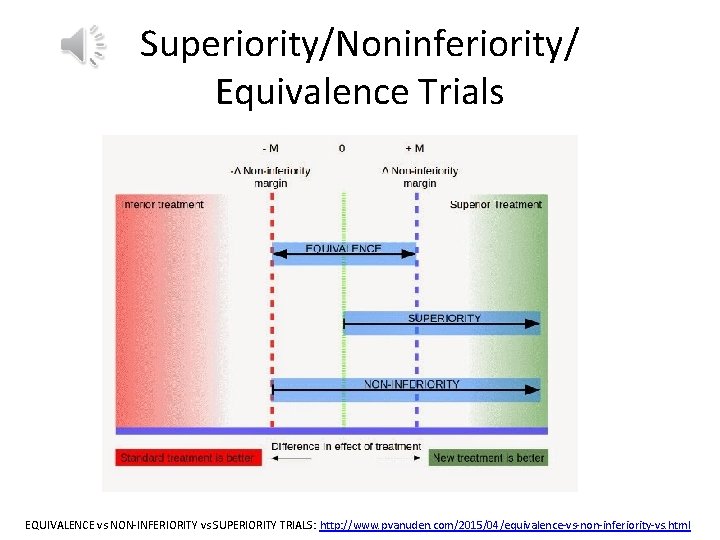
Superiority/Noninferiority/ Equivalence Trials • In biomedical and mental health research, by far the most common conceptual approach is traditional significance testing in between-group designs, useful for determining if group outcomes are clinically and statistically different from each other and if so, in which direction. • This is the standard approach used in most treatment outcome studies, where it is hypothesized that an experimental treatment is superior to a comparison treatment. • These are superiority trials.
Superiority/Noninferiority/ Equivalence Trials • “Noninferiority” and “equivalence” are often used interchangeably to refer to trials in which the primary objective is to show that a novel intervention is as effective as the standard intervention.
Superiority/Noninferiority/ Equivalence Trials • Noninferiority designs are a one-sided test used to determine if a novel intervention is no worse than a standard intervention. • A noninferiority trial is designed to show that the novel treatment is no less than a certain amount from the standard intervention (i. e. , a one-sided test)
Superiority/Noninferiority/ Equivalence Trials • Equivalence designs, a two-sided test, pose a similar question, but also allow for the possibility that the novel intervention is no better than the standard one. • An equivalence trial is a trial designed to show that two interventions do not differ in either direction by more than a pre-specified unimportant or insignificant amount (i. e. , a two-sided test),
Superiority/Noninferiority/ Equivalence Trials EQUIVALENCE vs NON-INFERIORITY vs SUPERIORITY TRIALS: http: //www. pvanuden. com/2015/04/equivalence-vs-non-inferiority-vs. html
Community Intervention • In contrast to a controlled clinical trial, a community intervention allocates the trial to a group of subjects. These types of trials are generally conducted when the intervention inherently operates at a group-level (e. g. , changing a law or policy) or because it would be difficult to give the intervention to some people in the group while withholding it from others.
Community Intervention • Group units might be families, schools, or medical practices. • In the 1940 s the effectiveness of fluoride in preventing dental caries was tested comparing the frequency of caries in the children in Kingston and Newburgh, New York after Newburgh had fluoride added to the town's drinking water.
Question • A control group of pediatric patients with asthma was assigned to be given standard asthma educational resources, while the experimental group of pediatric patients with asthma was assigned to be given standard resources plus multimedia resources. The study found a reduction in daily symptoms, in emergency room visits, in school days missed, and in days of limited activity in the group given multimedia education resources. Which of the following correctly identifies the study design used by the researcher? • Community Intervention • Double Blind Randomized Controlled Trial • Randomized Controlled Trial
Answer • Randomized Controlled Trial • Subjects were randomly assigned to one or another of competing interventions.
Question • In an ongoing study a researcher hypothesizes that using a telemental health modality will not be worse than the traditional mode of service delivery (face-to-face), on both clinical and process measures, for providing Cognitive Processing Therapy in a group format for veterans with PTSD. Which of the following correctly identifies the study design used by the researcher? • Equivalence Trial • Noninferiority Trial • Superiority Trial
Answer • Noninferiority Trial • A noninferiority trial aims to demonstrate that the test product is not worse than the comparator by more than a small prespecified amount. This amount is known as the noninferiority margin, or delta.