
Study Area 11 Stress and Health Stress Stress
- Slides: 38
Study Area 11 Stress and Health
Stress • Stress: physical, emotional, cognitive, and behavioral responses to events that are appraised as threatening or challenging. • Stressors: events that cause a stress reaction. • Stress is simply a reaction to a stimulus that disturbs our physical or mental equilibrium. In other words, it's an omnipresent part of life. A stressful event can trigger the “fight-or-flight” response, causing hormones such as adrenaline and cortisol to surge through the body.
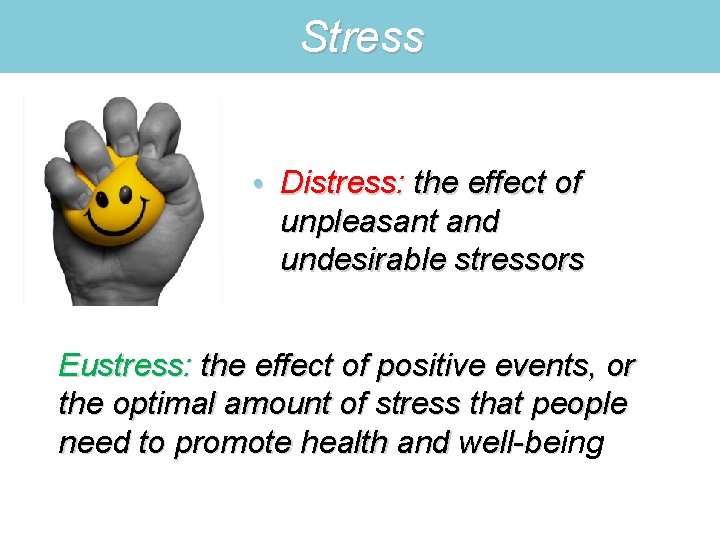
Stress • Distress: the effect of unpleasant and undesirable stressors Eustress: the effect of positive events, or the optimal amount of stress that people need to promote health and well-being well-be
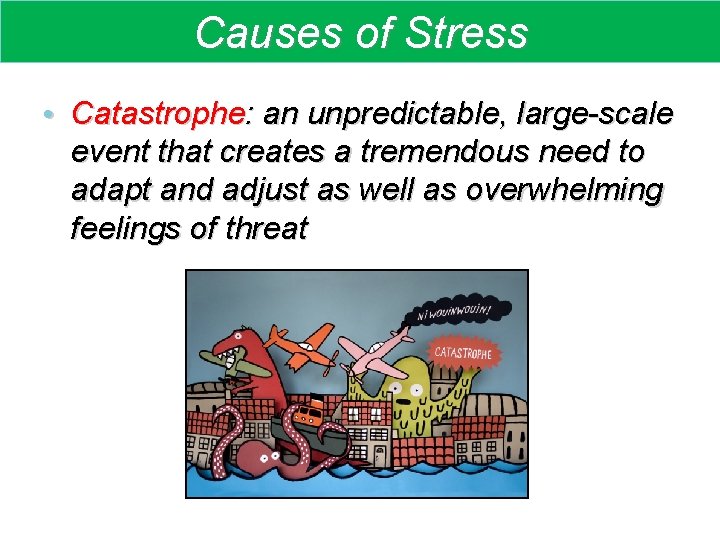
Causes of Stress • Catastrophe: an unpredictable, large-scale event that creates a tremendous need to adapt and adjust as well as overwhelming feelings of threat
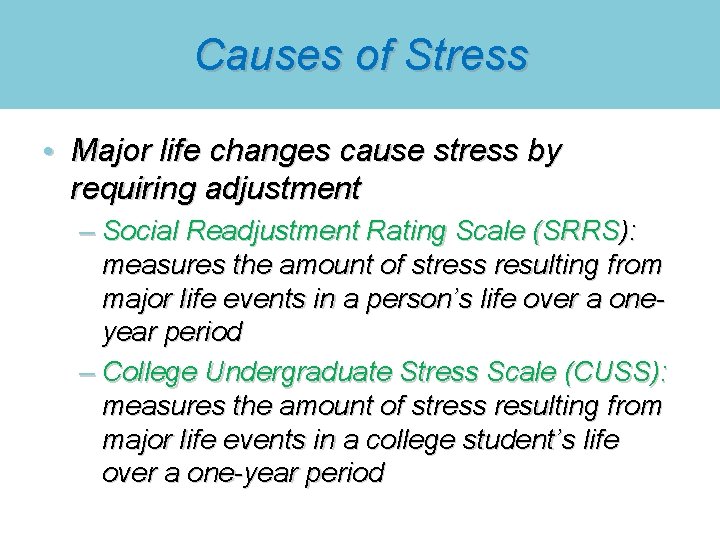
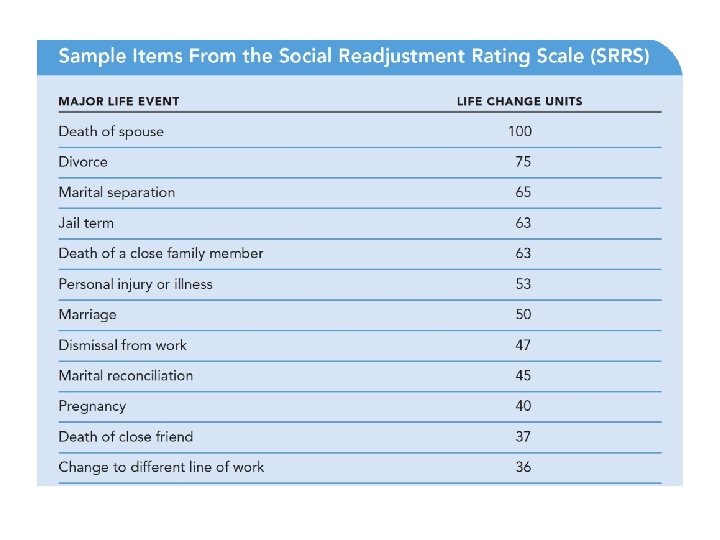
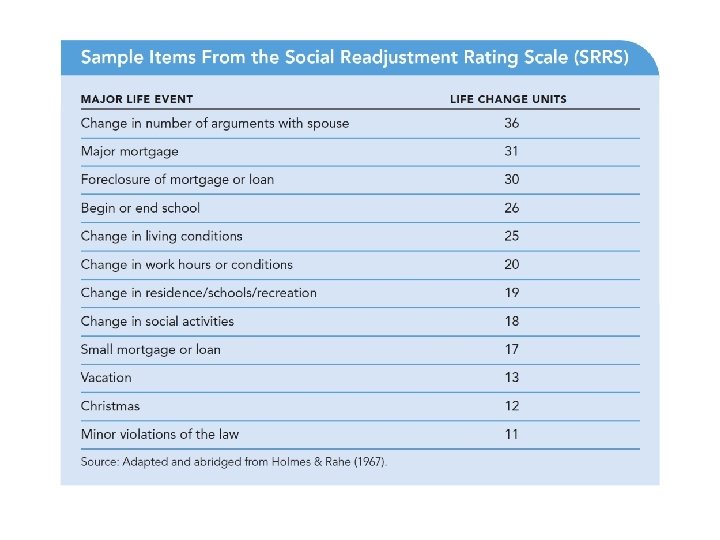
Causes of Stress • Major life changes cause stress by requiring adjustment – Social Readjustment Rating Scale (SRRS): measures the amount of stress resulting from major life events in a person’s life over a oneyear period – College Undergraduate Stress Scale (CUSS): measures the amount of stress resulting from major life events in a college student’s life over a one-year period
Table 11. 1 (continued) Sample Items From the Social Readjustment Rating Scale (SRRS)
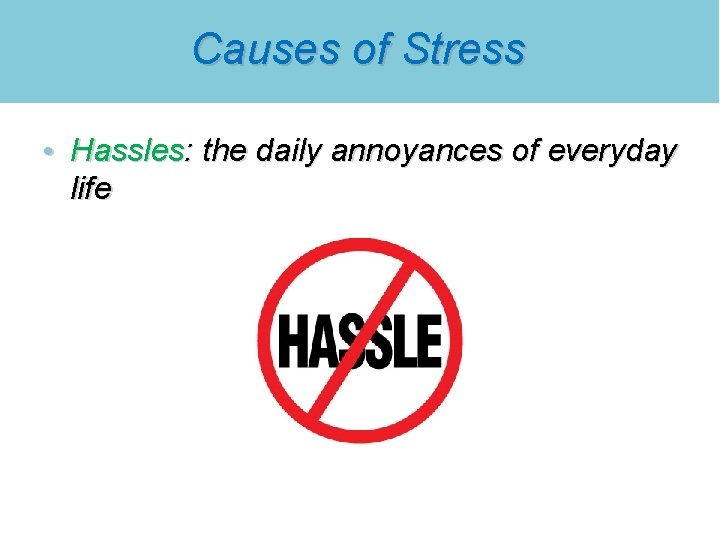
Causes of Stress • Hassles: the daily annoyances of everyday life
Everyday Sources of Stress • Pressure: the psychological experience produced by urgent demands or expectations for a person’s behavior that come from an outside source • Uncontrollability: the degree of control that the person has over a particular event or situation – the less control a person has, the greater the degree of stress stres
Everyday Sources of Stress • Frustration: the psychological experience produced by the blocking of a desired goal or fulfillment of a perceived need • Possible reactions to frustration – aggression: actions meant to harm or destroy – displaced aggression: taking out one’s frustrations on some less threatening or more available target § a form of displacement
Everyday Sources of Stress • Possible reactions to frustrations (cont’d): – escape or withdrawal: leaving the presence of a stressor § either literally or by a psychological withdrawal into fantasy, drug abuse, or apathy - Flight -
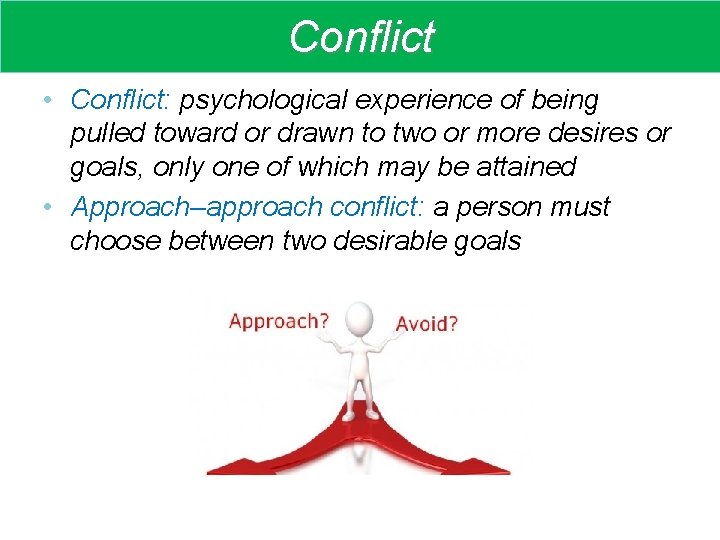
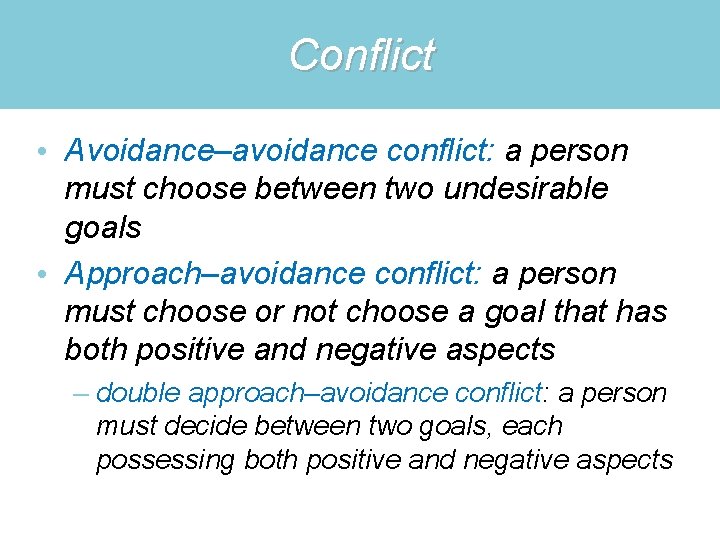
Conflict • Conflict: psychological experience of being pulled toward or drawn to two or more desires or goals, only one of which may be attained • Approach–approach conflict: a person must choose between two desirable goals
Conflict • Avoidance–avoidance conflict: a person must choose between two undesirable goals • Approach–avoidance conflict: a person must choose or not choose a goal that has both positive and negative aspects – double approach–avoidance conflict: a person must decide between two goals, each possessing both positive and negative aspects
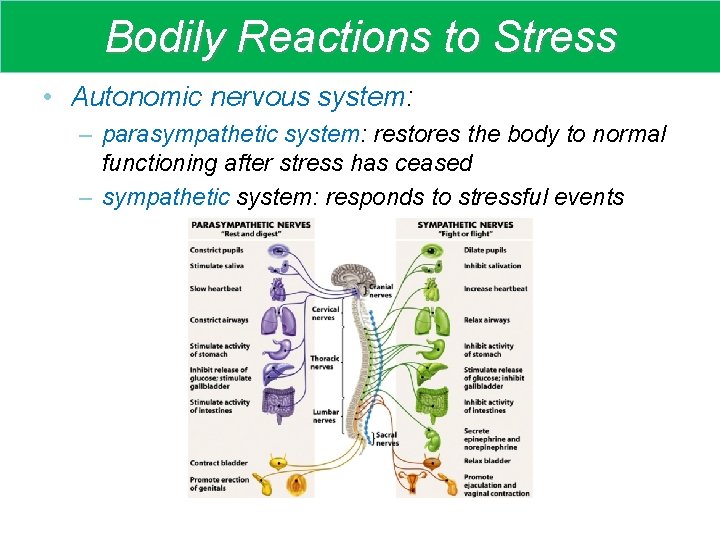
Bodily Reactions to Stress • Autonomic nervous system: – parasympathetic system: restores the body to normal functioning after stress has ceased – sympathetic system: responds to stressful events
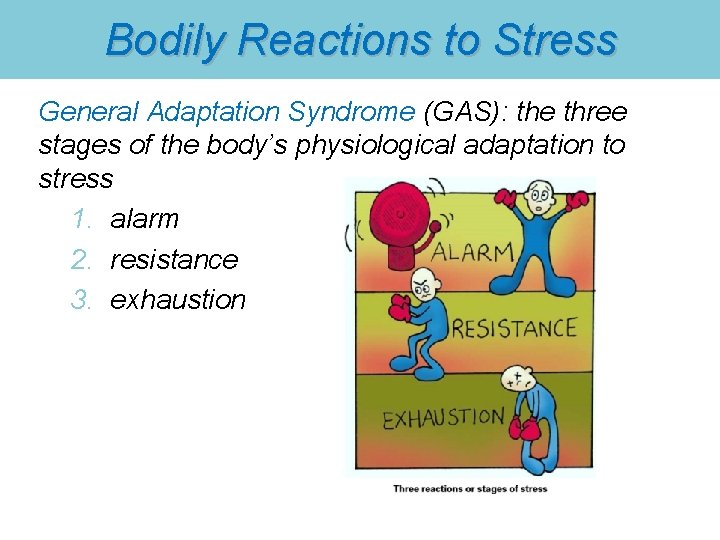
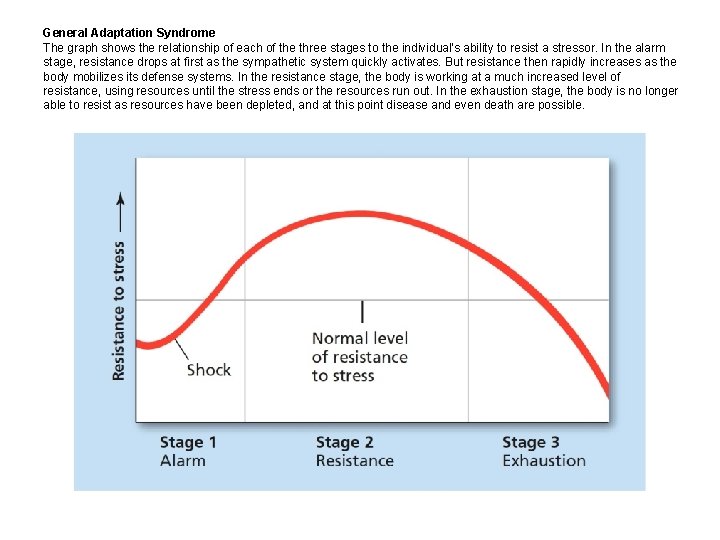
Bodily Reactions to Stress General Adaptation Syndrome (GAS): the three stages of the body’s physiological adaptation to stress 1. alarm 2. resistance 3. exhaustion
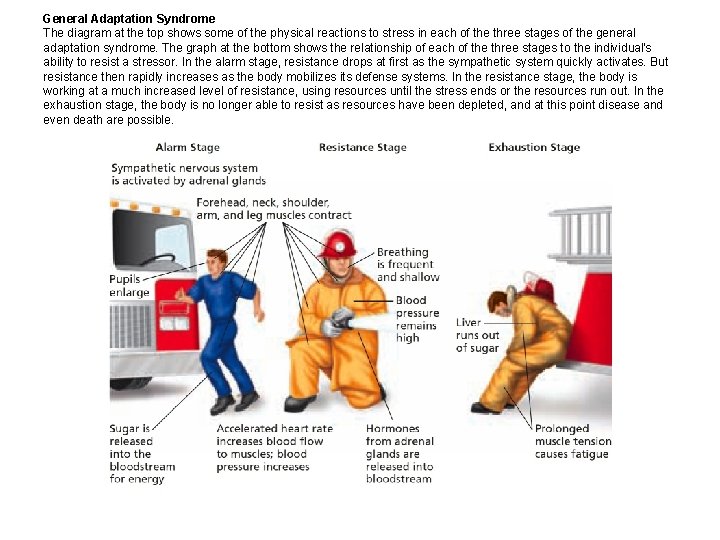
General Adaptation Syndrome The diagram at the top shows some of the physical reactions to stress in each of the three stages of the general adaptation syndrome. The graph at the bottom shows the relationship of each of the three stages to the individual’s ability to resist a stressor. In the alarm stage, resistance drops at first as the sympathetic system quickly activates. But resistance then rapidly increases as the body mobilizes its defense systems. In the resistance stage, the body is working at a much increased level of resistance, using resources until the stress ends or the resources run out. In the exhaustion stage, the body is no longer able to resist as resources have been depleted, and at this point disease and even death are possible.
General Adaptation Syndrome The graph shows the relationship of each of the three stages to the individual’s ability to resist a stressor. In the alarm stage, resistance drops at first as the sympathetic system quickly activates. But resistance then rapidly increases as the body mobilizes its defense systems. In the resistance stage, the body is working at a much increased level of resistance, using resources until the stress ends or the resources run out. In the exhaustion stage, the body is no longer able to resist as resources have been depleted, and at this point disease and even death are possible.
Stress and the Immune System • Immune system: cells, organs, and chemicals of the body that respond to attacks from diseases, infections, and injuries – negatively affected by stress • Psychoneuroimmunology: the study of the effects of psychological factors on the immune system
Stress and the Immune System • Heart disease: stress puts people at higher risk for coronary heart disease (CHD) • Diabetes: type 2 diabetes is associated with excessive weight gain – occurs when pancreas insulin levels become less efficient as the body size increases • Cancer: stress increases malfunction of natural killer (NK) cell – NK cell: responsible for suppressing viruses and destroying tumor cells
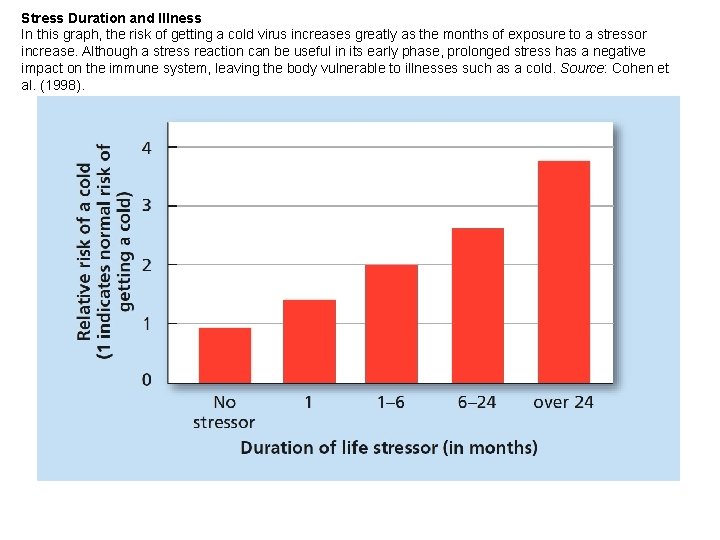
Stress Duration and Illness In this graph, the risk of getting a cold virus increases greatly as the months of exposure to a stressor increase. Although a stress reaction can be useful in its early phase, prolonged stress has a negative impact on the immune system, leaving the body vulnerable to illnesses such as a cold. Source: Cohen et al. (1998).
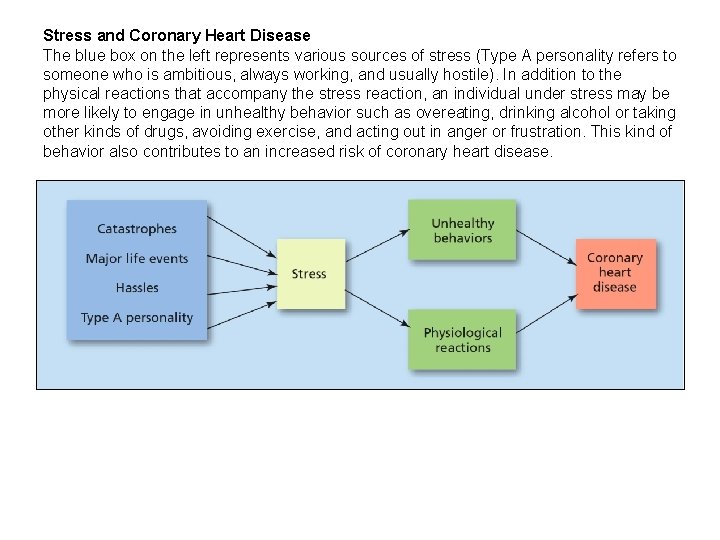
Stress and Coronary Heart Disease The blue box on the left represents various sources of stress (Type A personality refers to someone who is ambitious, always working, and usually hostile). In addition to the physical reactions that accompany the stress reaction, an individual under stress may be more likely to engage in unhealthy behavior such as overeating, drinking alcohol or taking other kinds of drugs, avoiding exercise, and acting out in anger or frustration. This kind of behavior also contributes to an increased risk of coronary heart disease.
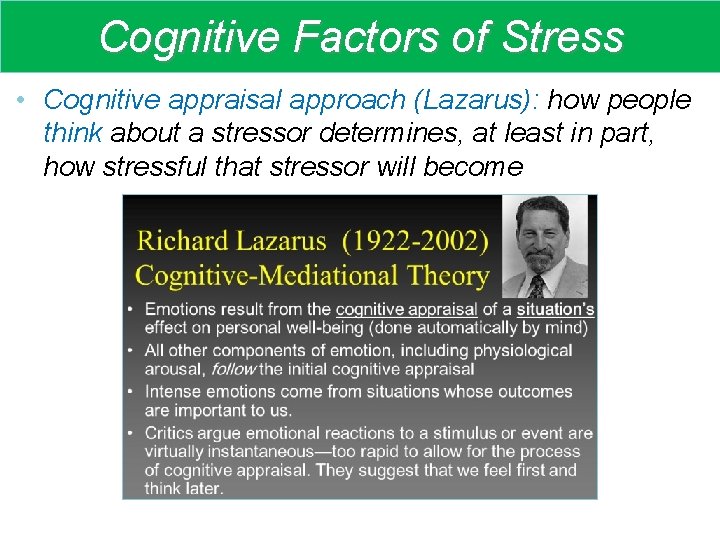
Cognitive Factors of Stress • Cognitive appraisal approach (Lazarus): how people think about a stressor determines, at least in part, how stressful that stressor will become
Cognitive Factors of Stress • Cognitive appraisal approach – primary appraisal: involves estimating the severity of a stressor and classifying it as either a threat or a challenge – secondary appraisal: involves estimating the resources available to the person for coping with the stressor
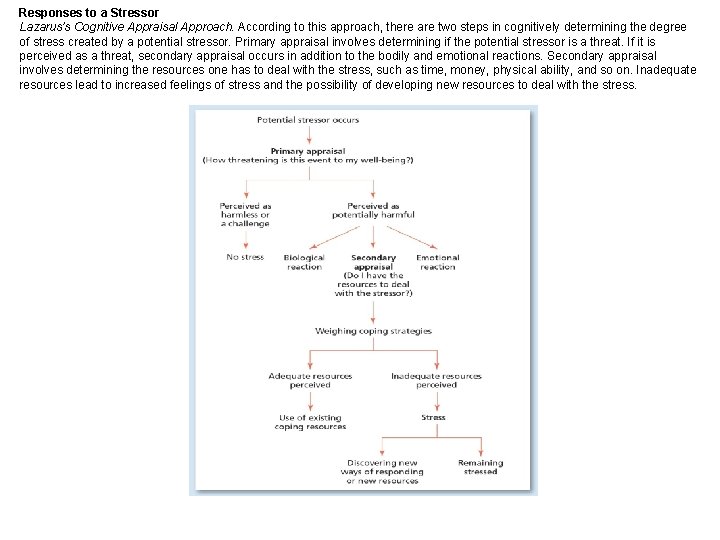
Responses to a Stressor Lazarus’s Cognitive Appraisal Approach. According to this approach, there are two steps in cognitively determining the degree of stress created by a potential stressor. Primary appraisal involves determining if the potential stressor is a threat. If it is perceived as a threat, secondary appraisal occurs in addition to the bodily and emotional reactions. Secondary appraisal involves determining the resources one has to deal with the stress, such as time, money, physical ability, and so on. Inadequate resources lead to increased feelings of stress and the possibility of developing new resources to deal with the stress.
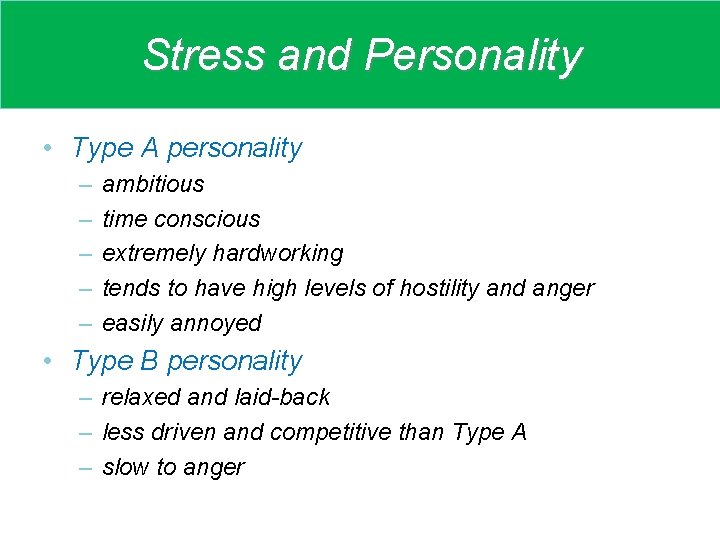
Stress and Personality • Type A personality – – – ambitious time conscious extremely hardworking tends to have high levels of hostility and anger easily annoyed • Type B personality – relaxed and laid-back – less driven and competitive than Type A – slow to anger
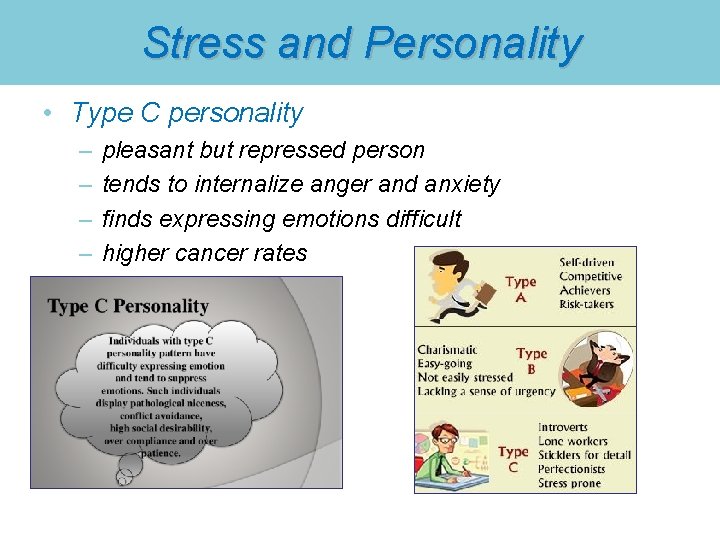
Stress and Personality • Type C personality – – pleasant but repressed person tends to internalize anger and anxiety finds expressing emotions difficult higher cancer rates
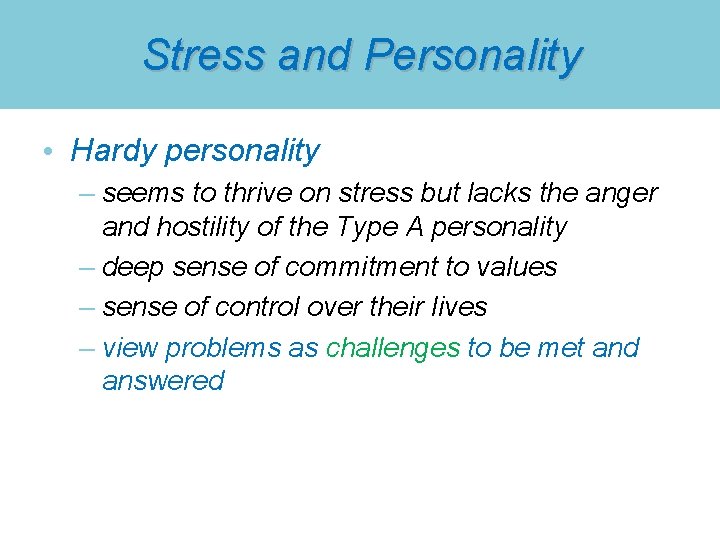
Stress and Personality • Hardy personality – seems to thrive on stress but lacks the anger and hostility of the Type A personality – deep sense of commitment to values – sense of control over their lives – view problems as challenges to be met and answered
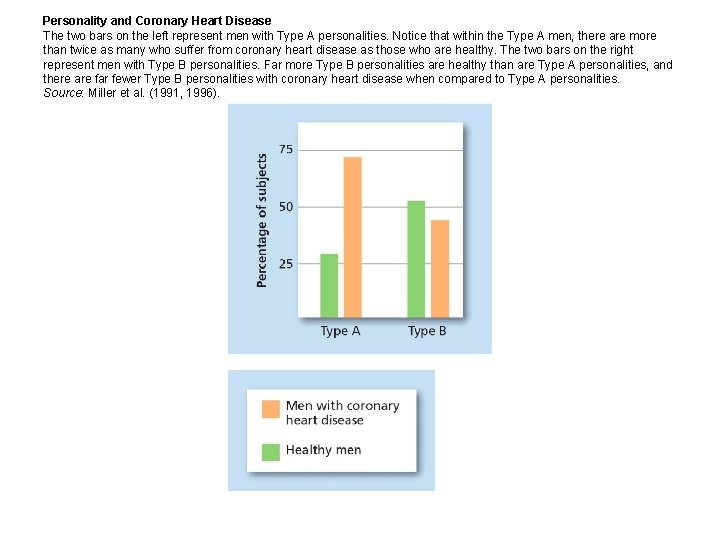
Personality and Coronary Heart Disease The two bars on the left represent men with Type A personalities. Notice that within the Type A men, there are more than twice as many who suffer from coronary heart disease as those who are healthy. The two bars on the right represent men with Type B personalities. Far more Type B personalities are healthy than are Type A personalities, and there are far fewer Type B personalities with coronary heart disease when compared to Type A personalities. Source: Miller et al. (1991, 1996).
Stress and Personality • Explanatory styles – optimists: expect positive outcomes – pessimists: expect negative outcomes – optimists less likely to § develop learned helplessness § ignore their health § become depressed It’s better to be an optimist – most of us are!
Stress and Social Factors • Social factors increasing the effects of stress include: – poverty – stresses on the job or in the workplace – entering a majority culture that is different from one’s culture of origin • Burnout: negative changes in thoughts, emotions, and behavior as a result of prolonged stress or frustration
Stress and Social Factors • Acculturative stress: results from the need to change and adapt to the majority culture – four methods of acculturation: 1. integration: maintaining a sense of original culture while forming positive relationship with majority culture 2. assimilation: giving up original cultural identity and adopting majority culture 3. separation: rejecting the majority culture’s ways 4. marginalization: maintaining no ties with original or majority cultures
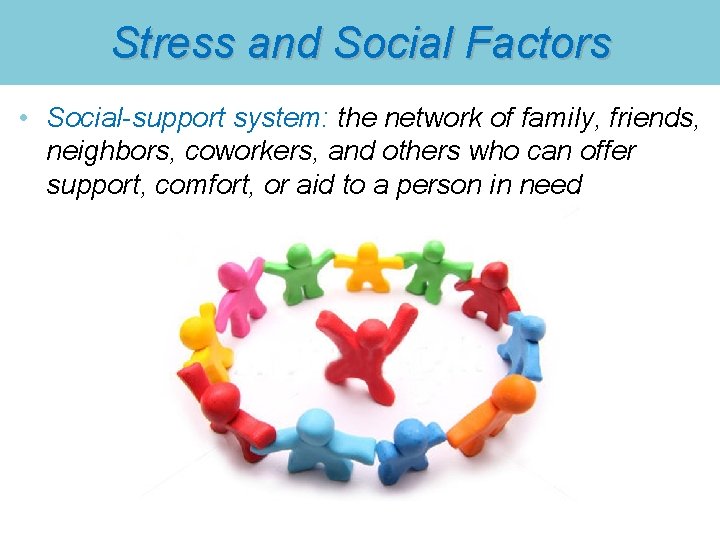
Stress and Social Factors • Social-support system: the network of family, friends, neighbors, coworkers, and others who can offer support, comfort, or aid to a person in need
Ways to Deal with Stress • Coping strategies: actions that people can take to master, tolerate, reduce, or minimize the effects of stressors – problem-focused coping: one tries to eliminate the source of a stress or reduce its impact through direct actions – emotion-focused coping: one changes the impact of a stressor by changing the emotional reaction to the stressor
Meditation • Meditation: mental exercises meant to refocus attention and achieve a trancelike state of consciousness and relaxation • Concentrative meditation: a person focuses the mind on some repetitive or unchanging stimulus so that the mind can be cleared of disturbing thoughts and the body can experience relaxation
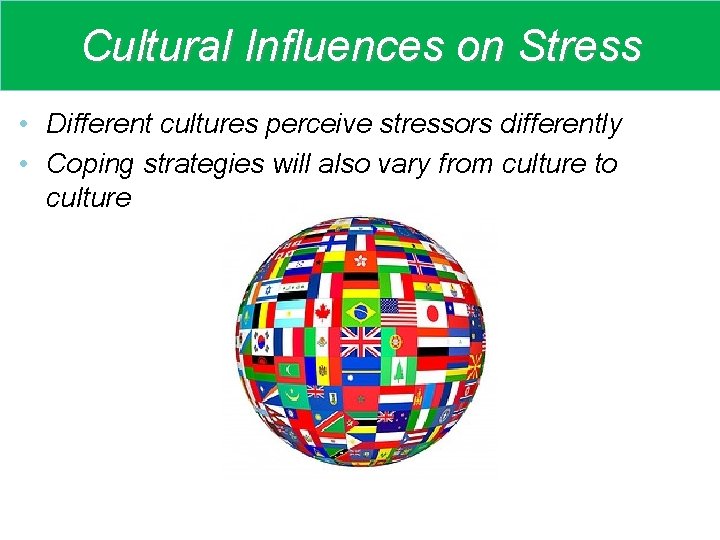
Cultural Influences on Stress • Different cultures perceive stressors differently • Coping strategies will also vary from culture to culture
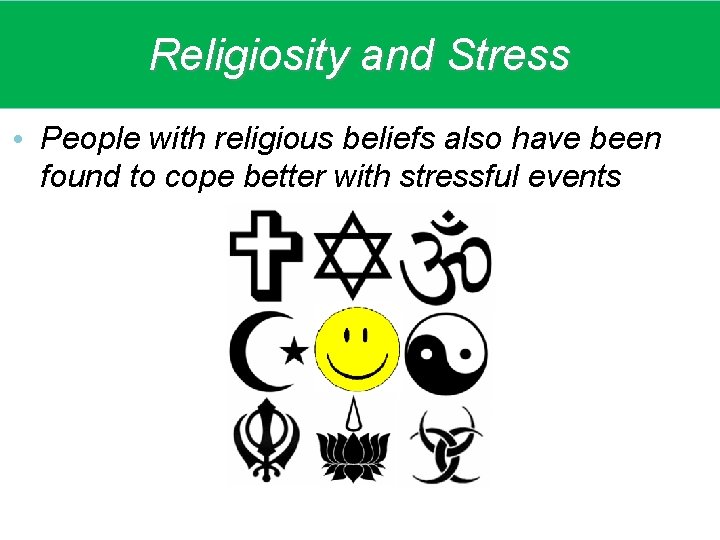
Religiosity and Stress • People with religious beliefs also have been found to cope better with stressful events
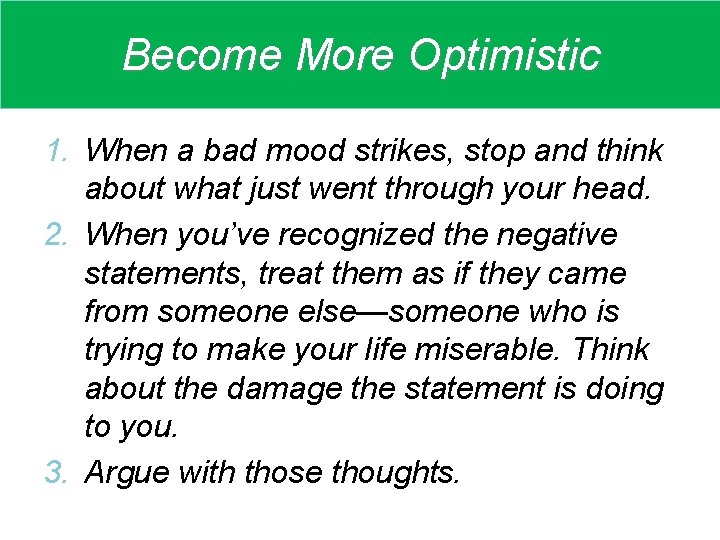
Become More Optimistic 1. When a bad mood strikes, stop and think about what just went through your head. 2. When you’ve recognized the negative statements, treat them as if they came from someone else—someone who is trying to make your life miserable. Think about the damage the statement is doing to you. 3. Argue with those thoughts.
The End – Study Area 11 Stress and Health