
Studio Empathy Assignment 1 Introduction to Human Computer
- Slides: 27
Studio – Empathy & Assignment #1 Introduction to Human Computer Interaction & Design Hao-Hua Chu National Taiwan University Sept 19, 2016 *** Adapt teaching materials from the Stanford HCI course (with permission & many thanks to Prof. James Landay of Stanford) as well as Stanford D. School 9/22/2015 1
Studio: Empathy Exercises • • Open-ended questions (10 min) Basic interviewing skills (45 min) Observation vs Interpretation (20 min) Extreme Users (15 min) September 24, 2015 dt+UX: Design Thinking for User Experience Design, Prototyping & Evaluation 2
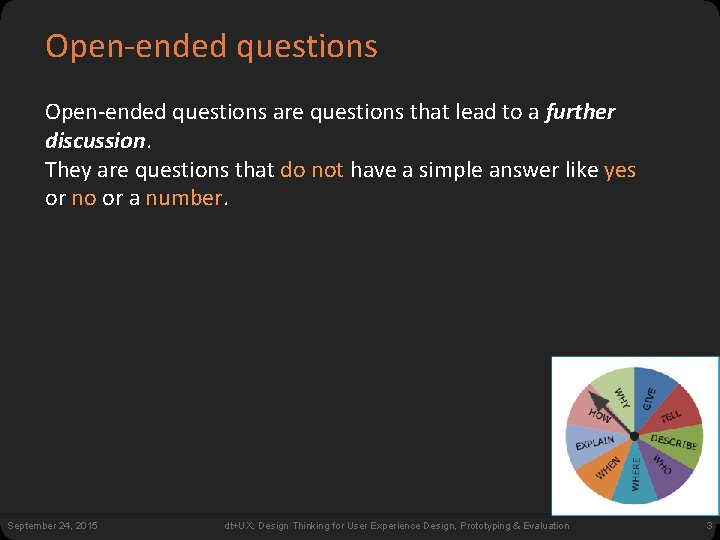
Open-ended questions are questions that lead to a further discussion. They are questions that do not have a simple answer like yes or no or a number. September 24, 2015 dt+UX: Design Thinking for User Experience Design, Prototyping & Evaluation 3
Open-ended questions are questions that lead to a further discussion. They are questions that do not have a simple answer like yes or no or a number. Example: - Did you like that activity? What are your favorite things about this activity? Did you have fun with that activity? What would you change about that activity? September 24, 2015 dt+UX: Design Thinking for User Experience Design, Prototyping & Evaluation 4
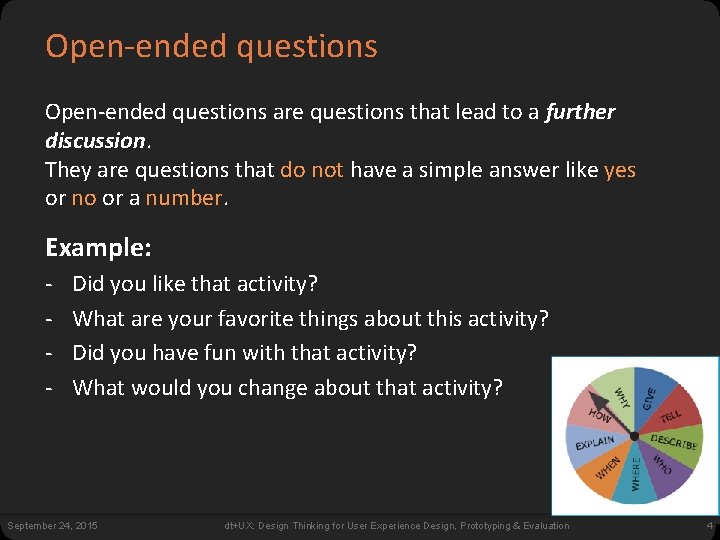
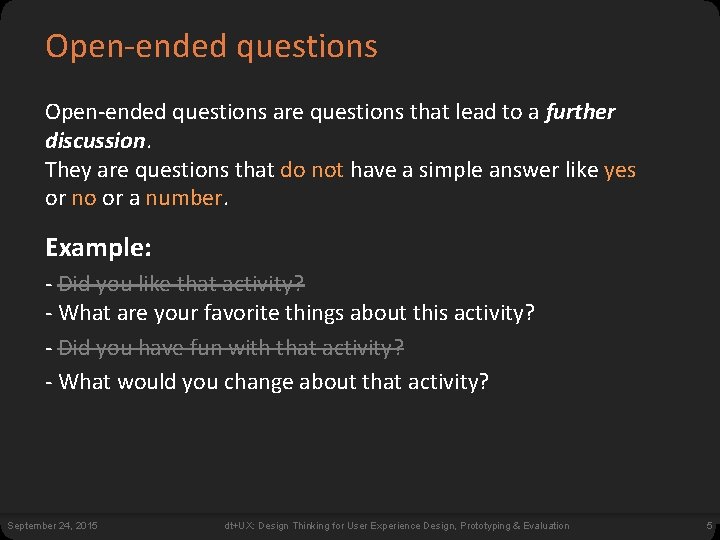
Open-ended questions are questions that lead to a further discussion. They are questions that do not have a simple answer like yes or no or a number. Example: - Did you like that activity? - What are your favorite things about this activity? - Did you have fun with that activity? - What would you change about that activity? September 24, 2015 dt+UX: Design Thinking for User Experience Design, Prototyping & Evaluation 5
Ask your partner following questions For 4 minutes (A -> B) - What did you eat for breakfast this morning? - Describe your ideal weekend? September 24, 2015 dt+UX: Design Thinking for User Experience Design, Prototyping & Evaluation 6
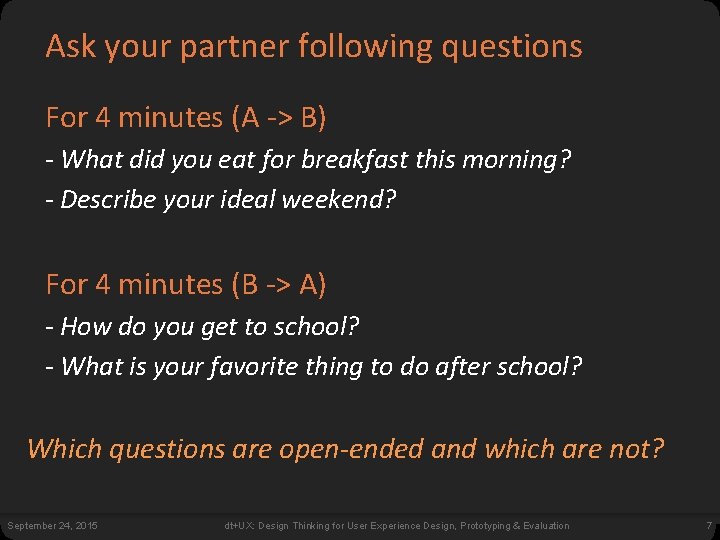
Ask your partner following questions For 4 minutes (A -> B) - What did you eat for breakfast this morning? - Describe your ideal weekend? For 4 minutes (B -> A) - How do you get to school? - What is your favorite thing to do after school? Which questions are open-ended and which are not? September 24, 2015 dt+UX: Design Thinking for User Experience Design, Prototyping & Evaluation 7
Studio: Empathy Exercises • • Open-ended questions (10 min) Basic interviewing skills (45 min) Observation vs Interpretation (20 min) Extreme Users (15 min) September 24, 2015 dt+UX: Design Thinking for User Experience Design, Prototyping & Evaluation 8
What is interview? Think of it as engaging with someone, rather than interviewing or surveying someone. This mindset allows us to seek the deeper insights and ask the harder questions. September 24, 2015 dt+UX: Design Thinking for User Experience Design, Prototyping & Evaluation 9
What is interview? Think of it as engaging with someone, rather than interviewing or surveying someone. This mindset allows us to seek the deeper insights and ask the harder questions. Why interview? By understanding the choices that person makes and the behaviors that person engages in, we can identify needs and design for these needs. September 24, 2015 dt+UX: Design Thinking for User Experience Design, Prototyping & Evaluation 10
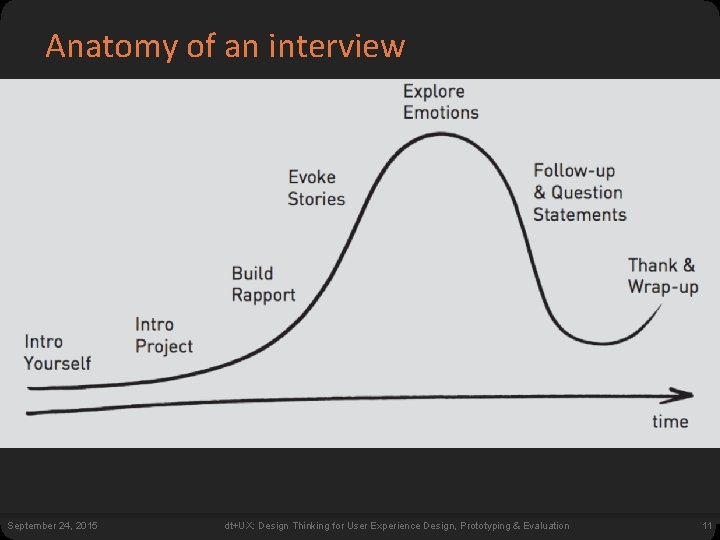
Anatomy of an interview September 24, 2015 dt+UX: Design Thinking for User Experience Design, Prototyping & Evaluation 11
How to prepare for an interview? Brainstorm questions Get all of the potential questions your team can generate. Identify and order themes Once you’ve identified themes of your question-pool, determine the order that would allow the conversation to flow most naturally Refine questions Filter out redundant and strange questions. Make sure that you leave room in your planning to ask plenty of “why? ”, “how the user FEELS” and “tell me about the last time you _____? ” questions September 24, 2015 dt+UX: Design Thinking for User Experience Design, Prototyping & Evaluation 12
How to interview? Advice for engaging • • • Never say “usually” when asking a question Ask why Encourage stories Look for inconsistencies & contradiction Listen to nonverbal cues Don’t be afraid of silence Don’t suggest answers to your questions Don’t ask binary questions Only ten words to a question Only ask one question at a time, one person at a time Make sure you’re prepared to capture September 24, 2015 dt+UX: Design Thinking for User Experience Design, Prototyping & Evaluation 13
Pair Exercise Learn about what is stressing your partner out Break into pairs Interview preparation: 6 min Developing interview questions Interview your partner: 8 min (8 min for each person) September 24, 2015 dt+UX: Design Thinking for User Experience Design, Prototyping & Evaluation 14
Group learning • • Share major insights from your interview What was the most challenging part? If you had to do it again what would you do differently? What did you learn that surprised you the most? September 24, 2015 dt+UX: Design Thinking for User Experience Design, Prototyping & Evaluation 15
Studio: Empathy Exercises • • Open-ended questions (10 min) Basic interviewing skills (45 min) Observation vs Interpretation (20 min) Extreme Users (15 min) September 24, 2015 dt+UX: Design Thinking for User Experience Design, Prototyping & Evaluation 16
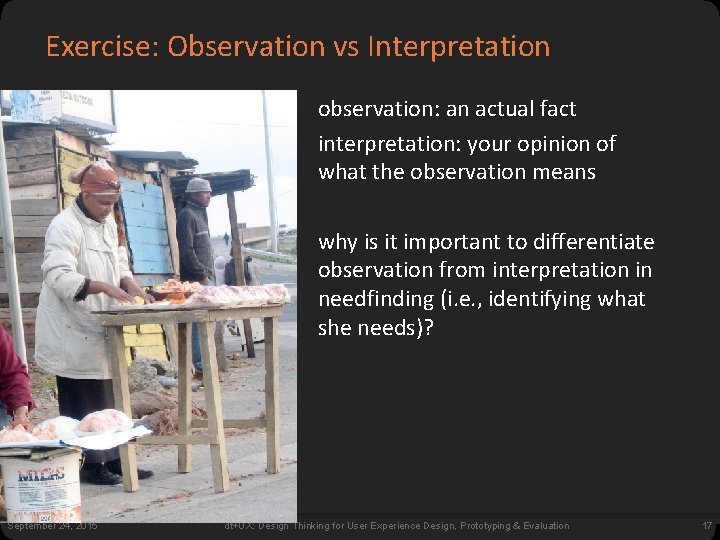
Exercise: Observation vs Interpretation observation: an actual fact interpretation: your opinion of what the observation means why is it important to differentiate observation from interpretation in needfinding (i. e. , identifying what she needs)? September 24, 2015 dt+UX: Design Thinking for User Experience Design, Prototyping & Evaluation 17
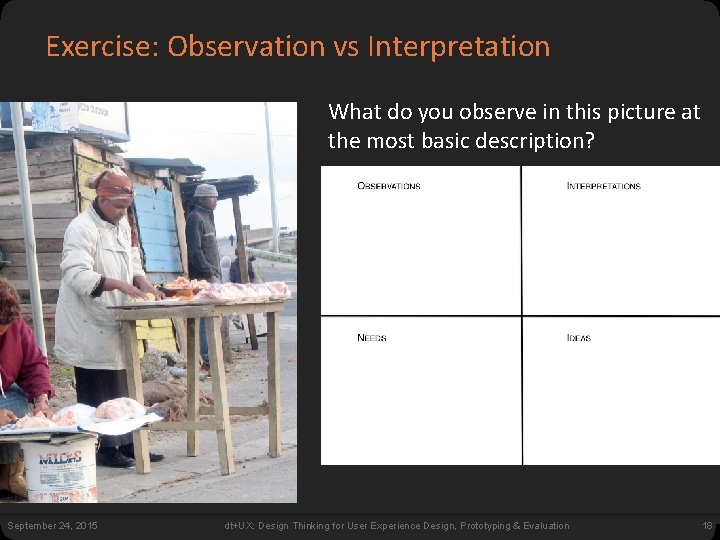
Exercise: Observation vs Interpretation What do you observe in this picture at the most basic description? September 24, 2015 dt+UX: Design Thinking for User Experience Design, Prototyping & Evaluation 18
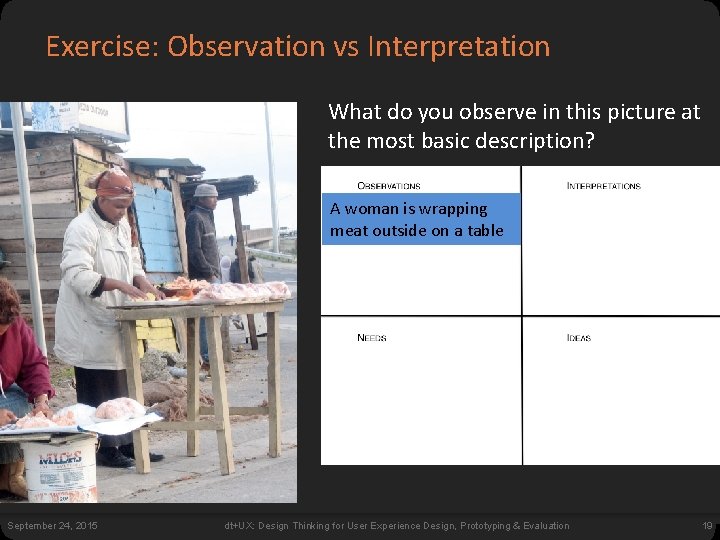
Exercise: Observation vs Interpretation What do you observe in this picture at the most basic description? A woman is wrapping meat outside on a table September 24, 2015 dt+UX: Design Thinking for User Experience Design, Prototyping & Evaluation 19
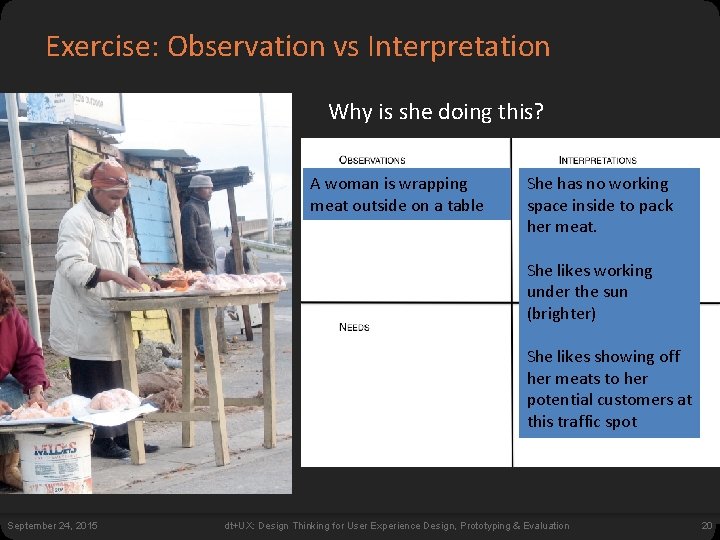
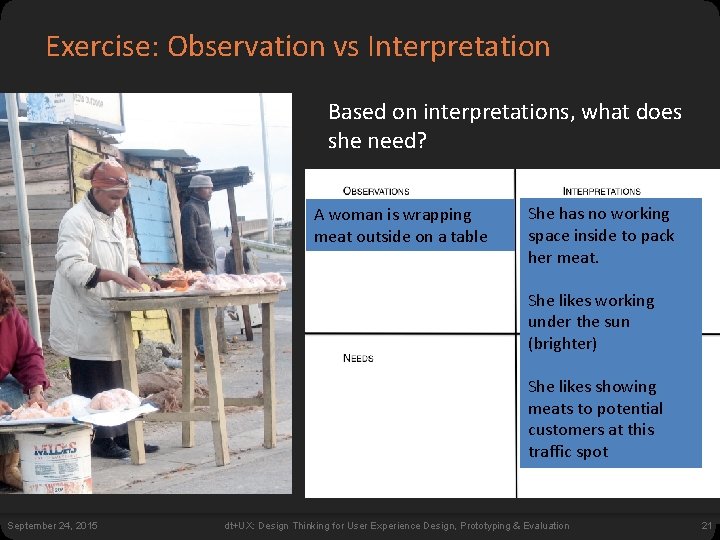
Exercise: Observation vs Interpretation Why is she doing this? A woman is wrapping meat outside on a table She has no working space inside to pack her meat. She likes working under the sun (brighter) She likes showing off her meats to her potential customers at this traffic spot September 24, 2015 dt+UX: Design Thinking for User Experience Design, Prototyping & Evaluation 20
Exercise: Observation vs Interpretation Based on interpretations, what does she need? A woman is wrapping meat outside on a table She has no working space inside to pack her meat. She likes working under the sun (brighter) She likes showing meats to potential customers at this traffic spot September 24, 2015 dt+UX: Design Thinking for User Experience Design, Prototyping & Evaluation 21
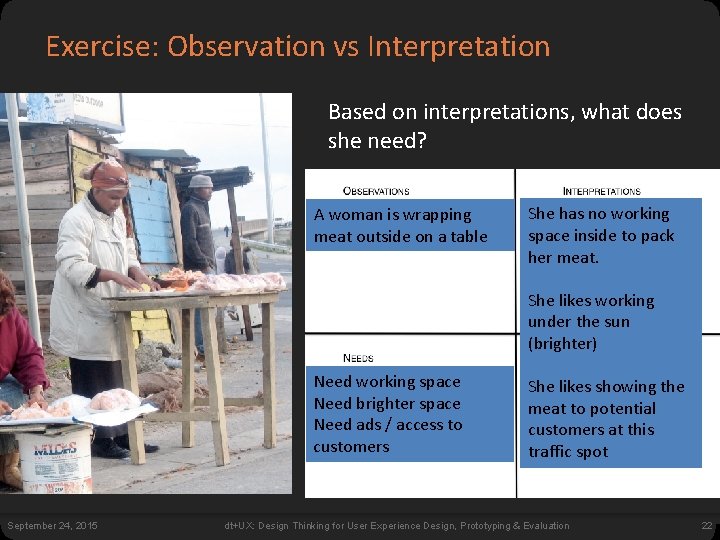
Exercise: Observation vs Interpretation Based on interpretations, what does she need? A woman is wrapping meat outside on a table She has no working space inside to pack her meat. She likes working under the sun (brighter) Need working space Need brighter space Need ads / access to customers September 24, 2015 She likes showing the meat to potential customers at this traffic spot dt+UX: Design Thinking for User Experience Design, Prototyping & Evaluation 22
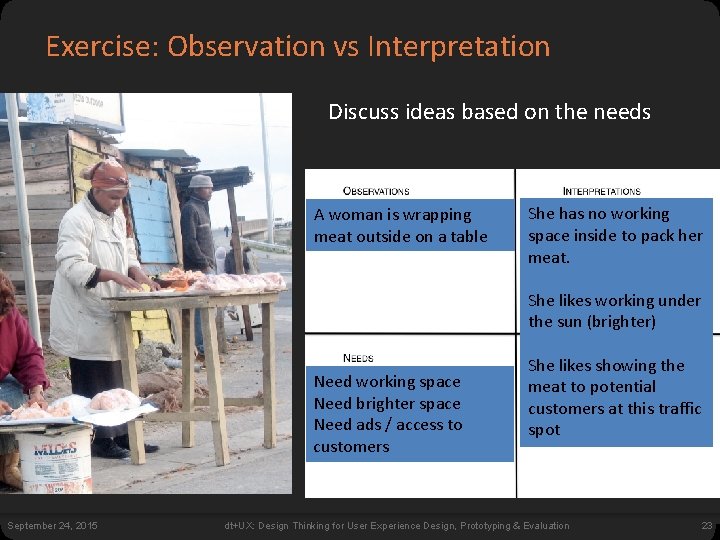
Exercise: Observation vs Interpretation Discuss ideas based on the needs A woman is wrapping meat outside on a table She has no working space inside to pack her meat. She likes working under the sun (brighter) Need working space Need brighter space Need ads / access to customers September 24, 2015 She likes showing the meat to potential customers at this traffic spot dt+UX: Design Thinking for User Experience Design, Prototyping & Evaluation 23
Studio: Empathy Exercises • • Open-ended questions (10 min) Basic interviewing skills (45 min) Observation vs Interpretation (20 min) Extreme Users (15 min) September 24, 2015 dt+UX: Design Thinking for User Experience Design, Prototyping & Evaluation 24
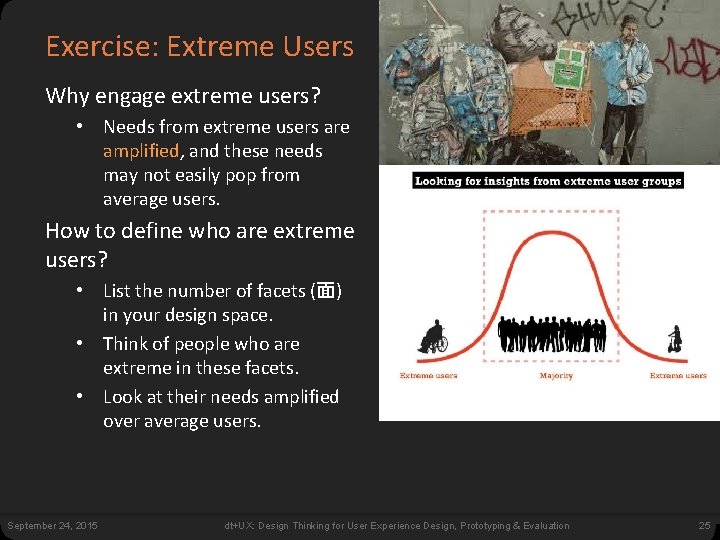
Exercise: Extreme Users Why engage extreme users? • Needs from extreme users are amplified, and these needs may not easily pop from average users. How to define who are extreme users? • List the number of facets (面) in your design space. • Think of people who are extreme in these facets. • Look at their needs amplified over average users. September 24, 2015 dt+UX: Design Thinking for User Experience Design, Prototyping & Evaluation 25
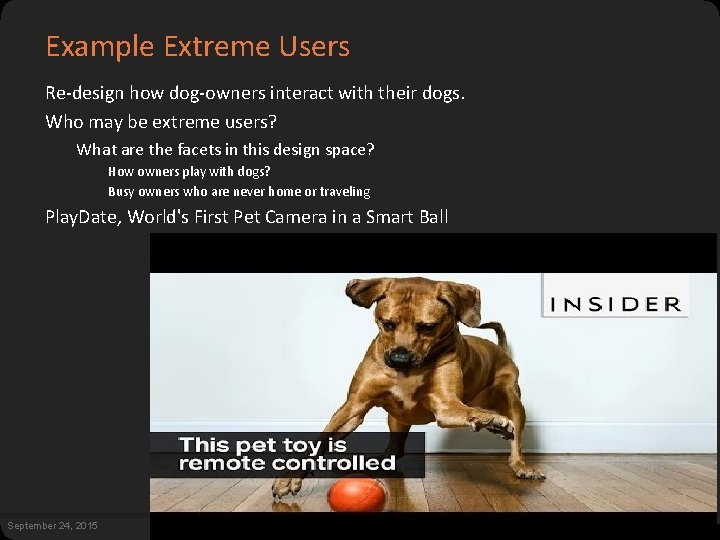
Example Extreme Users Re-design how dog-owners interact with their dogs. Who may be extreme users? What are the facets in this design space? How owners play with dogs? Busy owners who are never home or traveling Play. Date, World's First Pet Camera in a Smart Ball September 24, 2015 dt+UX: Design Thinking for User Experience Design, Prototyping & Evaluation 26
Exercise: Extreme Users How to define who are extreme users? List the number of facets (面) in your design space. Think of people who are extreme in these facets. Team exercise: Redesign grocery shopping experience (8 min) What facets to consider? Who may be extreme in these facets? Reflection September 24, 2015 dt+UX: Design Thinking for User Experience Design, Prototyping & Evaluation 27