
Studies of Cosmicray Acceleration with Cosmic Gammaray Hiroyasu
- Slides: 20
Studies of Cosmic-ray Acceleration with Cosmic Gamma-ray Hiroyasu Tajima Stanford Linear Accelerator Center Kavli Institute for Particle Astrophysics and Cosmology Outline • Introduction. • Gamma-ray detectors. • SNR • Galaxy cluster • GRB October 31, 2006 Joint Meeting of Pacific Region Particle Physics Communities
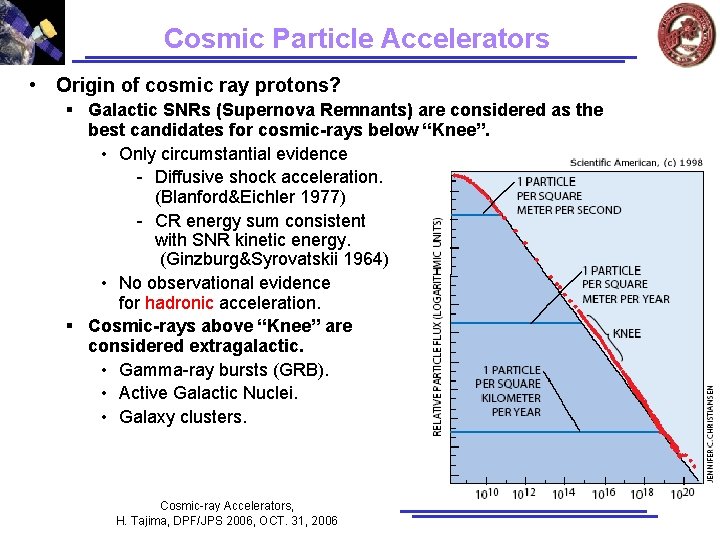
Cosmic Particle Accelerators • Origin of cosmic ray protons? § Galactic SNRs (Supernova Remnants) are considered as the best candidates for cosmic-rays below “Knee”. • Only circumstantial evidence - Diffusive shock acceleration. (Blanford&Eichler 1977) - CR energy sum consistent with SNR kinetic energy. (Ginzburg&Syrovatskii 1964) • No observational evidence for hadronic acceleration. § Cosmic-rays above “Knee” are considered extragalactic. • Gamma-ray bursts (GRB). • Active Galactic Nuclei. • Galaxy clusters. Cosmic-ray Accelerators, H. Tajima, DPF/JPS 2006, OCT. 31, 2006
Why Gamma-rays? • Charged particles are bent by interstellar magnetic field. § Requires E>1019 e. V for straight propagation. • Neutral particles § Neutrino: not sufficient sensitivity § Photon • Radio, Optical, X-ray: thermal emission dominant • Gamma-ray: high energy particle origin Cosmic-ray Accelerators, H. Tajima, DPF/JPS 2006, OCT. 31, 2006
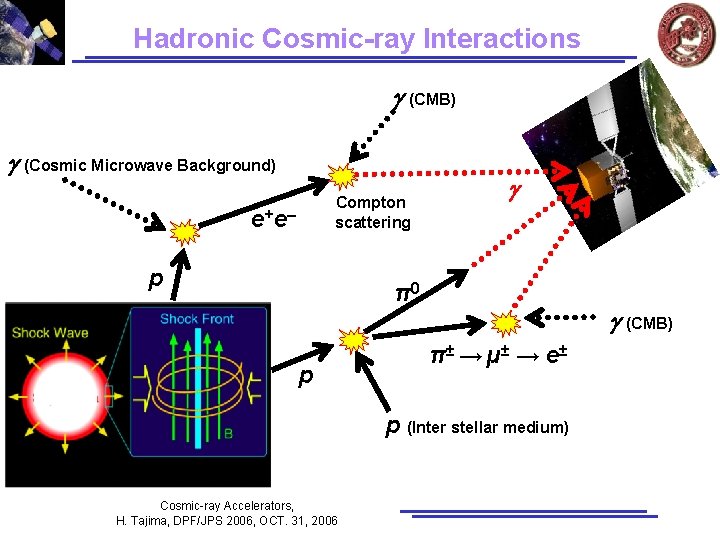
Hadronic Cosmic-ray Interactions (CMB) (Cosmic Microwave Background) Compton scattering e+ e– p π0 p (CMB) π± → µ± → e± p (Inter stellar medium) Cosmic-ray Accelerators, H. Tajima, DPF/JPS 2006, OCT. 31, 2006
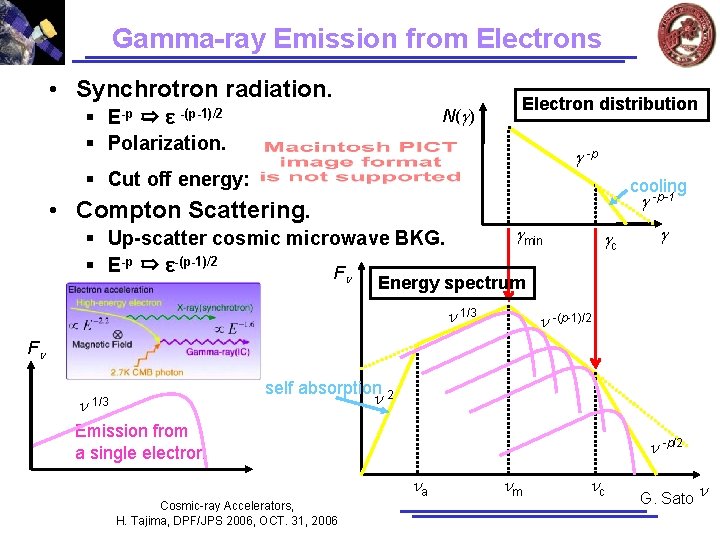
Gamma-ray Emission from Electrons • Synchrotron radiation. Electron distribution N(g) § E-p ➯ ε -(p-1)/2 § Polarization. g -p § Cut off energy: cooling g -p-1 • Compton Scattering. § Up-scatter cosmic microwave BKG. § E-p ➯ ε-(p-1)/2 F n gmin gc g Energy spectrum n 1/3 n -(p-1)/2 Fn n self absorption 2 n 1/3 Emission from a single electron n -p/2 na Cosmic-ray Accelerators, H. Tajima, DPF/JPS 2006, OCT. 31, 2006 nm nc G. Sato n
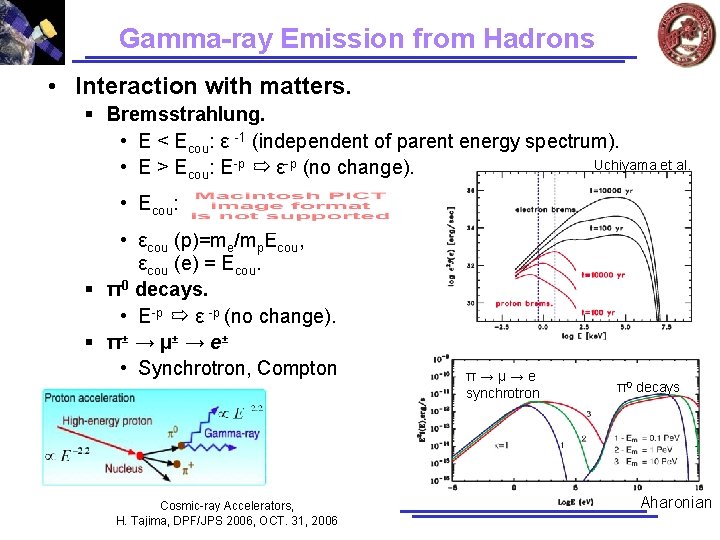
Gamma-ray Emission from Hadrons • Interaction with matters. § Bremsstrahlung. • E < Ecou: ε -1 (independent of parent energy spectrum). Uchiyama et al. • E > Ecou: E-p ➯ ε-p (no change). • Ecou: • εcou (p)=me/mp. Ecou, εcou (e) = Ecou. § π0 decays. • E-p ➯ ε -p (no change). § π± → µ± → e± • Synchrotron, Compton Cosmic-ray Accelerators, H. Tajima, DPF/JPS 2006, OCT. 31, 2006 π → µ → e synchrotron π0 decays Aharonian
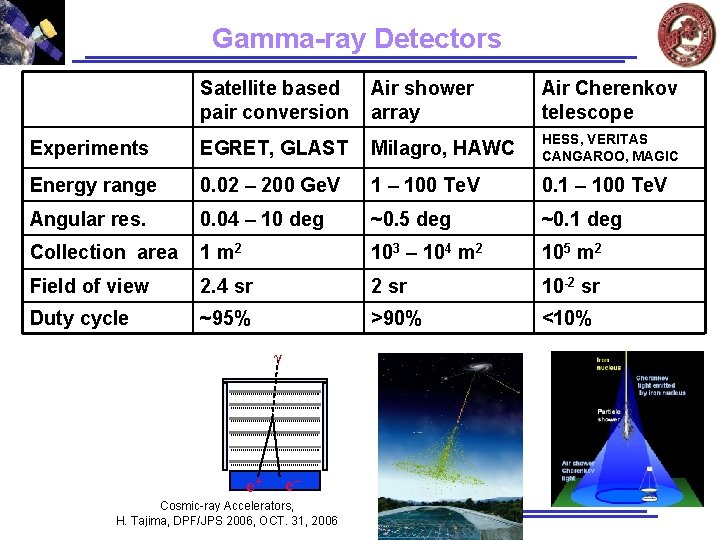
Gamma-ray Detectors Satellite based pair conversion Air shower array Air Cherenkov telescope Experiments EGRET, GLAST Milagro, HAWC HESS, VERITAS CANGAROO, MAGIC Energy range 0. 02 – 200 Ge. V 1 – 100 Te. V 0. 1 – 100 Te. V Angular res. 0. 04 – 10 deg ~0. 5 deg ~0. 1 deg Collection area 1 m 2 103 – 104 m 2 105 m 2 Field of view 2. 4 sr 2 sr 10 -2 sr Duty cycle ~95% >90% <10% e+ e– Cosmic-ray Accelerators, H. Tajima, DPF/JPS 2006, OCT. 31, 2006
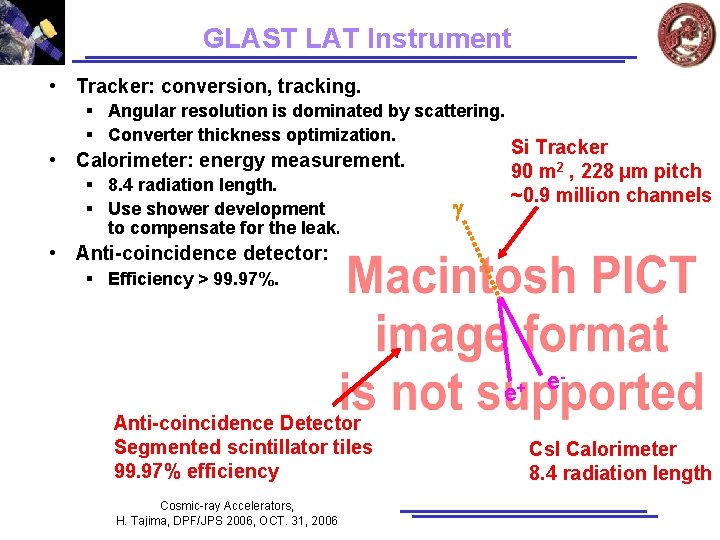
GLAST LAT Instrument • Tracker: conversion, tracking. § Angular resolution is dominated by scattering. § Converter thickness optimization. • Calorimeter: energy measurement. § 8. 4 radiation length. § Use shower development to compensate for the leak. Si Tracker 90 m 2 , 228 µm pitch ~0. 9 million channels • Anti-coincidence detector: § Efficiency > 99. 97%. e+ Anti-coincidence Detector Segmented scintillator tiles 99. 97% efficiency Cosmic-ray Accelerators, H. Tajima, DPF/JPS 2006, OCT. 31, 2006 e. Cs. I Calorimeter 8. 4 radiation length
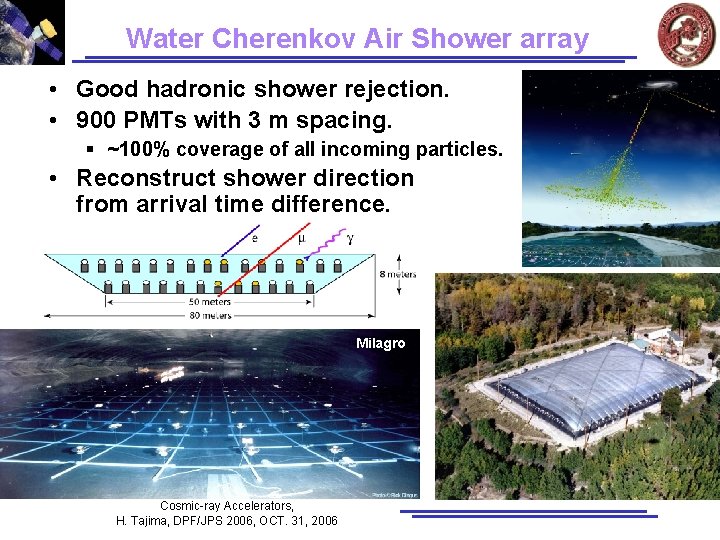
Water Cherenkov Air Shower array • Good hadronic shower rejection. • 900 PMTs with 3 m spacing. § ~100% coverage of all incoming particles. • Reconstruct shower direction from arrival time difference. Milagro Cosmic-ray Accelerators, H. Tajima, DPF/JPS 2006, OCT. 31, 2006
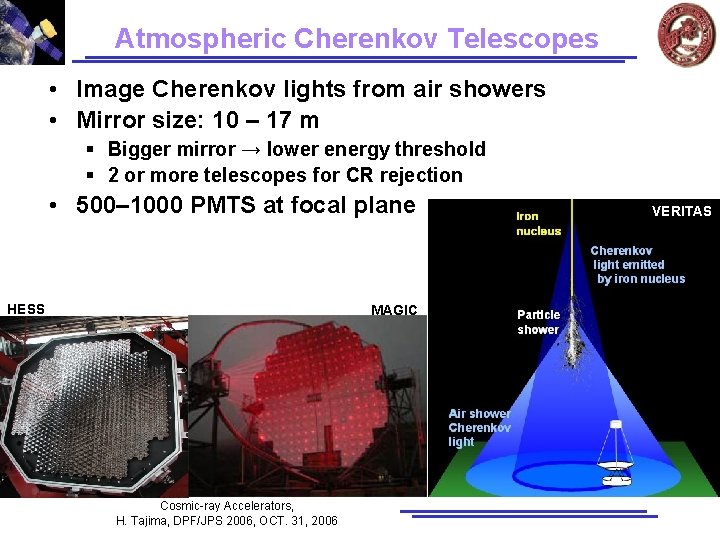
Atmospheric Cherenkov Telescopes • Image Cherenkov lights from air showers • Mirror size: 10 – 17 m § Bigger mirror → lower energy threshold § 2 or more telescopes for CR rejection • 500– 1000 PMTS at focal plane HESS MAGIC Cosmic-ray Accelerators, H. Tajima, DPF/JPS 2006, OCT. 31, 2006 VERITAS
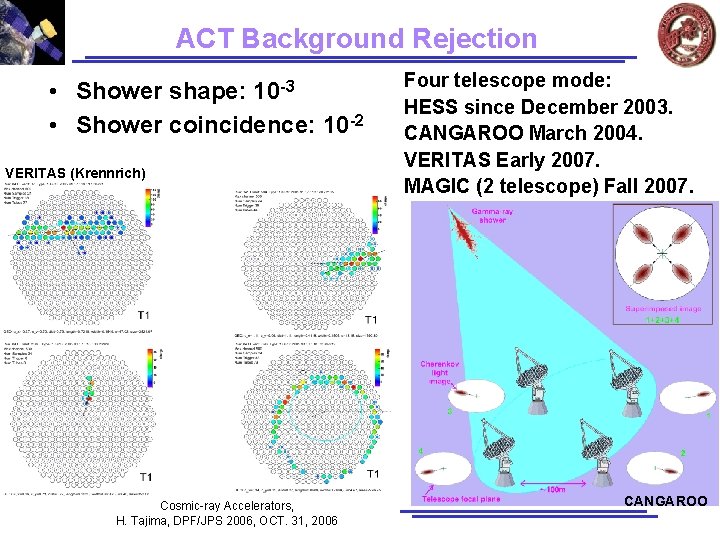
ACT Background Rejection • Shower shape: 10 -3 • Shower coincidence: 10 -2 VERITAS (Krennrich) Cosmic-ray Accelerators, H. Tajima, DPF/JPS 2006, OCT. 31, 2006 Four telescope mode: HESS since December 2003. CANGAROO March 2004. VERITAS Early 2007. MAGIC (2 telescope) Fall 2007. CANGAROO
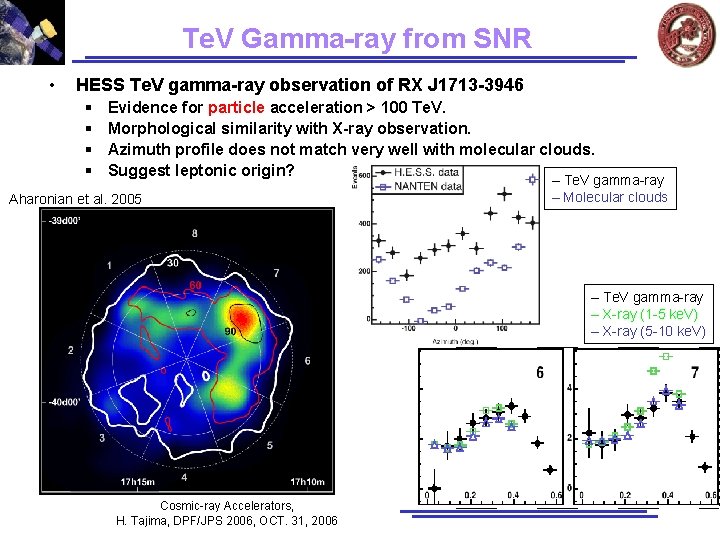
Te. V Gamma-ray from SNR • HESS Te. V gamma-ray observation of RX J 1713 -3946 § § Evidence for particle acceleration > 100 Te. V. Morphological similarity with X-ray observation. Azimuth profile does not match very well with molecular clouds. Suggest leptonic origin? Aharonian et al. 2005 HESS/ASCA – Te. V gamma-ray – Molecular clouds – Te. V gamma-ray – X-ray (1 -5 ke. V) – X-ray (5 -10 ke. V) Cosmic-ray Accelerators, H. Tajima, DPF/JPS 2006, OCT. 31, 2006
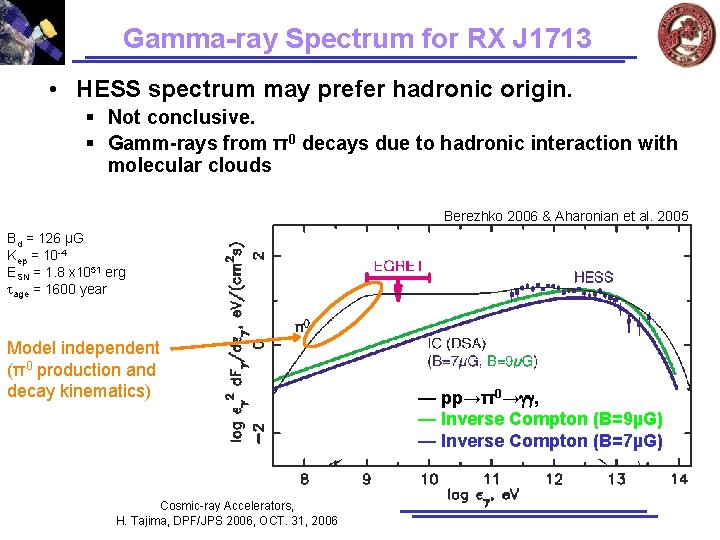
Gamma-ray Spectrum for RX J 1713 • HESS spectrum may prefer hadronic origin. § Not conclusive. § Gamm-rays from π0 decays due to hadronic interaction with molecular clouds Berezhko 2006 & Aharonian et al. 2005 Bd = 126 µG Kep = 10 -4 ESN = 1. 8 x 1051 erg age = 1600 year Model independent (π0 production and decay kinematics) Cosmic-ray Accelerators, H. Tajima, DPF/JPS 2006, OCT. 31, 2006 — pp→π0→ , — Inverse Compton (B=9µG) — Inverse Compton (B=7µG)
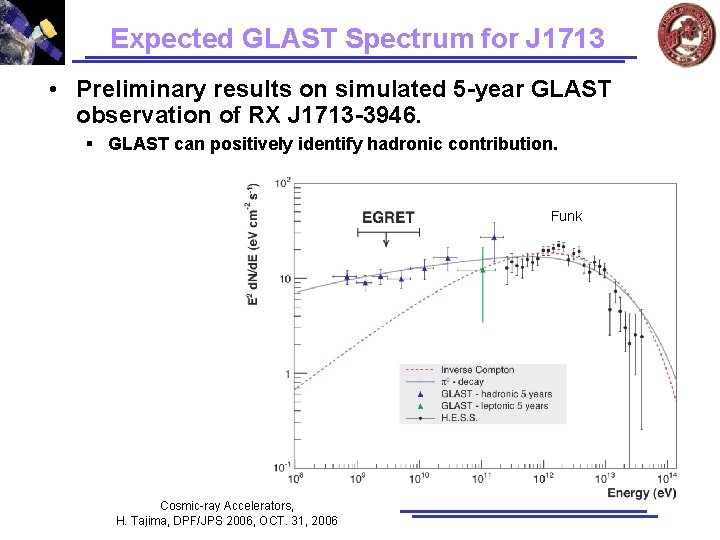
Expected GLAST Spectrum for J 1713 • Preliminary results on simulated 5 -year GLAST observation of RX J 1713 -3946. § GLAST can positively identify hadronic contribution. Funk Cosmic-ray Accelerators, H. Tajima, DPF/JPS 2006, OCT. 31, 2006
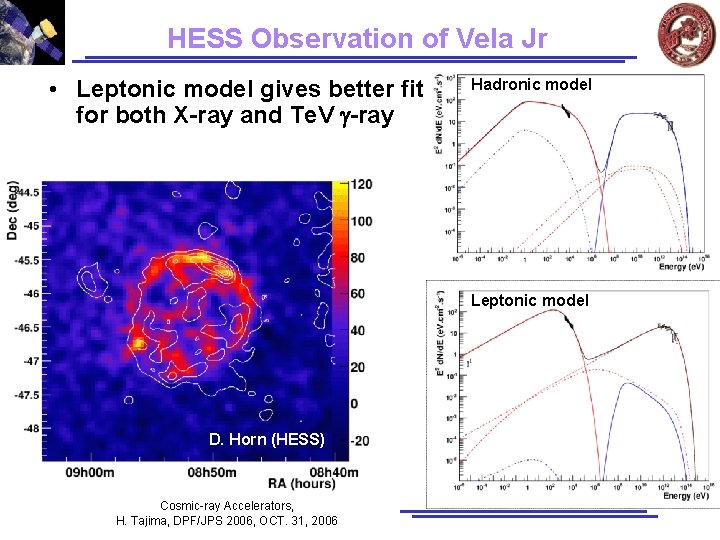
HESS Observation of Vela Jr • Leptonic model gives better fit for both X-ray and Te. V -ray Hadronic model Leptonic model D. Horn (HESS) Cosmic-ray Accelerators, H. Tajima, DPF/JPS 2006, OCT. 31, 2006
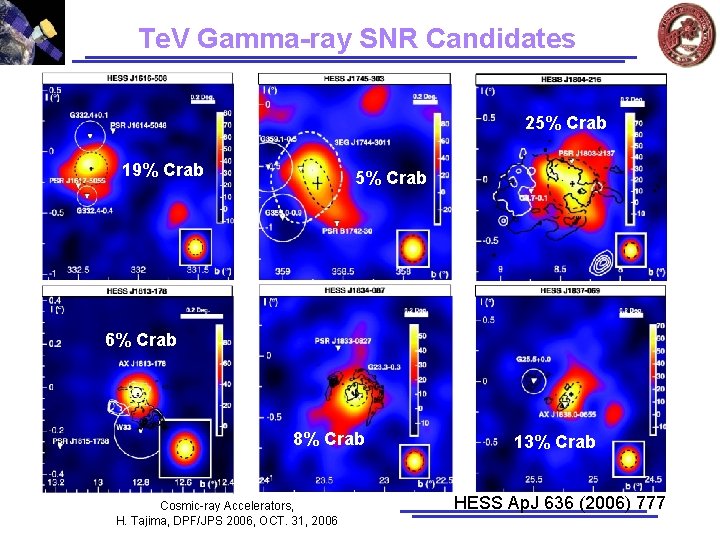
Te. V Gamma-ray SNR Candidates 25% Crab 19% Crab 5% Crab 6% Crab 8% Crab Cosmic-ray Accelerators, H. Tajima, DPF/JPS 2006, OCT. 31, 2006 13% Crab HESS Ap. J 636 (2006) 777
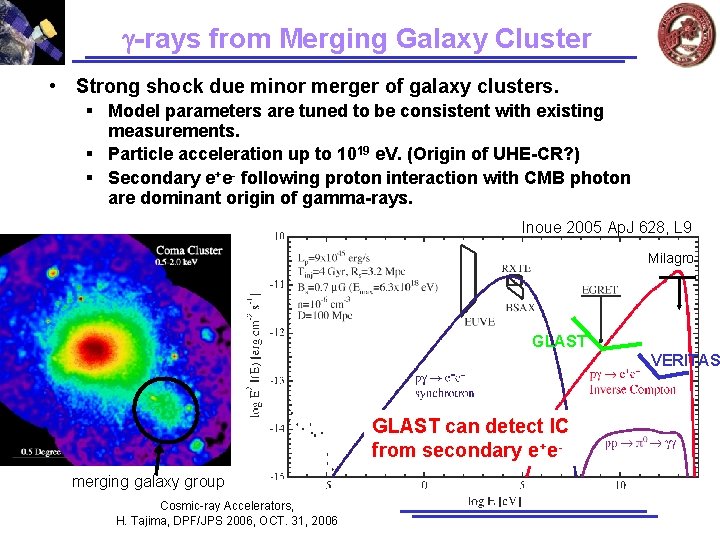
-rays from Merging Galaxy Cluster • Strong shock due minor merger of galaxy clusters. § Model parameters are tuned to be consistent with existing measurements. § Particle acceleration up to 1019 e. V. (Origin of UHE-CR? ) § Secondary e+e- following proton interaction with CMB photon are dominant origin of gamma-rays. Inoue 2005 Ap. J 628, L 9 Milagro GLAST VERITAS GLAST can detect IC from secondary e+emerging galaxy group Cosmic-ray Accelerators, H. Tajima, DPF/JPS 2006, OCT. 31, 2006
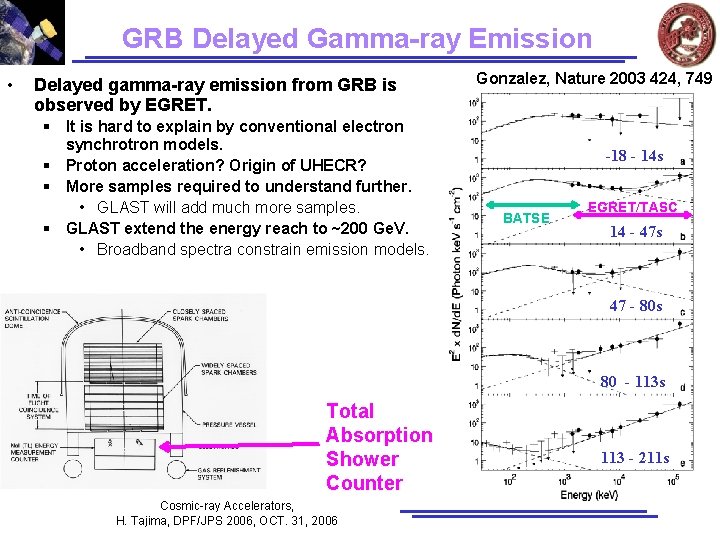
GRB Delayed Gamma-ray Emission • Delayed gamma-ray emission from GRB is observed by EGRET. § It is hard to explain by conventional electron synchrotron models. § Proton acceleration? Origin of UHECR? § More samples required to understand further. • GLAST will add much more samples. § GLAST extend the energy reach to ~200 Ge. V. • Broadband spectra constrain emission models. Gonzalez, Nature 2003 424, 749 -18 - 14 s BATSE EGRET/TASC 14 - 47 s 47 - 80 s 80 - 113 s Total Absorption Shower Counter Cosmic-ray Accelerators, H. Tajima, DPF/JPS 2006, OCT. 31, 2006 113 - 211 s
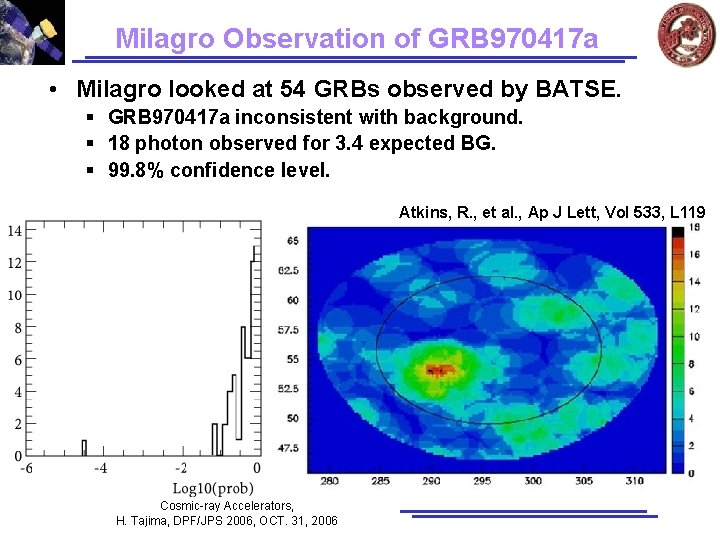
Milagro Observation of GRB 970417 a • Milagro looked at 54 GRBs observed by BATSE. § GRB 970417 a inconsistent with background. § 18 photon observed for 3. 4 expected BG. § 99. 8% confidence level. Atkins, R. , et al. , Ap J Lett, Vol 533, L 119 Cosmic-ray Accelerators, H. Tajima, DPF/JPS 2006, OCT. 31, 2006
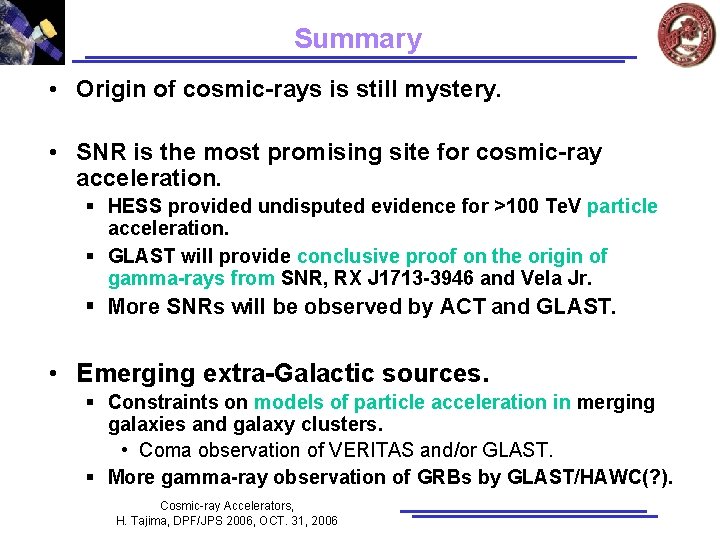
Summary • Origin of cosmic-rays is still mystery. • SNR is the most promising site for cosmic-ray acceleration. § HESS provided undisputed evidence for >100 Te. V particle acceleration. § GLAST will provide conclusive proof on the origin of gamma-rays from SNR, RX J 1713 -3946 and Vela Jr. § More SNRs will be observed by ACT and GLAST. • Emerging extra-Galactic sources. § Constraints on models of particle acceleration in merging galaxies and galaxy clusters. • Coma observation of VERITAS and/or GLAST. § More gamma-ray observation of GRBs by GLAST/HAWC(? ). Cosmic-ray Accelerators, H. Tajima, DPF/JPS 2006, OCT. 31, 2006