
Students with Special Needs Accommodation and modification An

- Slides: 13
Students with Special Needs Accommodation and modification An accommodation is a device, material, or support process that will enable a student to accomplish a task more efficiently. Modification refers to changes to the instructional outcomes; a change or decrease in the course content or outcome.
Students with Learning Disabilities A learning disabled student … Has poor auditory memory — both short term and long term. Has a low tolerance level and a high frustration level. Has a weak or poor self-esteem. Is easily distractible. Finds it difficult to stay on task for extended periods of time. Is spontaneous in expression; often cannot control emotions.
Students with Learning Disabilities Is easily confused. Is verbally demanding. Has some difficulty in working with others in small or large group settings. Has difficulty in following complicated directions or remembering them. Has coordination problems with both large and small muscle groups. Has inflexibility of thought; is difficult to persuade otherwise. Has poor handwriting skills. Has a poor concept of time.
Students with Learning Disabilities Provide oral instruction for students with reading disabilities. Provide students with frequent progress checks. Give immediate feedback. Make activities concise and short, whenever possible. Whenever possible, provide students with concrete objects and events—items they can touch, hear, smell, etc.
Students with Learning Disabilities They need and should get lots of specific praise. Instead of just saying, “You did well, ” provide specific praising comments that link the activity directly with the recognition; for example, “I was particularly pleased by the way in which you organized the rock collection for Karin and Miranda. ” When necessary, plan to repeat instructions or offer information in both written and verbal formats. Again, it is vitally necessary that learning disabled children utilize as many of their sensory modalities as possible. Encourage cooperative learning activities when possible.
Students Who Have Higher Ability A gifted student… Has a high level of curiosity. Has a well-developed imagination. Often gives uncommon responses to common queries. Can remember and retain a great deal of information. Can not only pose original solutions to common problems but can also pose original problems, too. Has the ability to concentrate on a problem or issue for extended periods of time. Is capable of comprehending complex concepts. Is well organized. Is excited about learning new facts and concepts. Is often an independent learner.
Teaching Gifted Students Allow gifted students to design and follow through on self-initiated projects. Provide gifted students with lots of open-ended activities. Keep the emphasis on divergent thinking. Provide opportunities for gifted youngsters to engage in active problem-solving. Encourage gifted students to take on leadership roles. Provide numerous opportunities for gifted students to read extensively about subjects that interest them. Provide numerous long-term and extended activities that allow gifted students the opportunity to engage in a learning project over an extended period of time.
Students who have hearing impairments Provide written or pictorial directions. Physically act out the steps for an activity. Seat a hearing impaired child in the front of the classroom and in a place where he or she has a good field of vision of both you and the board. When addressing the class, be sure to enunciate your words and look directly at the hearing impaired student or in his or her general direction. Provide a variety of multisensory experiences for students. Whenever possible, use lots of concrete objects such as models, diagrams, realia, samples, and the like.
Students Who Have Visual Impairments Tape-record portions of textbooks so students can listen (with earphones) to an oral presentation of necessary material. When using the board, use white chalk and bold lines. It is important to seat the visually impaired student close to the main instructional area. Provide clear oral instructions. Partner the student with other students who can assist or help.
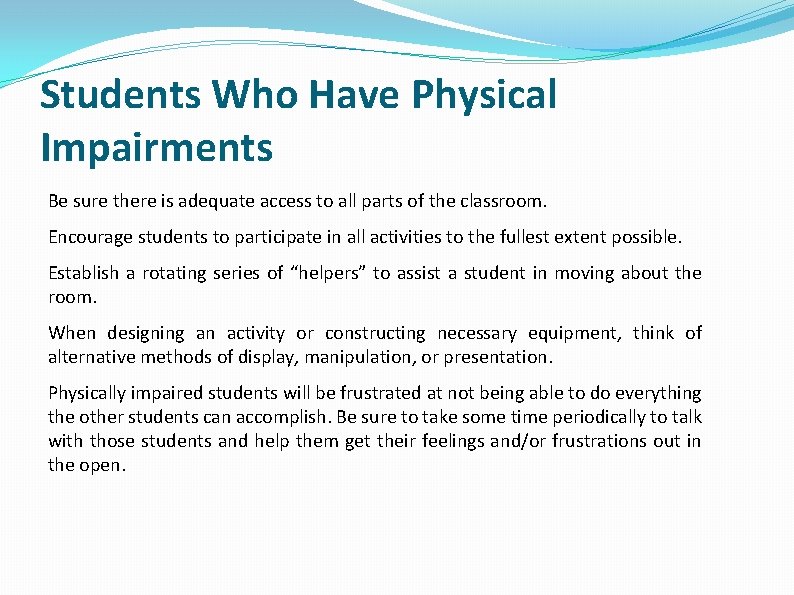
Students Who Have Physical Impairments Be sure there is adequate access to all parts of the classroom. Encourage students to participate in all activities to the fullest extent possible. Establish a rotating series of “helpers” to assist a student in moving about the room. When designing an activity or constructing necessary equipment, think of alternative methods of display, manipulation, or presentation. Physically impaired students will be frustrated at not being able to do everything the other students can accomplish. Be sure to take some time periodically to talk with those students and help them get their feelings and/or frustrations out in the open.
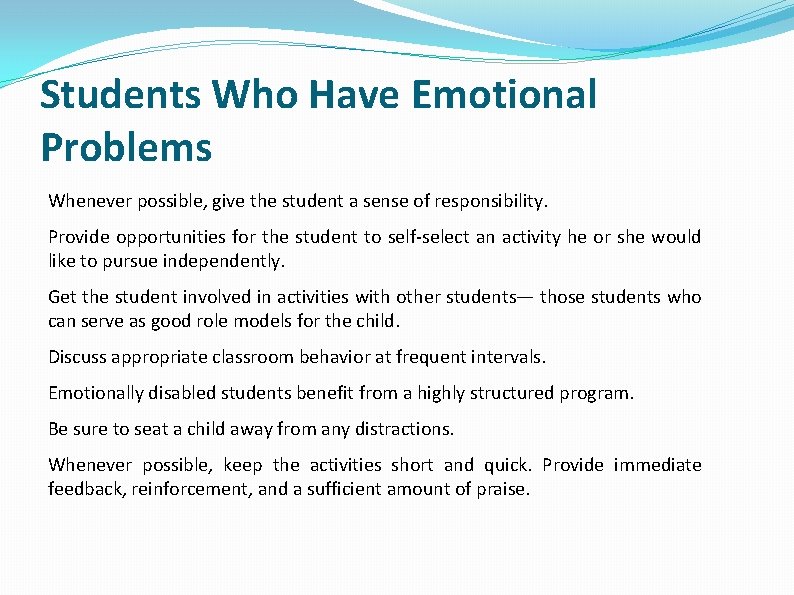
Students Who Have Emotional Problems Whenever possible, give the student a sense of responsibility. Provide opportunities for the student to self-select an activity he or she would like to pursue independently. Get the student involved in activities with other students— those students who can serve as good role models for the child. Discuss appropriate classroom behavior at frequent intervals. Emotionally disabled students benefit from a highly structured program. Be sure to seat a child away from any distractions. Whenever possible, keep the activities short and quick. Provide immediate feedback, reinforcement, and a sufficient amount of praise.
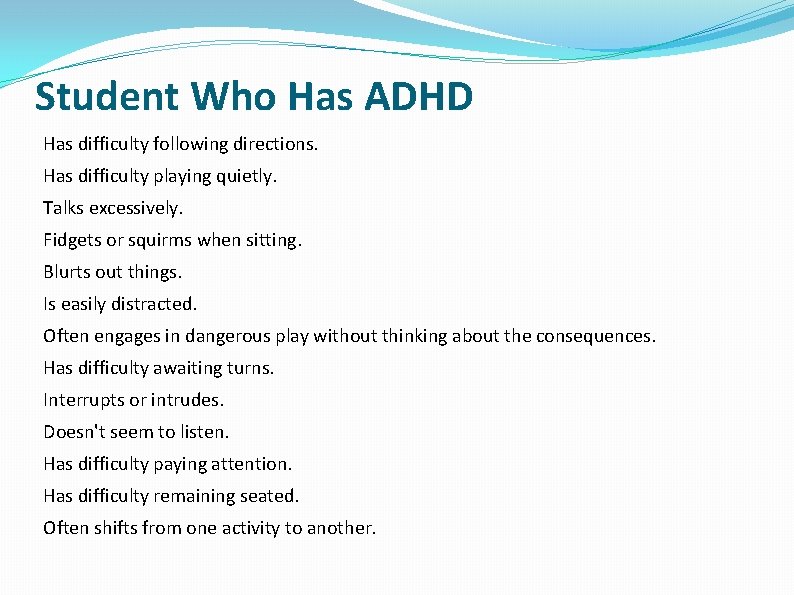
Student Who Has ADHD Has difficulty following directions. Has difficulty playing quietly. Talks excessively. Fidgets or squirms when sitting. Blurts out things. Is easily distracted. Often engages in dangerous play without thinking about the consequences. Has difficulty awaiting turns. Interrupts or intrudes. Doesn't seem to listen. Has difficulty paying attention. Has difficulty remaining seated. Often shifts from one activity to another.
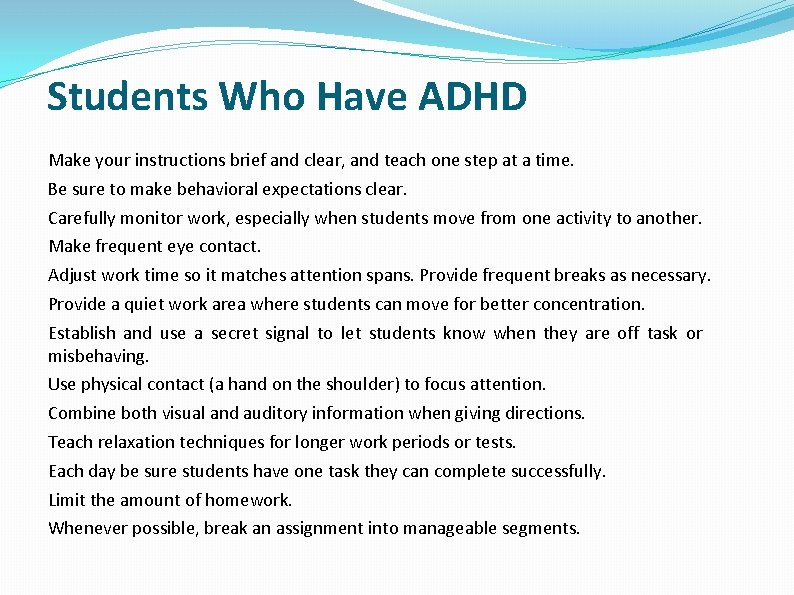
Students Who Have ADHD Make your instructions brief and clear, and teach one step at a time. Be sure to make behavioral expectations clear. Carefully monitor work, especially when students move from one activity to another. Make frequent eye contact. Adjust work time so it matches attention spans. Provide frequent breaks as necessary. Provide a quiet work area where students can move for better concentration. Establish and use a secret signal to let students know when they are off task or misbehaving. Use physical contact (a hand on the shoulder) to focus attention. Combine both visual and auditory information when giving directions. Teach relaxation techniques for longer work periods or tests. Each day be sure students have one task they can complete successfully. Limit the amount of homework. Whenever possible, break an assignment into manageable segments.