
Students t Distribution Lecture 35 Section 10 2
Student’s t Distribution Lecture 35 Section 10. 2 Mon, Mar 28, 2005
What if is Unknown? It is more realistic to assume that the value of is unknown. n (If we don’t know the value of , then we probably don’t know the value of ). n In this case, we use s to estimate . n
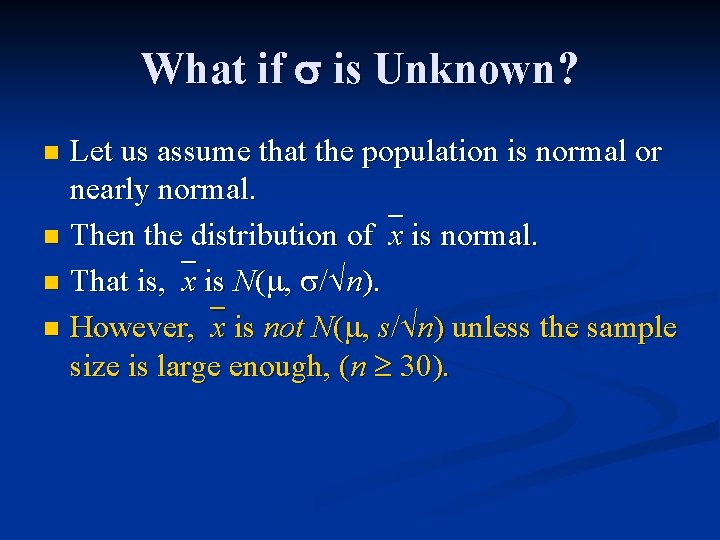
What if is Unknown? Let us assume that the population is normal or nearly normal. n Then the distribution of x is normal. n That is, x is N( , / n). n However, x is not N( , s/ n) unless the sample size is large enough, (n 30). n
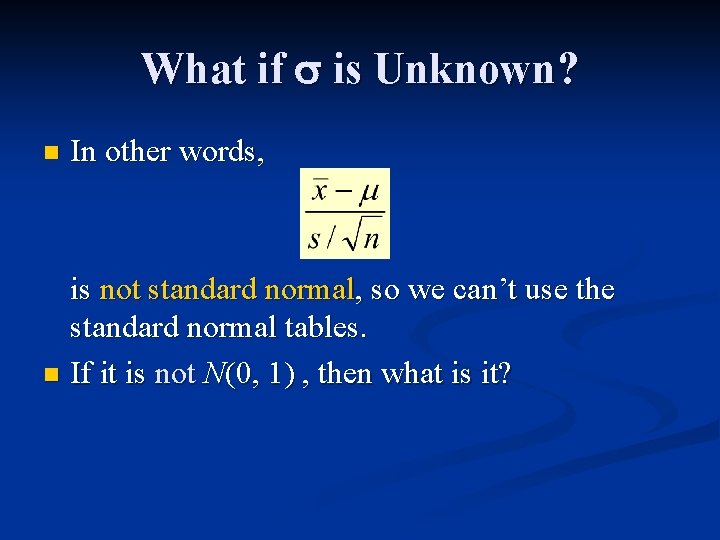
What if is Unknown? n In other words, is not standard normal, so we can’t use the standard normal tables. n If it is not N(0, 1) , then what is it?
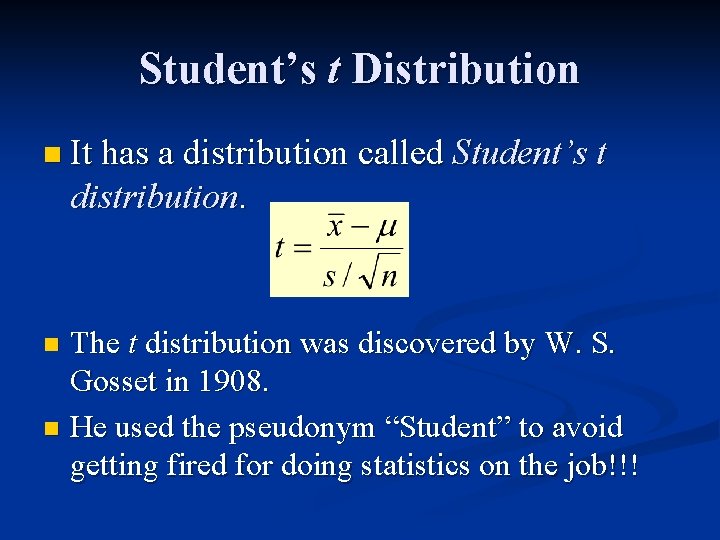
Student’s t Distribution n It has a distribution called Student’s t distribution. The t distribution was discovered by W. S. Gosset in 1908. n He used the pseudonym “Student” to avoid getting fired for doing statistics on the job!!! n
The t Distribution The shape of the t distribution is very similar to the shape of the standard normal distribution. n However, the t distribution has a (slightly) different shape for each possible sample size. n They are all symmetric and unimodal. n They are all centered at 0. n
The t Distribution But, they are somewhat broader than Z, reflecting the additional uncertainty resulting from using s in place of . n As n gets larger and larger, the shape of the t distribution approaches the standard normal. n In fact, if n 30, then the t distribution is approximately standard normal. n
Degrees of Freedom If the sample size is n, then t is said to have n – 1 degrees of freedom. n We use df to denote “degrees of freedom. ” n We will use the notation t(df) to represent the t distribution with df degrees of freedom. n For example, t(5) is the t distribution with 5 degrees of freedom (i. e, sample size 6). n
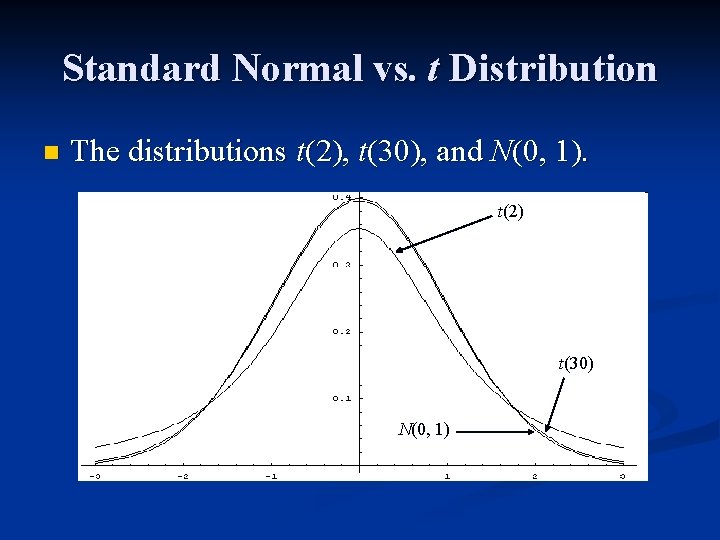
Standard Normal vs. t Distribution n The distributions t(2), t(30), and N(0, 1). t(2) t(30) N(0, 1)
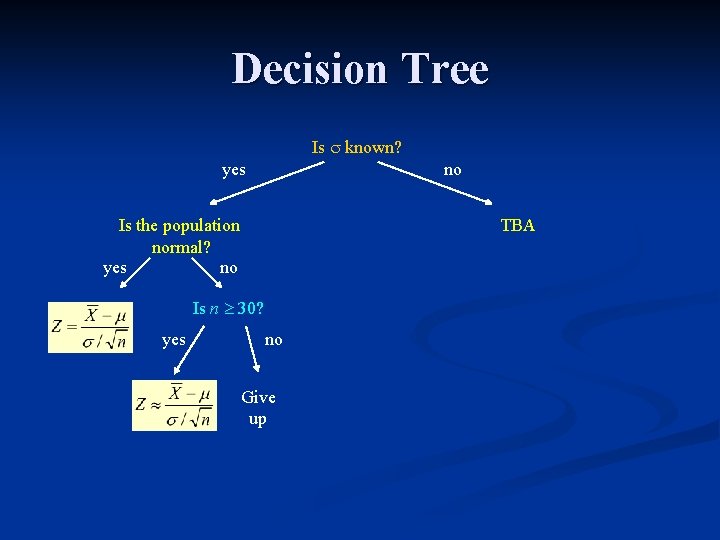
Decision Tree Is known? yes no Is the population normal? yes no TBA Is n 30? yes no Give up
Decision Tree Is known? yes no Is the population normal? yes no Is n 30? yes no Give up
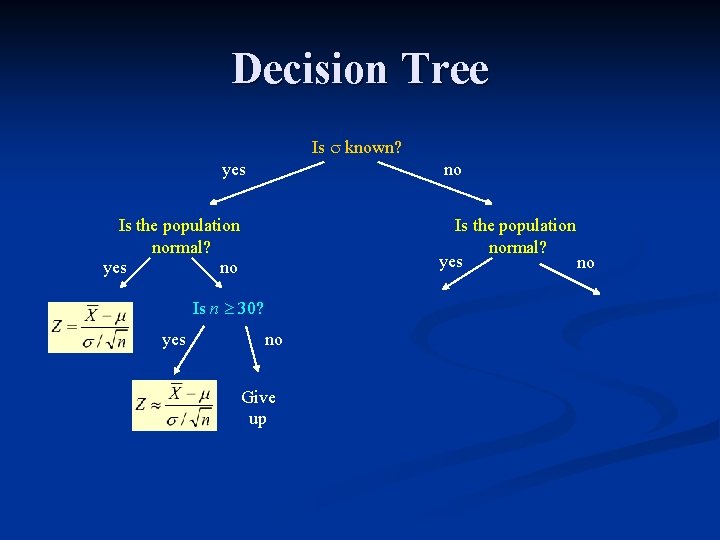
Decision Tree Is known? yes no Is the population normal? yes no Is n 30? yes no Give up yes no
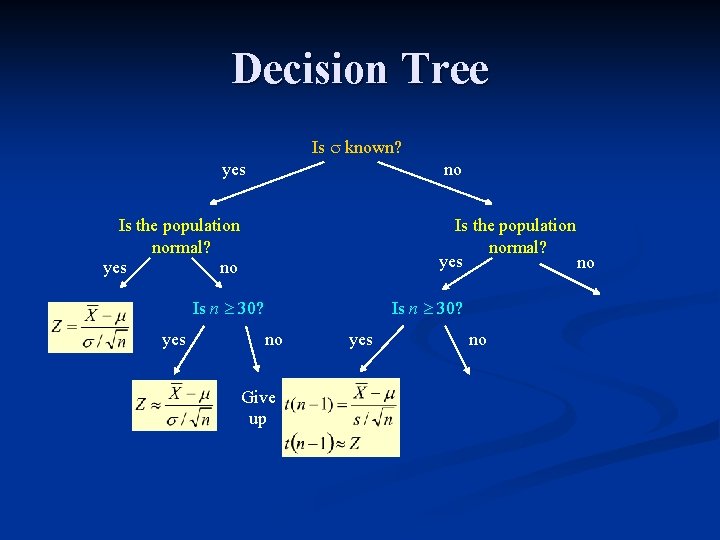
Decision Tree Is known? yes no Is the population normal? yes no Is n 30? yes no Give up yes no
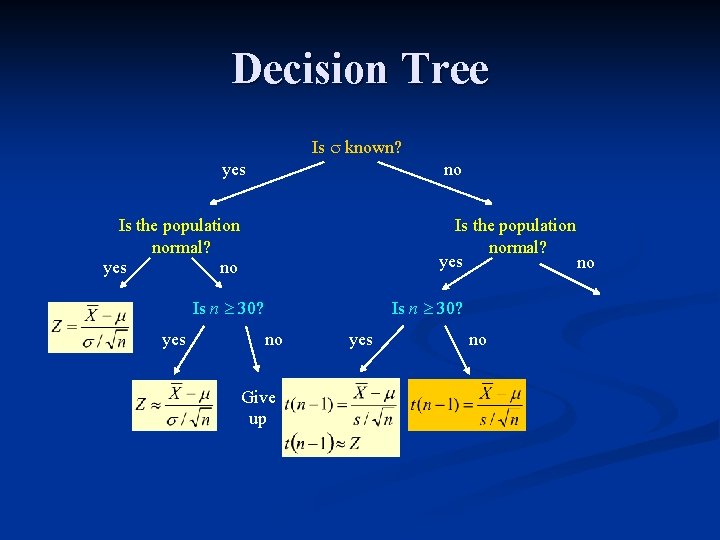
Decision Tree Is known? yes no Is the population normal? yes no Is n 30? yes no Give up yes no
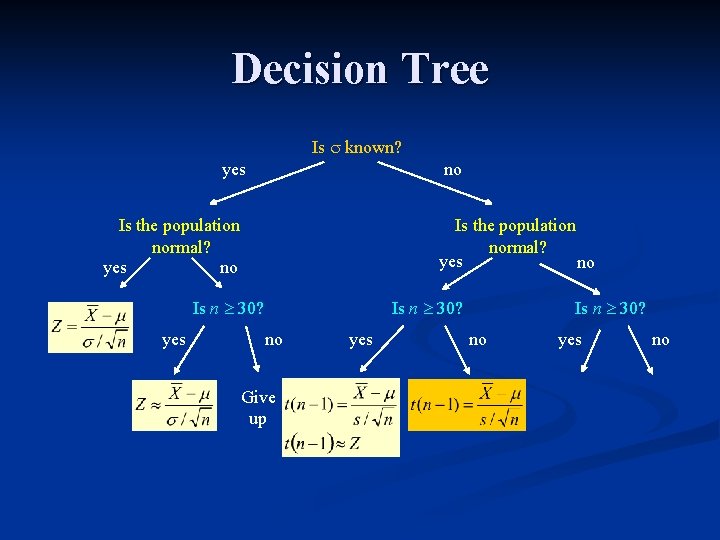
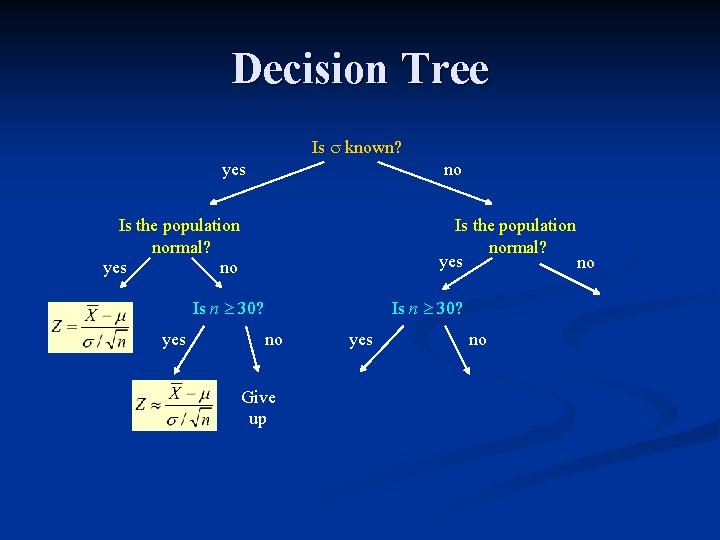
Decision Tree Is known? yes no Is the population normal? yes no Is n 30? yes no Give up yes Is n 30? no yes no
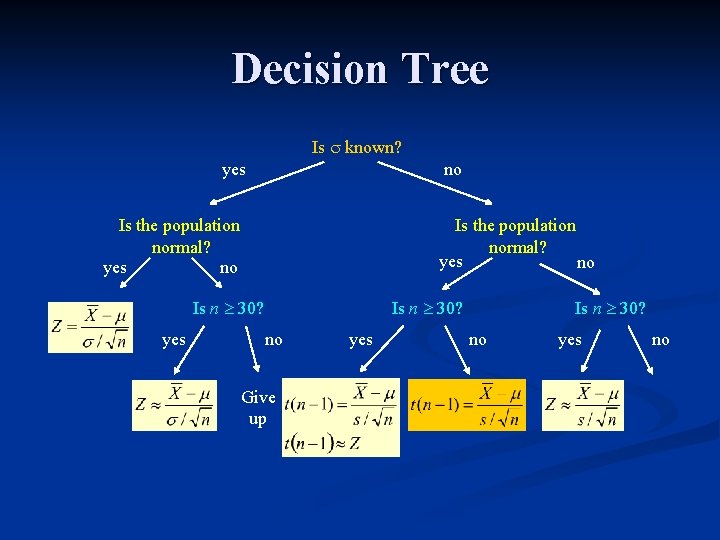
Decision Tree Is known? yes no Is the population normal? yes no Is n 30? yes no Give up yes Is n 30? no yes no
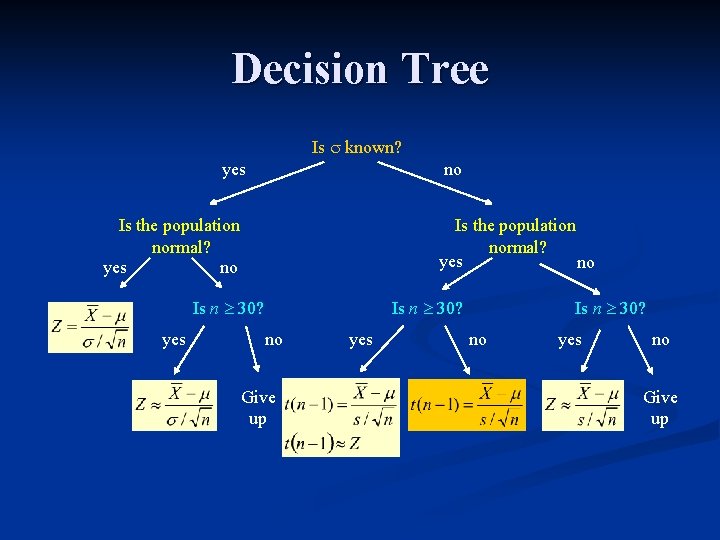
Decision Tree Is known? yes no Is the population normal? yes no Is n 30? yes no Give up yes Is n 30? no yes no Give up
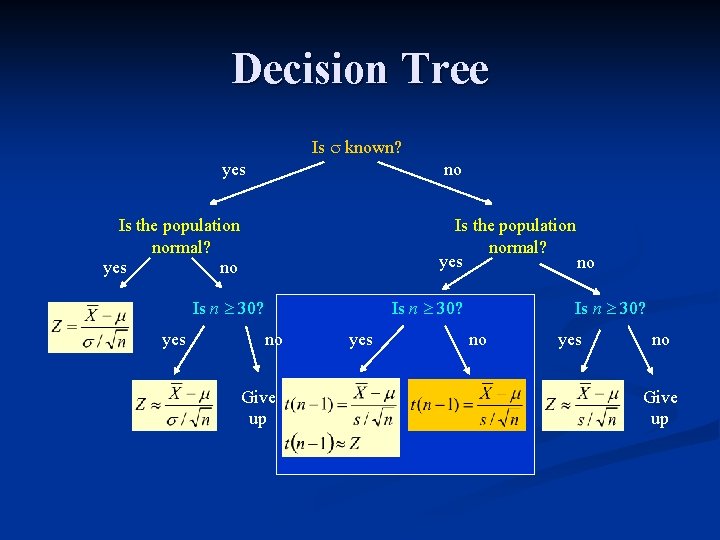
Decision Tree Is known? yes no Is the population normal? yes no Is n 30? yes no Give up yes Is n 30? no yes no Give up
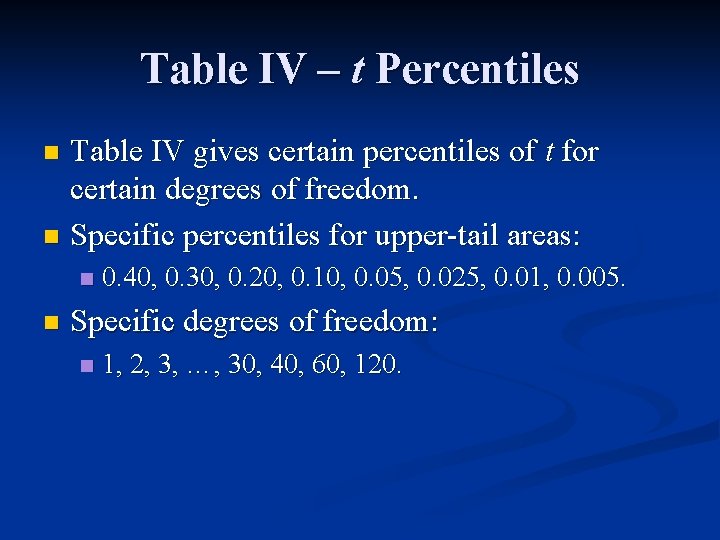
Table IV – t Percentiles Table IV gives certain percentiles of t for certain degrees of freedom. n Specific percentiles for upper-tail areas: n n n 0. 40, 0. 30, 0. 20, 0. 10, 0. 05, 0. 025, 0. 01, 0. 005. Specific degrees of freedom: n 1, 2, 3, …, 30, 40, 60, 120.
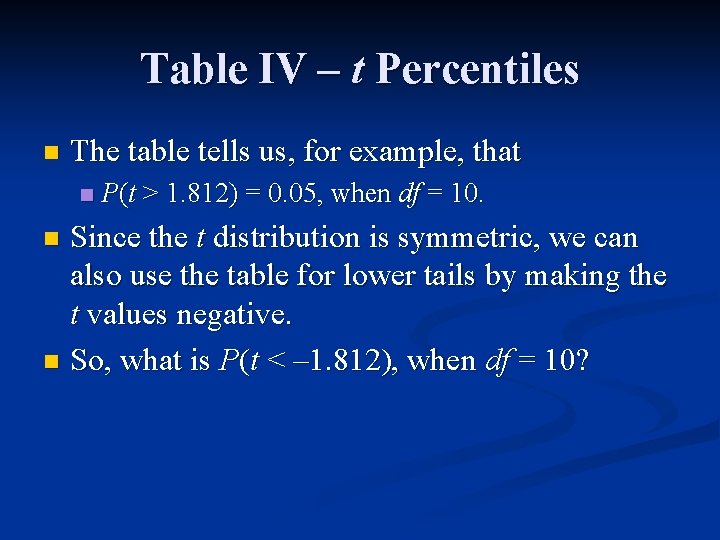
Table IV – t Percentiles n The table tells us, for example, that n P(t > 1. 812) = 0. 05, when df = 10. Since the t distribution is symmetric, we can also use the table for lower tails by making the t values negative. n So, what is P(t < – 1. 812), when df = 10? n
Table IV – t Percentiles n The table allows us to look up certain percentiles, but it will not allow us to find probabilities.
TI-83 – Student’s t Distribution The TI-83 will find probabilities for the t distribution (but not percentiles). n Press DISTR. n Select tcdf and press ENTER. n tcdf( appears in the display. n Enter the lower endpoint. n Enter the upper endpoint. n
TI-83 – Student’s t Distribution Enter the number of degrees of freedom (n – 1). n Press ENTER. n The result is the probability. n
Example Enter tcdf(1. 812, 99, 10). n The result is 0. 0500. n Thus, P(t > 1. 812) = 0. 05 when there are 10 degrees of freedom (n = 11). n
Hypothesis Testing with t n We should use the t distribution if The population is normal (or nearly normal), and n is unknown, so we use s in its place, and n The sample size is small (n < 30). n n Otherwise, we should not use t. n Either use Z or “give up. ”
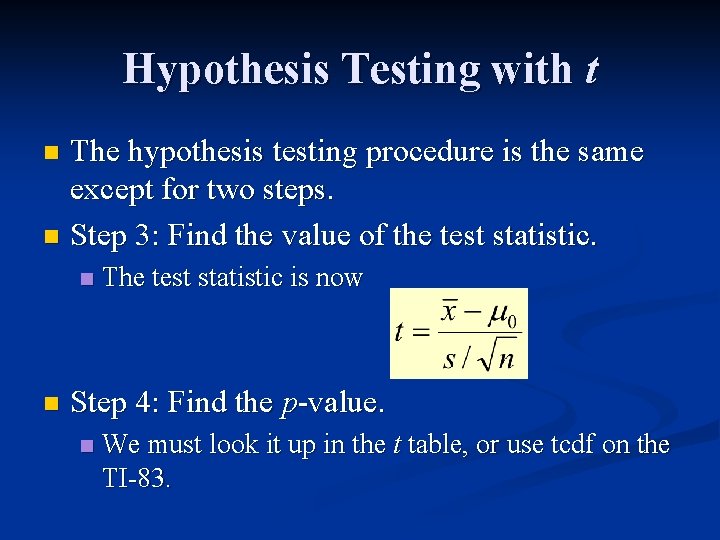
Hypothesis Testing with t The hypothesis testing procedure is the same except for two steps. n Step 3: Find the value of the test statistic. n n n The test statistic is now Step 4: Find the p-value. n We must look it up in the t table, or use tcdf on the TI-83.
Example n Re-do Example 10. 1 (by hand) under the assumption that is unknown.
TI-83 – Hypothesis Testing When is Unknown Press STAT. n Select TESTS. n Select T-Test. n A window appears requesting information. n Choose Data or Stats. n
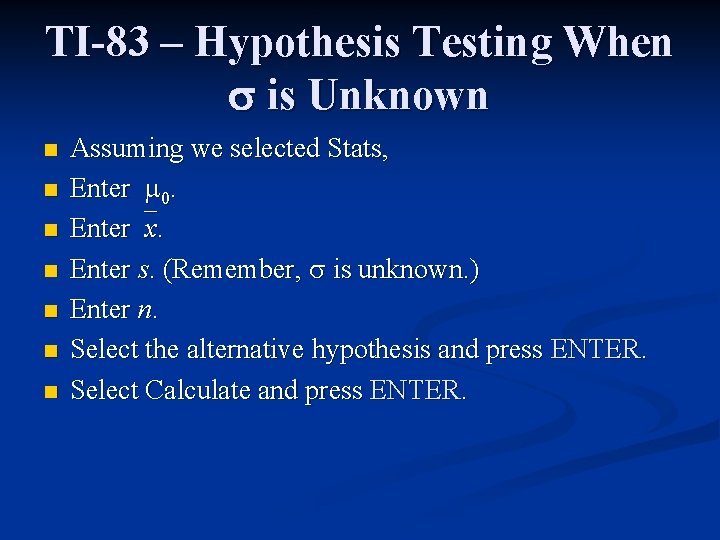
TI-83 – Hypothesis Testing When is Unknown n n n Assuming we selected Stats, Enter 0. Enter x. Enter s. (Remember, is unknown. ) Enter n. Select the alternative hypothesis and press ENTER. Select Calculate and press ENTER.
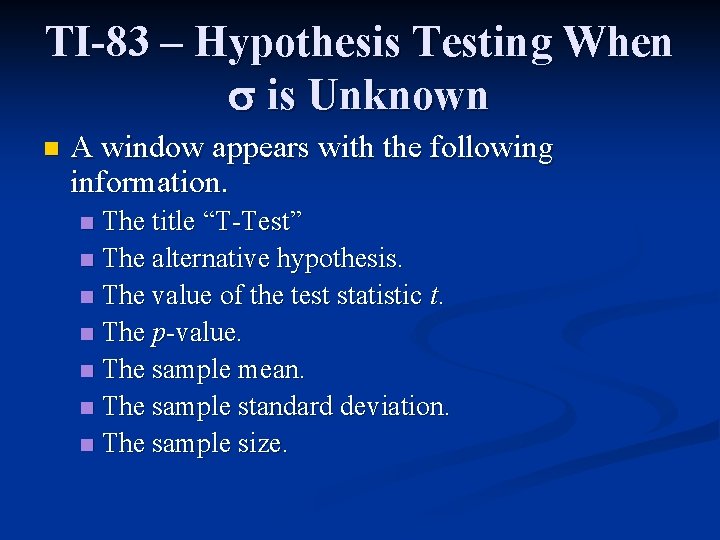
TI-83 – Hypothesis Testing When is Unknown n A window appears with the following information. The title “T-Test” n The alternative hypothesis. n The value of the test statistic t. n The p-value. n The sample mean. n The sample standard deviation. n The sample size. n
Example n Re-do Example 10. 1 on the TI-83 under the assumption that is unknown.
Let’s Do It! Let’s do it! 10. 3, p. 582 – Study Time. n Let’s do it! 10. 4, p. 583 – p. H Levels. n
- Slides: 32